
Florida Reckless Driving Statute an Attorney's Guide
Jason Goldsmith, Esq
A lot of people find out about the Florida reckless driving statute in the worst possible way. A traffic stop starts like any other. The officer asks for your license, returns to the patrol car, then comes back and says you're not just getting a ticket. You're being charged with reckless driving.
That moment rattles people because they assumed this was a speeding matter or maybe a careless driving citation. Instead, they're suddenly facing a criminal case. That means court dates, prosecutors, and the risk of a record that can follow you long after the stop is over.
From a former prosecutor's perspective, that shock makes sense. Drivers usually focus on what they did behind the wheel. The State focuses on how to frame those facts as a crime. In Broward County, Fort Lauderdale, Miami-Dade, Palm Beach, and across South Florida, that framing matters. The same driving pattern can look very different depending on the officer's report, witness statements, and whether the prosecutor believes the facts suggest a deliberate disregard for safety.
If you're dealing with this now, the first thing to understand is simple. A charge is not a conviction. The second is that reckless driving cases often turn on details that are more debatable than people think.
Table of Contents
Your Guide to a Florida Reckless Driving Charge
If you've been charged under the Florida reckless driving statute, you're probably asking two questions at once. How serious is this, and what do I do next?
It's serious because reckless driving in Florida isn't handled like an ordinary traffic ticket. It's prosecuted as a criminal offense. That changes everything about how you should respond. You're no longer just deciding whether to pay a citation. You're deciding how to protect your record, license, and credibility in court.
In practice, these cases often start with a familiar allegation. Speeding fast enough to alarm an officer. Weaving through traffic. Accelerating hard in a crowded area. Sometimes the report makes the driving sound far worse than the driver remembers. Sometimes there's a real issue, but the charge still overstates what the evidence can prove.
Practical rule: Don't treat a reckless driving charge like a payable ticket. Once it's criminal, the strategy changes.
A former prosecutor looks at a reckless driving case a little differently. The first question isn't whether the driving looked bad. The first question is whether the State can prove the legal standard the statute requires. That's where many people have an advantage they don't realize they have.
A solid response usually starts with a few immediate steps:
Protect your statements: Don't try to “explain everything” to law enforcement after the stop.
Get the paperwork together: Keep the citation, notice to appear, bond paperwork, and any court date information.
Write down the facts early: Road conditions, traffic flow, passengers, weather, and what the officer said can matter later.
Talk to counsel before court: Early review can identify weaknesses before positions harden.
For clients in Fort Lauderdale, Broward County, Miami-Dade, Palm Beach, and nearby South Florida courts, the right approach is usually focused and practical. Control the facts. Test the legal basis for the charge. Then decide whether the best path is dismissal, reduction, or trial.
Decoding the Florida Reckless Driving Statute 316.192
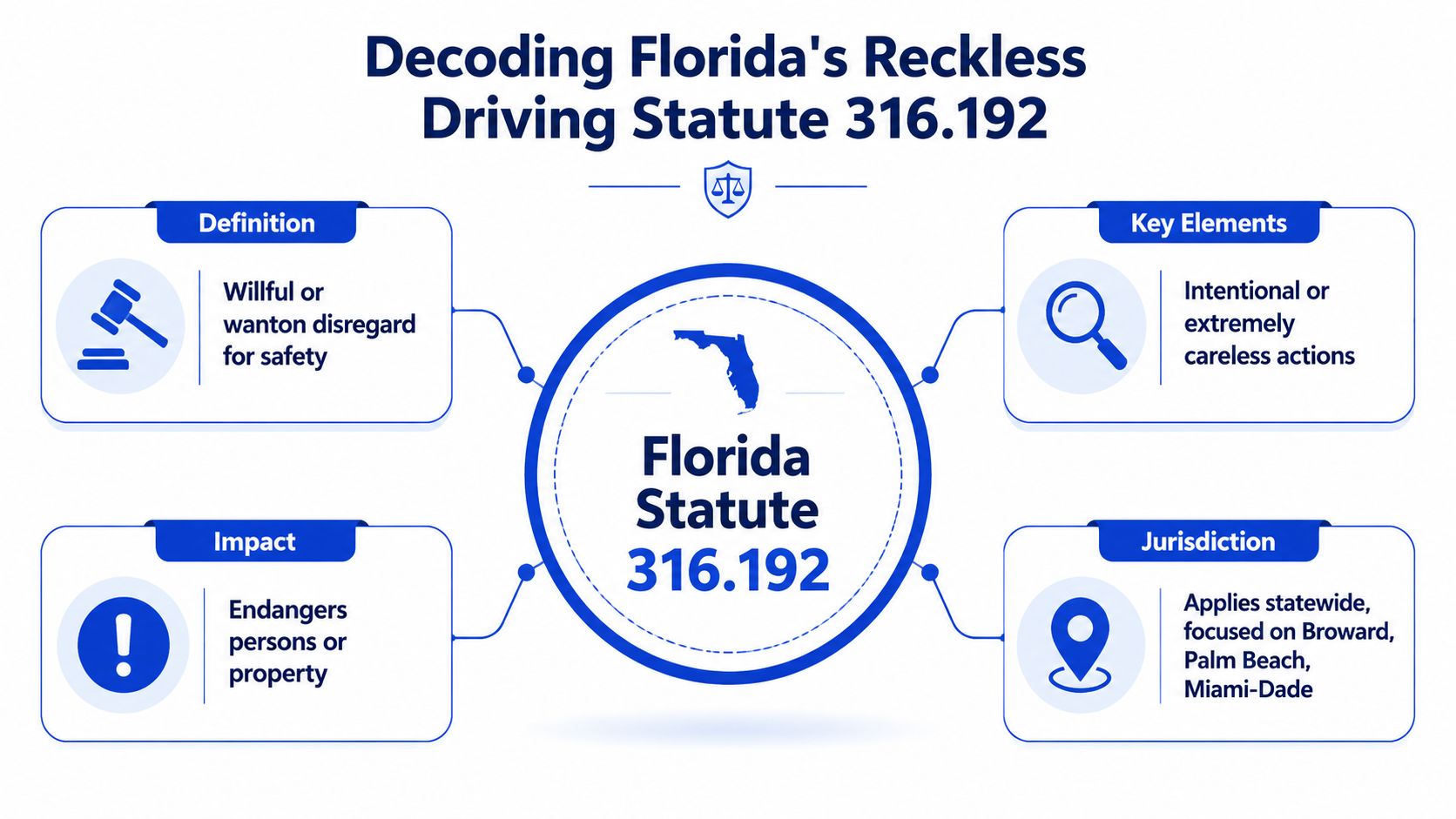
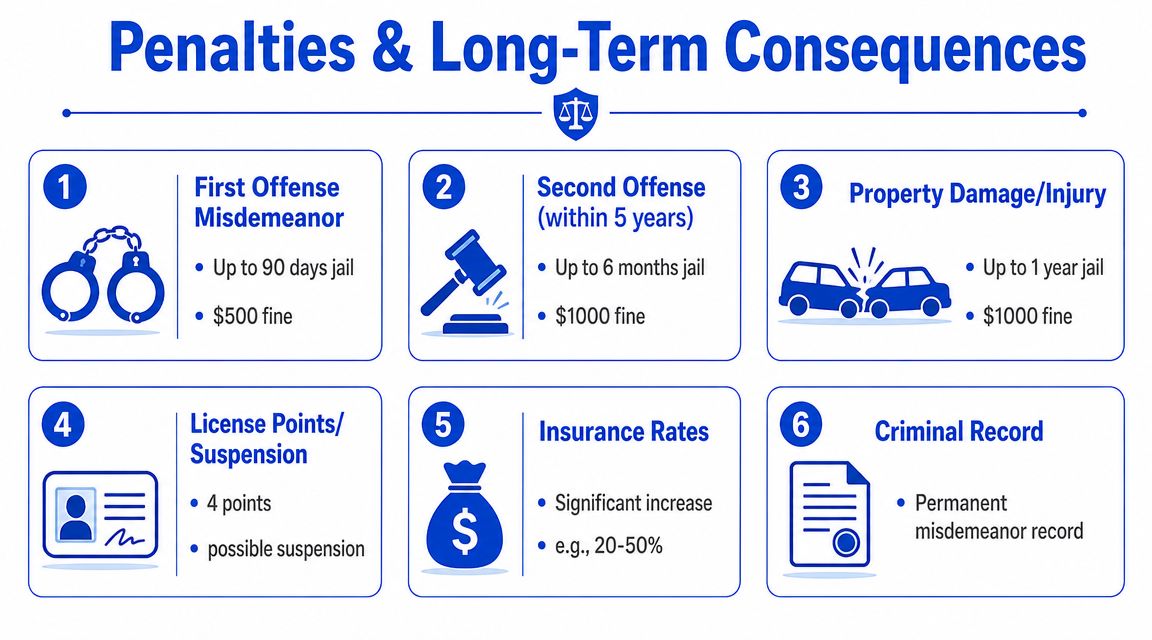
The core of the Florida reckless driving statute is found in Fla. Stat. § 316.192, which defines the offense as driving with “willful or wanton disregard” for the safety of persons or property. Florida law also makes clear that this is a criminal offense, not a civil infraction, and a first conviction can bring up to 90 days in jail and a $500 fine, while a second offense can bring up to 6 months in jail and a $1,000 fine under the statute's text at the Florida Legislature's section 316.192 page.
Why the wording matters
Those words, willful or wanton disregard, do a lot of work.
In plain English, willful points to conduct that isn't accidental. Wanton points to conduct that shows conscious indifference to what could happen. That's different from ordinary bad driving. It's different from a mistake, inattention, or simple negligence.
That distinction matters because the prosecutor doesn't just need to show that your driving was unsafe. The State tries to show that the facts support a much harsher conclusion about your mindset.
A useful way to think about it is this:
Driving issue | How it's commonly viewed |
|---|---|
Brief lapse or mistake | Often argued as carelessness |
Clear rule violation without criminal mindset | Often treated as a traffic matter |
Conduct suggesting conscious disregard of danger | Prosecutor may argue reckless driving |
What the prosecutor has to prove
From the prosecution side, these cases are usually built through inference. Officers rarely have direct proof of what a driver was thinking. Instead, the State uses surrounding facts to argue intent or indifference.
That usually includes:
The officer's observations: Speed, lane movement, distance from other cars, braking, and road conditions.
The setting: A crowded roadway, intersection, neighborhood street, or other place where risk looks more obvious.
Witness descriptions: Other drivers or passengers may give the State language that sounds dramatic.
The driver's statements: Admissions made during the stop can make a weak case stronger.
The battle in many reckless driving cases isn't over what happened. It's over what the facts mean.
That's one reason these charges can be challenged. The phrase “willful or wanton” is powerful, but it's also subjective at the edges. In court, that creates room to argue that the driving may have justified a citation, but not a criminal conviction under the Florida reckless driving statute.
What Counts as Reckless Driving in South Florida
In South Florida courtrooms, reckless driving allegations often arise from a pattern of conduct, not just one isolated fact. The issue is rarely “Was the driver perfect?” The issue is whether the officer and prosecutor can package the driving as criminal.
Recent commentary about Florida practice highlights a key point for defendants. The line between reckless driving, careless driving, and speeding isn't always clean. Charging discretion matters, and the same driving pattern can be framed differently by law enforcement depending on how the facts are used to infer “willful or wanton” disregard, as discussed in this Florida reckless driving analysis from Brancato Law Firm.
Conduct that often leads to charges
Certain fact patterns tend to draw reckless driving allegations in Broward, Miami-Dade, and Palm Beach County:
Aggressive lane changes: Rapid weaving through traffic tends to concern officers because it looks deliberate and risky.
High-speed driving with surrounding traffic: Speed by itself may be one thing. Speed combined with congestion, close following distance, or erratic movement is another.
Street-racing style behavior: Hard acceleration, competing with another driver, or treating a public road like a track usually brings criminal scrutiny.
Danger near pedestrians or property: Driving that appears to threaten nearby people, parked cars, or structures can quickly escalate the report language.
Sometimes reckless driving charges also appear in DUI-related investigations when the officer believes the manner of driving itself supports a separate criminal allegation. That overlap is one reason people charged after a stop involving alcohol should understand how related traffic crimes are handled through a broader Florida DUI defense hub.
Where the gray area usually is
Defense work becomes important. Not every bad fact equals reckless driving.
A driver may have been speeding. A driver may have made an unsafe lane change. A driver may even have caused an officer genuine concern. None of that automatically proves the criminal state of mind the statute requires.
Consider the practical difference:
Speeding is often a traffic offense.
Careless driving is generally treated as a civil infraction.
Reckless driving is charged as a crime.
A prosecutor often wants the judge to hear a dangerous story. The defense has to separate a dramatic description from proof of criminal conduct.
That's especially important after Florida's statutory changes discussed in recent commentary about excessive speed and charging decisions. In borderline cases, the defense question is often whether law enforcement chose the most severe label available, rather than the label the evidence supports.
Penalties and Long Term Consequences of a Conviction
If you want the straight answer, here it is. A reckless driving conviction can affect your freedom, your record, and your bargaining power in future cases.
Early in a case, many people focus only on the fine. That's a mistake. The more serious issue is that Florida law allows jail even when no crash occurred, which is why these cases need to be treated like criminal matters from the start.
What the statute allows
Florida's penalty structure escalates with prior history and with harm. Under the statute text summarized at Florida's section 316.192 entry on Justia, a first conviction is punishable by up to 90 days in jail and a fine of $25 to $500. A second or subsequent conviction increases exposure to up to 6 months in jail and a fine of $50 to $1,000. If the offense causes property damage, it can be enhanced to a first-degree misdemeanor. If it causes serious bodily injury, it can become a third-degree felony punishable by up to 5 years in prison and up to a $5,000 fine.
A quick video overview can help put that escalation in context.
The practical takeaway is that injury changes the whole case. A charge that may have started as a traffic-style prosecution can move into felony territory based on the harm alleged.
What hurts beyond the courtroom
The statute gives the court sentencing power. The conviction itself creates the longer shadow.
Common long-term concerns include:
Criminal record exposure: Even a misdemeanor record can affect applications, background checks, and credibility.
Employment pressure: Jobs involving driving, company vehicles, or professional trust can become harder to protect.
Insurance problems: Carriers often respond harshly to criminal driving convictions.
License issues: A traffic crime conviction can create complications that go beyond the courtroom sentence.
If your driving privilege is already in trouble, it also helps to understand the separate process for getting back on the road through a Florida license reinstatement guide.
Bottom line: The fine is usually the smallest part of the problem. The record is what keeps costing you.
That's why experienced defense lawyers push hard on charge reduction when the facts support it. A reduction can matter not only because of the immediate sentence, but because it can change how the case follows you afterward.
Navigating the Court Process in Broward and Surrounding Counties
Most clients calm down once they understand the sequence. Criminal court is still stressful, but it becomes much easier to handle when you know what each stage means and what can be done there.
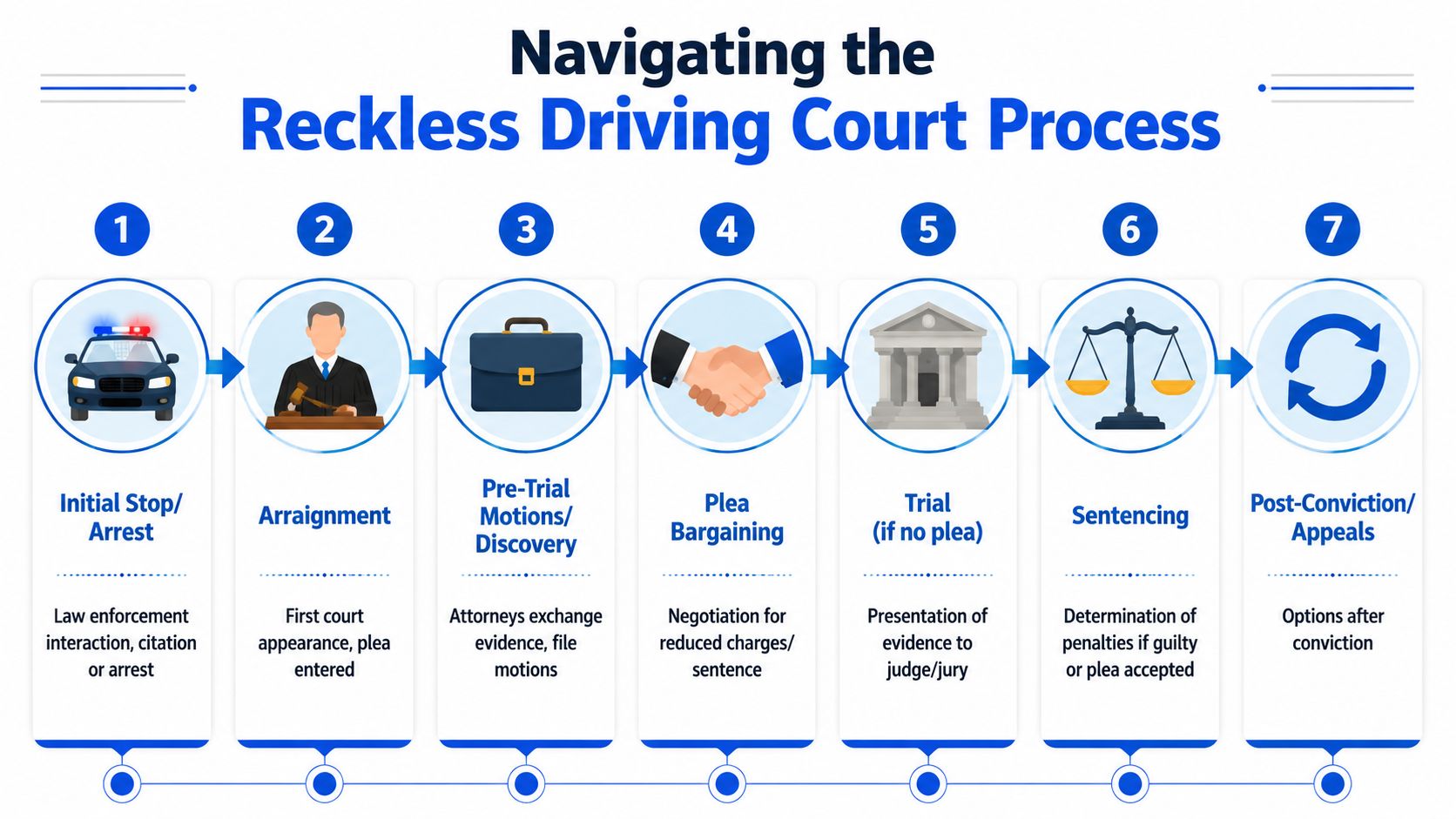
In Broward County, Miami-Dade, Palm Beach County, and nearby South Florida courts, a reckless driving case usually moves through a familiar path. The exact scheduling varies by courthouse and judge, but the structure is broadly similar.
What usually happens first
A case may begin with an arrest or with a notice to appear. Either way, the criminal process starts once the State files and the court sets the matter.
The first stages often look like this:
Initial charging event
You're cited, arrested, or formally given notice to appear in court.Arraignment
This is the first formal court appearance where a plea is entered. It's not the trial, and it usually isn't the place where the case gets fully argued.Discovery and review
The defense obtains reports, videos, witness information, and other evidence.Pre-trial conferences
These are the working hearings where lawyers discuss status, negotiations, and possible resolutions.
Where cases are often won or improved
Many reckless driving cases don't turn on dramatic trial moments. They turn on preparation before trial.
That can include:
Testing the stop: Was there a lawful basis for the traffic stop in the first place?
Reviewing the evidence carefully: Dashcam, bodycam, and report language don't always line up.
Negotiating from strength: A prosecutor is more likely to discuss reduction when weaknesses are documented clearly.
Evaluating diversion options: In some cases, structured alternatives may be part of the conversation depending on the county, prosecutor, and client's background.
For some defendants, it also makes sense to explore whether a program discussed in this Florida pre-trial intervention overview could be relevant to the broader strategy.
Court is not one event. It's a series of pressure points. Good defense work means knowing which point matters most in your case.
In Fort Lauderdale and throughout South Florida, local practice matters. Judges differ. Prosecutors differ. Some courtrooms move quickly. Some expect early documentation from the defense. Knowing that rhythm can help reduce surprises and improve decision-making.
Strategic Defenses to a Florida Reckless Driving Charge
The most important thing I tell new clients is this. Reckless driving is often more arguable than it sounds on paper. Police reports tend to use broad, loaded language. The legal question is whether the evidence supports the criminal label.
How the State usually builds the case
From the prosecution side, the case is often built around a theme: this driver knowingly created danger.
The State usually tries to support that theme with the officer's narrative, any video that exists, witness statements, and sometimes the driver's own words. If the report says you were weaving, accelerating hard, ignoring nearby traffic, or placing property or people at risk, the prosecutor will use those facts to argue “willful or wanton” disregard.
That approach has weaknesses. Officers still make judgment calls. Witnesses can exaggerate. Video may show less than the report suggests. A fact pattern that sounds reckless in a narrative may look less severe when slowed down and tested piece by piece.
Where an experienced defense attacks it
A strong defense often focuses on one or more of these pressure points:
The conduct didn't rise to criminal recklessness: Even if the driving was imperfect, the State may still fall short of proving the mindset required by statute.
The officer's interpretation was subjective: What one officer called reckless may look more like speeding or carelessness when viewed objectively.
There was a lawful explanation: Emergency conditions, road hazards, another driver's conduct, or a sudden reaction can matter.
The stop or evidence may be challengeable: If the stop was unlawful or evidence was obtained improperly, the defense may be able to limit what the State can use.
The report overreaches: In many traffic crime cases, the wording is harsher than the provable facts.
One practical goal in the right case is to create enough pressure for the State to back away from the original charge. Sometimes that means a negotiated reduction. Sometimes it means a dismissal. Sometimes prosecutors decide not to proceed, which is why defendants should understand what a nolle prosequi in Florida can mean.
This is also the point in the article where it makes sense to say one thing plainly. Firms like Ticket Shield, PLLC review these cases by looking at the same issues a former prosecutor would look at: the wording of the report, the quality of the stop, the available video, and whether the facts support the criminal element.
The best defense in a reckless driving case usually isn't theatrical. It's precise.
That precision matters in South Florida courts, where the same facts can support very different outcomes depending on how early the weaknesses are identified and how clearly they're presented.
Frequently Asked Questions about Reckless Driving
Can a reckless driving charge be sealed or expunged in Florida
That depends on the final outcome of the case and your prior record. Eligibility issues can be very specific. The answer often turns on whether there was a conviction, a withhold, a dismissal, or some other disposition. This is one of those questions that should be reviewed case by case.
What is the difference between reckless driving and DUI
They are different charges. Reckless driving focuses on the manner of driving and whether the State can prove willful or wanton disregard for safety. DUI focuses on impairment or unlawful alcohol level under a different legal framework. In some cases, prosecutors negotiate a DUI allegation down to reckless driving, but that depends on the evidence.
Will a reckless driving conviction affect a CDL
It can. Commercial drivers often face higher practical stakes because employers, insurers, and licensing consequences can all come into play quickly. If you hold a CDL, don't assume this is a minor traffic matter.
Do I need an attorney for a reckless driving charge
If a charge is criminal and carries possible jail time, having counsel is usually the smart move. A lawyer can review the report, court file, video, and stop issues, then assess whether the better path is negotiation, motion practice, or trial preparation.
Can the charge be reduced
Sometimes, yes. That depends on the facts, the quality of the evidence, the county, and your history. Reduction discussions are often strongest when the defense can show the conduct may have justified a lesser traffic-based allegation but not the criminal mental state the statute requires.
If you're facing a reckless driving charge in Fort Lauderdale, Broward County, Miami-Dade, Palm Beach, or elsewhere in Florida, don't guess your way through criminal court. Contact Ticket Shield, PLLC for a confidential consultation to review the stop, the charging documents, and the strongest strategy for protecting your record, license, and future.
Reckless driving in Florida is a criminal charge, not just a ticket. An attorney explains the statute, penalties, and how to fight it.