
Super Speeder Law Florida: Penalties & Defense for 2026
Jason Goldsmith, Esq
You were driving fast. The lights came on. The officer walked up and said something that sounded more serious than a normal speeding ticket.
That reaction you're having right now, confusion, fear, and the urge to just pay whatever appears on the citation and move on, is common. Under Florida's new law, that can be a costly mistake.
For some drivers in Broward County, Fort Lauderdale, Miami-Dade, Palm Beach, and across South Florida, extreme speeding is no longer just a civil traffic issue. It can be a criminal traffic offense. That means court, a judge, possible jail exposure, and consequences that can follow you far beyond one bad drive home.
Table of Contents
A Florida Speeding Ticket Is Now a Criminal Matter
The first thing to understand about the Super Speeder law Florida drivers are now dealing with is simple. You may not be holding an ordinary ticket.
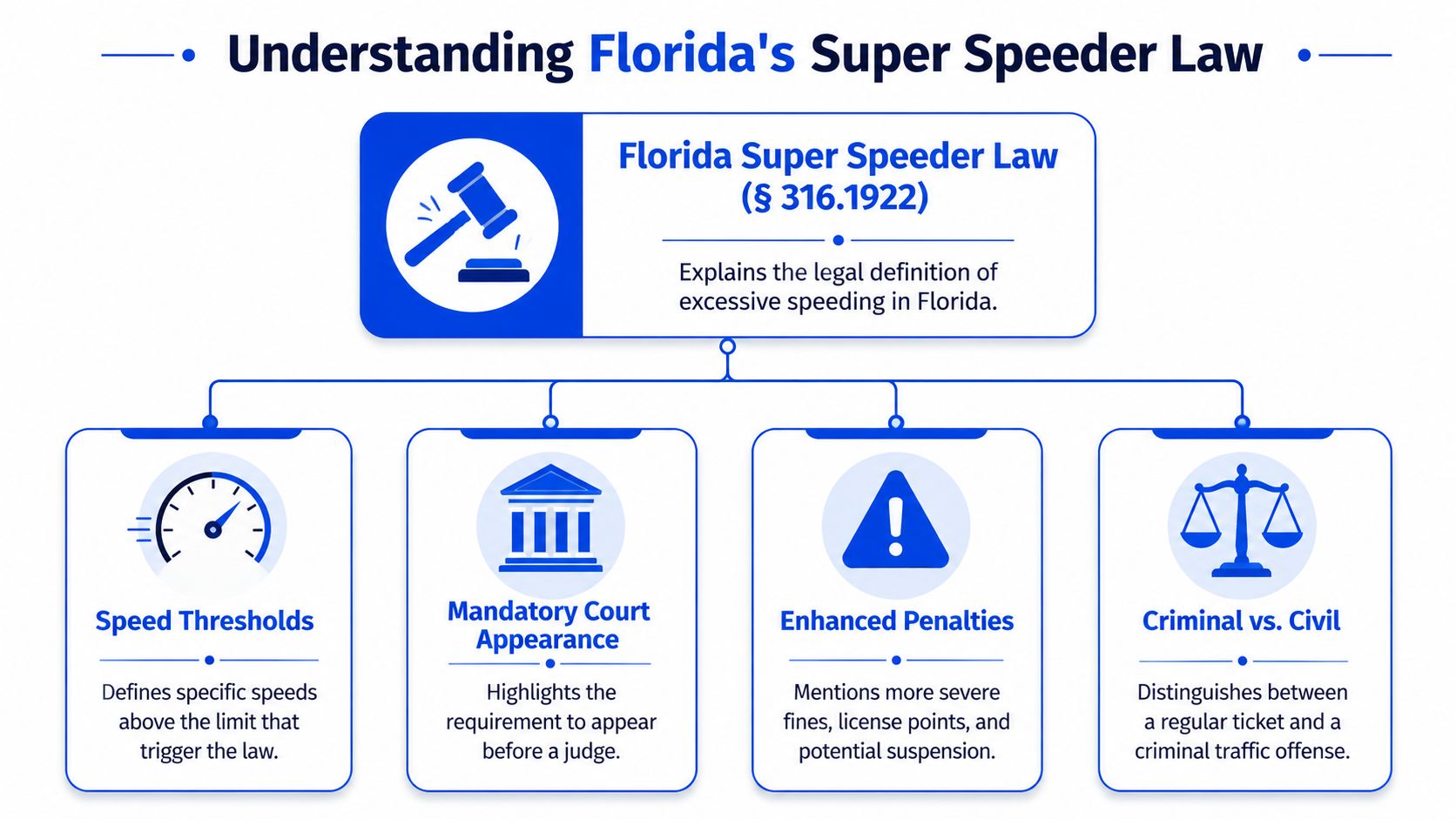
Florida's dangerous excessive speeding law, codified at § 316.1922, took effect on July 1, 2025 and created a new criminal traffic offense for driving 50 mph or more over the posted limit or driving 100 mph or more in a way that threatens safety or interferes with another vehicle's operation, as stated in Florida Statute § 316.1922.
That change matters because the old instinct, pay the citation and move on, may not apply. A regular speeding ticket is usually a civil matter. This law moved certain extreme speeding allegations into criminal court.
What that means in real life
If you're cited under this law in Fort Lauderdale, Miami, West Palm Beach, or anywhere else in Florida, you should treat it like a criminal case from day one. The practical consequences are different.
You may have to appear in court: This usually isn't something you resolve online like a routine ticket.
A conviction can carry jail exposure: Even if nobody was hurt and this is your first criminal traffic case.
Your license and record are at risk: That can affect work, commuting, and future background checks.
Practical rule: If the paperwork suggests criminal excessive speeding, don't assume traffic school or online payment will solve it.
Why drivers get caught off guard
Individuals charged under this statute are typically not career criminals. They were late, frustrated, showing off, or made a reckless decision on I-95, the Turnpike, or another South Florida road.
What catches them off guard is the classification. They expected a steep ticket. Instead, they walked into a criminal process.
That shift is the center of the problem. Once the case is criminal, your defense strategy changes. The goal isn't just lowering a fine. It's protecting your record, your license, and your future options in court.
What Is the Florida Super Speeder Law
Florida's new statute is commonly called the Florida super speeder law, but the charge is dangerous excessive speeding under section 316.1922. The label matters less than the trigger. A case that sounds like “just speeding” can turn on facts that prosecutors treat like criminal driving conduct.
Two ways the charge can happen
The statute creates two separate paths to the same misdemeanor charge. That distinction often shapes the defense from the start.
Trigger | What prosecutors focus on |
|---|---|
50 mph or more over the posted limit | The speed itself |
100 mph or more in a manner that threatens safety or interferes with another vehicle's operation | The speed plus how the vehicle was being driven |
The first path is usually the cleaner one for the State. If the allegation is based on driving at least 50 mph over the limit, the fight often centers on the speed reading, the officer's observations, traffic conditions, and whether law enforcement identified the right car.
The second path gives the defense more room to work. At 100 mph or more, the statute does not stop at the number alone. The State also has to prove the manner of operation threatened safety or interfered with another vehicle. In practice, that means details matter. Was the driver weaving, tailgating, cutting someone off, forcing another car to brake, or blocking a lane change?
That language is not a technical footnote. It is often the center of the case.
In Broward, Miami-Dade, and Palm Beach, I would expect prosecutors to look closely at the officer's narrative, any dashcam or bodycam footage, and whether another driver was affected. If the report states “100-plus” but does not clearly describe dangerous movement or interference with another vehicle, that gap can matter. A former prosecutor sees the issue from both sides. The State needs more than a high number if it charged the case under the second prong.
Why the "manner of operation" clause matters
Drivers often assume any triple-digit allegation automatically proves the charge. That is not how this statute is written.
A person accused of driving 95 mph in a 45 mph zone may face the charge based on the amount over the limit alone. A person accused of driving 100 mph or more under the second pathway can have a different defense if the officer cannot clearly explain what made the driving dangerous under the statute.
That is a real trade-off in these cases. If the speed evidence is strong, the defense may shift to whether the driving threatened safety or interfered with another vehicle. If the officer's description is vague, inconsistent, or unsupported by video, the prosecution may have a proof problem.
Fast driving is serious. Criminal dangerous excessive speeding still requires the State to prove the exact elements the statute demands.
Penalties for a Super Speeder Conviction
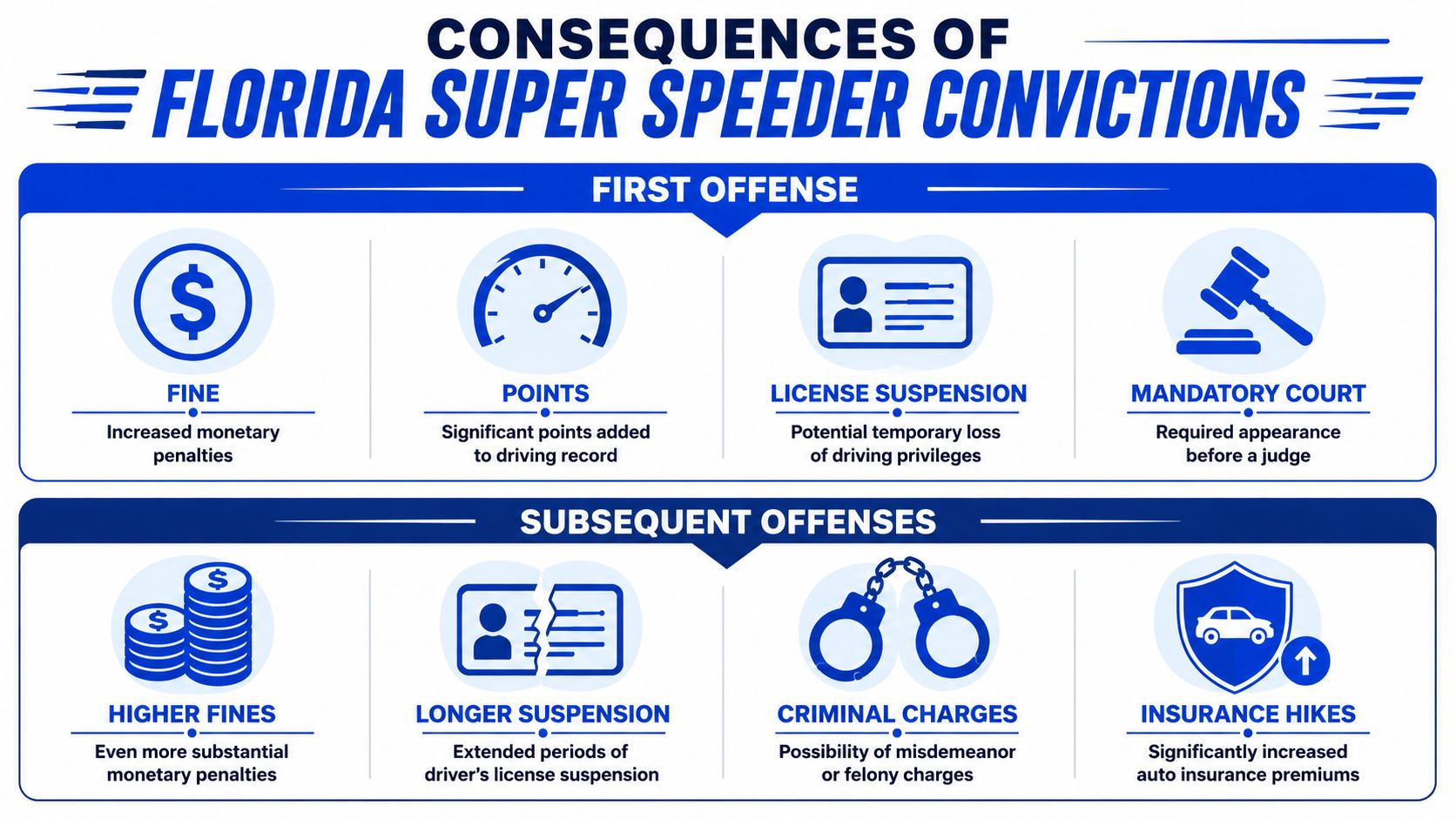
A super speeder charge exposes you to more than a fine. It puts jail, a criminal judgment, and your license at risk.
What the court can impose
Under Florida Statute § 316.1922, the formal penalty range depends on whether this is your first conviction or a repeat case.
First offense: Up to 30 days in jail or a $500 fine.
Second or subsequent offense: Up to 90 days in jail or a $1,000 fine.
Repeat offense within 5 years: The court can trigger a driver's license revocation for at least 180 days and up to 1 year.
Those are the statutory ceilings. The practical risk often turns on the facts in the report, the county where the case is filed, your record, and whether the prosecutor believes the driving looked closer to ordinary speeding or something more aggressive.
That distinction matters in South Florida. In Broward, Miami-Dade, and Palm Beach, prosecutors and judges do not treat every triple-digit case the same way. A clean record, no crash, and weak proof on dangerous driving can affect how a case is resolved. A bad driving history, passengers in the car, heavy traffic, or facts that resemble reckless driving under Florida law can make the case harder to contain.
The penalties drivers tend to miss
The fine is usually the smallest part of the problem.
A conviction can add points to your driving record, raise insurance costs, and create trouble for anyone who depends on a license for work, school, or family responsibilities. Commercial drivers and people who commute long distances usually feel the pressure first, because even a short loss of driving privileges can disrupt income and routine overnight.
The criminal record issue matters too. Clients often call focused on the ticket amount, then realize the larger goal is avoiding a misdemeanor conviction if the facts and the law allow it. That is the trade-off. Sometimes the defense is aimed at dismissal. Sometimes it is aimed at reducing the charge, protecting the license, or keeping the result from looking like an admission to dangerous driving.
As a former prosecutor, I look at these cases the way the State will. If the officer can prove the speed cleanly and describe driving that clearly endangered others, penalty exposure becomes more serious. If the report is thin, the video does not match the accusation, or the manner of operation is overstated, that changes the conversation in court.
Criminal vs Civil Consequences Explained
A driver going 102 on I-95 often assumes the case will end with a fine and traffic school. Under Florida's super speeder law, that assumption can put you behind from the start. The case is handled in criminal court, and the stakes change immediately.

Why this is different from a normal ticket
A standard speeding ticket is usually a civil infraction. In many cases, the driver can pay it, contest it through traffic procedures, or resolve it without the pressure that comes with a misdemeanor case.
A super speeder charge is different. Court is required. The prosecutor is involved. The judge is looking at more than the speed number alone.
That shift matters because the case can turn on facts that do not matter much in an ordinary ticket. How the officer described the driving. Whether traffic was heavy. Whether lane changes, following distance, or other conduct made the report sound more dangerous than the video shows. If the State starts framing the driving as aggressive or hazardous, the case can begin to resemble issues raised under Florida's reckless driving statute.
In Broward, Miami-Dade, and Palm Beach, that distinction is practical, not theoretical. A civil ticket is often about points and fines. A criminal traffic case is about protecting your record, controlling what gets said about your driving, and keeping a bad stop from becoming a lasting problem.
Why Florida changed the law
Florida adopted this law to treat the highest-speed allegations more harshly than routine speeding. Central Law's review of Florida's super-speeder law reports that speeding-related crashes in Florida remained a serious public safety issue in 2023, including fatal crashes.
The policy reason explains the law. It does not prove your case.
For any individual driver, the primary issue is what the State can prove in court and how the officer described the manner of operation. That phrase matters. I have seen cases where the speed allegation gets the driver into criminal court, but the outcome depends on whether the surrounding facts support the officer's claim that the driving created real danger. That is often where a defense can narrow the case, challenge exaggeration in the report, and push back against an overcharged narrative.
A misdemeanor conviction can affect employment screenings, professional licensing, security clearance issues, and insurance costs in a way a civil citation usually does not. That is why the first goal is not merely reducing the fine. It is keeping a traffic stop from becoming a criminal record.
How to Defend Against a Super Speeder Charge in South Florida
A super speeder charge is serious, but serious doesn't mean automatic guilt. The State still has to prove the case, and these cases are often more vulnerable than people think.

The State still has to prove the case
In South Florida courts, defense work starts with the evidence. How was speed measured. Radar. Laser. Pacing. Aircraft support. Dashcam estimate. Officer observation alone. Each method has weaknesses, and each creates different records to examine.
A strong defense often begins with questions like these:
Was the equipment reliable: Calibration, maintenance, and operator training can become central issues.
Was the vehicle correctly identified: On crowded roads like I-95, officers can make mistakes about which car produced the reading.
Did the stop follow the law: If the stop or seizure was unlawful, the defense may explore suppression issues through a motion to suppress evidence in Florida.
When I evaluate these cases, I don't assume the speed reading is untouchable. I want the records. I want the officer's narrative. I want to know whether the facts on paper match what the roadway conditions were.
The manner of operation defense
This is the most important strategic issue in many cases.
If the allegation is based on the 100 mph or more part of the statute, the prosecution doesn't just need a number. It needs proof that the car was operated in a manner that threatened safety or interfered with another vehicle's operation.
That language gives the defense room to work. The officer may say the speed was dangerous, but the court still needs facts supporting that conclusion.
Consider what can matter:
Defense issue | Why it matters |
|---|---|
Traffic conditions | Heavy traffic and open roadway conditions create very different arguments |
Lane position | Staying in one lane differs from weaving through vehicles |
Other driver interaction | The statute focuses on threatened safety or interference with another vehicle |
Officer detail | Vague descriptions are easier to challenge than specific observations |
In court, labels don't carry the case. Facts do.
If the officer wrote only a general statement that the speed was unsafe, that may not be enough by itself to establish the required manner of operation. On the other hand, if the report describes tailgating, cutting off cars, or forcing braking, the State's case may be stronger. Good defense work means separating assumptions from provable facts.
A brief overview of the issues also helps some clients before a hearing:
Why local court experience matters
Broward, Miami-Dade, and Palm Beach courts don't process these cases in a vacuum. Prosecutors, judges, and hearing officers all respond to preparation. A lawyer who understands criminal traffic practice can often spot where the State's theory is weak, where negotiation may be realistic, and where a factual hearing has value.
Former prosecutor insight can matter here because it helps you see the case the way the State is likely to build it. That includes where officers tend to overstate danger, where reports are too thin, and where a speed case may be vulnerable despite a dramatic allegation.
Some drivers hire general traffic counsel. Others look for a criminal-defense lawyer with courtroom experience in South Florida. Ticket Shield, PLLC is one Florida option that handles criminal defense and traffic-related matters, which can matter when a speeding stop starts looking more like a misdemeanor prosecution than an ordinary citation.
Your Immediate Next Steps After a Citation
If you've already been cited or arrested, the first few days matter. The right response can preserve defenses. The wrong one can lock you into a criminal outcome too early.
What to do in the first days
Keep every document
Save the citation, court paperwork, bond documents, and any property receipt or notice you received. Small details on those papers often matter later.Write down what happened
Do it while your memory is fresh. Note the roadway, lane position, traffic conditions, weather, what the officer said, whether other cars were nearby, and whether you changed lanes or interacted with another driver.Check the court date and instructions
Missing a required appearance can create a second problem on top of the speeding charge.Talk with counsel before making decisions
In many criminal traffic cases, the smartest move is to get legal advice before you respond, plead, or assume the matter can be handled like a normal ticket.
What not to do
Don't just pay it without legal advice: In a criminal traffic matter, payment can function like a guilty resolution.
Don't post detailed explanations online: Social media turns frustration into evidence.
Don't ignore your driving status: If separate license issues arise, learn how suspended license reinstatement works in Florida.
Write down the facts before you rewrite them in your own head. The first version is usually the most useful for the defense.
The goal right now is control. Preserve the facts. Protect your options. Treat the case seriously from the beginning if the citation points to excessive criminal speeding in Fort Lauderdale, Miami, West Palm Beach, or anywhere else in South Florida.
Florida Super Speeder Law FAQs
Am I guaranteed to go to jail for a first offense
No. Jail is a possible penalty, not an automatic result. The outcome depends on the facts, your record, the court, and how the case is defended.
Can the charge be reduced
Sometimes, yes. That depends on the evidence, the officer's report, the speed proof, and whether the State can establish the elements of the offense. In some cases, the defense pushes for dismissal. In others, the focus is a negotiated resolution that avoids the worst consequences.
What if I have a CDL or need to drive for work
That raises the stakes. Any criminal traffic conviction can create employment problems for commercial drivers and for people who depend on a clean record to keep driving for work. If your livelihood depends on your license, get legal advice early rather than hoping the court will sort it out for you.
Do I really need a lawyer for this
If the case is charged as a criminal traffic offense, a lawyer is often the safest course. You're not just contesting a fine. You're dealing with evidence, court procedure, negotiation strategy, and the risk of a criminal record.
Can this lead to other charges
It can, depending on the facts. Extreme speed combined with other conduct may draw attention to related criminal allegations. That's one reason lawyers look carefully at the full stop, not just the speed number.
Is there ever a way to avoid a conviction
In some cases, there may be alternatives worth exploring depending on the county, your history, and the prosecutor's position. For some defendants in some kinds of cases, programs such as Florida pre-trial intervention may be part of the broader discussion, although eligibility always depends on the specific charge and local practice.
If you're facing a Florida super speeder charge in Broward County, Fort Lauderdale, Miami-Dade, Palm Beach, or elsewhere in South Florida, get legal advice before you plead or pay anything. Ticket Shield, PLLC offers confidential consultations to review the citation, explain the court process, and help you understand your options for protecting your record, license, and future.
Extreme speeding in Florida now triggers enhanced penalties. Learn what the super speeder law covers and your defense options.