
Penalties for DUI in Florida: A 2026 Guide
Jason Goldsmith, Esq
If you're reading this after an arrest, you're probably asking the same questions every Florida DUI client asks in the first hour. Am I going to jail? Am I losing my license? Do I have to go to court? Can this be beaten?
Those are the right questions.
A DUI charge in Florida is serious, but confusion makes it worse. It is not widely understood that they're dealing with two separate problems at once. One is the criminal case. The other is the license case. If you miss the deadline on the license side, you can lose important rights before your criminal defense even gets moving.
That's why I tell new clients the same thing at the start. Don't guess. Don't wait. Don't assume a first offense will work itself out. The penalties for DUI in Florida can escalate fast, and the early decisions matter.
Table of Contents
A Florida DUI Arrest What Happens Now
Start with this. Florida treats DUI arrests as routine, high-volume prosecutions. The state averages between 30,000 and 40,000 DUI arrests annually, recorded over 33,000 DUI arrests in 2022, and approximately 60% of people cited for DUI are ultimately convicted under Florida Statute 316.193. That means you shouldn't treat this like a ticket. The system won't.
Right now, you need to focus on three things.
Protect your license immediately. The clock starts fast after arrest.
Preserve the facts. Write down where you were, what you drank, what the officer said, whether tests were requested, and whether there's video.
Stop talking casually about the case. Not to friends, not by text, not on social media.
The first mistake people make
The primary focus is often only on court. That's a mistake. Your license issue can move before your criminal case is resolved.
Another common mistake is assuming the officer's version is airtight. It often isn't. DUI cases depend on observations, roadside exercises, machine results, and procedure. Each of those can be challenged. If you want a better sense of how roadside exercises are attacked, read about Florida field sobriety tests.
Practical rule: Treat the first few days after a DUI arrest as a defense window, not as dead time.
What you should do today
Call a DUI lawyer. Get the arrest paperwork together. Save towing records, bond paperwork, and your notice of suspension. If there was a passenger, a crash, or a refusal, say that up front. Those details can change the entire case.
The Two-Front Battle Criminal Court And The DMV
The biggest point of confusion in a Florida DUI is simple. You are not fighting one case. You are fighting two.
One track is in criminal court. The other is with the driver's license agency. They overlap, but they are not the same, and winning on one side doesn't automatically fix the other.
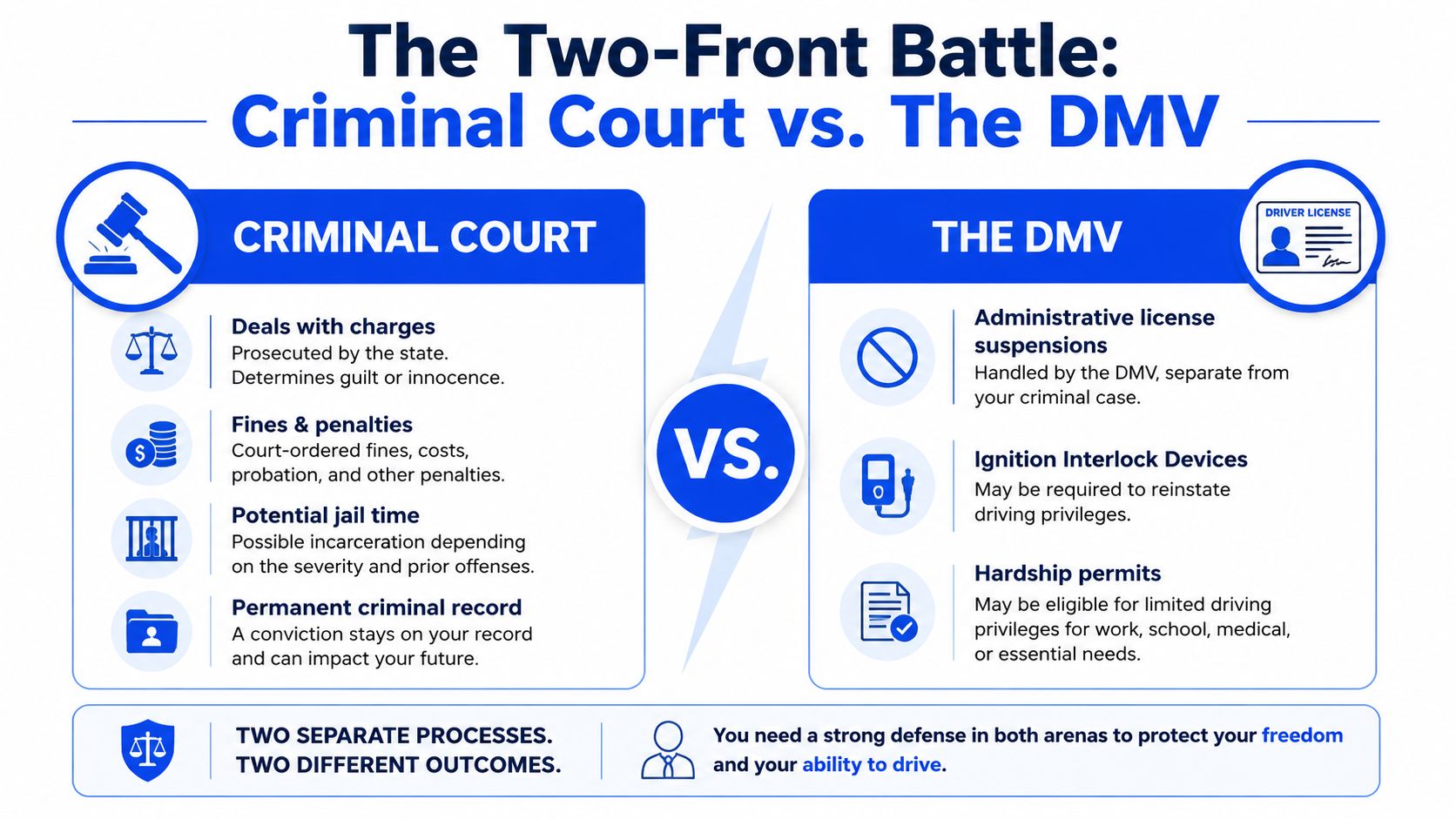
Criminal court decides guilt and punishment
The criminal case is where the State tries to prove DUI. That's where you face consequences like fines, probation, possible jail, DUI school, and a criminal record if there's a conviction.
Your defense here looks at questions like these:
Was the stop legal: If the officer lacked a lawful basis to pull you over, the case may have serious problems.
Were the tests reliable: Breath testing and officer observations are only useful if procedure was followed.
Can the prosecutor prove impairment: Suspicion is not the same as proof beyond a reasonable doubt.
The DMV track hits your license fast
The administrative side is about driving privileges. On this front, many people lose ground because they wait too long.
You generally have a 10-day deadline from the arrest to act if you want to challenge the suspension or protect your ability to drive. Miss that window, and your options narrow quickly. If your case involves a refusal allegation, read about refusal to submit to a breath test in Florida, because refusal cases carry their own administrative consequences.
The court decides whether the State can convict you. The DMV side decides whether you can keep driving while that fight is happening.
Why this matters in Broward and South Florida
In Fort Lauderdale, Broward County, Miami-Dade, Palm Beach, and nearby courts, clients usually care about one practical issue almost immediately. How do I get to work, school, treatment, or my kids?
That's why a DUI defense has to address both fronts from day one. A good plan doesn't just focus on trial strategy. It also deals with deadlines, paperwork, hearing requests, and what's needed to preserve or restore limited driving privileges.
Florida DUI Criminal Penalties By Offense
Florida uses a tiered system. The penalties for DUI in Florida get harsher as the record gets worse. A first offense is serious. A repeat offense can become life-changing very quickly.
The basic point is this. A first-time conviction carries a statutory minimum fine of $500, while a third DUI within ten years is a third-degree felony that can bring a fine of up to $5,000 and up to five years in prison under this Florida DUI penalties summary.
What a first conviction can bring
For a first conviction, Florida law can impose consequences that affect your money, your time, and your license all at once. The standard first-offense range includes a fine, possible jail, DUI school, and a license revocation period. Courts can also impose related conditions tied to driving and supervision.
Here's the simplest way to look at the escalation:
Offense level | Charge level | Fine range discussed here | Jail exposure discussed here | Key consequence |
|---|---|---|---|---|
First DUI | Usually misdemeanor | Starts at $500 | Can include jail exposure | DUI school and license consequences |
Third DUI within ten years | Third-degree felony | Up to $5,000 | Up to five years | Felony record and major license consequences |
That table doesn't tell the whole story, but it tells you the part that matters most. Florida does not treat repeat DUI as a routine traffic matter.
When a DUI becomes a felony
A third DUI within ten years changes the case completely. The charge moves into felony territory. That changes plea bargaining power, sentencing risk, and the collateral damage that can follow you into employment and licensing.
Florida also treats some repeat DUI situations harshly even when the prior cases are older. Once the record gets long enough, the case stops being about one bad night and starts being treated as an ongoing public safety problem.
If your charge is already being described as felony DUI, review felony DUI in Florida and get specific advice immediately.
A repeat DUI case is not just a “bigger first offense.” It is a different category of risk.
What clients should take from this
Don't minimize the charge because nobody was hurt. Don't assume a first offense means no jail. And don't assume a prosecutor will ignore old history. The right defense starts with the exact timeline of prior allegations, the legality of the stop, and whether the testing evidence can survive scrutiny.
License Suspensions Hardship Permits And IIDs
For many clients, the license issue hurts first. You can deal with embarrassment later. You still need to get to work tomorrow.
Florida's DUI process allows the driving side of the case to move on its own timetable. That's why smart defense work deals with transportation immediately, not after the court dates start piling up.
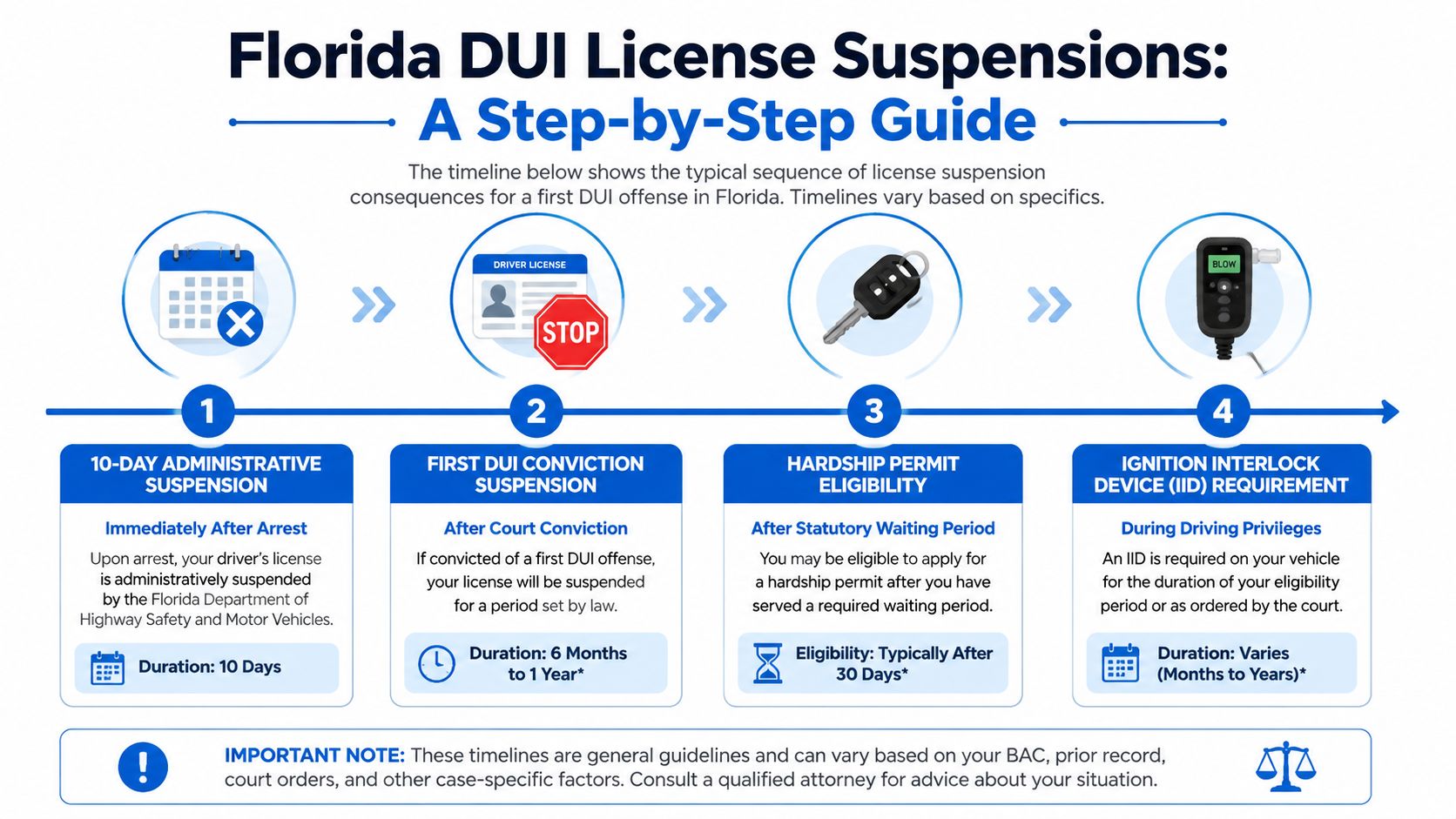
What happens to your driving privilege
After a DUI arrest, your ability to drive can be restricted before your criminal case is finished. Whether you allegedly blew over the limit or refused testing affects the path forward. So does your prior history.
Here's the practical approach:
Act before the deadline expires: Waiting can shut off options that may have kept you on the road.
Ask about hardship eligibility: Some drivers can seek limited driving privileges for work or necessary life activities.
Enroll when required: Administrative and court-related requirements often matter for getting back behind the wheel legally.
A lot of people need a roadmap for reinstatement, not just a defense strategy. If that's where you are, review how to reinstate a suspended license.
Here's a short visual explanation of how the process works in practice.
Why ignition interlock changes the case
An ignition interlock device, or IID, is not a technical footnote. It changes how you live. It affects every trip, every errand, and often every family routine involving your car.
For some DUI cases, IID is mandatory. In others, it becomes part of the negotiation and sentencing picture. Either way, you need to know whether your case triggers it, how long it may stay in place, and whether limited driving privileges will depend on it.
If driving is essential to your job or your family, the license strategy needs attention as early as the criminal defense.
Enhanced Penalties For Aggravating Factors
Not every DUI is sentenced the same way. Two arrests can look similar at first and end in very different places because one fact changes the entire exposure.
Florida judges and prosecutors pay close attention to aggravating factors. The most common ones are a high alcohol reading, a child passenger, a crash, a serious injury, a death, or a repeat record.
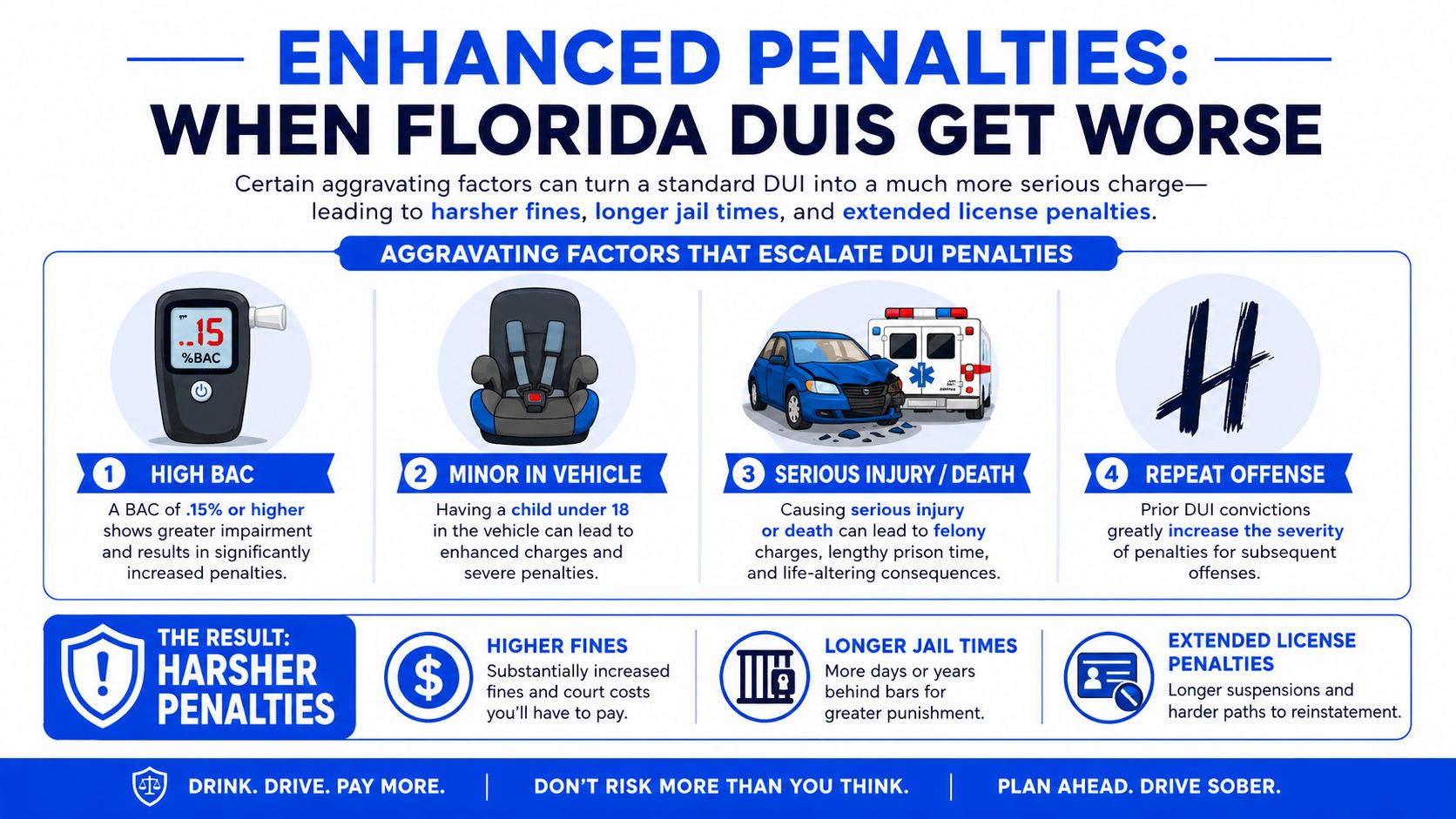
High BAC or a child in the car
Take a first offender with no crash. If the alleged BAC is 0.15% or higher, or there was a minor passenger, the ceiling gets worse. On a first offense, that enhancement raises the maximum jail term from 6 months to 9 months and triggers a mandatory ignition interlock device for 6 months under Florida law, as summarized earlier in the statutory scheme.
That matters because the prosecution often treats those facts as an advantage from the start. A case that might otherwise look negotiable becomes harder.
Consider two examples:
Driver A: First arrest, no child in the car, no unusually high reading alleged.
Driver B: First arrest, but the reported BAC is in the enhanced range.
Driver B is looking at more than optics. Driver B is exposed to tougher sentencing rules.
Crashes injuries and death
Now take another scenario. A person is arrested after a minor stop versus after a collision. Same basic charge at first glance, but the stakes can be dramatically different if the facts include injury or death.
Florida law treats DUI manslaughter as a second-degree felony with a maximum prison sentence of 15 years when a DUI causes death. That is not a case for delay, casual explanations, or wishful thinking.
There are also cases where property damage or bodily injury intensifies the way the prosecutor and the court approach the file, even before trial preparation is complete.
The fact that this is your first DUI does not mean it is a low-risk DUI.
Long-Term Consequences And Potential Defenses
The sentence is only part of the problem. A DUI conviction can keep showing up long after the court date is over.
That matters in South Florida because people here often depend on driving for work, hold professional credentials, travel for business, or need a clean record to stay employable. A DUI can complicate all of that.
The conviction follows you
Clients usually think first about fines and jail. They should also think about the longer tail:
Employment issues: Employers may treat a DUI as a judgment and reliability problem, especially for driving-related or safety-sensitive jobs.
Professional licensing trouble: Some boards care about criminal convictions even when the offense happened off the clock.
Insurance and transportation costs: A DUI often makes driving more expensive and more difficult.
Family disruption: If your household relies on one driver, a suspension affects more than one person.
For commercial drivers, the risk can be even more severe. Some licenses and job paths don't tolerate alcohol-related driving offenses well at all.
An arrest is still only an allegation
Here is the part people need to hear clearly. An arrest is not a conviction. DUI cases are beatable. They are reduced. They are challenged. Sometimes they fall apart because the evidence is weaker than the paperwork suggests.
Common defense angles include:
The stop itself: If the officer had no legal reason to pull you over, key evidence may be attacked.
Roadside exercises: These are highly subjective and often affected by nerves, shoes, lighting, weather, age, injury, and medical issues.
Breath testing procedure: Machines and operators must follow rules. Shortcuts matter.
Video evidence: Body cam and dash cam footage sometimes contradict the report.
Rising alcohol and timing issues: The State still has to prove impairment or unlawful alcohol level at the legally relevant time.
A defense lawyer's job is to test every piece of the State's case, not to assume the arrest report is accurate. One option available to people facing charges in Broward and statewide is Ticket Shield, PLLC, which handles Florida criminal defense and DUI matters including license-related issues.
Good DUI defense is detail work. Small procedural failures can change the outcome.
Your Next Steps Why You Must Act Quickly
If you're facing DUI charges in Fort Lauderdale, Broward County, Miami-Dade, Palm Beach, or anywhere else in Florida, speed matters. The criminal case is already moving. The license side may be moving faster.
Your job right now is simple:
Gather your paperwork
Stop discussing the facts casually
Get legal advice before deadlines pass
A DUI case can involve jail risk, license consequences, mandatory programs, interlock issues, and long-term record damage. It can also involve defenses you won't spot on your own from a police report.
Don't wait for the next court date to get serious. Early action gives your lawyer more room to challenge the stop, preserve evidence, address the administrative case, and push for a better outcome.
Frequently Asked Questions About Florida DUI Penalties
Will I definitely go to jail for a first DUI
Not necessarily. Jail is possible, but the outcome depends on the facts, the county, the judge, your record, and whether there are aggravating circumstances.
Do I have to appear in court every time
Often, a lawyer can handle many court appearances for you, depending on the stage of the case and the court's rules. You should ask that question at the start, not after missing work.
Can I still drive
Maybe, but don't assume it. The answer depends on timing, the administrative action, and whether you qualify for limited driving privileges.
What if I refused the breath test
Refusal changes the case and can create its own license consequences. It also changes how the defense should approach the evidence and the administrative side.
Is a DUI just a traffic ticket
No. A DUI is a criminal charge. Treating it casually is one of the worst mistakes you can make.
If you were arrested for DUI in Florida, get answers now, not after the deadline passes. Ticket Shield, PLLC handles DUI and criminal defense cases across Broward County, Fort Lauderdale, Miami-Dade, Palm Beach, and surrounding South Florida areas. Contact the firm for a confidential consultation to understand your license risk, court exposure, and defense options.
From first-offense fines to felony DUI, Florida's penalties escalate quickly. Here's a full breakdown of what a conviction really costs.