Assault and Battery Defense Strategies in Florida
Jason Goldsmith, Esq
You just left the jail, your phone is buzzing, and someone is telling you to “explain your side” before this gets worse. If you were arrested in Fort Lauderdale, Miami, or West Palm Beach after a bar argument, a neighbor dispute, or a fight that went sideways, the next few hours matter more than you might think. The State will start sorting your case into a story, and your job is to stop that story from hardening before anyone has checked the video, the witnesses, or the actual context.
Table of Contents
What to Do Right After an Assault or Battery Charge in Florida
How Video and Digital Evidence Shape Modern Defense Strategy
What to Do Right After an Assault or Battery Charge in Florida
The worst moment is usually the quiet one after release. You're home, still shaken, and the questions start. Should you call the alleged victim? Should you post a message? Should you wait for the detective to call back and “clear things up”?
Don't. That instinct ruins more cases than people think.
A prosecutor in South Florida usually starts from the arrest report, the complainant's statement, and any visible injuries or video. If the allegation came out of a parking lot, a kitchen, a hallway, or a crowded bar, the State will try to lock in a simple narrative, who was scared, who touched whom, and whether the contact looked offensive or harmful. The defense job is to slow that process down, preserve the facts, and keep you from making statements that turn a messy incident into an easy conviction.
Practical rule: the first 24 hours are about protecting evidence, not winning arguments.
That means two things right away. First, don't talk about the incident on social media, by text, or to friends who might repeat it later. Second, get legal help before you answer more questions, because even a short explanation can be used against you if the other side has a different version.
A good early defense also asks basic but essential questions. Was there a real threat? Was the contact accidental? Was anyone injured? Did anyone else record the encounter? Those answers shape whether the case is a simple misdemeanor, a more serious charge, or a weak filing that should be challenged before it gains momentum.
For a related Florida-specific overview of how battery charges are typically framed, see battery charges in Florida.
How Florida Law Separates Assault From Battery
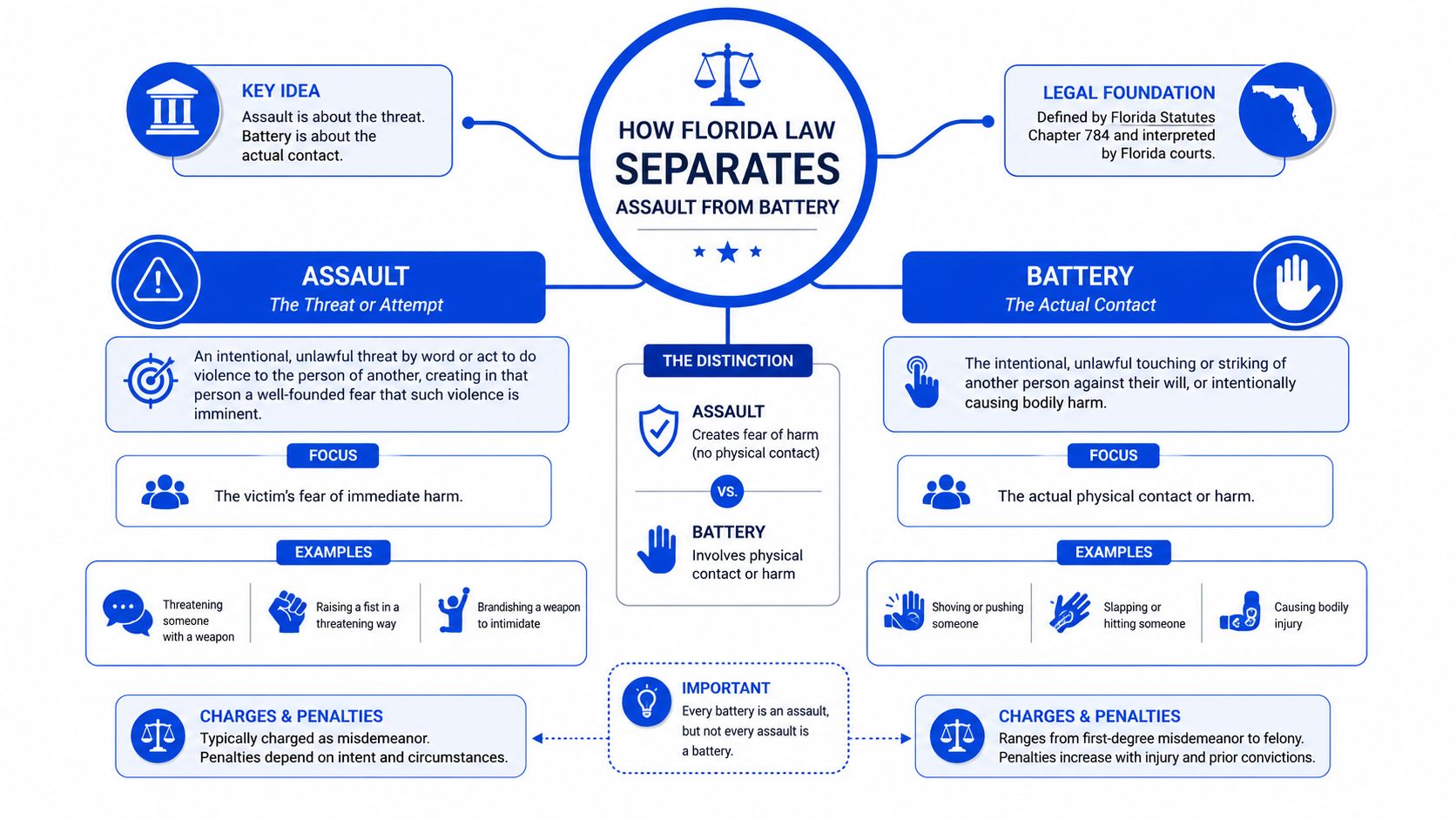
A bar argument can turn into an assault case even when no one lands a punch. A sports collision can lead to a battery charge even when the contact happened fast and the players were already in motion. Florida law separates those situations by looking at fear, contact, intent, and whether the touching was lawful.
Assault is a threatening act or gesture that places another person in fear of imminent harm. Battery is actual offensive or harmful contact. A person can face assault charges without any physical contact at all. A battery charge can still stand when the contact was offensive, even if there was no pain or visible injury, because the issue is often the character of the contact, not how badly someone was hurt.
That distinction gives prosecutors their first charging decision. If the evidence shows a credible threat but no touch, they will usually press the assault theory. If the evidence shows contact, they will look hard at battery, then test whether the touching was intentional, defensive, accidental, or not criminal under Florida law.
Common charging labels
Florida clients often hear different labels depending on the facts and the alleged victim. Those labels can include simple battery, felony battery, aggravated assault, or aggravated battery. Prosecutors tend to charge more aggressively when a weapon is involved, when there is a serious injury claim, or when another aggravating fact makes the case easier to present to a judge or jury.
Consent and mutual combat are where a lot of people misread the law. A willing exchange in a bar fight does not automatically wipe out criminal exposure, and a player agreeing to physical contact in a sports setting does not give blanket permission for conduct that goes beyond the rules of the game or the scope of the contact. The State will still ask whether the other person consented to that level of force, whether the encounter stayed within accepted limits, and whether the facts support a lawful defense or just a later excuse.
Civil claims are separate. A person can still face a lawsuit even if the criminal case is dropped, because civil court asks a different question, whether unlawful contact or threat caused damages under that standard. The criminal case is about guilt and punishment. Civil court is about liability and compensation.
Video and text messages can change the entire analysis. Body-worn camera, phone video, and messages sent before or after the incident may help a self-defense claim, but they can also undercut it if they show threats, pursuit, boasting, or a version of events that does not match the report. A defense lawyer listens for those details early, because the difference between assault and battery often turns on a few seconds of footage or a few words in a text thread. For a broader Florida-specific overview of battery charges, see battery charges in Florida.
Felony and Misdemeanor Penalties Florida Prosecutors Pursue
A prosecutor's first question is rarely, “What happened in the abstract?” It is, “What charge will hold, and how much pressure does that give us?” In Florida, that decision can turn on a shove, a bruise, a prior record, a claimed weapon, or facts that make the conduct look more serious than a simple street scuffle.
That charge level changes the whole defense posture. A misdemeanor case often pushes a client to protect employment, avoid a permanent mark, and limit court supervision. A felony case brings a different set of risks, including jail exposure, probation, and a conviction that can affect licensing, housing, and immigration status. The earlier the defense knows which facts the State can prove, the better it can answer the plea offer and bond conditions that follow.
Florida Assault and Battery Penalties at a Glance | Statutory Degree | Maximum Penalty | Common Triggering Facts |
|---|---|---|---|
Simple battery | Misdemeanor level | Lower-level jail exposure compared with felony conduct | Unwanted contact, alleged touching without serious injury |
Felony battery | Felony level | Greater exposure than simple battery | Prior qualifying history or aggravated circumstances |
Aggravated assault | Felony level | Serious felony exposure | Threat with a weapon or conduct creating heightened fear |
Aggravated battery | Felony level | Serious felony exposure | Serious injury, weapon use, or legally aggravating facts |
Prosecutors also look beyond the charge sheet. A domestic violence label can bring injunction issues, firearm consequences, and other court orders that reach well past the criminal case itself. Non-citizens need counsel to weigh immigration fallout before any plea is entered. People with professional licenses face a separate problem too, because a violent offense can trigger discipline even when the jail issue seems manageable.
The label matters because it changes the dynamics, not just language. A case that starts out sounding minor can become much harder to resolve once the State files a felony theory and points to aggravating facts the judge and jury will hear.
For a Florida-focused discussion of higher-level battery exposure, see felony battery in Florida.
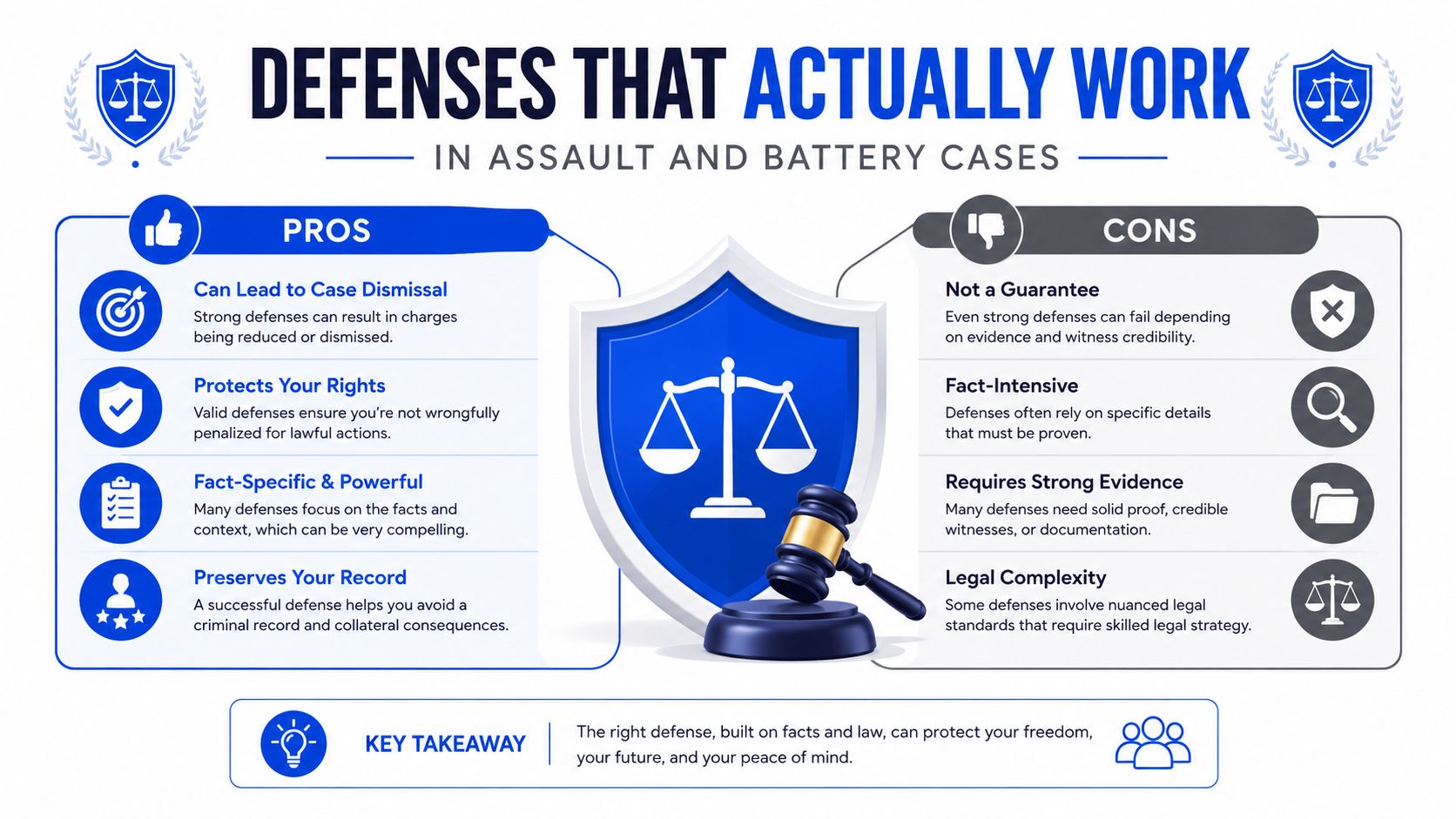
Defenses That Actually Work in Assault and Battery Cases
The strongest defense is the one that fits the facts instead of the one that sounds best in the abstract. A prosecutor wants a clean story, but real incidents are usually sloppier, with shouting, movement, fear, alcohol, witnesses who didn't see the whole scene, and video that captures only part of the encounter.
Self-defense and defense of others
Self-defense is often the first place a serious assault and battery defense starts, but it only works when the facts support objective reasonableness, not just panic. The accused generally needs a perceived threat, a reasonable basis to fear imminent harm, no provocation, and no reasonable chance to retreat or escape. If those pieces are weak, the claim gets harder to sell to a judge or jury.
Defense of others works the same way in many cases, especially when a defendant stepped in because a friend, partner, or child appeared to be in immediate danger. The State will look hard at whether the response matched the threat.
Consent, mutual combat, and intent
Consent matters more than many people realize. In some cases, the fight was mutual, the contact was expected, or the physical interaction happened in a setting where the parties had agreed to some level of contact, such as sports or other consensual activity. That does not automatically end the case, because consent has limits, and prosecutors will argue that someone went beyond what was agreed to.
Lack of intent can also help. If the contact was accidental, reflexive, or the result of a stumble in a crowded space, the State may have trouble proving the mental state it needs. That's especially important when the allegation looks dramatic but the actual facts are thin.
Mistaken identity and credibility problems
Assault cases often rise or fall on witness perception. In a fast-moving scene, people misread gestures, confuse who started what, or assume the person standing at the end of the fight was the aggressor. If the identification is shaky, the defense may have a real reasonable-doubt problem for the State.
Practical rule: if the State's whole case depends on one upset witness, the defense should test everything that witness said, when they said it, and what the physical evidence shows.
How Video and Digital Evidence Shape Modern Defense Strategy
A defense lawyer used to live and die on witness interviews. That still matters, but video now changes the entire fight. Body-worn cameras, cell phone clips, surveillance systems, and text messages can either confirm a self-defense story or destroy it in a few seconds if the footage shows hesitation, distance, or an opportunity to leave.
The key question is not just what the video shows, but what it proves about imminence and proportionality. If a clip captures the other person closing the distance, reaching first, or continuing the aggression, that footage can support the defense. If the recording instead shows the defendant stepping away, pausing, or continuing after the threat ended, prosecutors will use that same clip to argue the danger had passed.
Digital messages matter for the same reason. Text threads can show prior threats, a plan to meet, or a dispute that explains why both sides showed up angry. They can also backfire if a defendant texts an apology that sounds like an admission before legal advice is given.
A smart defense team also watches for preservation problems. Video gets overwritten, surveillance systems cycle data, and phones are replaced before key files are copied. Chain-of-custody issues can become important when the State relies on a clip that nobody can fully authenticate or explain. For a deeper look at how that evidence trail can break down, review chain of custody evidence.
Immediate Steps to Protect Your Defense After an Arrest
The first 48 to 72 hours after arrest are about damage control. You do not need to persuade the officer, the detective, or the complaining witness. You need to avoid new statements, preserve evidence, and make sure the court doesn't lock you into conditions that create another violation before the case is even evaluated.
What to say and what not to say
Use the right to remain silent. Ask for a lawyer. Don't explain the incident to police in the hope that your version will “clear it up,” because officers usually write down the parts that help the State, not the parts that help you. Don't call the alleged victim either, even if you think an apology will calm things down.
What to preserve right away
Keep clothing, photos of injuries, damaged property, and screenshots of messages. If there was business surveillance, a door camera, a rideshare, or a nearby phone recording, your lawyer may need to move quickly before that evidence disappears.
Save every message thread: Include texts, DMs, call logs, and voicemails tied to the incident.
Document visible injuries: Take clear photos as soon as possible, then preserve them with dates.
Identify witnesses immediately: Names and phone numbers matter before people forget details.
Back up your phone: A deleted clip or message can matter later if the State claims you acted first.
Follow bond terms carefully: No-contact orders and release conditions can trigger new charges if ignored.
Bond court is not the end of the story. A defense lawyer can sometimes ask for modified conditions, especially if a no-contact order is broader than necessary or blocks innocent daily life. For a plain-English explanation of the warning signs officers and prosecutors use, see what Miranda rights are.
Choosing Between Trial and Plea Negotiations
The choice is rarely “fight or plead” in the abstract. It's whether the State can prove the charge it filed, whether key evidence survives challenge, and whether the case can be reduced before the prosecutor gets too entrenched in the original theory.
Trial makes sense when the proof is weak, the witness story is inconsistent, or the video helps more than hurts. Plea negotiations make sense when the exposure is real but the defense can still push for a better outcome, such as a reduction to a lesser offense, a deferred or withheld result where available, or a resolution that limits the record impact. The right answer depends on the facts, the client's record, and what motions can be filed before any final decision.
A motion to suppress or a motion to dismiss can change the conversation fast. If the State loses key evidence, a better offer often follows. If the evidence stays strong, then the defense has to weigh risk carefully and look for the lowest-cost resolution that still protects the client's future.
How a Florida Criminal Defense Attorney Builds Your Case
A strong assault and battery defense starts with the scene, not the courtroom speech. The lawyer should collect witness names, request video, analyze timing, review reports for contradictions, and press the prosecutor on weak points before the case gets overbuilt. That work matters in Broward County, Miami-Dade, Palm Beach, and throughout South Florida because the details of the encounter usually decide whether the State can prove its case.
Attorney Jason S. Goldsmith's background as a former state attorney helps with one thing that clients need most, realistic case evaluation. A former prosecutor knows what makes an assistant state attorney dig in, what creates motion pressure, and what facts usually move a case toward reduction or dismissal. That kind of insight is useful when the other side is relying on a fast arrest narrative instead of a full investigation.
Ticket Shield, PLLC also offers 24/7 intake, which matters when an arrest happens late at night or on a weekend. Early contact lets the defense preserve evidence, calendar deadlines, and shape the case before the first serious negotiation happens. The goal is simple, expose weaknesses, protect your rights, and make sure you're not pleading to a version of events that can still be challenged.
Ticket Shield, PLLC helps people facing assault and battery charges fight back with a defense built on facts, not assumptions. If you're worried about jail, a permanent record, or a condition of release that's already making life harder, visit Ticket Shield, PLLC and ask for a confidential consultation.