
Armed Robbery Florida
Jason Goldsmith, Esq
Your phone rings in the middle of the night. Someone you love is in custody, and the words armed robbery are the only part of the conversation you can clearly remember. Before you try to explain what happened or call everyone involved, pause. The immediate task is to protect the accused person's rights and preserve facts that may look very different from the arrest report.
Table of Contents
Sentencing Exposure Under 10-20-Life and Habitual Offender Laws
How the State Builds Its Case and Where the Evidence Can Break
A Call That Changes Everything
A family in Fort Lauderdale might hear that police found their relative with someone suspected of a robbery. A parent in Miami-Dade might learn that a witness identified their child from a photograph. In Palm Beach, an argument over property might suddenly become an allegation involving a gun.
These are illustrative situations, not reported cases. What they share is uncertainty: an arrest gives you an accusation, not a complete account of the evidence.
Florida's robbery history provides context, but it doesn't decide an individual case. Florida Department of Law Enforcement robbery data recorded 13,514 robberies in 2020, a rate of 62.6 per 100,000 residents, roughly 68% below the 1990 peak of 41,909 offenses, with firearms involved in 37.1% of cases.
Separate urgent questions from unanswered facts
Families understandably want to know when their loved one can come home. Counsel also needs to examine questions that affect everything afterward:
What allegedly happened? Identify the property, the claimed confrontation, and the accused person's alleged role.
What makes the accusation armed? Determine what object witnesses described and how investigators connected it to the accused.
What needs preserving? Locate messages, video, witnesses, and records before anyone deletes or loses them.
The following visual offers a calm starting point for handling that first conversation.
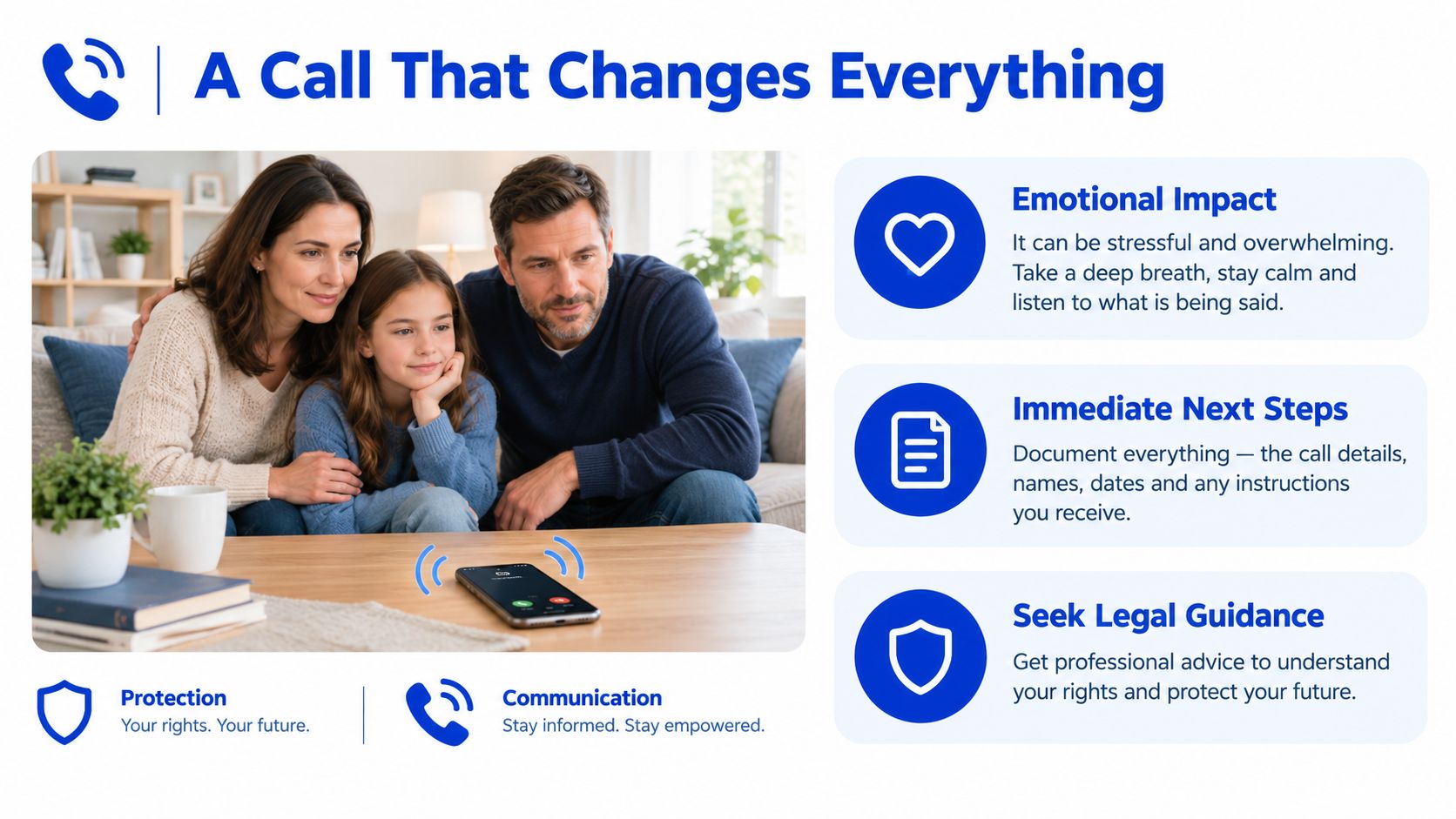
Defense work needn't wait until prosecutors make a final charging decision. A lawyer can begin identifying evidence and evaluating the allegation without asking the accused to give an informal explanation to investigators.
Practical rule: Help organize the facts. Don't try to conduct the defense through phone calls with police, witnesses, or an alleged accomplice.
How Florida Defines Robbery and What Must Be Proven
Robbery isn't another word for stolen property. Under Florida's robbery statute, section 812.13, prosecutors must establish a taking from another person or that person's custody, the required intent to deprive, and force, violence, assault, or putting the person in fear.
The statutory elements are easier to understand when separated visually.
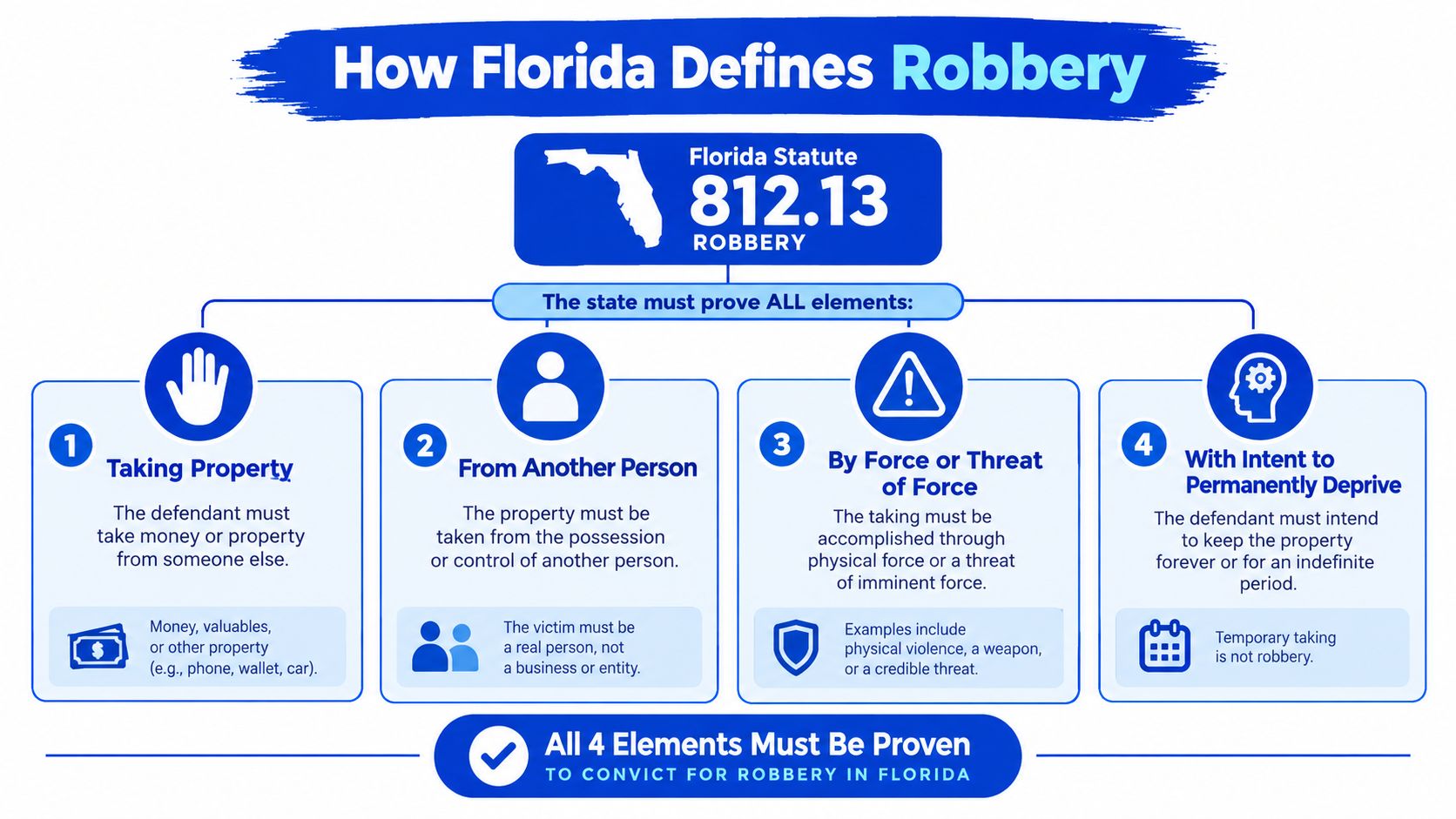
Test the taking, intent, and force separately
A disciplined case review asks distinct questions rather than accepting the label in the police report.
Taking and custody: What money or property changed hands, and whose possession or custody was it taken from? A missing item does not by itself identify who took it.
Intent to deprive: The statute includes an intent to deprive the person temporarily or permanently. A plan to return an item does not automatically resolve this element.
Force or fear: What conduct accompanied the taking? Counsel should distinguish what the witness observed from the witness later characterization of the encounter.
Consider a hypothetical dispute over a phone. Video might establish that someone picked it up while leaving the alleged threat outside the camera's view. That supports investigation of the taking, but it doesn't answer the force question.
A quick grab also calls for careful offense analysis rather than assumptions. Florida's separate offense of robbery by sudden snatching deserves its own review when the facts involve property taken directly from someone.
Examine the weapon allegation independently
The Florida Supreme Court's interpretation of the weapon-carrying element makes an important distinction: prosecutors need not prove that the firearm or deadly weapon was displayed or used. They must prove that the accused carried it during the robbery.
Consequently, a defense based only on “nobody saw a gun pointed” may miss the actual legal issue. Counsel should examine the alleged object's identity, location, accessibility, and connection to the taking.
This accompanying video provides another way to consider the robbery allegation.
The prosecution bears the burden beyond a reasonable doubt. The defense doesn't have to treat every disputed fact as equally important.
Sentencing Exposure Under 10-20-Life and Habitual Offender Laws
The charge's maximum penalty and a mandatory minimum are different questions. A maximum describes the upper sentencing exposure. A mandatory minimum, when legally applicable, limits the court's ability to impose a shorter prison term.
Florida's firearm sentencing law requires close attention to what prosecutors allege and can prove about the particular defendant. Under section 775.087, Florida's firearm sentencing statute, qualifying firearm conduct can produce these minimum terms:
Actual possession: A 10-year minimum for actual firearm possession during a qualifying felony.
Discharge: A 20-year minimum when the firearm is discharged during the felony.
Death or great bodily harm: A minimum of 25 years, potentially extending to life, when the discharge causes death or great bodily harm.
These aren't interchangeable allegations. Counsel should compare the charging document with the evidence of possession, discharge, and causation rather than accepting a general statement that the case “falls under 10-20-Life.”
Prior record and release status require separate review
Florida's offense-classification materials identify firearm or deadly-weapon robbery within the Prison Releasee Reoffender framework when eligibility requirements are satisfied. Release status, the timing of the alleged offense, and the qualifying conviction records therefore deserve independent examination.
Potential habitual-offender treatment under section 775.084 also requires individualized legal review. A prior record shouldn't be reduced to a criminal-history printout and an assumption that every listed event qualifies for enhanced treatment.
A sentencing assessment should identify which provisions actually apply, which facts remain disputed, and which records the prosecutor still needs to establish eligibility.
The practical trade-off is significant. Negotiating before understanding an enhancement may mean evaluating an offer against the wrong sentencing exposure. Refusing negotiations based on an equally mistaken assumption can be just as harmful.
A focused review of Florida's 10-20-Life law should distinguish the underlying robbery allegation from firearm-specific sentencing consequences. Neither a firearm accusation nor a prior conviction justifies treating every possible enhancement as automatic.
Robbery Grading and Felony Degrees at a Glance
The alleged weapon can matter more to robbery grading than the value of the property. Section 812.13's grading provisions distinguish robbery without a weapon, robbery with a weapon, and robbery with a firearm or other deadly weapon.
Florida Robbery Grades and Typical Exposure
Robbery Type | Felony Degree | Maximum Penalty | Likely Sentence Enhancers |
|---|---|---|---|
Robbery without a firearm or weapon | Second-degree felony | General statutory maximum for the felony degree, subject to applicable enhancements | Prior-record frameworks require individual review |
Robbery with a weapon that isn't a firearm or deadly weapon | First-degree felony | General statutory maximum for the felony degree, subject to applicable enhancements | Prior-record frameworks; firearm treatment isn't established merely by the word “weapon” |
Robbery with a firearm or other deadly weapon | First-degree felony | A term of years not exceeding life imprisonment | Firearm minimums when applicable; Prison Releasee Reoffender treatment when eligibility is established |
Classification is a legal question, not just a label
A witness's description of an object is evidence to examine, not the end of the classification analysis. Counsel should compare that description with photographs, recovered items, testing, and the legal requirements for the charged category.
An allegation involving an unloaded or inoperable gun also needs careful review. Don't assume that a condition affecting operation automatically defeats firearm-grade treatment. The analysis must address the object's legal classification and the particular sentencing provision at issue, not whether someone says it could fire.
Ask for precision: Is the State alleging a firearm, another deadly weapon, or a weapon?
Separate grading from sentencing: An object's treatment under the robbery statute doesn't eliminate the need to examine each proposed enhancement.
Avoid misdemeanor assumptions: The robbery categories in the table are felonies. A lower-grade robbery allegation isn't a misdemeanor resolution.
For broader context, Florida felony classifications explain why the degree matters. For an individual accused person, however, the useful assessment is the charged subsection plus the supported enhancements, not a generic penalty chart alone.
How the State Builds Its Case and Where the Evidence Can Break
A prosecutor may assemble a robbery case from several sources that appear persuasive together. Defense counsel should determine whether those sources independently corroborate each other or merely repeat the same initial assumption.
The statewide numbers don't answer that question. FDLE's weapon-series data show firearm-involved robberies declined 54.9% between 2010 and 2020, from 11,107 to 5,015, while their share of robberies decreased from 42.6% to 37.1%. Those historical patterns provide context, not proof of any defendant's conduct.
The evidence review should follow each connection investigators claim to have established.

Ask what each item actually establishes
Identification requires more than asking whether a witness sounds certain. Review the original description, viewing conditions, stress, cross-racial identification issues, and what investigators showed or told the witness before an identification.
For surveillance, obtain the original files where possible. A selected clip may show a person entering a location without showing the encounter, an exchange of property, or what happened outside the frame.
Fingerprints and DNA: Examine what was tested, where any material was found, and whether the result connects the accused to the relevant conduct rather than merely an object.
Possession evidence: Ask who controlled the location where police found the item and when the accused allegedly possessed it.
Digital location records: Identify the device, account, timestamp, and limits of the record before drawing conclusions about who was present.
Reliability and admissibility are different issues
An inconsistency may affect how much weight a jury gives evidence. A constitutional violation may instead raise a question about whether prosecutors can use it at all, making a motion to suppress evidence a separate strategic consideration.
Circumstantial evidence isn't automatically weak, and direct testimony isn't automatically reliable. The useful question is whether the combined evidence establishes every required element beyond a reasonable doubt, without filling gaps through speculation.
Defense Strategies That Disprove What the State Must Prove
A focused defense doesn't dispute everything just to appear aggressive. It identifies which necessary part of the prosecution's case lacks reliable support, then builds the investigation around that issue.
Mistaken identity attacks whether the accused was the person involved. A force-element challenge may accept that a property exchange happened while disputing the alleged threat. A weapon challenge may address the enhanced allegation without conceding the remaining robbery elements.
Effective preparation requires reviewing the underlying records, not only the arrest narrative.

Match the defense to the disputed conduct
Florida's forcible-felony statute includes robbery within that classification. Florida's self-defense framework recognizes justified deadly force when a person reasonably believes it necessary to prevent imminent death, great bodily harm, or the imminent commission of a forcible felony.
That doesn't mean an accused person can relabel a taking as self-defense. Counsel must reconstruct who initiated violence, what danger existed, whose protection was involved, and how any property-taking allegation fits the sequence.
Mistaken identity: Compare the earliest description with objective records, including appearance, clothing, location, and timing.
Duress or coercion: Preserve the alleged threats and surrounding communications. Counsel must assess whether those circumstances satisfy a legally available defense, not merely explain why someone felt pressured.
Weapon-element dispute: Investigate whether the evidence connects the alleged object to the accused during the relevant episode.
Negotiate from evidence, not assumptions
Early negotiations may address a charge reduction, a different resolution, or the consequences of cooperating. Diversion shouldn't be presented as an expected option for a serious violent-felony allegation; counsel must evaluate actual eligibility and prosecutorial willingness.
Strategy checkpoint: A defense theory should explain the evidence you have and identify the evidence you still need. It shouldn't depend on a hoped-for witness recantation.
Potential outcomes include a decision not to prosecute, dismissal, reduction, a negotiated plea, or trial. None follows automatically from a weakness in the arrest report.
What to Do in the First 72 Hours After an Arrest
The early priority is preservation, not persuasion. Families can help enormously by collecting accurate information without trying to convince investigators, contact an accuser, or reconcile everyone's accounts.
The accused should clearly invoke the right to remain silent and request counsel before an interview. Don't assume that an informal conversation, a ride with an investigator, or a request to “clear something up” is a safe opportunity to explain.
Preserve records without changing them
Keep original messages, account information, photographs, and location records. Screenshots can help counsel identify relevant material, but they shouldn't replace complete conversations or original files when those remain available.
Identify video locations: Record nearby businesses, apartment entrances, parking areas, and video doorbells. Give counsel the location and likely time window so preservation can be addressed promptly.
List witnesses privately: Note names, contact details, and what each person may have personally observed. Don't coach anyone or organize a shared version of events.
Document an alibi: Preserve receipts, transportation records, work records, and communications that may establish whereabouts.
Leave digital content intact: Don't delete posts, edit messages, reset a phone, or ask someone else to remove material.
Digital evidence needs interpretation as well as collection. A shared account, borrowed phone, or incomplete location history can require explanation through records rather than an unsupported assertion.
Keep legal communications controlled
Avoid discussing disputed facts with family, acquaintances, or alleged participants. Give counsel the full account privately, including uncomfortable facts, so the attorney can assess risks before making representations to prosecutors.
Use this compact checklist alongside more detailed guidance on what to do when arrested:
Request counsel: Stop substantive questioning rather than attempting a partial explanation.
Save paperwork: Keep booking information, court notices, and any listed conditions together.
Preserve evidence: Maintain originals and tell counsel where additional records may exist.
Avoid contact: Don't approach witnesses or the alleged victim to fix the situation.
Prepare questions: Ask about custody, upcoming proceedings, charging decisions, and immediate preservation needs.
Prompt action matters, but a delay doesn't mean the defense is lost. Start with what can still be secured.
Questions Families Ask After Reading This Guide
Does the alleged weapon have to be recovered?
No, not necessarily. As the statutory discussion above explains, the State can sometimes rely on witness testimony or circumstantial evidence about what the accused carried rather than producing a recovered gun.
The absence of recovery still deserves attention. Ask what evidence identifies the object and connects it to the accused, rather than assuming either that the case must disappear or that a witness's description resolves everything.
What if the gun was unloaded or didn't work?
Neither description supplies a complete legal answer. The classification analysis discussed earlier must address the actual object, the evidence of its condition, and the particular charge or enhancement.
Ask counsel to distinguish the robbery grade from firearm sentencing consequences. Don't rely on an informal assurance that an unloaded or inoperable object makes the allegation harmless.
Can an armed-robbery adjudication be sealed or expunged?
Don't plan a plea around the assumption that the record can later be erased. A lawyer needs to evaluate the exact disposition and the applicable record-relief restrictions before advising whether any meaningful route exists.
The practical concern is timing: raise record consequences before accepting a resolution. A promise that the matter can be cleaned up afterward isn't an adequate substitute for that analysis.
What should we expect at the first bond hearing?
Prepare for a custody-focused proceeding, not a full trial of the robbery allegation. Counsel should review the arrest paperwork, the accused person's circumstances, and the legal basis for any requested release or continued detention.
Families can help by supplying accurate residence information, employment details, and information about available support. Don't assume that release is guaranteed or that the first hearing settles the final charge, defense strategy, or sentencing exposure.
The most useful question isn't “Can you promise this will go away?” It's “Which elements are supported, which are disputed, and what will you investigate next?”
For someone facing an armed-robbery allegation in Broward County, Fort Lauderdale, Miami-Dade, Palm Beach, or surrounding South Florida, Ticket Shield, PLLC offers criminal defense representation that examines the taking, force, identification, and weapon evidence separately. Visit the firm to request a free consultation, discuss urgent evidence-preservation needs, and understand the available defense options before making statements or decisions about a plea.