
DUI Lawyer Broward County: Your 2026 Defense Guide
Jason Goldsmith, Esq
You were probably booked, searched your name on your phone, and realized fast that this is bigger than a traffic ticket. In Broward County, a DUI arrest can threaten your license, your job, and your record before you've even had a chance to sleep it off. The move now is simple, protect the criminal case and the license case at the same time, because if you treat them like the same problem, you'll lose ground on both.
Table of Contents
The Broward Criminal Case Timeline From Arraignment to Resolution
Questions to Ask Before Hiring a DUI Lawyer in Broward County
The First 24 Hours After a Broward DUI Arrest
The arrest usually feels chaotic on purpose. One minute you're on Federal Highway or coming off I-95, the next you're in cuffs, your car is being towed, and someone is telling you to give a breath sample, answer questions, or “clear things up.” Don't help them build a case.
Say as little as possible. Give identification, follow lawful commands, and stop talking about where you were, what you drank, or how you feel. The state already has your stop, your roadside performance, and likely video. You don't need to volunteer the rest.
If the officer asks for breath or urine testing, that decision matters. Florida's implied-consent system creates immediate license consequences for refusal, and those consequences are separate from the criminal charge, so this is not a casual call. A Fort Lauderdale DUI lawyer should be the first real phone call after release, not a later one after you've explained the story to three relatives and a coworker. Refusing a Breathalyzer in Florida
Bond out as soon as you can, then get organized. Your car may already be in an impound lot, and your citation or temporary permit will control the first deadline that matters. Detention can be short or it can drag, but the clock starts when you leave.
Practical rule: the first 72 hours are about preserving evidence and deadlines, not making speeches. If you wait to “see what happens,” you're helping the other side.
Write down everything you remember while it's fresh. Where the stop happened, what the officer said, whether there was video, who was with you, and whether you were asked to perform roadside exercises, all of that becomes useful quickly. The people who lose the most ground are usually the ones who assume they can sort it out next week.
How Florida's Two-Track DUI System Works
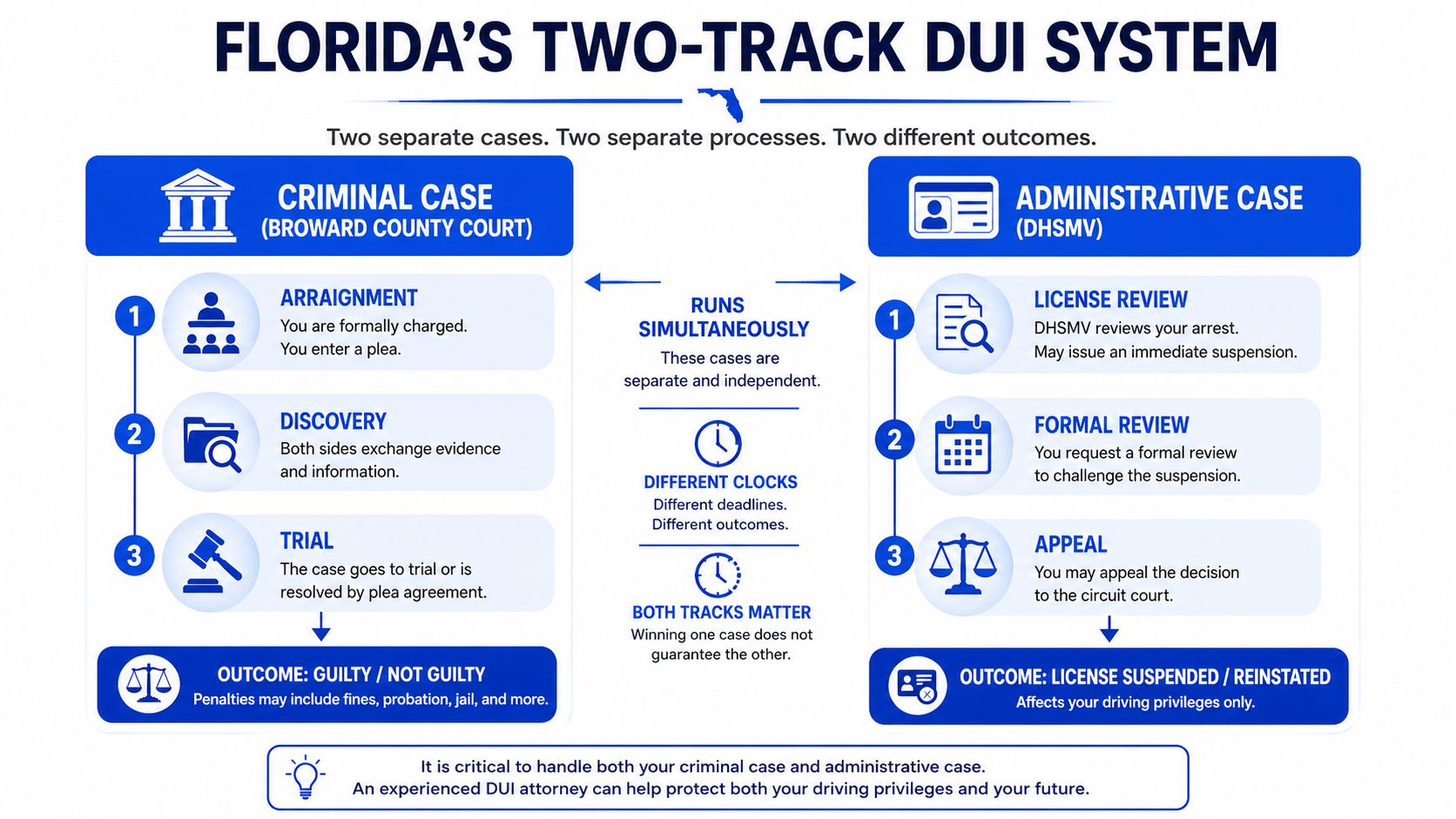
Florida DUI defense runs on two tracks, and they do not wait for each other. The criminal case moves through Broward County court, while the DHSMV administrative suspension runs on its own schedule. If your lawyer only focuses on one, you're leaving the other exposed.
The license side moves fast. Florida's implied-consent rules can trigger a suspension after a refusal, and the state gives you only a short window to request a formal review hearing. Miss that deadline, and you can lose your chance to fight the administrative suspension while the criminal case is still pending. That's why a lawyer typically files the hearing request right away, often the same day they're hired. License Reinstatement After DUI
The criminal case is different. It's where the prosecutor tries to prove impairment, and it's where defenses to the stop, field exercises, and testing get developed. A win on the license track doesn't erase the criminal charge, and a good result in court doesn't automatically restore your driving privileges. They are related, but they are not the same fight.
The fastest mistake is treating the suspension notice like paperwork you can deal with later. In Broward, later is usually too late.
That's the point many overlook. The deadline pressure is not a technicality, it's the difference between preserving a strong position and handing it away. A Broward DUI lawyer worth hiring should move on both tracks at once, because the state already is.
The Broward Criminal Case Timeline From Arraignment to Resolution
The criminal case starts with arraignment, where the charge is formally entered and your plea is handled. In many Broward cases, counsel can waive a personal appearance when that makes sense, but you should never assume that without asking. The point of arraignment is not drama, it's positioning.
After that comes discovery. That's the packet of reports, video, testing records, and witness material the state has to turn over, and it's where weak cases start showing their flaws. A former prosecutor reads that material differently, because the hidden issue is usually not what the officer said in court, it's what the file fails to support. What Happens at a DUI Arraignment
What the calendar usually looks like
The first few court dates are often about access and pressure, not final decisions. Counsel reviews the discovery, compares the report to the body-cam, and decides whether a suppression motion is worth filing. If the defense sees a bad stop, a shaky test, or a video that undercuts the officer's story, negotiations change fast.
Plea talks usually start only after the evidence has been tested. If the file is clean and the facts are ugly, then the case may move toward a negotiated resolution. If the file has real problems, the defense should force the state to deal with them instead of rushing to accept the first offer.
Bottom line: don't measure your case by the first court date. Measure it by how the evidence holds up after review.
Most first-offense cases don't need a year-long war, but some do. If the case is headed for hearing or trial, the timeline stretches, because motions, witness work, and testing issues take time to do right.
Where Broward DUI Cases Break
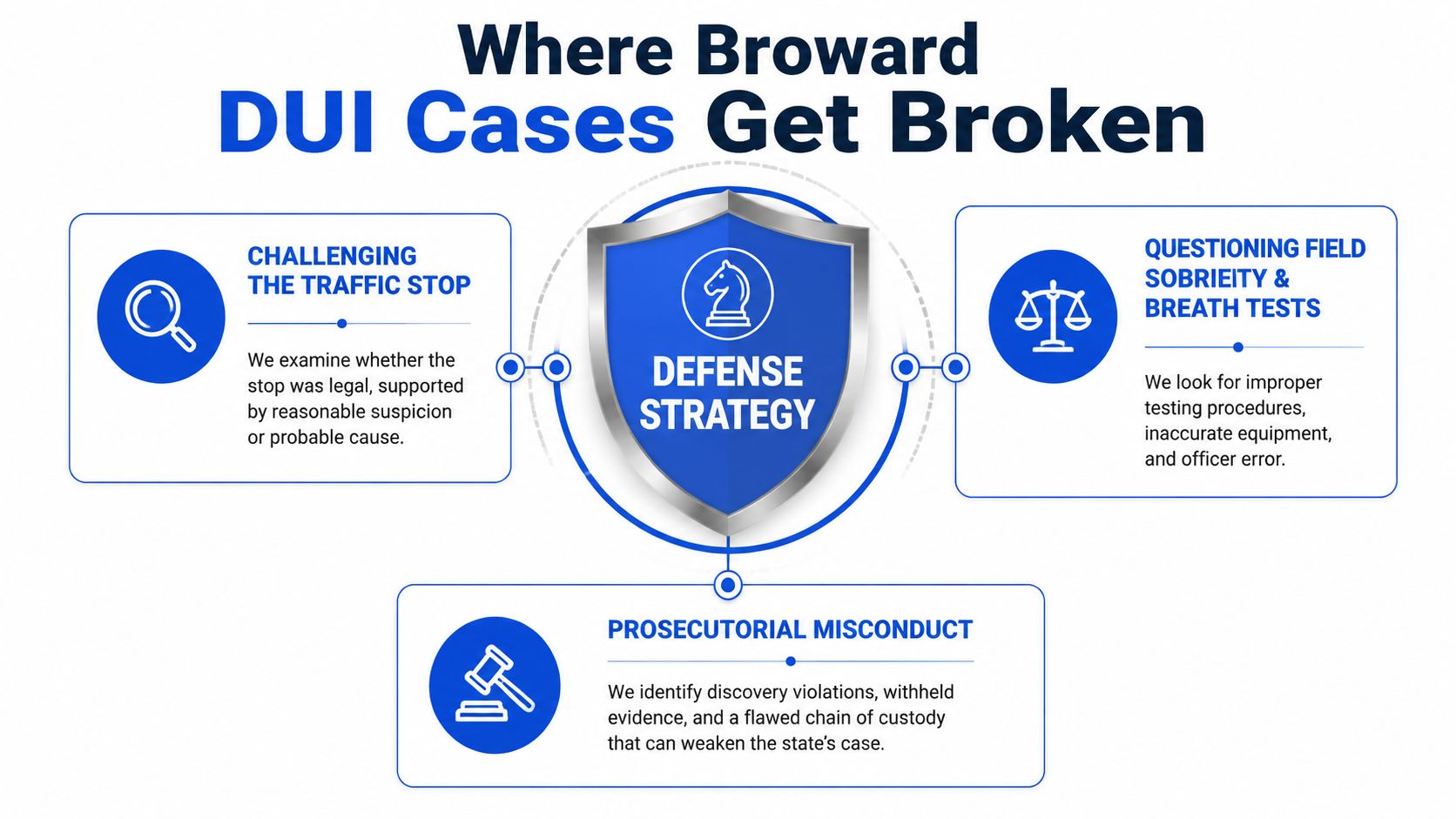
Broward DUI cases usually break at the proof stage, not in a courtroom speech. If the stop was unlawful, the roadside exercises were handled badly, or the video does not match the report, the case loses force fast. That matters even more in Broward, because the criminal case and the DHSMV license suspension move on separate tracks, and both have to be attacked at the same time if you want a real chance at a better result.
The stop has to survive first
An officer needs a lawful reason to pull you over. If the stop came from a hunch, or if the officer tried to justify it after the fact, the defense should challenge it right away. Dispatch logs, dash-cam, body-cam, and the stated basis for the stop matter more than many realize, because once the stop fails, the rest of the evidence can start falling with it. How to Get DUI Charges Dropped
The testing and video need a hard look
Field sobriety exercises depend on how they were given and where they happened. Uneven pavement, bad lighting, poor instructions, fatigue, and officer mistakes can all distort the result. Breath testing has its own problems, so calibration records, maintenance logs, and the officer's training file should be requested early.
Body-cam and dash-cam footage also matter because the video sometimes shows a calmer, cleaner interaction than the report suggests. In a Fort Lauderdale arrest, that gap between the paper file and the footage can be the difference between a case that pushes toward dismissal and one that keeps moving toward trial.
Florida also recognizes actual physical control, so prosecutors can charge someone even if the car was not moving, as long as the facts support control and impairment. That makes the keys, the ignition, and where the person was seated important details, not trivia. Florida DUI Law Overview
The evidence request list should go out immediately
Ask for or have your lawyer request:
Dispatch and stop records, because they show why the officer approached the car.
Body-cam and dash-cam footage, because video often tells a different story than the arrest report.
Breath instrument and calibration records, because testing reliability lives or dies there.
Officer training records, because bad administration creates defense issues.
Any accident or scene photos, because conditions on the ground matter.
A lawyer who knows how to press these issues early can change the direction of the case before the state settles into its story. If your file has weak or shifting evidence, start with a close look at how DUI charges get knocked down in Florida. Ticket Shield, PLLC is one option that handles Florida DUI defense alongside other criminal matters, including searches and seizure issues, so the evidence review happens early instead of after the damage is done.
Questions to Ask Before Hiring a DUI Lawyer in Broward County
Hiring fast is fine. Hiring blindly is not. You need a lawyer who can answer direct questions without giving you polished nonsense.
Ask the questions that expose the real fit
Start with these:
How many Broward DUI cases have you handled recently? Local volume matters because Broward court practice is not abstract.
Have you worked as a prosecutor in this circuit? That background changes how negotiations are handled.
Who appears for my hearings? You want to know if the lawyer you hire is the one doing the work.
Do you handle the DHSMV hearing too? If not, you're probably doubling your stress.
What does your fee cover? Be specific. If the answer is vague, that's a problem.
What outcome ranges have you seen in cases like mine? Not guarantees, just realistic ranges.
A lawyer who promises a result before reviewing discovery is selling comfort, not defense. So is a lawyer who won't explain fees, won't discuss the license issue, or acts annoyed that you want straight answers.
Good representation sounds organized, not dramatic. If you hear swagger instead of strategy, keep looking.
The right lawyer should also be able to tell you what happens if your case shifts venues, needs motions, or turns into a bigger charge. Broward DUI defense is not a place for guesswork.
Realistic Outcomes for Broward DUI Cases
The right way to think about a DUI case is in buckets, not fantasies. Some cases are weak from the start, some are salvageable, and some are headed into real sentencing risk.
Bucket | Common Facts | Realistic Outcome | Key Risk |
|---|---|---|---|
Dismissal candidate | Weak stop, bad video, testing flaws, clean history | Possible dismissal or major weakening of the state's case | Waiting too long to attack the evidence |
Reduction candidate | Some evidence problem, but not enough for dismissal | Often negotiated to a lesser result, depending on the facts | Accepting a plea before discovery |
Sentencing-risk case | Prior record, accident, minor in the vehicle, strong test evidence | More serious penalty exposure and tighter negotiating room | Treating it like a standard first arrest |
A withhold of adjudication matters because it can reduce the damage of a conviction in some situations, but it is not a magic erase button. It can still carry consequences for licensing, background checks, and certain professional issues. That's why the outcome has to be judged by more than whether the case was “won” or “lost.”
Florida's first DUI penalty framework is not minor. The statutory fine range on a first offense is $500 to $1,000, and the maximum jail term is 6 months according to the Broward defense materials cited in the brief. A first conviction can also bring probation, DUI school, community service, and vehicle consequences, so anyone telling you a first arrest is “just paperwork” is not being honest. Broward County DUI Defense Overview
Common Mistakes Broward DUI Defendants Make
The biggest errors usually happen before the lawyer ever sees the file. Once those mistakes happen, defense options shrink.
The avoidable errors that keep hurting cases
Posting about the arrest, because social media creates a record you didn't need.
Missing the administrative hearing window, because the license fight has its own deadline.
Giving a recorded statement to insurance, because adjusters are not helping your criminal case.
Waiting on video requests, because footage can be lost or overwritten.
Taking the first plea offer, because discovery may show a better fight than the state expected.
Ignoring hardship license questions, because you may have a driving problem even if the criminal case is still pending.
If you want to avoid those mistakes, use a lawyer who responds fast and knows the Broward system. Ticket Shield, PLLC is built around direct phone, text, and email access, so the deadline issue doesn't get pushed aside while you wait for a callback.
There's also a practical reason prosecutor experience helps. A former prosecutor tends to spot what the state can prove, not just what it claims in the report. That's valuable in a county like Broward, where high-volume DUI practice rewards early triage and punishes hesitation.
A few questions come up over and over. Yes, a DUI can be challenged, and some cases do get dropped when the stop, testing, or video is weak. A DUI stays on a Florida record unless it's handled in a way the law allows, and sealing or expungement is limited by Florida rules. A DUI can affect professional licensing, including fields like nursing, real estate, and aviation, because many boards and employers care about criminal history. And no, hiring a lawyer doesn't always mean you'll personally sit through every court date, because counsel can often appear on your behalf in the earlier stages.
Take the next step now. The faster a Broward DUI lawyer gets the file, the better the odds of preserving your license, challenging the stop, and forcing the state to prove its case instead of letting it ride on assumptions. If you were arrested in Fort Lauderdale or anywhere in Broward County, get a defense review before the deadlines close in.
Ticket Shield, PLLC handles Florida DUI defense, license-suspension issues, and other criminal charges with direct attorney access and a case plan built around the evidence. If you need a clear read on your options after a Broward arrest, visit Ticket Shield, PLLC for a confidential consultation and get the criminal case and the DHSMV issue handled together.