
What Is Capital Murder? a Florida Legal Guide
Jason Goldsmith, Esq
In Florida, capital murder usually means a first-degree murder case with specific aggravating factors, and it can expose a person to the death penalty or life imprisonment without the possibility of parole. The charge is serious, but it still turns on what the State can prove.
A family often hears the news in the worst possible way, a late-night call, a patrol car at the door, or a detective saying someone has been arrested for a killing that may be treated as capital. Panic sets in fast, and that's where confusion starts, because the label sounds like a separate crime when it's really a legal classification tied to murder and aggravating facts under Florida law and related capital-sentencing rules Florida first-degree murder statute, Florida aggravating circumstances statute.
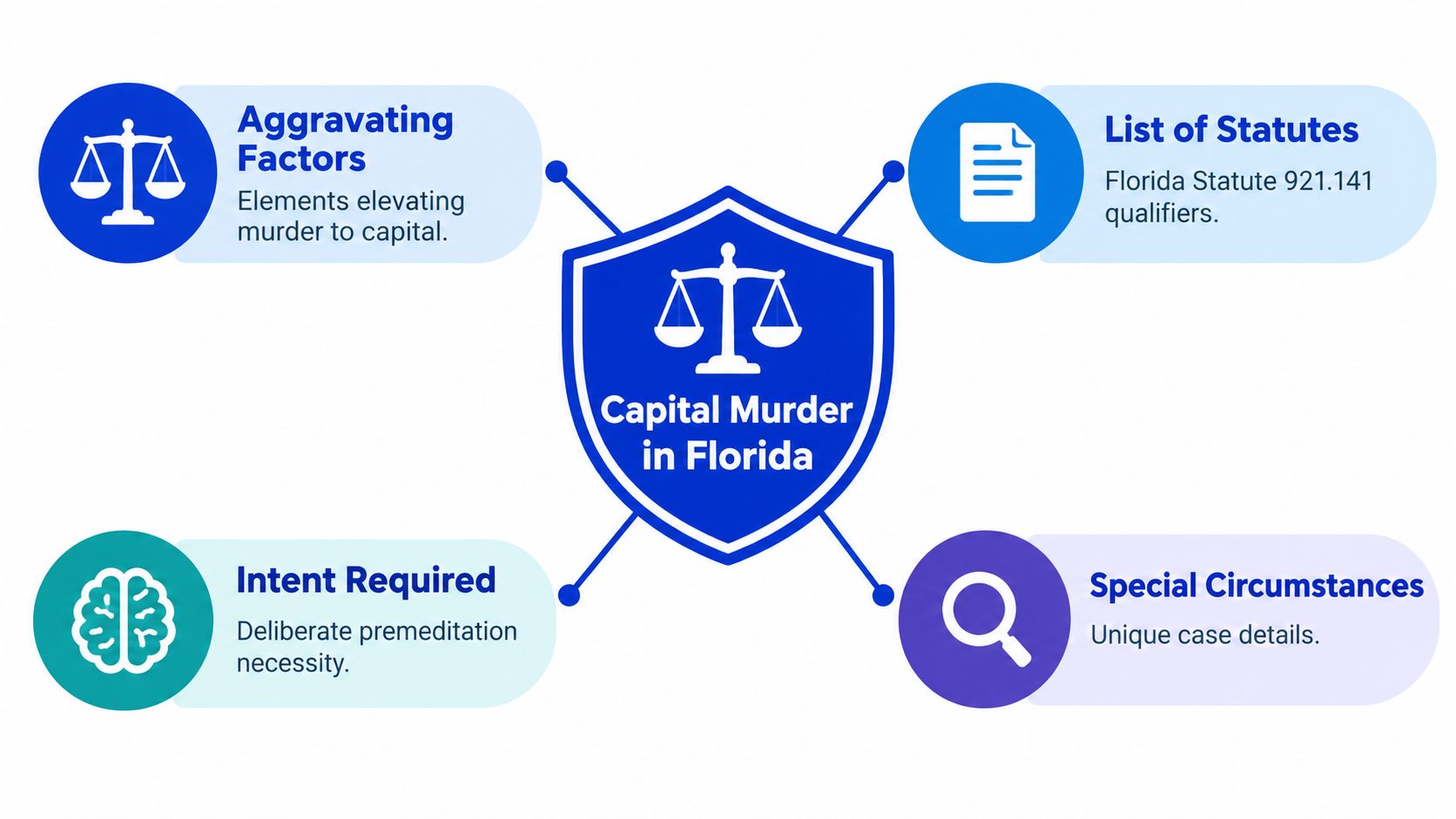
Table of Contents
Understanding Capital Murder in Florida
A spouse gets a call from a detective. A son is in custody, and the family is trying to understand whether the case points toward life in prison or the death penalty. The first step is to separate the label from the fear. Capital murder is not a standalone universal crime, it is a state-specific murder label that becomes death-eligible only when Florida law adds qualifying aggravating circumstances capital murder overview.
What the charge really means
In Florida, the starting point is usually first-degree murder. The State then looks for a legally recognized aggravator, such as a killing committed during a robbery or another listed felony, or another circumstance that can support the most serious punishment Florida first-degree murder statute, Florida aggravating circumstances statute.
That distinction matters because the word “capital” does not mean the sentence is automatic. It means the case is eligible for capital punishment if the State proves the charge, proves the aggravator, and survives the defense challenges that come next capital sentencing framework.
A simple way to hold the idea is this. The homicide charge is the base case. The aggravating circumstance is the extra fact that lets prosecutors seek the harshest penalty. Florida jury instructions treat that aggravator as something that increases the gravity of the offense beyond the harm already built into first-degree murder Florida jury instructions.
Practical rule: if the prosecutor cannot prove the aggravator, the case may still be serious, but it does not stay in the capital lane.
From a former prosecutor's view, this is the first charging decision that mattered. We asked whether the facts supported filing a notice of intent to seek death based on a specific aggravator, because that decision shaped the case from the start.
Statutory Elements and Aggravating Factors
A capital case in Florida starts with the homicide charge, then moves to the facts that make the case eligible for the harshest punishment. The prosecutor has to prove the murder elements first, then prove the aggravating factor beyond a reasonable doubt before death can even be considered. That second step is where cases often change, because the State must connect the facts to a legally recognized aggravator, not just describe the crime in emotional terms.
The mental state issue
Mens rea matters because the law separates one killing from another based on what the person meant to do. Prosecutors look for proof of intent, or proof that the facts fit the state of mind required by the charge. In practice, that means statements, texts, videos, and witness accounts often matter as much as the physical evidence.
A former prosecutor learns quickly that intent is usually the pressure point. If the evidence does not show the required mental state, the charge may still be serious, but it may not support capital treatment. That is one reason defense lawyers study the timeline so closely and compare it with how a lower homicide charge works in Florida, including situations discussed in Florida second-degree murder issues.
The aggravating circumstances Florida uses
Florida's aggravators are the extra facts that can move a murder into death-eligible territory. The statute includes killings tied to other serious felonies, murders for pecuniary gain, murders meant to avoid arrest, and killings that are especially heinous, atrocious, or cruel Florida aggravating circumstances statute.
The hard part is not memorizing the list. It is proving fit. If the State alleges pecuniary gain, for example, it has to show the murder was driven by financial benefit, not just that a robbery happened nearby. That distinction matters because defense counsel can separate the theft from the homicide and argue the killing was not motivated by money at all. The same kind of challenge applies when the State uses labels like heinous, atrocious, or cruel. The facts have to support the label, not the other way around.
The charge itself also matters. Florida treats first-degree murder as the type of homicide that can place a case in the capital lane under the sentencing rules for the most serious offenses Florida first-degree murder statute.
A capital case rises or falls on the details, not the headline.
Differences Between Murder and Capital Felony Penalties
A murder charge can carry very different outcomes depending on how Florida classifies the case. A regular homicide prosecution is serious, but a capital felony exposes the defendant to the most severe punishment the system allows.
Why the label changes everything
The label affects the entire defense. In Florida, first-degree murder can place a case in the capital track under Florida Statutes 782.04, which is why the State's theory matters as much as the facts it alleges. Once that happens, the case is no longer just about whether the accused is guilty. It becomes a two-track fight over conviction and punishment.
A former prosecutor sees this shift immediately. The defense has to prepare for motions, expert issues, and mitigation work long before trial ends. That is more than routine felony defense. It can affect discovery requests, negotiating power, and the funds needed to challenge the State's theory from the start.
The difference also shows up in sentencing exposure. A first-degree murder case can lead to life imprisonment without parole, while a capital felony finding opens the separate penalty process where death is on the table. The jury does not decide punishment by instinct. It weighs aggravating facts against mitigation, and that makes the quality of the evidence decisive.
For readers trying to sort out the homicide labels, manslaughter often comes up because it may fit when the proof does not support murder or the required mental state is missing. A clearer breakdown appears in Florida manslaughter guidance.
Why this distinction matters for defense planning
Defense planning changes because the risk changes. Counsel has to evaluate whether the State can carry its burden on intent, whether the alleged aggravation is truly supported, and whether constitutional challenges can narrow the case before sentencing ever begins.
That is the practical difference between ordinary murder exposure and capital exposure. One path focuses on prison time. The other can move into a separate punishment phase where the stakes, the strategy, and the defense work all become heavier from the first filing onward.
The Capital Sentencing Phase Explained
A capital case can feel like the finish line is the verdict. In Florida, the verdict is only the first half. The capital sentencing framework separates guilt from punishment, so the jury first decides whether the State proved the charge, then returns to decide whether death is legally justified.
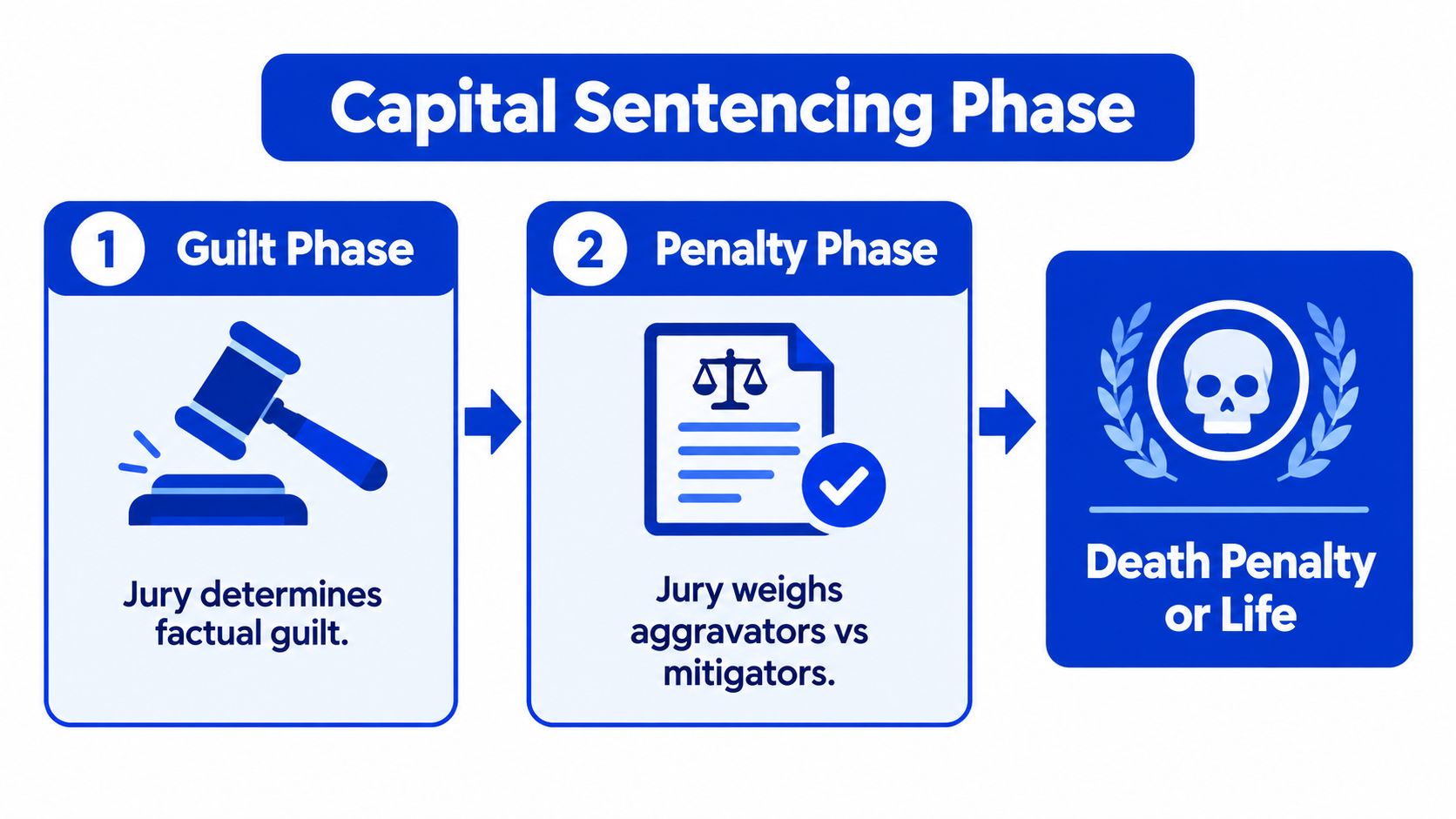
That split matters because a guilty verdict does not automatically lead to death. The prosecution still has to carry its burden in the penalty phase, and the defense gets a separate chance to show why the sentence should be something less than death. Prosecutors know this early. In practice, they start shaping the penalty file from the moment of arrest, collecting the kinds of records that can blunt mitigation later, including jail calls, financial records, and other evidence that may speak to character, history, or future dangerousness. That is why defense mitigation work should begin before indictment, not after the verdict.
How the penalty phase works
Florida jury instructions require the sentencer to find at least one aggravating circumstance, decide that the aggravation is sufficient to justify death, and conclude that mitigation does not outweigh it Florida jury instructions. Those are separate questions, and each one gives the defense room to work. Mitigation can include background, mental health, trauma, developmental history, or other facts that help explain the person standing before the jury.
The hard part for families is that the case changes character at this stage. The fight is no longer only about what happened. It becomes a comparison between the State's aggravation and the defense's humanizing evidence, with the jury asked to decide whether the full story justifies the harshest punishment available.
That is why the sentencing phase requires careful preparation from both sides. The law does not allow punishment to turn on outrage alone. It asks jurors to weigh the evidence, follow the instructions, and decide whether death fits this defendant in this case.
Common Legal Defenses in Capital Cases
A capital charge does not mean the case is over. It means the defense has to attack the State's proof with precision, especially on intent, identity, and the aggravating circumstances that make the case death-eligible.
The defense themes that matter most
Self-defense can matter if the facts support a lawful justification. Lack of intent matters when the State's theory depends on proving a deliberate killing or another required mental state. Mental incapacity can also matter in ways that affect culpability, mitigation, or the State's ability to prove the case as charged.
Witness credibility and forensic reliability matter just as much. If the State's case leans on a shaky statement, a contaminated scene, or an overread forensic opinion, the defense can use that weakness to challenge both guilt and aggravation. Those are not abstract arguments, they're the kind of pressure points that change how prosecutors negotiate and how jurors evaluate doubt.
For a broader look at defense categories, see criminal defense types.
How these defenses work together
A strong capital defense rarely relies on a single point. One argument may target the murder element itself, while another attacks the aggravator, and a third gives the jury a reason to reject death even if guilt is found. That layered approach matters because capital litigation is about more than one verdict form.
Sometimes the most important move is not a dramatic courtroom moment, but a careful challenge to what the State says the facts mean. If the prosecution calls a killing “especially heinous,” the defense can press for the actual evidence. If the State claims a felony-related aggravator, the defense can test whether the felony and the death really fit together under the statute.

Practical rule: a capital defense wins ground by narrowing the State's story, one element at a time.
Immediate Steps After a Capital Murder Charge
The first hours matter. People under pressure talk too much, try to explain everything, or answer questions because silence feels suspicious. That reaction is human, but in a capital case it can do damage quickly, especially when detectives are trained to build admissions from small inconsistencies.
What to do right away
The safest move is simple. Stop talking, ask for a lawyer, and do not discuss the facts with anyone except your attorney. That includes police officers, jail calls, friends, and family members who may later be asked to repeat what you said. Even innocent comments can become evidence in a serious homicide case what happens after arrest.
Short rule: if law enforcement wants a statement, your first answer should be that you want counsel.
After that, the defense starts working on the early structure of the case. In Florida, capital matters are not handled like routine misdemeanors, and the pretrial process can move in a way that makes preservation of rights critical. That means getting the discovery process started, identifying witnesses, and preventing avoidable harm from casual statements or informal interviews.
What families should understand
Families often focus on bail, but capital accusations are different from low-level charges. The court and the prosecutor are looking at a homicide case with death-eligible exposure, so every move has to be careful and documented. The sooner counsel is involved, the sooner the defense can start protecting the record.
A former prosecutor can be especially useful here because the early stage of a capital case is often about anticipating what the State will do next. That helps the defense respond before the case hardens around the prosecution's version of events.
Why Experienced South Florida Defense Matters
Capital cases are not won by slogans. They are handled through preparation, local knowledge, and a defense team that knows how South Florida prosecutors build these cases and how the courts expect them to be litigated.
What to look for early
Start with counsel who will protect your constitutional rights immediately. Then make sure the lawyer knows how to challenge statements, motions, aggravators, and mitigation in a capital setting. In Broward County, Miami-Dade, and Palm Beach County, local courtroom experience can affect scheduling, discovery practice, and how efficiently the defense can move.
A careful defense plan should also answer a few basic questions fast:
Who is handling the case directly? You need to know who will speak for you and how quickly.
What evidence is the State relying on? The aggravator only matters if the facts support it.
What constitutional issues exist? Illegal searches, custodial statements, and weak identifications can change the case.
What mitigation can be developed now? In capital cases, delay helps the prosecution more than the defense.
If you're trying to figure out what to ask before hiring counsel, use questions to ask a criminal defense lawyer as a starting point.
Ticket Shield, PLLC is one option for people facing serious Florida criminal charges. The firm is led by a former prosecutor and works on criminal defense matters statewide, with a focus on protecting rights, challenging the State's case, and building a plan early.
If you're facing a homicide accusation in South Florida, Ticket Shield, PLLC can help you understand the charge, the possible sentencing exposure, and the defense issues that may change the outcome. Visit Ticket Shield, PLLC to discuss your situation and get focused legal guidance as soon as possible.