Probation Violation Hearing: How to Prepare and Defend
Jason Goldsmith, Esq
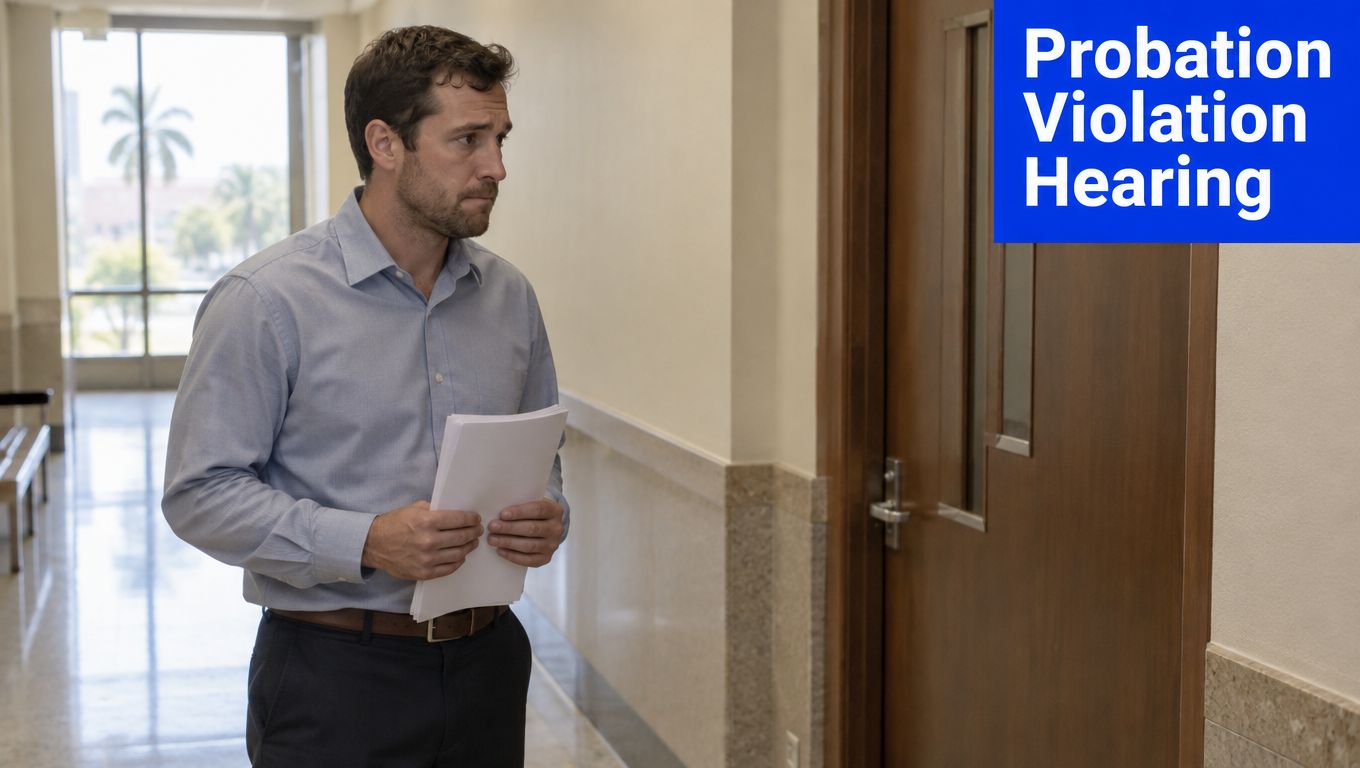
You're standing in a Broward County courthouse hallway with a thin stack of paperwork, trying to understand how a missed drug test, late payment, or new arrest turned into a court date. The notice may call it a probation violation hearing, or VOP. Whatever the label, don't assume it's a routine status check. The judge may be deciding whether your probation continues, changes, or ends with incarceration.
A VOP isn't a new criminal trial, but it can still put the sentence from your original case at risk. Florida judges decide these proceedings without a jury, and the State's burden is lower than it was at trial. The most useful preparation is practical: identify exactly what condition is alleged, preserve proof, avoid creating new problems, and prepare separately for both the violation finding and the possible consequence.
Table of Contents
What a Probation Violation Hearing Really Is
A probation violation hearing begins with the probation order, not with the courtroom drama. The State may allege that you failed to report, missed treatment, didn't pay restitution, tested positive, violated a curfew, or broke the law. The judge then examines whether your conduct violated a specific condition imposed in your written order.
This is not a new criminal trial. A jury doesn't sit in the courtroom, and the State doesn't have to prove the alleged violation beyond a reasonable doubt. The judge decides whether the evidence shows that a condition was violated, then decides what should happen next. The same judge who sentenced the original case may already know the file, the presentence investigation, and the probation officer's reports.
That combination creates a serious practical disadvantage for an unprepared probationer. A person may believe the allegation is minor because no new crime was charged, while the court may view a missed appointment as evidence that supervision is failing. Technical violations can include missed check-ins, curfew failures, and failed drug tests. These behaviors become violations because probation imposed the condition, even when the conduct itself isn't a separate criminal offense, as discussed in Florida probation conditions and supervision policy.
The judge is deciding two different questions
First, the court asks whether a violation occurred. If the State fails to prove that point, probation continues under the existing order. If the judge finds a violation, the hearing moves to the consequence stage.
The possible consequences range from continued probation to stricter conditions, treatment, monitoring, or revocation. Revocation can expose you to incarceration based on the original case and applicable Florida sentencing law. The result depends on the original offense, the wording of the probation order, the alleged conduct, your history of compliance, and the evidence presented in court.
Practical rule: Never treat a VOP notice as proof that the judge has already made up their mind. Treat it as a warning that your preparation must address both the allegation and the consequence.
A missed appointment might be explainable with transportation records, employer documentation, or messages showing that you tried to reschedule. A new arrest requires a different analysis because the arrest itself isn't automatically proof of guilt, but it can still affect how the court evaluates supervision. Read the allegation carefully, then obtain advice before making admissions or explanations. A plain-language overview of what a Florida violation of probation case involves can help you identify the issues that need immediate attention.
How Florida Law Structures the Hearing in Two Stages
Florida probation proceedings generally have a two-stage structure. The first stage asks whether the violation happened. The second asks what consequence is appropriate if the judge finds a violation. Section 948.06 governs important aspects of this process, including the probationer's opportunity to be heard.
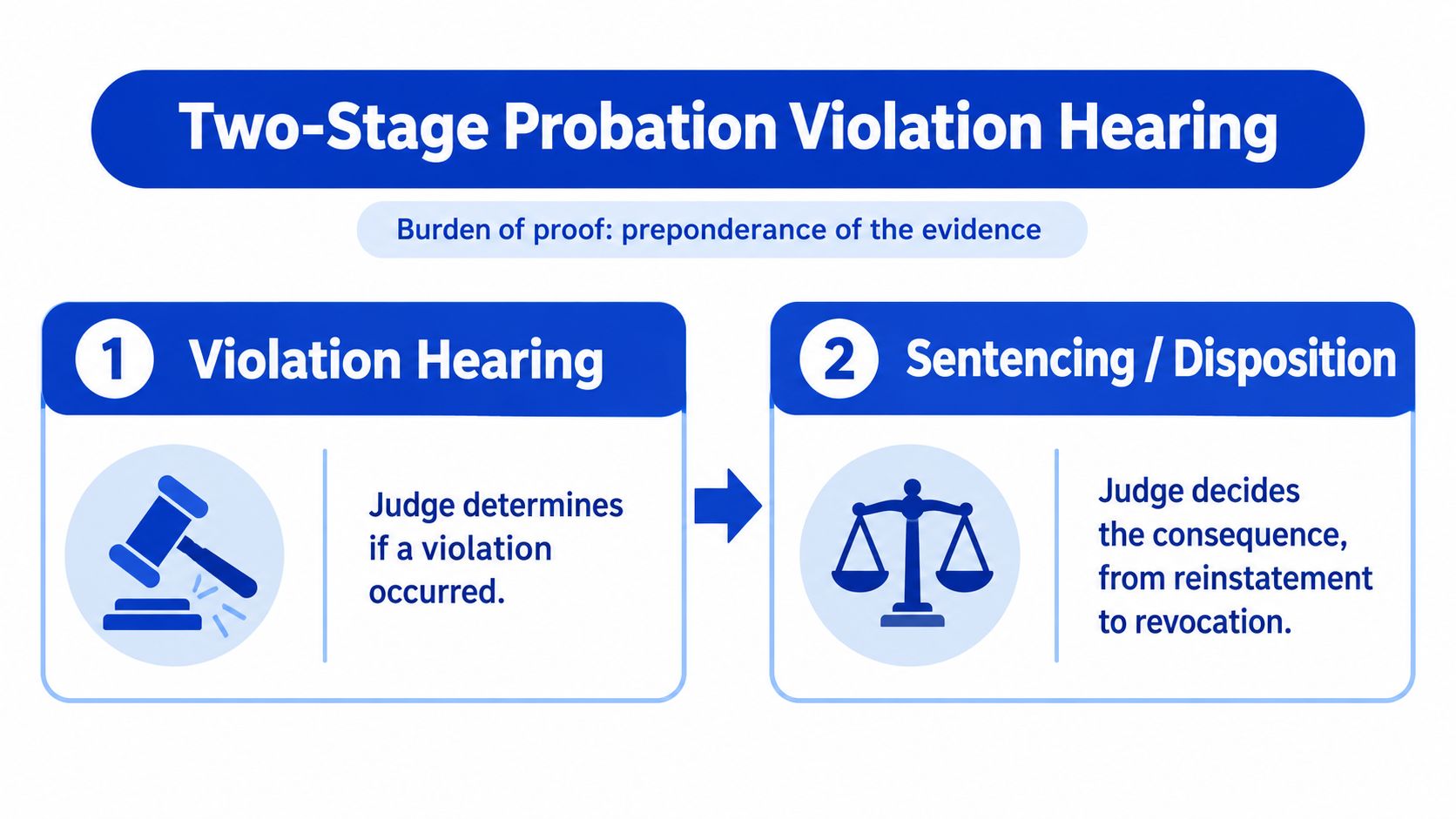
Stage one asks whether the condition was violated
The State typically relies on the probation officer, records, reports, test results, or other supporting evidence. The judge evaluates whether the alleged breach is more likely than not. That is the preponderance of the evidence standard, not the criminal-trial standard of proof beyond a reasonable doubt. Florida appellate authority describes the burden as the “preponderance of the evidence” or “greater weight of the evidence,” as summarized in this discussion of Florida probation violation proof standards.
You have the right to be heard through counsel, challenge the State's evidence, cross-examine witnesses, and present your own evidence. The court may consider records and testimony that would receive more complicated treatment in a jury trial. That doesn't mean the defense should ignore reliability, authenticity, relevance, or foundation. It means counsel must identify which objections matter and which facts need to be disputed directly.
If the judge finds no violation, the proceeding ends on that issue. Probation remains in place, subject to the original conditions.
Stage two concerns disposition
A violation finding doesn't automatically dictate one result. At disposition, the judge may consider the nature of the violation, your prior compliance, treatment participation, employment, family responsibilities, new arrests, and the steps taken since the alleged conduct. The court may continue probation, modify conditions, or revoke probation.
These stages require different preparation. A strong attack on the allegation may prevent revocation entirely. If the evidence makes a violation finding likely, the defense may need to show why continued supervision is safer and more appropriate than incarceration. A person who prepares only to deny the allegation can arrive at disposition without the documents that might persuade the judge to impose a less severe response.
The federal process also illustrates why timing matters. Rule 32.1 requires a prompt probable-cause hearing when someone is detained for an alleged federal probation or supervised-release violation, while state timing rules can vary by court and case posture. In Massachusetts practice, for example, guidance identifies presumptive timing for initial and final hearings, demonstrating why counsel should address custody and scheduling issues promptly rather than waiting for the final hearing date. Florida-specific representation and preparation are discussed through Florida violation of probation defense services.
First Steps to Take After Learning You Are Accused
The first days after receiving an affidavit of violation can shape the defense. Don't delete messages, ignore appointments, or call the probation officer to give an unscripted explanation. Start by preserving the evidence and limiting avoidable risk.
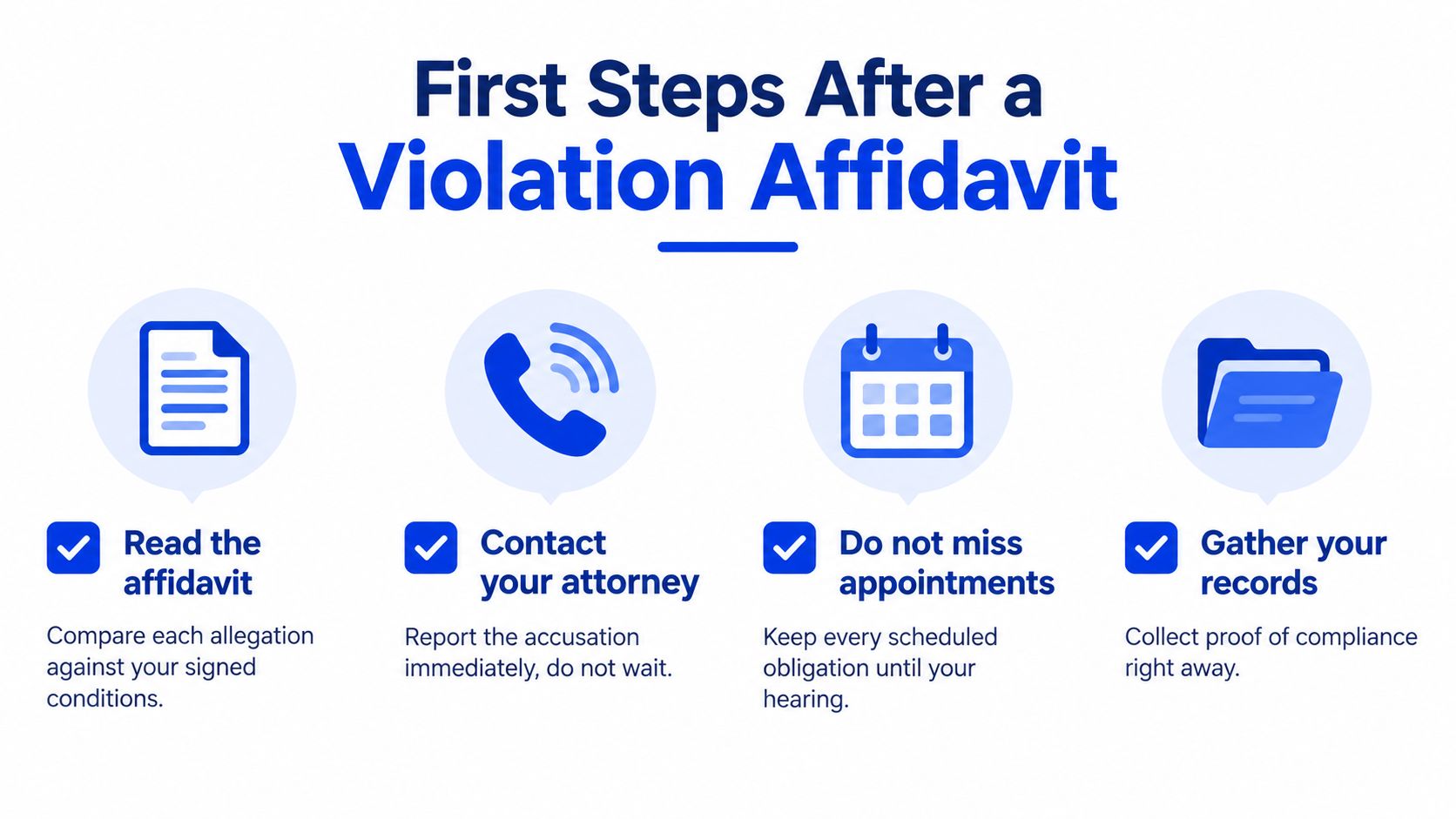
Read the allegation against the actual order
Obtain the signed conditions of probation and compare them line by line with the affidavit. The question is not merely whether something went wrong. The question is whether the conduct violated a condition the court imposed, whether the condition applied during the relevant period, and whether the affidavit describes the event accurately.
Write down disputed dates, names, locations, instructions, and documents. If the allegation concerns payment, identify the exact payment record. If it concerns treatment, locate the enrollment agreement and attendance history. If it concerns reporting, preserve appointment notices, confirmation messages, and any attempted rescheduling.
Preserve every record that touches the accusation
Create both a paper folder and a digital folder. Include:
Testing records: Keep receipts, laboratory reports, and confirmation of when and where a sample was collected.
Treatment proof: Gather sign-in logs, counselor letters, completion records, and attendance explanations.
Financial documents: Save payment stubs, money orders, restitution receipts, and correspondence about payment plans.
Employment and transportation records: Preserve schedules, supervisor messages, pay records, bus or rideshare information, and repair invoices if transportation is part of the explanation.
Electronic communications: Export relevant texts and emails rather than relying only on screenshots.
Stop posting about the case on social media. Don't contact an alleged victim, complaining witness, or anyone whose account may be part of the allegation. A new message can be misunderstood, preserved, or presented as evidence, and direct contact may create another alleged violation.
Protect the remaining probation period
Continue following every condition you can follow. Keep scheduled appointments, testing, treatment, reporting, and payment obligations unless counsel gives you a lawful alternative. Missing obligations after receiving the affidavit can give the State another fact to present and can make a mitigation argument harder.
Identify witnesses early. A treatment provider, employer, family member, counselor, or supervisor may help explain compliance, transportation barriers, work demands, or changes made since the alleged violation. Contact a Florida VOP lawyer before arraignment when possible. The time needed to obtain records, subpoena witnesses, review the probation file, and investigate the allegation begins running immediately. Guidance on responding to an alleged breach is also available in how to report a probation violation, although your own defense strategy should be handled confidentially with counsel.
Why the Preponderance Standard Changes the Defense
At a criminal trial, the State must prove guilt beyond a reasonable doubt. At a Florida probation violation hearing, the State generally needs to show that a violation is more likely than not. That lower burden changes the risk calculation and the way evidence must be evaluated.
The judge, not a jury, makes the decision. The court may rely on testimony from a probation officer, certified records, reports, and other evidence that can carry practical weight even when the defense disputes the underlying story. The defense still has meaningful tools, but stating that “the State can't prove this beyond a reasonable doubt” misses the governing standard.
The same facts can carry different force
A criminal trial may focus on whether the evidence eliminates reasonable doubt. A VOP hearing focuses on whether the judge is persuaded that the condition was probably violated. Credibility therefore matters intensely. So do inconsistencies in dates, missing records, unclear instructions, identity issues, testing procedures, and the precise language of the probation condition.
Element | Criminal Trial | Probation Violation Hearing |
|---|---|---|
Decision-maker | Judge or jury, depending on the case | Judge |
Main issue | Whether the defendant committed the charged crime | Whether a probation condition was violated |
State's burden | Beyond a reasonable doubt | Preponderance of the evidence, or greater weight of the evidence |
Evidence strategy | Formal trial objections and presentation | Focused challenges to reliability, foundation, credibility, and relevance |
Consequence | Acquittal or criminal conviction and sentence | Continued probation, modification, or revocation |
Defense preparation must be selective
The lower burden doesn't mean every State exhibit is automatically accepted or persuasive. Counsel can challenge whether a record is authentic, whether a witness has personal knowledge, whether the test was properly handled, and whether the evidence proves the condition alleged. A failed drug screen, for example, may require review of the collection process, laboratory documentation, timing, medication information, and chain of custody.
Florida appellate decisions, including cases such as Russell v. State, shape how courts evaluate evidence in VOP proceedings. The practical lesson is that counsel must separate three questions: what the probation order requires, what evidence supports the alleged breach, and what weaknesses could prevent the State from meeting its burden.
If the evidence is difficult to defeat, the defense should not abandon the case. Preparation shifts toward a negotiated resolution or a strong disposition presentation. Treatment enrollment, verified compliance after the incident, stable employment, and a workable plan can become central, but they don't replace a direct challenge when the allegation is unsupported.
Evidence to Gather Before Your Hearing Date
The probation officer's file often provides the first complete narrative the judge sees. Defense counsel needs competing proof organized clearly enough to correct errors and fill gaps. Bring evidence that answers each allegation, not a random stack of favorable documents.
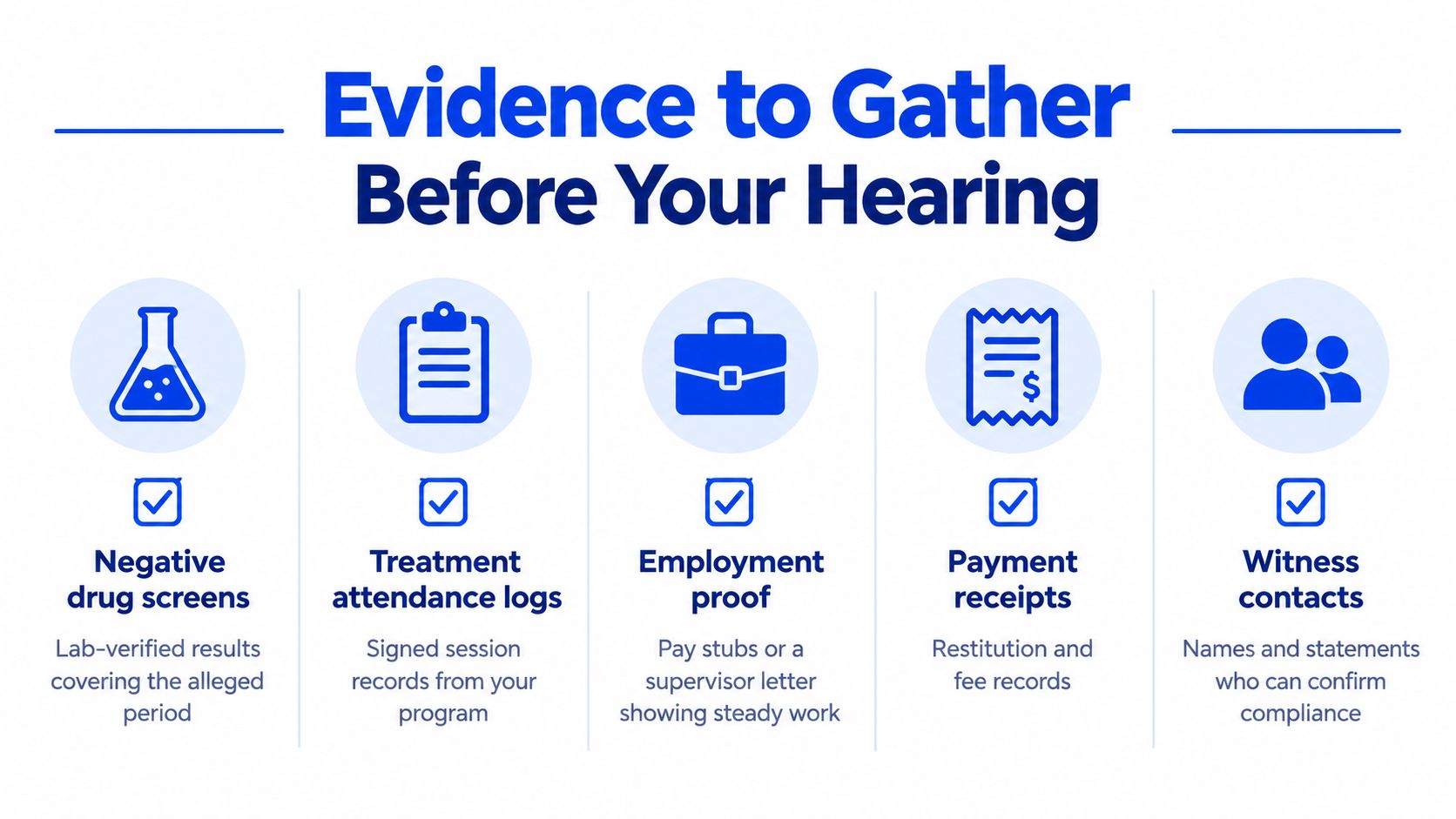
Build the packet around the affidavit
Create a section for every alleged violation. Put the affidavit and the corresponding probation condition at the front, then place supporting records behind them in chronological order.
Useful categories include:
Negative drug screens: Collect lab-verified results that cover the relevant period, along with collection and reporting information.
Treatment attendance: Obtain signed session records, counselor letters, treatment plans, and completion certificates.
Program documentation: Include drug court or other court-ordered program records when they relate to compliance.
Employment proof: Use pay stubs, schedules, and a supervisor letter showing work history and any conflict relevant to the allegation.
Community service records: Preserve hour logs, agency confirmations, and completion documentation.
Residence verification: Gather a lease, utility record, shelter confirmation, or letter from a responsible housing provider when residence is at issue.
Monitoring records: Request GPS or SCRAM printouts and identify any alerts that require explanation.
Payment receipts: Organize restitution, supervision fee, court cost, and other payment records.
Witness contacts: List people who can appear and explain exactly what each witness knows.
A character letter is more useful when it contains specific observations and comes from a person who understands the writer's relationship to you. Letterhead may help identify the author, but counsel should decide whether the letter is appropriate, admissible, or better used during negotiations.
Verify before relying on a document
Ask whether the record is complete, whether it covers the correct date, and whether the issuing organization can authenticate it. Certified copies may matter for official records. Screenshots without context can create questions about alteration or missing messages, so preserve the original source whenever possible.
Evidence handling also matters for testing and physical records. A focused review of chain-of-custody evidence can identify gaps that affect reliability, but the right challenge depends on the actual documents and testimony.
A useful packet tells the judge what happened, when it happened, and what you did afterward. It doesn't ask the court to search for the point.
Give counsel the packet early enough to contact witnesses and request missing records. A treatment provider may need time to release records. An employer may need time to prepare a letter or appear. Waiting until the morning of court limits the choices available to the defense.
Defense Strategies That Work in Florida VOP Cases
There isn't one universal VOP defense. The right approach depends on whether the allegation is factually wrong, technically supportable but minor, connected to a new arrest, or difficult to dispute. A useful defense plan may combine several approaches while keeping the violation stage separate from disposition.
Challenge the allegation when the proof is weak
Start with the condition itself. If the order doesn't prohibit the conduct alleged, or if the State relies on an inaccurate date, mistaken identity, incomplete record, or unreliable test, counsel can ask the judge to reject the violation.
Drug allegations deserve careful review. Counsel may examine collection procedures, laboratory records, chain of custody, medications, and whether the result establishes use or possession under the condition. Reporting allegations may require review of appointment notices, transportation problems, attempted contacts, and whether the probation officer gave clear instructions.
A new arrest isn't the same as a conviction. The defense should assess what the affidavit alleges and what admissible or persuasive evidence supports it, rather than assuming the arrest resolves the VOP issue.
Concede selectively when a technical violation is clear
Sometimes the evidence makes a narrow admission more credible than an all-or-nothing denial. A missed appointment or late payment may be acknowledged while the defense demonstrates that every other condition was followed and that the issue has been corrected.
That strategy only works when the admission is informed. The probationer should understand what is being admitted, what the State must still prove, and what sentencing exposure follows. Counsel may negotiate a warning, continued probation, added treatment, or another modification instead of revocation.
Build mitigation for the second stage
Mitigation should be concrete. Enrollment in treatment is stronger when supported by attendance and testing. A claim of stable work is stronger with pay records. A request to remain in the community is stronger when it includes a realistic plan for transportation, appointments, housing, testing, and payment.
Family responsibility can matter, but it shouldn't be presented as a substitute for accountability. Explain the problem, show what changed, and give the judge a supervision plan that can be monitored.
Negotiate a controlled resolution
Counsel may negotiate dismissal, continuation, modification, or a defined consequence rather than leave every issue to an open-ended revocation request. Florida law gives the court several responses under section 948.06, and the defense should evaluate whether a negotiated outcome protects liberty while addressing the court's concern.
For a narrower discussion of a technical case, see misdemeanor probation violation defense. The same preparation principles don't apply identically to every misdemeanor or felony case, especially when the original sentence and statutory maximum differ.
What Happens in Court and the Possible Outcomes
On hearing day in Broward or Miami-Dade, arrive early with counsel, identification, and an organized document packet. Wear clean, conservative clothing. Turn off your phone, don't argue in the hallway, and don't approach the probation officer or alleged victim to explain your side.
The courtroom may include the judge, assistant state attorney, probation officer, defense attorney, and defendant. The probation officer who prepared the affidavit may testify or provide records. The judge controls the procedure, and the exact sequence can vary by courtroom and case.
The violation stage comes first
The State usually presents its evidence first. That may include the probation officer's testimony, the affidavit, testing records, payment history, messages, or information about a new arrest. Defense counsel cross-examines the witness and identifies weaknesses in the State's proof.
The defense may then present witnesses and documents. You might testify, but that decision requires careful advice. Because your statements can affect both the violation finding and disposition, don't volunteer an explanation to the prosecutor, probation officer, or judge before counsel evaluates the risks.
If the judge finds no violation, probation continues under the existing order. If the judge finds a violation, the court considers disposition. The original presentence investigation, supervision history, compliance record, new arrests, treatment efforts, and mitigation may all affect the result.
Outcomes range from continuation to revocation
Possible outcomes include:
Dismissal or no violation finding: The court rejects the allegation, and probation remains in effect.
Continuance for proof: The court allows time for additional compliance records, treatment progress, or another appropriate development.
Modified probation: The judge adds conditions such as testing, treatment, curfew, reporting, electronic monitoring, or payment requirements.
Continued probation with a warning: The court finds a violation but permits supervision to continue under existing or adjusted terms.
Revocation: The court ends probation and imposes a sentence authorized by the original case, potentially including incarceration and any applicable credit for time served.
The outcome spectrum varies by jurisdiction, original offense, violation type, and individual history. National supervision data also shows why these proceedings are a routine enforcement stage rather than an unusual event. A U.S. Sentencing Commission report tracked 108,115 violation hearings tied to 82,384 offenders across fiscal years 2013 through 2017, with an overall violation-hearing rate of 16.9% and annual rates ranging from 16.2% to 18.4%. The report found that 93.2% of offenders had one violation hearing. These figures are federal supervision data, not a prediction of what will happen in a Broward or Miami-Dade case, but they underscore the importance of treating the hearing as a structured legal proceeding. The published probation hearing data provides that national context.
Bring your records, follow counsel's instructions, and answer only what you're asked. Don't interrupt the judge, blame the probation officer, minimize an allegation without understanding the evidence, or make a spontaneous admission. A careful defense gives the court a reliable alternative to the probation officer's account and a workable reason to choose supervision over incarceration.
Ticket Shield, PLLC reviews Florida probation orders, violation affidavits, compliance records, and available court responses for clients facing VOP proceedings. Visit Ticket Shield, PLLC to request a confidential consultation about preparing for your Broward, Miami-Dade, Palm Beach, or other Florida probation violation hearing.