
Violent Crime Defense Attorney: How to Choose Wisely
Jason Goldsmith, Esq
A phone call after dark can turn an ordinary evening into a criminal case before your family has time to understand what happened. Someone you love may be sitting in a South Florida jail, facing a violent felony, while police, prosecutors, and a judge begin making decisions that can affect liberty, employment, housing, and family relationships.
The right response isn't panic or a long explanation to investigators. It's preservation. Get the arrest paperwork, stop discussing the facts on recorded calls, identify witnesses, preserve video and messages, and speak with a violent crime defense attorney before the first court appearance. The earlier counsel can control information and investigate, the more defense options remain available.
Table of Contents
The Call That Changes Everything
At 11 p.m., a family member calls from a Hillsborough or Pinellas County jail. The words come quickly. There was an argument, someone was injured, the police arrived, and now the accused has been booked on a violent felony. The family wants to know what happened, whether bond is possible, and whether the person will come home.
Those questions matter, but the first priority is protecting the case. The first 48 hours can determine whether police obtain additional statements, whether a judge imposes restrictive release conditions, and whether important evidence survives long enough for a defense lawyer to examine it.
What families should do immediately
Collect the paperwork: Obtain the arrest affidavit, booking information, charging language, property receipts, and any documents provided at the jail.
Stop discussing the facts on jail calls: Jail calls are commonly recorded or monitored. Family members should assume that anything said about the incident may reach the prosecution.
Preserve digital evidence: Don't delete text messages, social media posts, location data, photographs, or videos. Keep the original files and avoid editing or forwarding them unnecessarily.
Identify witnesses: Write down names, phone numbers, locations, and what each person may have seen or heard. Don't coach witnesses or ask them to coordinate their stories.
Secure counsel before first appearance: A lawyer can address release conditions, communicate with investigators, request preservation of video, and begin reviewing the arrest narrative.
Practical rule: Don't try to fix the case by explaining it to the police after the arrest. Let counsel decide whether any statement is legally and strategically appropriate.
A first appearance is not a trial. The judge may address probable cause, release, and conditions, but the hearing can still shape the defendant's ability to work, contact family, travel, or gather evidence. A defense attorney should be ready to identify lawful release conditions and correct obvious inaccuracies in the arrest account.
The family should also move quickly on surveillance footage. Retail stores, apartment complexes, gas stations, residences, and businesses may overwrite recordings. A lawyer can send preservation requests and locate nearby cameras before the evidence disappears. The same applies to 911 audio, dispatch records, body-worn camera footage, photographs, medical records, and social media material.
Fear is understandable. Silence, preservation, and organized information are more useful than speculation. Write down the timeline while memories are fresh, but keep factual discussions between the accused and counsel protected by attorney-client privilege.
What a Violent Crime Defense Attorney Actually Does
A Florida violent crime defense attorney isn't a television performer waiting for a dramatic cross-examination. The work starts long before trial and usually involves strategy, investigation, constitutional litigation, negotiation, and preparation for several possible outcomes.
The lawyer's first task is to understand what the State really has, not merely what the arrest affidavit claims. An affidavit may summarize an investigation in the light most favorable to arrest. It may omit contradictory statements, missing video, unreliable identification procedures, or facts supporting justification.
The work behind the courtroom
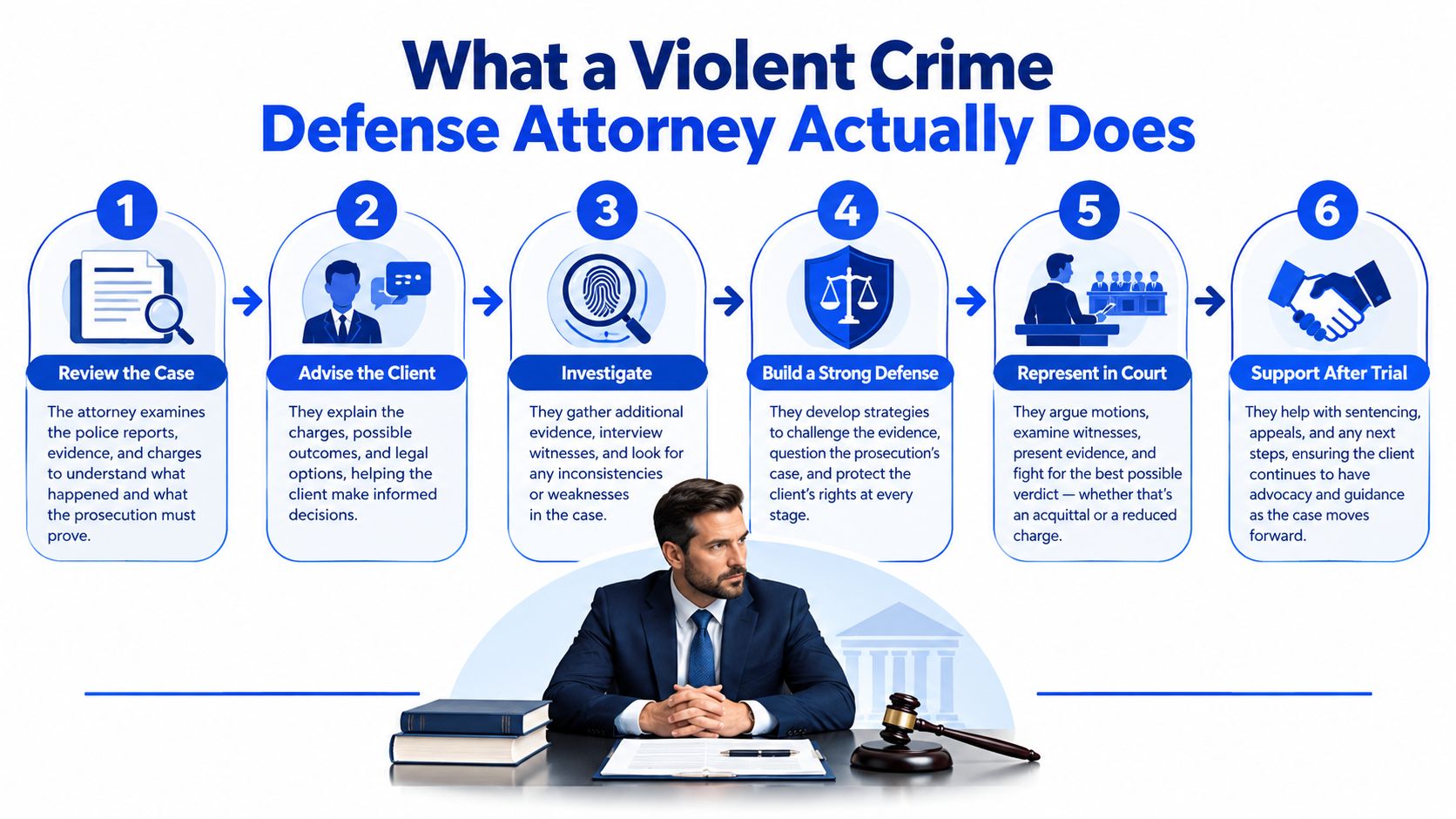
A defense team typically:
Reviews the arrest affidavit and charging documents. The attorney identifies the elements the State must prove and separates firsthand observations from hearsay or assumptions.
Audits the evidence. Body-camera footage, 911 audio, CAD records, photographs, medical records, forensic reports, and phone data must be compared against the written narrative.
Investigates independently. Witnesses may remember events differently after speaking with police or other participants. Defense counsel preserves original accounts and looks for corroboration.
Challenges unlawful evidence. A lawyer can file a motion to suppress an illegal search, an involuntary statement, or evidence obtained after a Miranda violation when the facts support that challenge.
Manages release and negotiations. Counsel can argue for more workable bond conditions and evaluate whether a charge reduction, dismissal, or negotiated resolution is realistic.
Prepares for trial from the start. Depositions, expert review, motions, jury strategy, and cross-examination preparation make the defense stronger even when the case ultimately resolves without a verdict.
Attorney-client privilege is central. The accused needs a protected setting to disclose facts that may be embarrassing, incomplete, or unfavorable. The lawyer then decides what information should be disclosed, when it should be disclosed, and whether disclosure advances the defense.
A case also requires disciplined information control. The defense lawyer communicates with the prosecutor, court, investigators, and witnesses while protecting the accused from avoidable statements. That doesn't mean hiding evidence or obstructing the process. It means ensuring that the State has to prove its case through admissible, reliable evidence.
A defense lawyer's job isn't to repeat the client's fear. It's to test every part of the State's proof and make the prosecution earn a conviction.
Public defense history shows why this work has become a specialized, high-volume part of American criminal litigation. The United States Courts' history of the Criminal Justice Act explains that federally funded professional counsel began with the Act signed on August 20, 1964. By 2013, the federal defender system covered 91 of 94 judicial districts, handled nearly 230,000 representations, and included about 1,300 full-time defenders and about 12,000 panel attorneys. Publicly financed lawyers represented over 80% of felony defendants charged with violent crimes in the nation's largest counties and 66% of federal defendants.
That history matters to a private client because serious violent-crime defense depends on the same fundamentals, constitutional access to counsel, evidence management, and trial preparation.
Common Violent Charges in Florida and Their Stakes
A violent-crime accusation can change a family's future before anyone has tested the evidence. A domestic-violence strangulation case raises different proof questions from a robbery involving a masked suspect. Aggravated battery may turn on the injury classification and self-defense, while sexual battery may center on consent, identification, timing, and corroboration.
Florida prosecutors may file charges for second-degree murder, manslaughter, aggravated battery, aggravated assault, kidnapping, carjacking, armed robbery, home-invasion robbery, sexual battery, or felony domestic violence by strangulation. The charge itself does not prove the injury, intent, identity, or absence of legal justification. For worked examples of how these allegations arise in real cases, review our guide to violent crime examples.
Separate the charge from the proof
The statutory label sets the starting point. The evidence determines whether the State can prove every element and whether a defense lawyer can reduce or defeat the charge. A former prosecutor will usually identify the State's likely theory early, then test the witnesses, records, physical evidence, and charging language against that theory.
The table gives general statutory exposure. Criminal history, sentencing enhancements, the scoresheet, mandatory terms, plea agreements, and facts proven in court can change the result. Ask counsel to identify the exact subsection and maximum that apply to the filed charge.
Charge | Florida statute | Felony degree and maximum penalty | Primary defense posture |
|---|---|---|---|
Second-degree murder | Florida homicide statutes | Second-degree felony, up to 30 years in prison | Self-defense, defense of others, causation, intent, and credibility |
Manslaughter | Florida homicide statutes | Second-degree felony, up to 15 years in prison | Justification, causation, accident, and proof of culpable conduct |
Aggravated battery | Fla. Stat. § 784.045 | Second-degree felony, up to 15 years in prison | Self-defense, injury classification, identity, and intent |
Aggravated assault | Florida assault statutes | Third-degree felony, up to 5 years in prison | Imminent threat, lack of intent, mistaken identification, and justification |
Kidnapping | Florida kidnapping statutes | First-degree felony, punishable by life in prison | Consent, duration, movement, intent, and mistaken identity |
Carjacking | Florida robbery statutes | First-degree felony, up to 30 years, with life authorized for a firearm or deadly weapon | Identity, possession, intent, and proof of force or threat |
Armed robbery | Florida robbery statutes | First-degree felony, punishable by life when a firearm or deadly weapon is involved | Identification, possession, intent, and suppression of evidence |
Home-invasion robbery | Florida robbery statutes | First-degree felony, punishable by life when a firearm or deadly weapon is involved | Entry, identity, intent, eyewitness reliability, and forensic proof |
Sexual battery | Florida sexual battery statutes | Degree and maximum vary by conduct, victim, injury, and subsection, including first-degree felony exposure and life imprisonment in specified cases | Consent where legally available, identity, timing, corroboration, and credibility |
Felony domestic violence by strangulation | Florida battery statutes | Third-degree felony, up to 5 years in prison | Mechanism of injury, intent, witness credibility, medical evidence, and self-defense |
Florida's aggravated battery statute includes intentionally or knowingly causing great bodily harm, permanent disability, or permanent disfigurement, using a deadly weapon, or committing the offense against a pregnant victim when the defendant knew or should have known of the pregnancy. The Florida aggravated battery statute must be compared with the medical records, witness accounts, alleged conduct, and evidence of intent.
A serious record can increase the authorized punishment. Florida's violent career criminal and habitual violent felony offender provisions can raise the consequences beyond the ordinary range. Under the Florida habitual offender statute, a second-degree felony can carry up to 30 years, while a first-degree felony or life felony can carry life imprisonment when the statutory requirements are met.
Current crime trends also affect prosecutorial priorities and plea discussions. A 2026 mid-year update reported 8% more domestic violence incidents, 6% fewer gun assaults, and 17% fewer robberies in the jurisdictions it examined, according to the Council on Criminal Justice crime trends update. Those figures do not decide an individual case. They can help explain intense attention to domestic cases, while declining robbery numbers may affect how prosecutors assess older or weaker identification evidence.
For broader context, the Pew Research Center's crime analysis reported that the U.S. violent crime rate fell 49% between 1993 and 2022. Robbery fell 74%, aggravated assault fell 39%, and murder and nonnegligent manslaughter fell 34% during that period. Public trends never replace an individualized defense or the State's burden to prove guilt beyond a reasonable doubt.
The Defense Playbook That Moves Cases
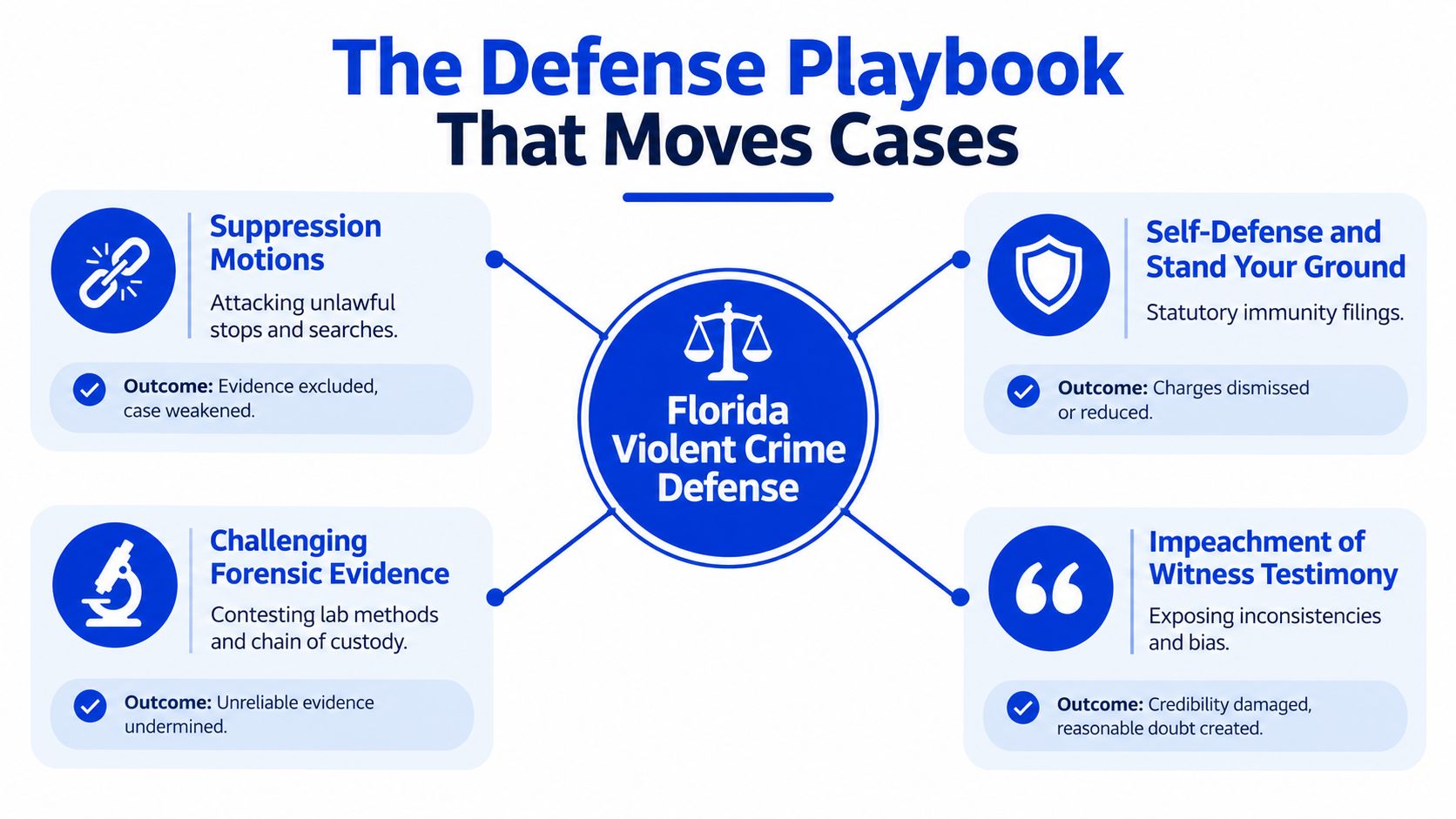
Strong defense work is technical. The central question isn't whether a lawyer can recite self-defense law. It's whether counsel can connect a legal tool to a specific weakness in the State's evidence before that weakness disappears.
Suppression starts with an evidence map
Counsel should trace every important item from the initial encounter to the courtroom. That means asking:
Why did the stop begin? Was there reasonable suspicion, or did officers act on an unsupported description?
What justified the search? The State may rely on a warrant, consent, exigency, automobile exception, or another theory.
Was the statement voluntary? Custodial questioning raises Miranda and coercion issues.
Was the evidence preserved correctly? Chain-of-custody gaps, altered files, missing timestamps, and unexplained handling can affect admissibility and weight.
A suppression motion under Florida criminal procedure can attack an unlawful stop, search, seizure, entry, or statement. The practical effect can be substantial because the State may lose a weapon, confession, phone extraction, or derivative evidence that formed the backbone of the case. Early review matters because plea pressure often hardens after the prosecution believes its evidence is secure.
Stand Your Ground is a pretrial strategy
Florida law permits a person to use or threaten force when the person reasonably believes it is necessary to stop another person's imminent unlawful force. Deadly force requires a reasonable belief that it is necessary to prevent imminent death, great bodily harm, or the imminent commission of a forcible felony. When the person isn't engaged in criminal activity and has a right to be in the location, Florida law provides no duty to retreat and recognizes a right to stand one's ground under the Florida self-defense statute.
A Stand Your Ground immunity motion under section 776.032 requires more than the defendant's label for the event. Counsel must develop photographs, medical evidence, witness accounts, video, 911 recordings, physical positioning, and the timeline of force. The State's response and the court's factual findings can determine whether the case continues toward trial or whether immunity ends the prosecution.
Identification and credibility require disciplined testing
Eyewitness confidence isn't the same as accuracy. Stress, lighting, distance, brief exposure, cross-racial perception, and suggestive procedures can affect memory. A defense team should compare the first description with later testimony, review whether a show-up or lineup was used, determine whether the administrator knew the suspect's identity, examine filler selection, and preserve body-camera and CAD timestamps.
The Neil v. Biggers factors may provide a framework for litigating identification reliability, but the work is evidentiary rather than rhetorical. Counsel should determine whether a witness had a meaningful opportunity to observe, whether the original description matched the accused, and whether later confidence increased after police suggestion.
Credibility disputes often decide violent cases. Inconsistent police reports, prior inconsistent statements, body-camera gaps, changing civilian accounts, and undisclosed bias can create reasonable doubt. An attorney should preserve the original versions instead of relying on a witness's final polished account.
Evidence priority: Preserve the recording, photograph the scene, obtain the medical record, and document the first account before later statements reshape the story.
The same evidence review informs negotiation. A lawyer evaluating whether a plea is sensible should understand the weaknesses exposed through motions and depositions. Families can learn more about that decision-making in this guide to plea bargaining in criminal cases, but no resolution should be accepted until counsel explains the evidence, collateral consequences, and realistic sentencing risk.
Inside the Florida Criminal Process Step by Step
The criminal process moves through recognizable stages, but the timing and decisions vary by charge and case facts. Families should ask the lawyer what has happened, what comes next, and which deadline or hearing requires action.
Arrest, booking, and first appearance
After arrest and booking, the accused may remain in custody until a first-appearance hearing. In Florida, that hearing generally occurs before a judge within 24 hours, not before a jury. The judge addresses probable cause and release conditions, and defense counsel can argue for a workable bond or nonmonetary conditions where the law permits.
Ask: What exactly does the arrest affidavit allege? What conditions are being requested? Is there a no-contact order, weapon restriction, or residence issue that affects the defense?
A prosecutor may later file an information or, for certain serious offenses, seek an indictment from a grand jury. The charging document controls what the State must prove, but it isn't a finding of guilt.
Arraignment and discovery
At arraignment, the accused enters a formal plea, commonly not guilty while counsel investigates. The defense then receives discovery under Florida Rule of Criminal Procedure 3.220, which may include reports, recordings, photographs, witness information, forensic material, and other evidence.
Depositions can be important in a violent case because they preserve testimony and expose differences between an initial report, a later statement, and courtroom testimony. Ask whether counsel plans to depose the alleged victim, eyewitnesses, officers, medical witnesses, and experts.
The Florida speedy-trial rule, Florida Rule of Criminal Procedure 3.191, includes a 175-day period for many felony prosecutions, subject to exceptions, waivers, extensions, and continuances. A defendant shouldn't assume the clock automatically produces dismissal. Ask how the rule applies to the case and whether a defense continuance or waiver affects the calculation.
Motions, negotiations, and trial
Pretrial motions may address suppression, immunity, bond, discovery violations, expert testimony, and the legal sufficiency of the charge. A motion hearing gives the judge a chance to rule on admissibility or immunity before a jury hears the evidence.
Plea discussions can occur throughout the case. Diversion or first-time violent felony alternatives may be available in limited circumstances, but eligibility depends on the statute, facts, injuries, record, victim position, and prosecutor policy. Counsel should explain whether a proposed resolution creates a conviction, requires admissions, affects immigration or licensing, or limits future defenses.
If the case proceeds to trial, the court selects a jury, the lawyers question prospective jurors under Florida's jury-challenge standards, and both sides present evidence. The defense should know the theory of the case before jury selection begins, not invent one during opening statements.
A conviction moves the case to sentencing, where the charge, scoresheet, prior record, minimum mandatory provisions, enhancements, victim injury, and mitigation can affect the result. A family should ask for a written explanation of every proposed plea and every sentencing consequence.
For a plain-language overview of the immediate post-arrest process, review what happens after an arrest. Then ask counsel to apply that general sequence to the specific county, charge, and custody status.
Why a Former Prosecutor Reads the Case Differently
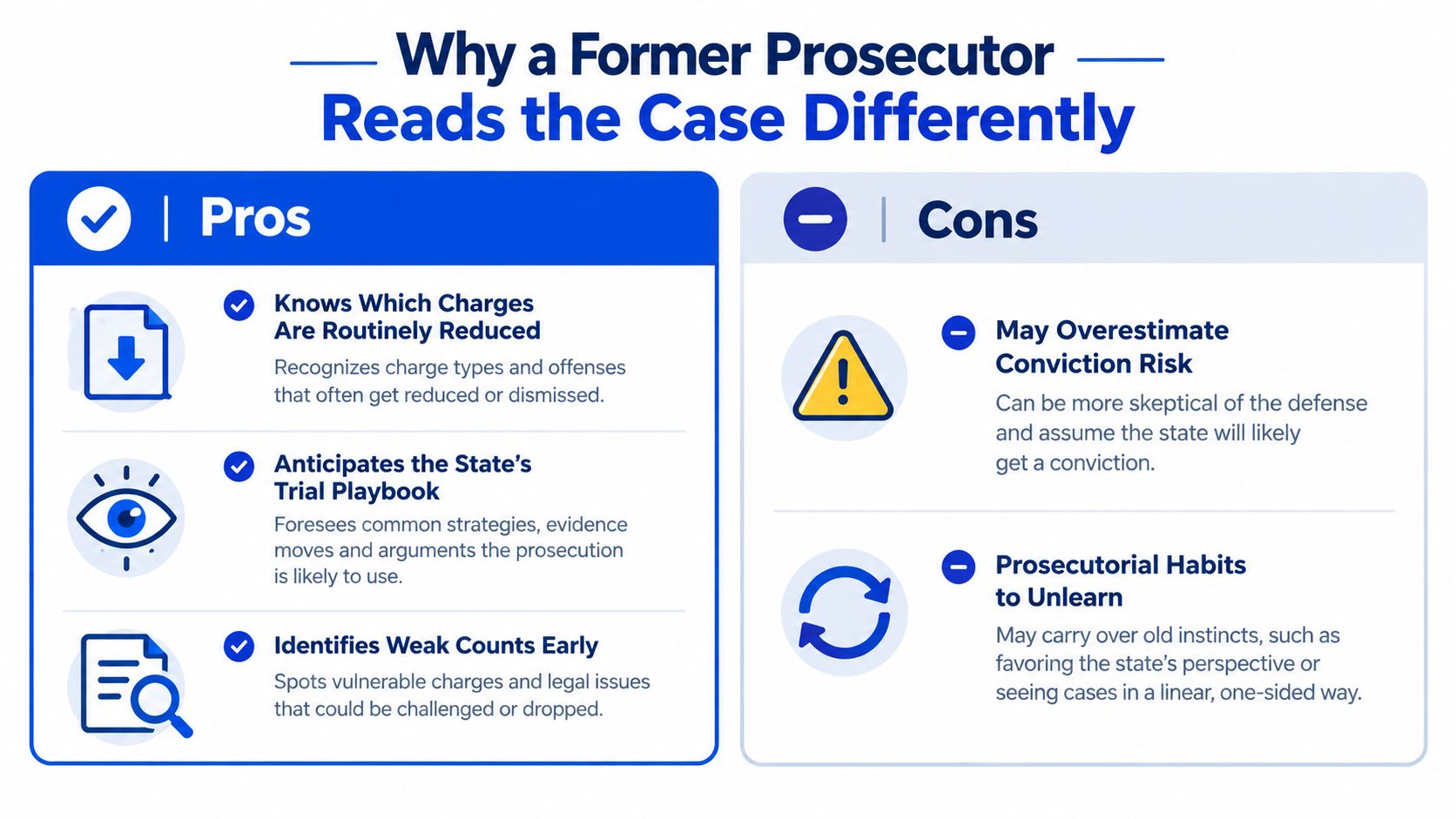
Former-prosecutor experience can provide a concrete strategic advantage, but only when the lawyer has fully moved to the defense side. The value isn't a title. It's knowing how charging decisions are made, how prosecutors evaluate credibility, and which weaknesses matter before trial.
A former prosecutor may recognize that one count in a multi-count case is routinely negotiated while another count is being used to create pressure. The lawyer may anticipate how an assigned assistant state attorney will present a cooperation request, frame a victim's credibility, seek restrictive bond conditions, or respond to a Stand Your Ground motion.
That perspective can improve the timing of defense decisions. Counsel may know when the State is waiting for a forensic report, when a witness coordination problem is developing, or when a prosecutor is unlikely to dismiss without a deposition, expert opinion, or motion hearing.
Insider knowledge isn't a substitute for defense work
Charging discretion affects how a case is valued before trial. A lawyer familiar with prosecutorial discretion in Florida can explain why the initial charge may not reflect the final negotiation posture, while still warning that prosecutors don't have to offer a reduction.
Former prosecutors may also understand how habitual offender allegations change the State's position. Florida's charging and sentencing framework can make early review of prior convictions, dates, and qualifying offenses especially important. Counsel should examine whether an enhancement is legally supported rather than treating it as inevitable.
A prosecutor's insider view matters most when it leads to a defense action, such as a targeted motion, a focused deposition, or a credible alternative theory.
There are limits. A lawyer who spent years evaluating cases for conviction may overestimate the strength of the State's evidence or default to office habits that don't serve an accused client. Former-prosecutor experience must be paired with current defense-side motion practice, persuasive jury communication, independent investigation, and the willingness to try the case when negotiation fails.
Ask for examples of how that experience changes the work. Does the lawyer identify weak counts early? Does counsel challenge the State's witnesses instead of just negotiating around them? Can the lawyer explain how the defense will preserve a self-defense theory, attack an identification, and respond to forensic evidence?
Choosing the Right Attorney for Your Case
Before signing a retainer, interview the lawyer as if the case requires both negotiation and trial. A serious violent felony deserves specific answers, not general assurances.
Ask:
Trial experience: How many violent-crime jury trials have you handled? What felony verdict experience do you have? Have you worked as a prosecutor or public defender?
Defense strategy: What defenses could apply to these facts? Which motions would you investigate first? How do you handle forensic experts and independent witnesses?
Personal involvement: Who will appear at hearings? Who will answer urgent questions? How often will the family receive updates?
Financial terms: Is the fee flat, hourly, or mixed? Are investigators, experts, depositions, and trial costs included? What happens if the case goes to trial?
Written agreement: Does the retainer identify the scope of representation, payment terms, communication expectations, and expenses?
Be cautious if anyone guarantees dismissal, promises a specific sentence, pressures the family to plead at the first meeting, or refuses to provide a written fee agreement. No ethical attorney can promise an outcome controlled by a judge, prosecutor, jury, witness, or changing evidence.
Verify the lawyer's Florida Bar status and read every retainer provision before signing. The questions to ask a criminal defense lawyer can help organize that conversation, but the final decision should follow a case-specific consultation.
How Ticket Shield Can Help and Questions Families Ask
A Florida defense practice can help after arrest by providing post-arrest availability, issuing rapid evidence-preservation requests, and applying former-prosecutor insight to violent-crime investigations. The useful question isn't whether a lawyer sounds confident. It's whether counsel can protect the accused's rights, explain the immediate risks, and build a defense around the actual evidence.
Frequently asked questions
How soon should I retain an attorney?
As soon as possible, ideally before the first appearance and before any further police questioning. Start by obtaining the paperwork and arranging a confidential consultation.
Can a statement to police be withdrawn?
Usually, a person cannot erase a statement by changing their mind. Tell counsel exactly what happened, including warnings, pressure, promises, and the timing of questioning, so the lawyer can evaluate suppression issues.
How long will the case take?
There is no universal timeline. It depends on custody, discovery, forensic testing, motions, witness availability, negotiations, and the court's calendar. Ask counsel what the next decision point is rather than relying on a generic estimate.
What bail options exist?
A judge may consider bond, release conditions, or detention depending on the charge, facts, record, and applicable law. Counsel should present stable residence, employment, treatment, family support, and lawful conditions that address the court's concerns.
Ticket Shield, PLLC provides Florida violent-crime defense, evidence preservation, constitutional motion practice, bond advocacy, and former-prosecutor case analysis for clients facing serious allegations. Visit Ticket Shield, PLLC to request a confidential consultation and discuss the next practical step in your defense.