
Violation of Pretrial Release in Florida: What Happens Next
Jason Goldsmith, Esq
You're asleep at home in South Florida when the phone rings at 11 p.m. A family member says someone has been arrested. Or officers are at the door with a warrant, claiming you violated a condition of pretrial release. You may not know which condition was allegedly broken, whether you'll be released again, or whether this accusation will damage the original criminal case.
Don't try to explain the facts before speaking with a lawyer. The first hours matter because the court may decide whether to keep you in custody, revoke release, or impose stricter conditions before your defense has gathered the records and witnesses needed to respond. A pretrial release order isn't a suggestion. It's a court order governing your freedom while the underlying case is pending.
Table of Contents
What Violation of Pretrial Release Actually Means in Florida
How the Florida Court Process Unfolds After an Alleged Violation
A Knock at the Door or a Call from the Station
A violation case often starts in one of two ways: a uniformed officer arrives with an arrest warrant, or someone already in custody calls a family member for help. The alleged breach might involve a new arrest, a missed court date, a positive drug test, a no-contact order, travel, electronic monitoring, or a missed check-in with pretrial services.
Pretrial release allows a defendant to remain out of jail before trial, subject to conditions designed to address court appearance and public safety. Some conditions are straightforward, such as attending every hearing. Others control daily life, including where you can go, whom you can contact, whether you must submit to testing, and whether you can possess weapons.
Practical rule: Treat every condition as a tripwire. A small technical problem can become a custody problem if you ignore it or assume someone else will fix it.
Florida judges view an alleged violation seriously because the original release decision rested on the expectation that you'd follow the court's instructions. The accusation doesn't automatically prove a violation, and it doesn't automatically mean jail. But the court may act before the underlying criminal case is resolved, which makes immediate legal advice critical.
Your family should avoid discussing the facts on recorded jail calls, social media, or with investigating officers. Gather the release order, messages from pretrial services, testing records, GPS information, work schedules, medical documents, and names of witnesses who can explain what happened. A prompt review of what happens after an arrest can help your family understand the immediate custody process, but a lawyer must evaluate the alleged violation itself.
What Violation of Pretrial Release Actually Means in Florida
A violation of pretrial release occurs when the State alleges that a defendant breached a condition imposed by the court. The condition must be part of the release order or another enforceable court directive. A person can't be found to have violated a restriction that was never imposed, never communicated, or doesn't cover the conduct alleged.
Technical violations usually involve noncompliance without an allegation of a new crime. Examples include missing a required check-in, failing a drug test, leaving an approved area, missing treatment, or allowing an electronic-monitoring alert. A substantive allegation claims conduct such as a new criminal offense, witness contact, weapon possession, or behavior that threatens the purpose of release.
Florida Statute 903.0471 gives the court authority to revoke pretrial release and order detention when there's probable cause to believe the defendant committed a new crime while released or materially violated another condition. The statute matters because a conviction isn't required before the court can act. The dispute may focus on whether probable cause exists and whether the alleged breach was material.

Materiality and intent change the analysis
A missed appointment caused by confusion, transportation failure, illness, or an unclear instruction isn't the same as deliberately contacting a protected person or committing a new violent offense. Judges consider the condition, the evidence, the explanation, the defendant's prior compliance, and the risk presented by the alleged conduct.
The State still must establish a legally sufficient violation. Defense counsel should demand the written order, identify the exact language at issue, review the supporting evidence, and test whether the allegation proves a breach rather than merely raising suspicion. For a plain-language foundation, review what pretrial release means, then compare that general framework with the specific order entered in your case.
The Most Common Ways Pretrial Release Gets Violated
Florida release conditions create different tripwires, and courts don't treat them equally. A new arrest, missed court date, weapon allegation, or serious no-contact breach can prompt immediate custody concerns. A missed check-in or disputed monitoring alert may receive a more individualized review, especially when the defense can show a credible explanation and a workable correction plan.
Federal data provide useful context, although they don't replace Florida-specific analysis. In fiscal years 2011 through 2018, 32% of federal defendants were released before trial, and 79% of those released had conditions attached. Eleven percent of released defendants had their release revoked, with higher revocation rates in weapons cases at 22%, violent offenses at 17%, and drug-trafficking offenses at 16%, according to the Bureau of Justice Statistics report on federal pretrial release and misconduct.
The practical point is that alleged misconduct isn't limited to new violent crimes. Earlier federal reporting found that technical violations made up most misconduct, including failed drug tests and electronic-reporting problems. The federal misconduct summary reported a 19% misconduct rate, with 17% involving technical violations during FY 2008 through 2010. Florida judges still examine the exact facts rather than applying federal outcomes mechanically.
Violation Type | Example | Typical Court Response |
|---|---|---|
New arrest or charge | Alleged assault, theft, drug, or weapons offense | Immediate custody review, possible revocation, and separate prosecution |
Failure to appear | Missing a required hearing | Warrant, custody, and possible bond reconsideration |
Drug or alcohol testing | Positive result or missed test | Verification, increased testing, treatment, or detention |
Pretrial-services check-in | Failure to report or update information | Compliance review, warning, modification, or revocation |
No-contact breach | Text, call, social-media message, or third-party contact | Strict review, possible detention, and possible new exposure |
Geographic restriction | Leaving Florida or an approved area | Inquiry into permission, purpose, and future monitoring |
Weapon possession | Possessing a firearm where prohibited | Serious revocation concern and possible new charge |
Monitoring interference | Removing, damaging, or tampering with equipment | Detention risk and stricter monitoring |
If a missed hearing is involved, don't assume the problem will disappear because you later appear. A failure-to-appear warrant can change the sequence and timing of the court response.
How the Florida Court Process Unfolds After an Alleged Violation
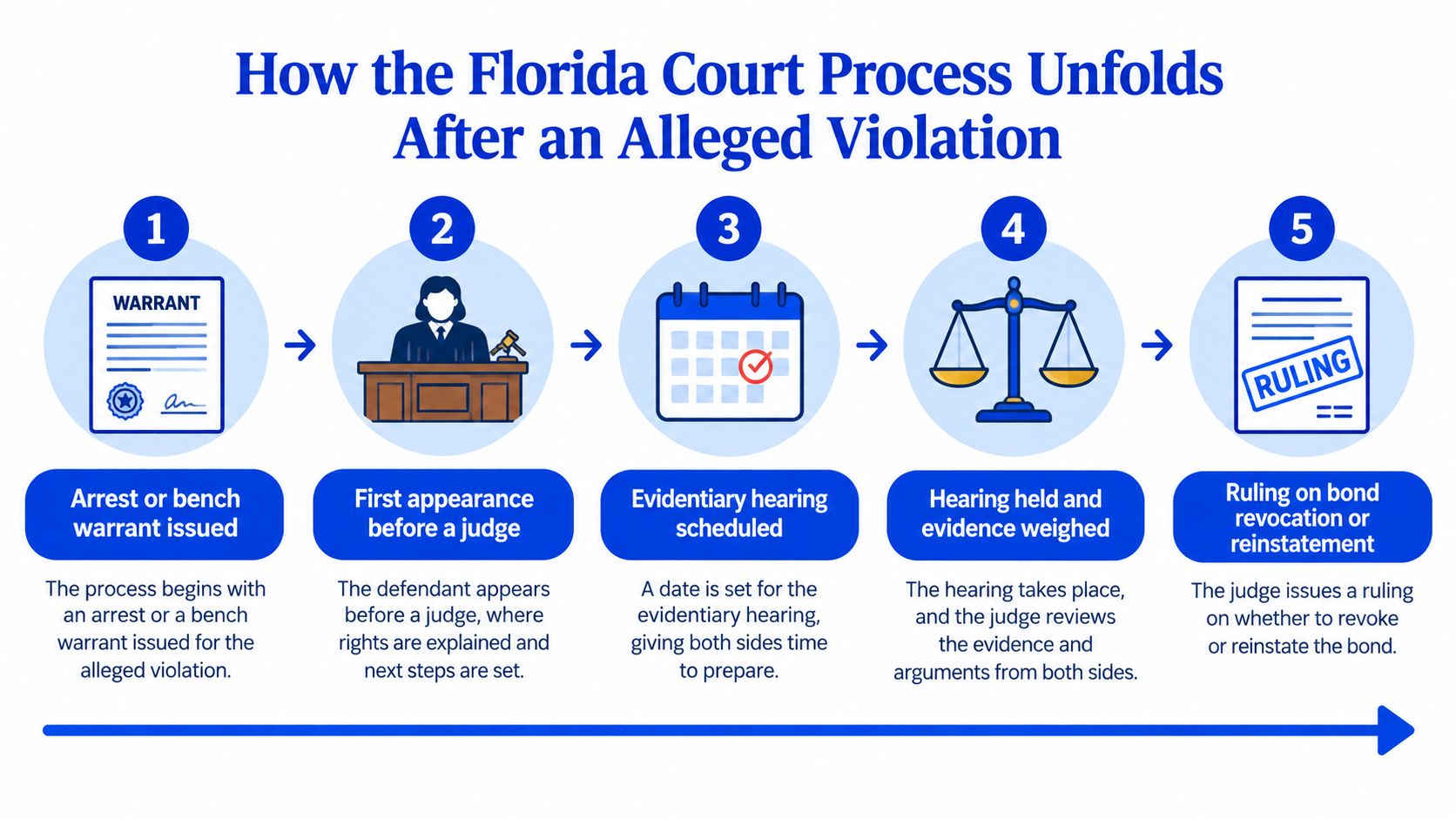
The process can move quickly. A pretrial-services officer, prosecutor, law-enforcement officer, testing provider, or protected person may report an alleged breach. The court may issue a warrant, and officers may arrest the defendant before a lawyer has investigated the claim.
At first appearance, the judge addresses custody and release. The defense should identify the alleged condition, request meaningful access to the accusation and supporting material, and argue for continued release or a prompt evidentiary hearing. The judge may leave the existing terms in place, modify them, or hold the defendant while the violation is evaluated.
The hearing is where the tripwire gets tested
Florida Rule of Criminal Procedure 3.790 governs proceedings involving revocation or modification of release in relevant circumstances. The hearing gives the defense an opportunity to challenge the alleged violation, probable cause, materiality, notice, reliability of the evidence, and the proposed consequence.
The State may present the release order, officer reports, GPS or monitoring records, test results, call records, witness statements, or evidence from a new arrest. Defense counsel should look for missing context, inaccurate timestamps, unclear instructions, chain-of-custody concerns, device error, conflicting witness accounts, and proof that the alleged conduct didn't violate the written order.
Broward, Miami-Dade, and Palm Beach courts have their own calendars, courtroom practices, and approaches to compliance reviews. A case may appear on a compliance docket, a drug-testing calendar, or a hearing calendar depending on the allegation and courthouse. Don't assume a routine-sounding setting makes the hearing low-risk.
Witnesses also need prompt attention. Employers, counselors, treatment providers, relatives, and transportation witnesses may remember the relevant facts now but lose records or details later. Counsel should preserve attendance logs, work schedules, treatment documentation, communications, and testimony before the State's version becomes the only organized account.
A practical explanation of a bond modification hearing can help families understand why the court may change conditions even when it doesn't fully revoke release.
Legal Consequences That Can Follow a Violation Finding
A sustained violation doesn't produce one automatic result in every Florida case. The judge may evaluate the original charge, the alleged breach, the defendant's history of compliance, the strength of the evidence, and the available way to protect court appearance and public safety.
The most severe result is full revocation, followed by pretrial detention. The court may also increase bond, add electronic monitoring, impose house arrest, require more frequent reporting, order additional testing, restrict travel, or reinstate release with a warning. A modification can preserve freedom while addressing the judge's concern, but it can also make daily life harder and create new opportunities for technical violations.
Outcome | When Usually Applied | Practical Effect |
|---|---|---|
Revocation and detention | New crime, serious material breach, or substantial safety concern | Defendant remains in custody while the case proceeds |
Increased or modified bond | Court wants added financial or supervisory assurance | Release may continue under stricter terms |
House arrest or monitoring | Court permits release but wants tighter location control | Travel, work, and daily activity become more restricted |
Added testing or reporting | Substance use or compliance problem is central | More appointments and records must be maintained |
Reinstatement with warning | Weak allegation, credible explanation, or strong compliance history | Existing release continues, but future mistakes carry greater risk |
The underlying criminal case and the violation proceeding are related but distinct. A new arrest may generate separate charges, while the release allegation can affect negotiations, credibility, and the judge's view of future compliance. Detention can also disrupt employment, treatment, housing, and family responsibilities. Immigration consequences require individualized advice because the original charge, new allegation, plea, and custody posture can each matter.
Florida's policy direction may become stricter in certain violent-crime cases. A 2026 Florida House bill, which remains proposed legislation rather than enacted law, would create additional consequences for certain willful violations, including increased consequences for a second or later violation and required custody until first appearance in some circumstances. The proposal is described in the Florida House bill record. It shouldn't be treated as current law, but it shows why the words willful, material, and violent-crime case matter.
For a broader explanation of how release amounts and conditions can operate in Florida, review the Florida bond schedule discussion, then have counsel apply it to the actual order in your case.
Defenses and Mitigation Strategies That Actually Work
The strongest defense starts with the accusation, not with an apology. Counsel should identify the exact condition, test the State's evidence, and decide whether the goal is dismissal of the allegation, continued release, or a carefully limited modification.
Four practical defense pillars
Probable-cause challenge: If the alleged violation depends on a new stop, search, arrest, or unreliable report, counsel can challenge the foundation that produced the accusation.
Lack of materiality: A technical breach may not have defeated the purpose of release. The defense can show that the incident didn't suggest flight, danger, witness interference, or deliberate defiance.
Lack of willfulness: Illness, addiction, mental-health symptoms, confusion, transportation problems, or unclear instructions can change the legal and practical meaning of the conduct. Documentation matters more than general assurances.
Substantial compliance: Work records, treatment attendance, clean tests, reporting history, and proof of stable residence can show that one alleged lapse doesn't define the defendant's compliance.
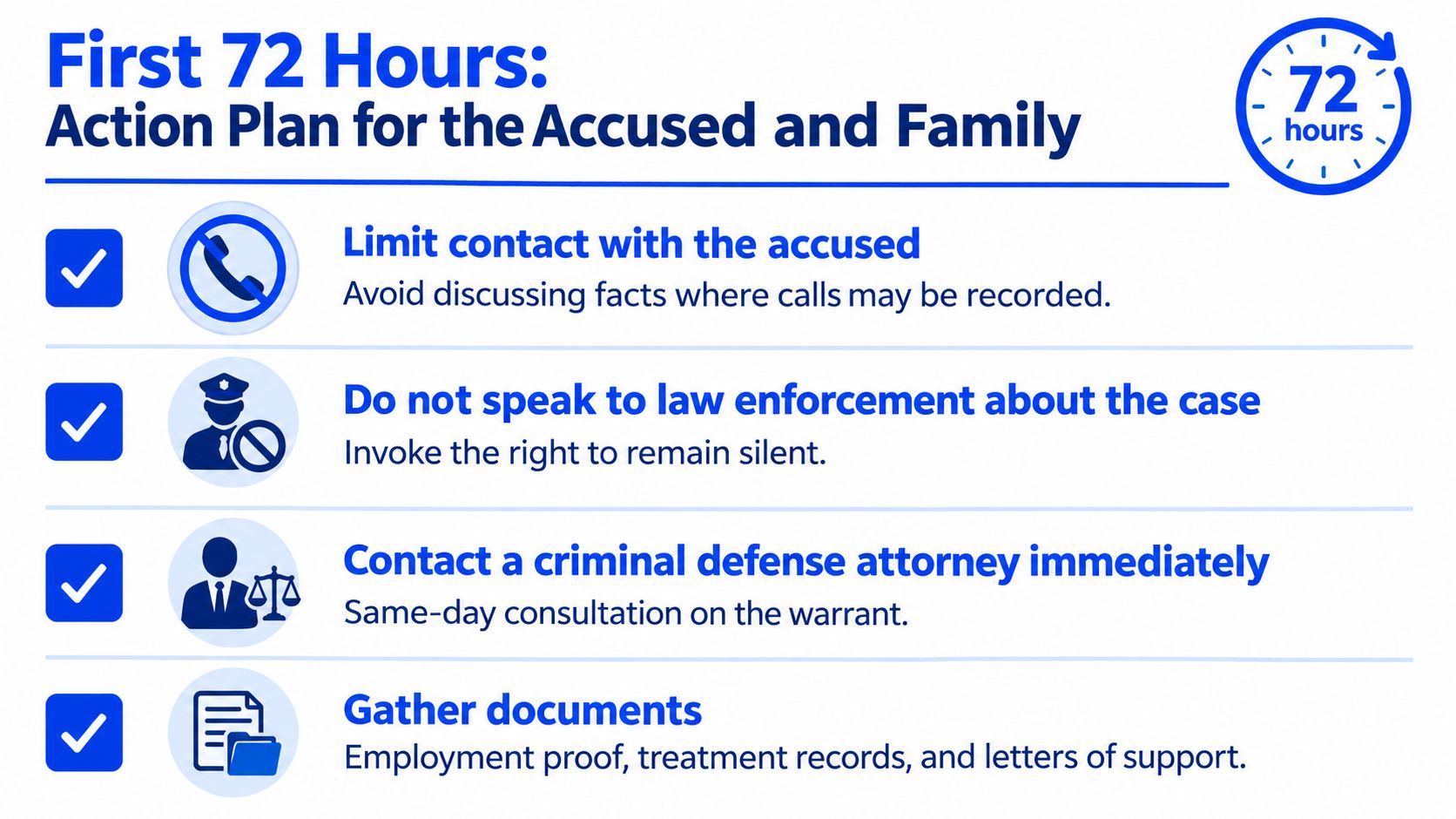
The first 72 hours should be used to build a remediation plan. That may include voluntary contact with supervision through counsel, immediate treatment enrollment, a new testing schedule, employer letters, transportation arrangements, and clean drug screens when legally and strategically appropriate. Don't submit statements or records blindly. Counsel should decide what helps, what creates new risk, and how the material should be presented.
The best mitigation package doesn't merely say, “It won't happen again.” It explains what happened, fixes the practical cause, and gives the judge a verifiable way to monitor compliance.
Immediate Steps for the Accused and Their Family
If a violation is suspected, act in this order.
Stop discussing the facts on recorded channels. Jail calls, texts, social-media posts, and family conversations may be preserved or misunderstood. Tell relatives not to contact alleged victims, witnesses, co-defendants, or law enforcement about the accusation.
Contact defense counsel immediately. A lawyer can determine whether a warrant exists, whether a recall request is possible, whether voluntary surrender makes sense, and what should be said at first appearance.
Collect the written order. Obtain every page describing testing, travel, reporting, no-contact, monitoring, curfew, treatment, and court dates. The precise language often decides whether the alleged conduct fits the condition.
Preserve compliance evidence. Save GPS logs, test receipts, appointment records, messages with pretrial services, work schedules, medical records, treatment attendance, and contact information for witnesses.
Don't surrender or seek a warrant recall alone. Both options can affect custody and the judge's perception. Counsel should assess timing, local procedure, the allegation's seriousness, and whether the State will oppose release.
Write a private timeline for your lawyer. Record dates, times, locations, instructions received, attempted check-ins, transportation problems, medical events, and communications. Don't embellish or guess.
Families should also protect employment and housing records without contacting people who may become witnesses in an uncoordinated way. Ask counsel how to preserve documents and whether a witness should provide a letter, declaration, or testimony. A calm, organized response gives the defense more options than an emotional explanation delivered after the bond has already been increased.
Why the Right Defense Lawyer Changes the Math
A pretrial-release violation hearing turns on four decisions. First, should the defense challenge probable cause or accept the factual premise and focus on mitigation? Second, does the alleged conduct amount to a material breach, or is the State trying to turn a minor technical problem into a custody case? Third, can the defense prove lack of willfulness or substantial compliance? Fourth, what bond terms address the court's concern without unnecessary detention?
Those decisions require more than reading the accusation. Counsel must understand how prosecutors frame violations, how judges evaluate supervision reports, and how local courtroom calendars operate in Broward, Miami-Dade, and Palm Beach. A lawyer with experience handling these matters from both sides of the courtroom can anticipate the State's strongest argument and prepare a response supported by records, witnesses, and a specific compliance plan.
The objective isn't to minimize a serious allegation or promise a particular result. It's to separate a new criminal threat from a technical problem, identify weaknesses in probable cause, challenge unreliable evidence, and negotiate terms that preserve freedom when detention isn't justified. Sometimes the right result is continued release. Sometimes it's a targeted modification, a prompt hearing, or a focused challenge to the allegation.
The stakes are personal. Detention can cost a job, interrupt treatment, separate a parent from children, and weaken the defense of the original case. Act before a preventable technical issue becomes the court's reason to take away your freedom.
Ticket Shield, PLLC helps Florida clients respond to alleged violations of pretrial release, including warrants, technical breaches, new allegations, and bond-modification hearings. Visit Ticket Shield, PLLC for a prompt consultation about protecting your release, challenging the accusation, and preparing for the next court appearance.