
Bond Modification Hearing in Florida Explained
Jason Goldsmith, Esq
A loved one has just been arrested in Broward County. The bond is higher than the family can manage, or release comes with a no-contact order, GPS monitoring, or another condition that makes work and family life difficult. The jail may be able to explain the current order, but it can't change it. A judge must decide whether the original terms should remain, change, or become more restrictive.
A bond modification hearing gives the defense an opportunity to present that request in court. The issue may involve the bond amount, the conditions of release, or both. The rules are procedural, the timing can matter, and a defendant's conduct after release can affect whether freedom continues.
Table of Contents
When Bail Keeps You in Jail After Arrest in Florida
The call often comes late at night. Someone has been arrested in Fort Lauderdale, Pompano Beach, Miami-Dade, Palm Beach County, or another South Florida community. The family learns that bail was set, but the amount is out of reach, or that the person remains jailed because the release conditions are too difficult to satisfy.
A family member may search for a way to bail someone out after an arrest, only to discover that paying the bond isn't the only obstacle. A no-contact order may prevent communication with a spouse or partner. A travel restriction may interfere with employment. Electronic monitoring may create additional supervision requirements. These terms can affect daily life even after a person leaves custody.
Practical point: A bond modification request isn't an informal favor to the jail. It's a court request asking an authorized judge to reconsider the release terms.
Why the first days matter
The original bond decision may have been made when the court had limited information about the defendant's residence, employment, family responsibilities, finances, criminal history, or ability to comply with supervision. A defense attorney can develop that information and present it in a form the court can evaluate.
The request might seek a lower financial condition because the defendant can't post the current amount. It might ask for a change to a release condition, such as permission to return to a residence, limited contact through an approved channel, or a different supervision arrangement. In a domestic violence, stalking, assault, or other victim-related case, the court must also consider safety and the victim's opportunity to be heard.
What this guide addresses
The central distinction is simple but important. Reducing bond amount asks the judge to change the financial requirement. Modifying bond conditions asks the judge to change the rules attached to release. A court may grant one request and deny the other.
For families dealing with a DUI, drug charge, theft allegation, violent crime, weapons case, probation violation, or another Florida criminal accusation, the hearing can affect whether the defendant remains in custody and what life looks like after release. Ticket Shield, PLLC is available around the clock for Florida criminal defense matters, with direct attorney communication and assistance evaluating urgent bond issues.
What a Bond Modification Hearing Really Is
Bail is meant to address two basic concerns before trial: whether the defendant will return to court and whether release conditions can address safety concerns. It isn't supposed to function as a pretrial conviction. The court sets terms intended to secure the defendant's appearance and manage lawful supervision while the criminal case continues.
A useful analogy is a key. The bond is part of the key that may enable release, but the court can attach instructions about how the defendant must use that freedom. A modification hearing asks whether the key's financial requirement or attached instructions should change.

Amount and conditions are different requests
A request to reduce bond amount may focus on ability to pay, lawful employment, community ties, appearance history, and the absence of evidence that a lower financial condition would create unacceptable risk. A request to modify conditions may focus on a no-contact order, GPS monitoring, travel limits, curfew, reporting obligations, or another restriction.
Those requests can overlap, but they aren't interchangeable. The Executive Office for Immigration Review's bond guidance illustrates the broader procedural distinction between redetermining bond and seeking later changes to conditions. Florida courts likewise treat the amount and conditions as separate subjects that may require different evidence.
What this hearing isn't
A bond modification hearing isn't the trial. The judge generally isn't deciding whether the defendant committed the charged offense. The hearing also isn't an arraignment, where the defendant addresses the pending charge and the case begins moving through the assigned court.
It's a focused proceeding about pretrial release. The judge may:
Lower the amount: Change the financial requirement so release becomes more attainable.
Change conditions: Adjust a restriction while keeping other terms in place.
Increase the burden: Impose stricter terms if the State presents a legally sufficient concern.
Deny the request: Leave the existing order in effect.
A motion hearing can involve many types of judicial requests. A plain-language explanation of what a motion hearing is in court can help families understand why filing a request doesn't guarantee that the judge will grant it.
Florida Law That Controls Bond Modification
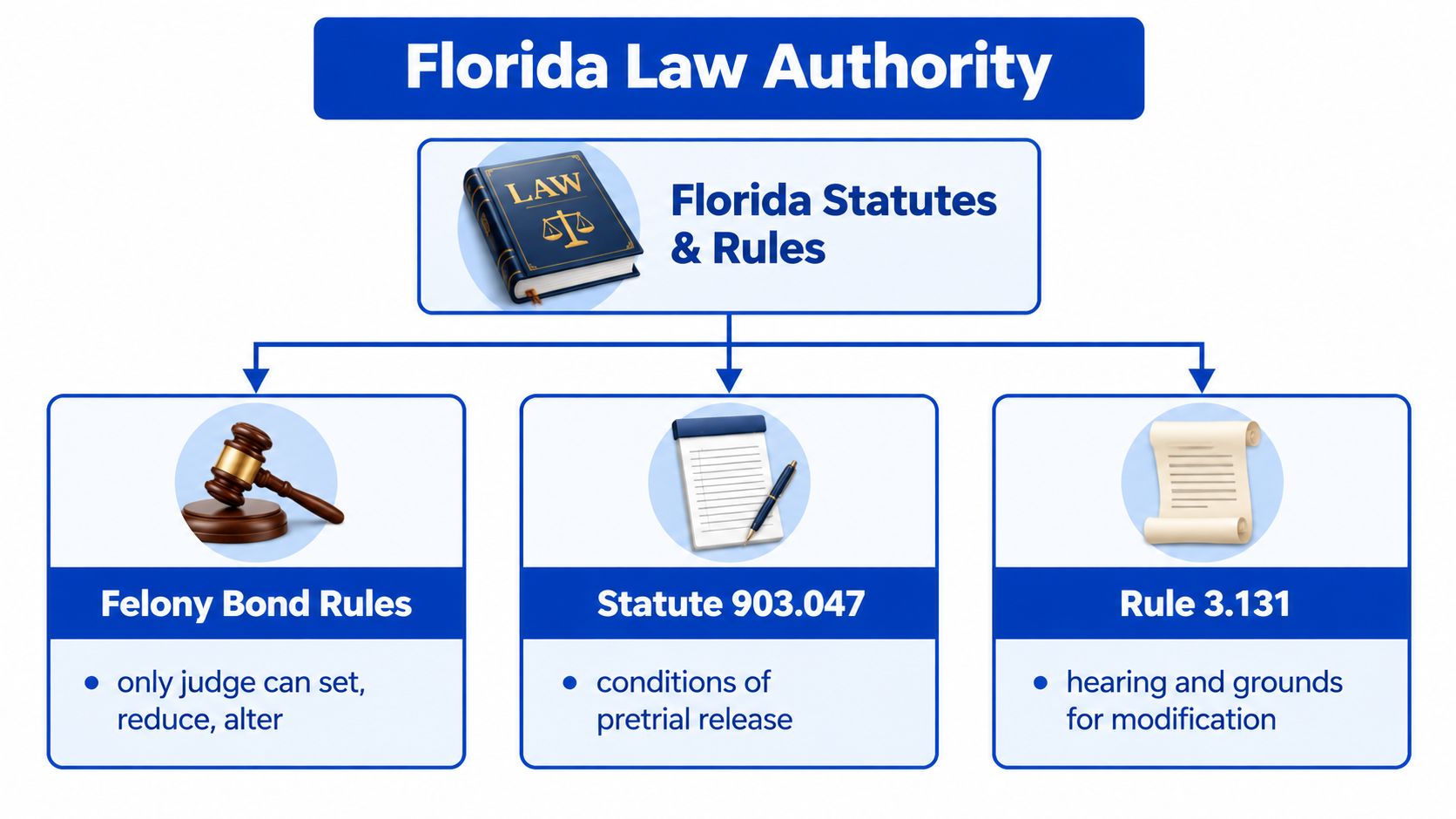
Florida law makes bond modification a judicial process. A jail employee, clerk, or pretrial services officer generally can't independently lower the amount or remove a condition from an existing release order. Unless a statutory exception applies, only a judge has authority to set, reduce, or otherwise alter bail, as reflected in Florida's bail statute.
That distinction matters when a family is searching for an immediate administrative solution. Calling the jail may clarify what paperwork or payment is required, but a request to change the court's order must be directed through the court.
Felony hearings have specific safeguards
In Florida felony practice, an application to modify bail must be heard in person with the defendant present. The State Attorney must receive at least 3 hours' notice before the hearing, according to the Florida Statutes provision governing bail hearings.
That rule creates a meaningful timing requirement. A defense lawyer can't treat a felony bond request as a paper-only filing and assume that the judge will change the order without the defendant appearing. The State must also have the required notice, giving the prosecution an opportunity to respond.
Not every judge can change every bond
Florida's rule materials and appellate authority limit which judges may modify a bond. The judge who imposed the bond, the chief judge, the assigned trial judge, or an authorized first-appearance judge may have authority to act. A judge of equal or inferior jurisdiction generally can't reduce or remove conditions unless an applicable exception permits that action, as discussed in Florida Supreme Court authority on bond modification.
The practical result is that filing in the wrong place, seeking relief from the wrong judge, or overlooking the defendant's procedural posture can delay a request. The court also has to consider the conditions of pretrial release, not the cash amount. For a plain-language overview of Florida pretrial release, families can review how release terms operate before trial.
Who Can Request a Change and How the Process Moves
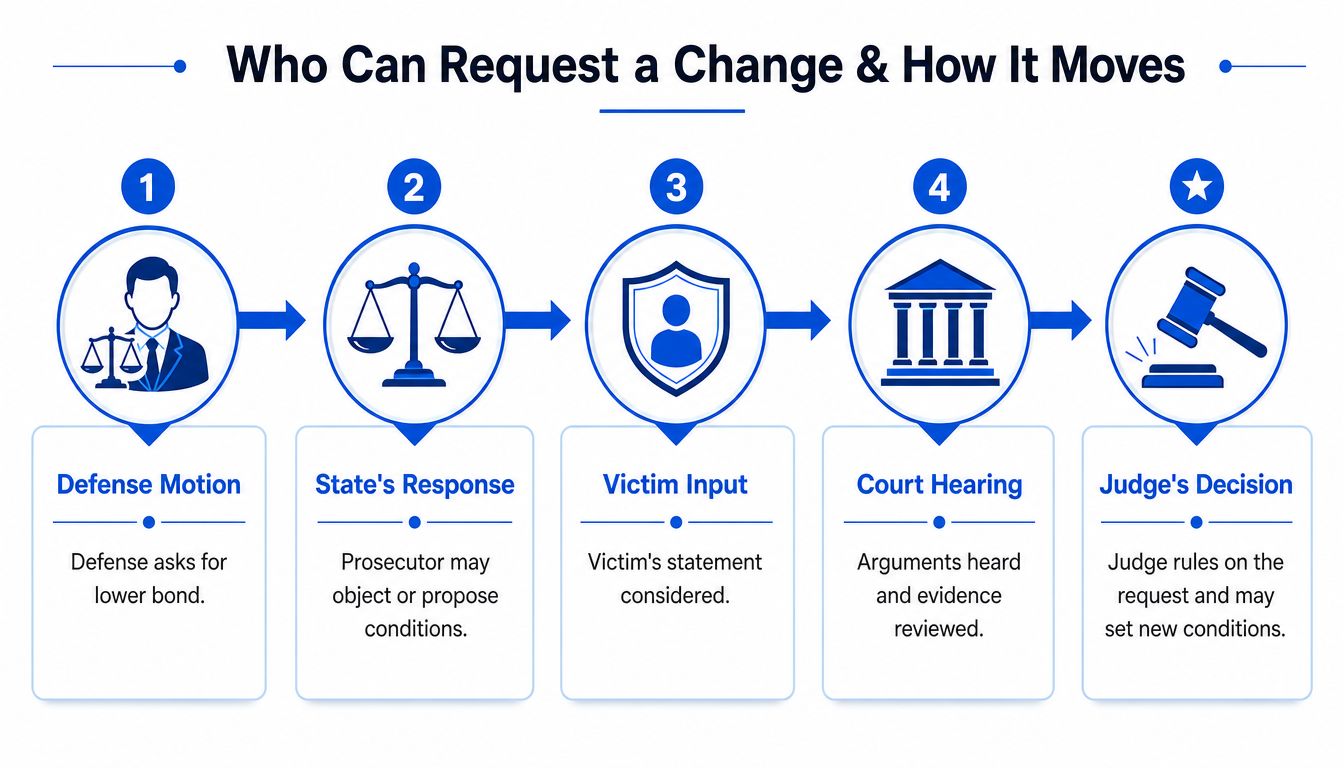
The defense commonly initiates a bond modification request, but the State may also seek a hearing when it believes a defendant violated or may violate release conditions. In victim-related cases, the victim's position can be relevant, and Florida law requires the victim to be notified and permitted to be heard when the court considers changing certain release conditions.
The process usually moves through several practical stages.
Filing the request
The defense identifies the precise relief sought. A motion might ask for a lower bond amount, removal or adjustment of GPS monitoring, a change to travel restrictions, or modification of a no-contact provision. It should explain the legal basis, the facts supporting the request, and the proposed safeguards.
A vague request creates avoidable problems. The judge needs to know what changed, why the existing term is excessive or unworkable, and how the proposed alternative addresses appearance and safety.
Notice and scheduling
The motion is filed with the appropriate clerk or court. The hearing then has to be scheduled before a judge with authority to act. In a Florida felony matter, the defendant must appear in person and the State Attorney must receive at least 3 hours' notice under the statutory framework cited above.
Local practice can affect how quickly a hearing reaches the calendar in Broward County, Fort Lauderdale, Miami-Dade, Palm Beach, and other Florida courts. Counsel should confirm the assigned division, filing procedure, hearing location, and any local requirements rather than relying on assumptions from another county.
The hearing and ruling
At the hearing, the defense presents the request and supporting evidence. The prosecutor may object, request additional safeguards, or agree to proposed terms. The judge may ask questions about housing, employment, finances, community ties, alleged conduct, and the proposed conditions.
Families can also review what happens after an arrest to understand how custody, first appearance, charging decisions, and early court proceedings can affect the timing of a bond request.
The court may permit the victim to address a proposed change to a no-contact or other victim-related condition. The judge then enters a ruling, which may reduce the amount, change conditions, increase restrictions, or deny the motion.
For additional context on courtroom procedure, this video addresses motion practice and related court concepts:
Evidence and Arguments That Actually Persuade a Judge
A judge needs more than a general statement that the bond is “too high” or that a condition is inconvenient. The strongest requests connect specific facts to a concrete release proposal. The defense should show why the proposed change addresses the court's concerns without creating an unreasonable burden.
For a bond amount reduction, useful evidence may include verified employment, stable housing, family responsibilities, financial records, prior court appearances, and a realistic explanation of how the defendant will comply with future hearings. Ability to pay can matter, but it's only part of the analysis. A defendant must also address any concern about flight or danger.
For a condition modification, the evidence should match the restriction. A work-related travel request may need an employer letter, schedule, or defined travel plan. A request involving a no-contact order requires a careful explanation of good cause and the proposed safeguards. Under Florida Rule of Criminal Procedure 3.131, a court may modify release conditions, including no-contact conditions tied to an alleged victim, when good cause exists and the interests of justice require it. The victim must be allowed to be heard.
A practical comparison
Request Type | Strong Supporting Evidence | Common Weakness to Avoid |
|---|---|---|
Lower bond amount | Proof of lawful income, stable residence, family support, and a concrete plan for appearing in court | Claiming the amount is unaffordable without showing finances or addressing safety concerns |
Change travel or work limits | Employer documentation, defined locations, and a proposed reporting or supervision plan | Asking for unrestricted travel without explaining where the defendant will go or how the court will track compliance |
Modify GPS or monitoring | Records showing compliance, a specific reason the condition is excessive, and a workable alternative | Removing equipment without a court order or treating monitoring as optional |
Change a no-contact condition | Evidence supporting good cause, a narrowly tailored request, and a safety plan | Directly contacting the alleged victim before the judge changes the order |
Respond to an alleged violation | Proof of what happened, explanation of any misunderstanding, and immediate corrective steps | Minimizing the alleged breach or blaming supervision personnel without documentation |
A person should also avoid confusing unrelated evidence with bond evidence. The reliability of physical evidence, for example, may be central to a defense involving chain of custody, but a bond request still needs focused proof about release, compliance, appearance, and safety.
Evidence matters most when it answers the judge's question: “Why is this proposed change safe, workable, and legally justified now?”
What Happens at the Hearing and What Comes Next
A bond modification hearing is usually narrower than a trial, but it can still feel intimidating. The defendant appears before the judge, the defense explains the requested change, and the State responds. The judge may ask direct questions, review documents, hear from the victim when the law permits or requires it, and decide whether the proposed terms are appropriate.
The defense should prepare the client to answer truthfully and briefly. A defendant who argues with the judge, contacts a protected person, or promises to ignore an existing restriction can damage the request. Until a new order is entered, the original conditions remain in effect.
The judge can separate money from supervision
A common misunderstanding is that a lower bond automatically restores normal life. It doesn't. The court may reduce the financial requirement while keeping a no-contact order, stay-away restriction, GPS monitoring, curfew, travel limit, or reporting obligation.
That outcome can still help a defendant leave custody, but it may not permit contact with family, access to a shared home, travel for work, or unrestricted movement. The written order controls. A defendant should obtain and follow the updated terms rather than relying on what someone remembers hearing in the courtroom.
Possible rulings
The judge may:
Grant the request: The amount or condition changes as requested.
Grant part of it: The judge lowers the bond but keeps supervision, or changes one condition while leaving others intact.
Impose different terms: The court may approve release with safeguards different from those proposed.
Deny the motion: The original order remains in place.
Increase restrictions: The judge may respond to a proven or credible compliance concern with stricter terms.
Florida administrative guidance from the 12th Judicial Circuit illustrates the seriousness of release conditions. A person released before trial must refrain from criminal activity and contact with the alleged victim except through authorized discovery, and violating those terms can expose the person to bond revocation under the court's administrative order.
If the judge grants relief, the change takes effect according to the entered order and the procedures used by the court, jail, clerk, and supervision provider. If the request is denied, counsel can evaluate whether changed circumstances, additional documentation, or another procedural remedy supports a later request. The defendant must continue following the existing order in the meantime.
How a Florida Defense Attorney Strengthens Your Request
A bond modification hearing rewards precision. The motion must identify the exact relief requested, comply with Florida's procedural requirements, reach a judge with authority to act, and give the State the notice required in felony matters. Counsel also has to present facts that address the court's real concerns rather than repeat that the defendant wants release.
A former prosecutor may anticipate the objections the State is likely to raise. Those objections can involve community safety, the seriousness of the accusation, prior compliance, alleged victim concerns, or the possibility that the defendant won't appear. A defense lawyer can prepare documents, organize witnesses, propose narrower alternatives, and challenge unsupported claims without asking the court to disregard legitimate safety issues.
The same strategy applies across criminal defense matters. A person charged with DUI may need release terms compatible with employment and transportation. Someone facing a domestic violence allegation may need advice about no-contact restrictions. A defendant accused of drug crimes, theft, a weapons offense, a violent crime, or a probation violation may need a plan that addresses both custody and supervision.
Ticket Shield, PLLC, led by former prosecutor Jason S. Goldsmith, handles Florida criminal defense matters and can help evaluate bond requests, prepare motion-hearing arguments, and communicate with clients directly by phone, text, or email. Because Florida law gives only a judge authority to alter bail, families should seek a court-based solution rather than rely on an informal request to jail staff.
Ticket Shield, PLLC offers confidential consultations for families dealing with a Florida bond modification hearing, including requests involving high bond, no-contact orders, GPS monitoring, and probation-related holds. Contact the firm promptly to discuss the current order, the evidence available, and the next lawful step toward seeking appropriate pretrial release.