
Early Termination of Probation Florida: Your 2026 Guide
Jason Goldsmith, Esq
Probation can feel like life on pause. You may be doing everything right, reporting on time, paying what the court ordered, finishing classes, and staying out of trouble, yet still dealing with travel limits, job headaches, and the stress of knowing one mistake could put you back in court.
A lot of people in Broward County, Fort Lauderdale, Miami-Dade, Palm Beach, and across South Florida assume they just have to wait it out. That's often wrong. Florida law gives many people a real path to get off supervision early, but success usually depends on more than filing a motion and hoping the judge signs it.
Building a clean, credible story that shows the court supervision has done its job is crucial. For guidance on early termination of probation in Florida, the smartest approach is to treat it like a targeted legal project, not a formality. If you need help with related criminal defense issues, review the firm's broader Florida criminal defense services.
Table of Contents
Your Path Off Probation Starts Sooner Than You Think
If you're on probation and trying to move forward, the burden usually shows up in ordinary moments. A job opportunity comes up and travel is an issue. A family event gets planned and you need permission. A simple reporting requirement starts to affect work, childcare, or transportation.
That's why early termination matters. It isn't just about convenience. It's about getting your life back under your own control when you've already shown the court you can follow rules, complete obligations, and stay compliant.
People often think judges only grant these motions in unusual cases. In practice, many strong motions come from something less dramatic. A person did what the court asked, finished what needed to be finished, and presented the request the right way.
Why this is more realistic than many people think
In Florida, probation doesn't always have to last until the final scheduled date. For many people, there's a lawful path to ask the court to end supervision early once the right benchmarks have been met.
The practical question isn't just, “Can I ask?” The better question is, “Can I show the judge there's no good reason to keep me reporting?”
Early termination requests are strongest when they read like the natural final step in a completed case, not an attempt to shortcut responsibility.
The unwritten rule most people miss
From a practitioner's perspective, judges and prosecutors usually respond better to preparation than speeches. If the record is clean, the probation officer isn't raising concerns, the money is paid, and every condition is documented, the motion starts from a much better position.
That's especially true in busy South Florida courtrooms, where a judge may only have a short time to review your file. A polished request makes it easier for the court to say yes.
Do You Qualify for Early Termination in Florida
Eligibility is the first filter. Before anyone talks strategy, narrative, or hearing presentation, the court will want to know whether you meet the basic requirements.
Florida's framework changed in a major way on October 1, 2019. For eligible probationers sentenced on or after that date, Fla. Stat. § 948.04 requires the court to either early terminate supervision or convert it to administrative probation if the statutory conditions are met, unless the court makes written findings that continued reporting is necessary to protect the community or serve the interests of justice. You can review the statute directly in the Florida Legislature's text of Fla. Stat. § 948.04.
If you're dealing with compliance concerns first, it also helps to understand the broader context of Florida probation violation defense.
The legal checklist that matters
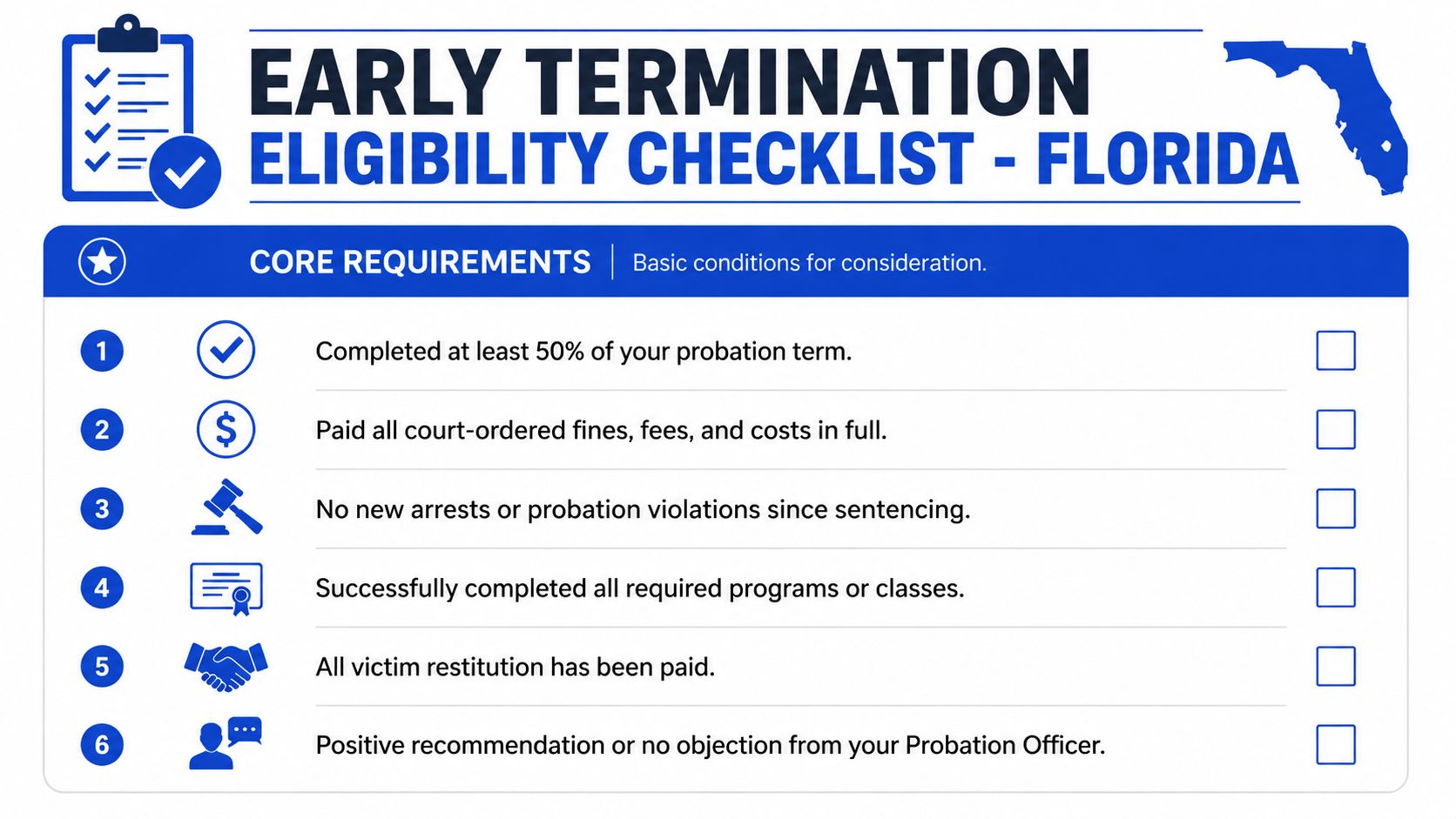
For most people searching for early termination of probation in Florida, the core checklist is straightforward:
Half the term completed. You must have completed at least half of the probation term.
All other conditions completed. Classes, counseling, treatment, community service, or other special conditions need to be finished.
No filed violation affidavit during the current term. A filed violation can block eligibility.
No negotiated exclusion. If early termination was excluded in the negotiated sentence, that matters.
Not a violent felony offender of special concern. That category is treated differently under the statute.
Here's the practical version. If anything is still open, the motion is weaker. If money is still owed, paperwork is missing, or a program is incomplete, you're usually better off fixing the problem before filing.
What eligibility does and does not guarantee
Meeting the statute puts you in the conversation. It does not automatically end probation in every case.
Judges still look at risk, accountability, and whether continued reporting serves a useful purpose. That means two people may both technically qualify, but only one presents a file that feels ready for termination.
A useful way to think about it is this:
Issue | Helps the motion | Hurts the motion |
|---|---|---|
Financial obligations | Paid in full | Balance still open |
Special conditions | Completed with proof | Incomplete or undocumented |
Supervision history | Clean and steady | Prior reporting problems |
Plea terms | No exclusion | Early termination excluded |
Practical rule: Eligibility opens the door. Preparation gets you through it.
Building a Winning Case Before You File Your Motion
Most weak motions fail before the hearing ever starts. Not because early termination was impossible, but because the filing package told the court there were loose ends, missing documents, or unanswered concerns.
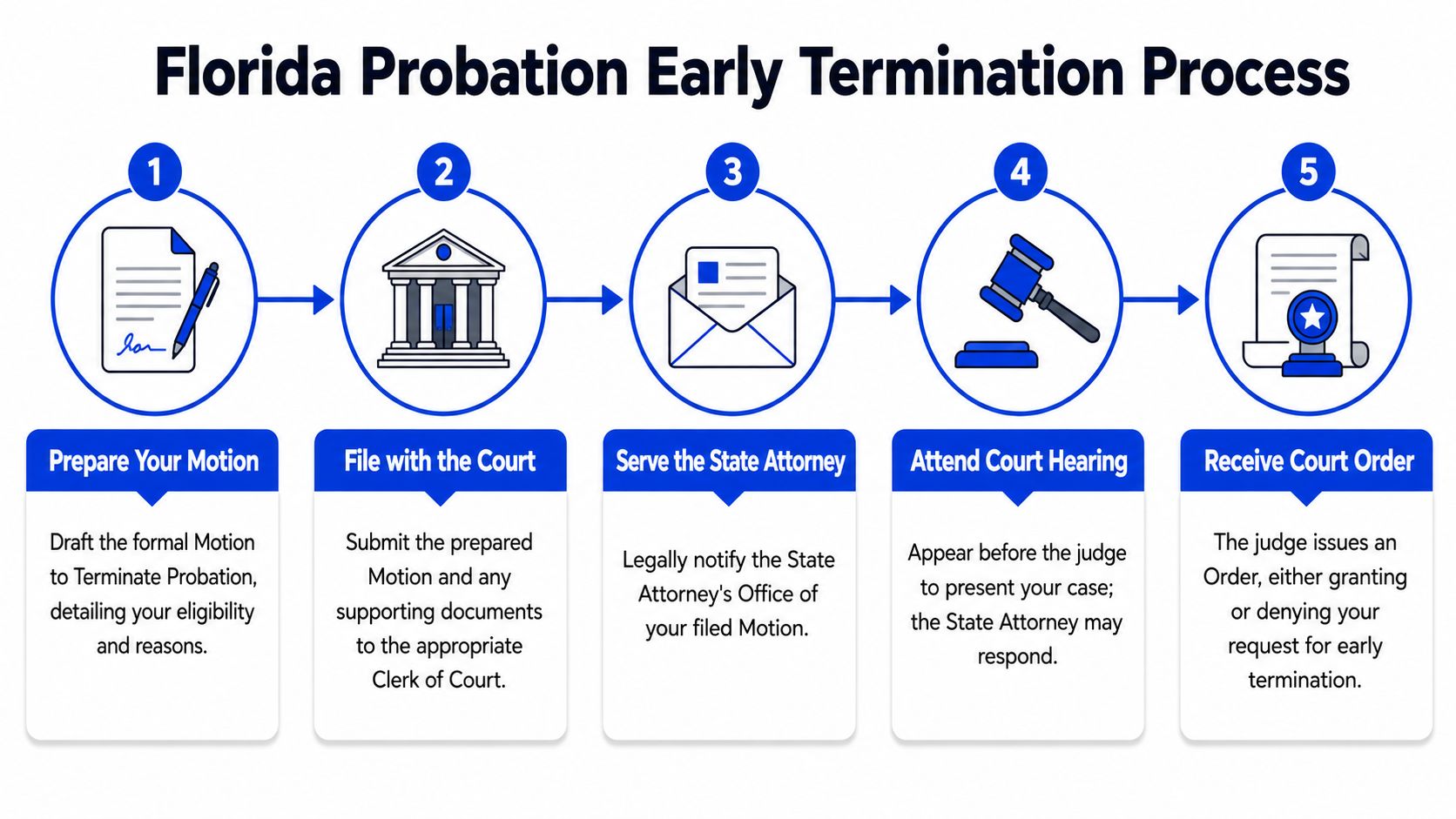
The process is highly procedural. The probationer or counsel files a Motion to Terminate Probation with the clerk, serves the State Attorney and probation officer, and attaches a proposed order. A hearing is then set unless the court rules on the papers. The common failure points are technical, including unpaid fines or restitution, any reported violation, missing service on the State or probation officer, or an incomplete packet lacking key case information or a proposed order. Florida's pro se forms also tell defendants to contact the probation officer first and bring proof of completed conditions, which reflects what judges usually care about most: clean compliance documentation. That workflow is described in this discussion of Florida early termination procedure and practice points.

If you're already worried about how a probation issue can spiral, it's worth reading about what a probation violation lawyer near you handles in practice.
What judges actually want to see
Judges rarely want drama in these hearings. They want clarity.
A strong packet tells the court, without guesswork, that the case is finished in every meaningful sense. The person followed instructions. The obligations were completed. There's nothing left to supervise except the calendar.
That's why the narrative matters. The best story is usually simple and disciplined:
Compliance was consistent. No spotty reporting, no surprise issues.
The conditions were completed early or on time. The person didn't wait until the last minute.
The request makes sense now. Work, family, stability, and rehabilitation line up with termination.
The probation officer isn't blindsided. Opposition often gets stronger when the officer learns about the motion late.
The packet should answer every obvious question
Before filing, gather proof the way a prosecutor would want to see it and a judge would want to review it.
Bring order to the file:
Proof of payment. Receipts or ledger confirmation for fines, costs, and restitution.
Completion records. Certificates for classes, counseling, treatment, or other required programs.
Service documentation. Clear proof that the State Attorney and probation officer were served.
A proposed order. Make it easy for the judge to sign if the motion is granted.
A motion should also explain why continued supervision no longer adds value. That argument works best when it's tied to documented facts, not just requests for a break.
A persuasive motion doesn't ask for mercy first. It shows the court there's no unfinished business left to supervise.
The Legal Process for Filing Your Motion to Terminate
Once the groundwork is done, the filing itself needs to be clean. In Broward County, Miami-Dade, Palm Beach, and other Florida courts, procedural mistakes can slow the case down or sink an otherwise solid request.
Early in the process, it helps to visualize the sequence.
If your situation is more complicated because there's already a compliance issue or pending allegation, review what goes into a Florida violation of probation defense.
What gets filed and where it goes
The usual filing package includes:
Motion to Terminate Probation
This should identify the case, sentence, probation term, completed conditions, and the legal basis for the request.Supporting attachments
These are the documents that prove completion, payment, and compliance.Proposed order
Judges appreciate a ready-to-sign order that states the relief requested clearly.Service on the proper parties
The State Attorney's Office and the probation officer need to receive the motion.
After filing with the clerk, the matter is either set for hearing or reviewed on the papers, depending on the judge and the case.
A short video overview can also help if you're trying to understand how these motions are typically handled in practice.
How to avoid procedural mistakes
A common point of difficulty for many self-filed motions is this. The law may allow the request, but the paperwork doesn't make it easy to grant.
Common procedural problems include:
Missing identifying details. The case number, offense, or sentencing information is incomplete.
No proposed order attached. The judge has no ready vehicle to grant the motion.
Improper service. Someone filed with the clerk but didn't properly notify the State or probation.
Unsupported claims. The motion says conditions were completed, but nothing backs that up.
Here's the practical takeaway. A filing should look finished. If the judge has to wonder whether fines are unpaid or a condition remains open, that uncertainty works against you.
Navigating the Court Hearing and Arguing Your Case
The hearing is often shorter and less dramatic than people expect. Your case gets called. The judge has the file. The prosecutor may state a position. The probation officer's view may come up directly or indirectly. Then the court decides whether supervision should end.
That simplicity can be deceptive. A short hearing puts pressure on preparation because there may be very little time to fix confusion in the room.
What the courtroom usually looks like
From the client's perspective, the hearing often turns on a few practical questions:
Has everything been completed?
Is there any reason the State objects?
Does probation oppose, support, or take no position?
Does the judge see any public safety or justice concern in ending reporting now?
If the answers are favorable, the argument doesn't need to be theatrical. It needs to be focused.
In many courtrooms, a neutral or favorable probation officer makes a real difference. Judges know probation officers have seen the reporting history up close. If the officer has no issue with termination, that often helps calm judicial concern.
How a persuasive argument is framed
The strongest argument is usually not “my client deserves a break.” It is “continued supervision no longer serves a useful purpose.”
That framing matters. It respects the sentence while showing the court the sentence has accomplished its rehabilitative function.
A good courtroom presentation usually sounds like this in substance:
The defendant completed the required conditions, paid all financial obligations, had no supervision problems during the current term, and has demonstrated stability. There is no unresolved condition that requires continued reporting.
What doesn't work as well? Excuses, vague claims of hardship, or emotional appeals unsupported by records. Judges hear those every day. A clean file carries more weight than a dramatic statement.
If the prosecutor objects, the response should stay narrow. Address the concern directly. Correct factual misunderstandings. Bring the judge back to completed conditions, clean compliance, and the absence of any real supervisory need.
Potential Outcomes and Why Early Termination Matters
A motion like this usually ends in one of three ways. The court grants it, denies it, or converts reporting probation to administrative probation when that option fits the statute and the facts.
Each result matters, but they are not equal.
Granted denied or converted
Here's the side-by-side view:
Outcome | What it means | Practical effect |
|---|---|---|
Granted | Probation ends | Reporting and supervision obligations stop |
Denied | Probation continues | You remain on the original terms unless later modified |
Converted to administrative probation | Active reporting ends, but the sentence continues in a different form | Less day-to-day supervision, but not a full discharge |
A denial isn't always the end of the road. Sometimes it means the judge wants another condition completed, wants more time to see stability, or wasn't satisfied with the way the motion was presented. In those cases, the next move is usually to fix the weakness, not to refile the same request with the same problem.
Why getting off supervision matters in the real world
This isn't just about fewer appointments.
A 2022 Florida Criminal Justice Institute report found that Florida's probation revocation rate had hovered near 48% since 2012, and 57% of revocations from 2010 to 2019 were tied to technical violations rather than new crimes. The report also said nearly one in three revocations resulted in state prison time. Those findings appear in the Florida Criminal Justice Institute revocation analysis report.
That's why early termination can be so important. Once probation ends, the risk of being violated for a technical mistake ends with it. For many people, that's the most valuable part of the process.
Probation looks manageable until one missed report, unpaid balance, or misunderstood condition turns into a violation case.
In plain terms, ending supervision early can remove ongoing risk, not just inconvenience.
Common Questions About Ending Probation Early in Florida
People usually have the same practical concerns once they learn this option exists. They want to know how long it takes, whether a felony case is harder, and whether they can do it themselves.
FAQ
Can I ask for early termination myself?
Yes, in many cases you can file on your own. The challenge isn't just filing a motion. It's making sure the packet is complete, properly served, and supported with records that answer the judge's questions.
How long does the process take?
That depends on the court, the judge's calendar, whether the State objects, and whether your paperwork is complete. Some motions move quickly. Others take longer because a hearing has to be set or missing issues need to be resolved first.
Is it harder in a felony case than a misdemeanor case?
It can be. Judges often scrutinize felony cases more carefully, especially when the original offense raises public safety concerns. Still, strong compliance and complete documentation matter in both.
Do I need my probation officer to agree?
Not always. But support, or at least no objection, can make the motion stronger. A probation officer's concerns should be addressed before the hearing if possible.
What if I still owe money?
That's one of the most common reasons motions stall. If fines, costs, or restitution remain unpaid, the court may see the case as unfinished.
What if I had a prior problem on probation?
That depends on what happened and whether it resulted in a filed violation during the current term. The details matter, and so does how the issue was resolved.
If you think you may qualify for early termination of probation in Florida, getting a case-specific review is the smartest next step. What looks like a simple motion can turn on details in the plea, payment history, probation file, or local courtroom practice.
If you're ready to pursue early termination or need help dealing with a probation issue in Broward County, Fort Lauderdale, Miami-Dade, Palm Beach, or anywhere in Florida, contact Ticket Shield, PLLC for a confidential consultation. Attorney Jason S. Goldsmith is a former prosecutor who understands how judges and prosecutors evaluate these motions, and the firm can help you build a focused strategy to seek the best possible result.
Florida law lets many people end probation early. Learn the eligibility rules and how to file a winning early termination motion.