Misdemeanor Meaning in Florida: Your 2026 Legal Guide
Jason Goldsmith, Esq
You're probably reading this after one of two moments. An officer handed you a Notice to Appear in Broward County, or someone you care about got arrested in Fort Lauderdale, Miami-Dade, Palm Beach, or another South Florida court jurisdiction. Your mind usually goes straight to the same questions. Is this serious? Am I going to jail? Will this stay on my record?
Those are the right questions.
From a former prosecutor's perspective, the most useful way to understand misdemeanor meaning isn't as a dictionary definition. It's as a practical decision point. What you do in the first days after a misdemeanor charge can affect your record, your license, your job, and the way the State handles your case.
Table of Contents
Understanding Your Florida Misdemeanor Charge
A misdemeanor is a criminal charge that's less severe than a felony, but it is still a criminal accusation. In plain English, it means the State says you broke a criminal law and can ask the court to punish you. In Florida county court, that can involve jail, probation, fines, classes, community service, no-contact orders, license consequences, and a public criminal case.
This isn't a rare corner of the system. Misdemeanors make up approximately 80% of all criminal dockets in the United States, and the system processes over 10 million minor cases annually, according to the Equal Justice Initiative's review of America's misdemeanor system. That matters because county courts in places like Broward and Miami-Dade move quickly, and people often underestimate how much is at stake.
What the charge usually feels like at first
Individuals often aren't calm when they first see the paperwork. They're worried about work, family, immigration issues, school, or a professional license. They also assume that if the charge says “misdemeanor,” the court will treat it as minor.
That's not how county court works.
Practical rule: A misdemeanor is small only if it ends the right way. A conviction can follow you much longer than the court date itself.
What to do right away
If you've been charged with a misdemeanor in South Florida, focus on the basics first:
Read every document carefully. Look for your court date, the exact charge, and any release conditions.
Don't miss court. Failing to appear creates a new problem that is often worse than the original one.
Stop talking about the facts. Don't text about the incident, don't post online, and don't try to “clear things up” with law enforcement on your own.
Preserve what helps you. Save receipts, photos, messages, call logs, witness names, and any video you can lawfully obtain.
If you were searching for the meaning of a misdemeanor because you're scared, that reaction makes sense. The better response is to treat the case early, strategically, and with a full understanding of what Florida courts can do.
Misdemeanor vs Felony The Critical Distinctions in Florida
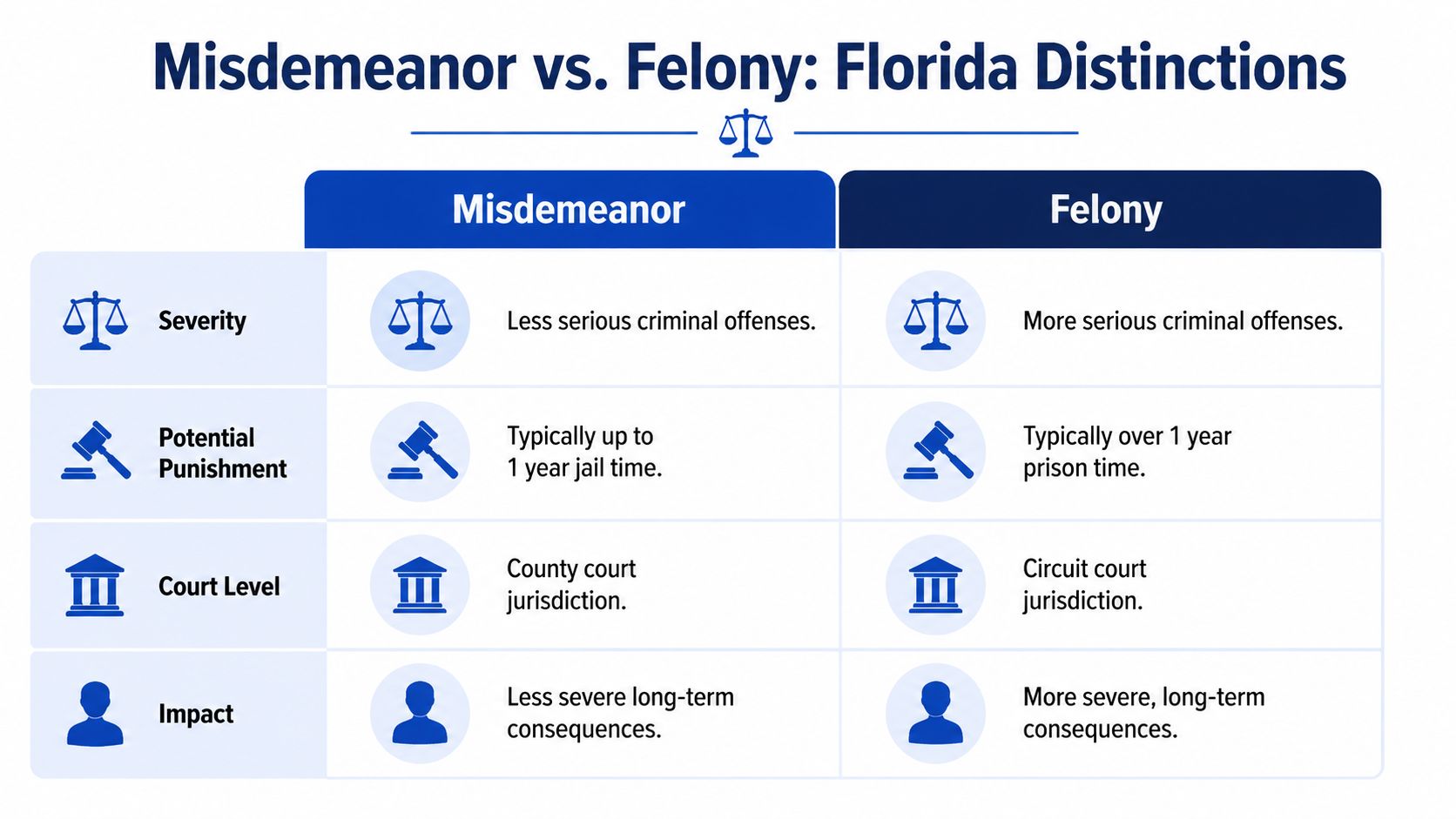
People often know that a felony is “worse” than a misdemeanor, but that doesn't give them a useful rule for their own case. The clearer way to think about it is this. A misdemeanor is serious county court exposure. A felony is higher-level criminal exposure with broader long-term consequences.
The one year rule
In criminal law, the main dividing line is the maximum authorized incarceration. An offense punishable by up to 12 months in local or county jail is a misdemeanor, while an offense punishable by more than one year is a felony, as explained by the Legal Information Institute at Cornell Law School.
That one-year rule helps answer the basic misdemeanor meaning question fast. If the statute caps the case at a year or less, you're generally in misdemeanor territory. If the potential sentence goes beyond that, you're in felony territory.
A practical comparison
A useful analogy is weather. A felony is a major hurricane. A misdemeanor is a severe tropical storm. One is plainly more destructive, but both can damage your life if you ignore the warnings.
Issue | Misdemeanor | Felony |
|---|---|---|
Maximum incarceration | Up to 1 year | More than 1 year |
Typical place of incarceration | County jail | State prison exposure may apply |
Court level in Florida | Usually county court | Usually circuit court |
Daily life impact | Can affect work, housing, licenses, and reputation | Often carries broader and more severe consequences |
How employers may view it | Still appears as a criminal matter | Usually viewed as more serious |
Two points matter here for anyone facing a DUI, theft, battery, drug, traffic, gun, probation, or domestic violence-related case in South Florida.
First, don't confuse misdemeanor with harmless. Many county court cases carry conditions that immediately affect where you can go, who you can contact, or whether you can drive.
Second, the charge level doesn't decide the defense value. Some misdemeanor cases are highly defensible because of weak witnesses, bad police procedure, unreliable identification, or search and seizure issues.
Prosecutors often evaluate misdemeanor files quickly. Defense counsel should slow the case down, test the evidence, and force the State to prove what it claims.
If you're comparing a misdemeanor to a felony, the misdemeanor is plainly the lower category. But if you're deciding whether to take the case seriously, the answer is yes.
Florida Misdemeanor Classes and Potential Penalties
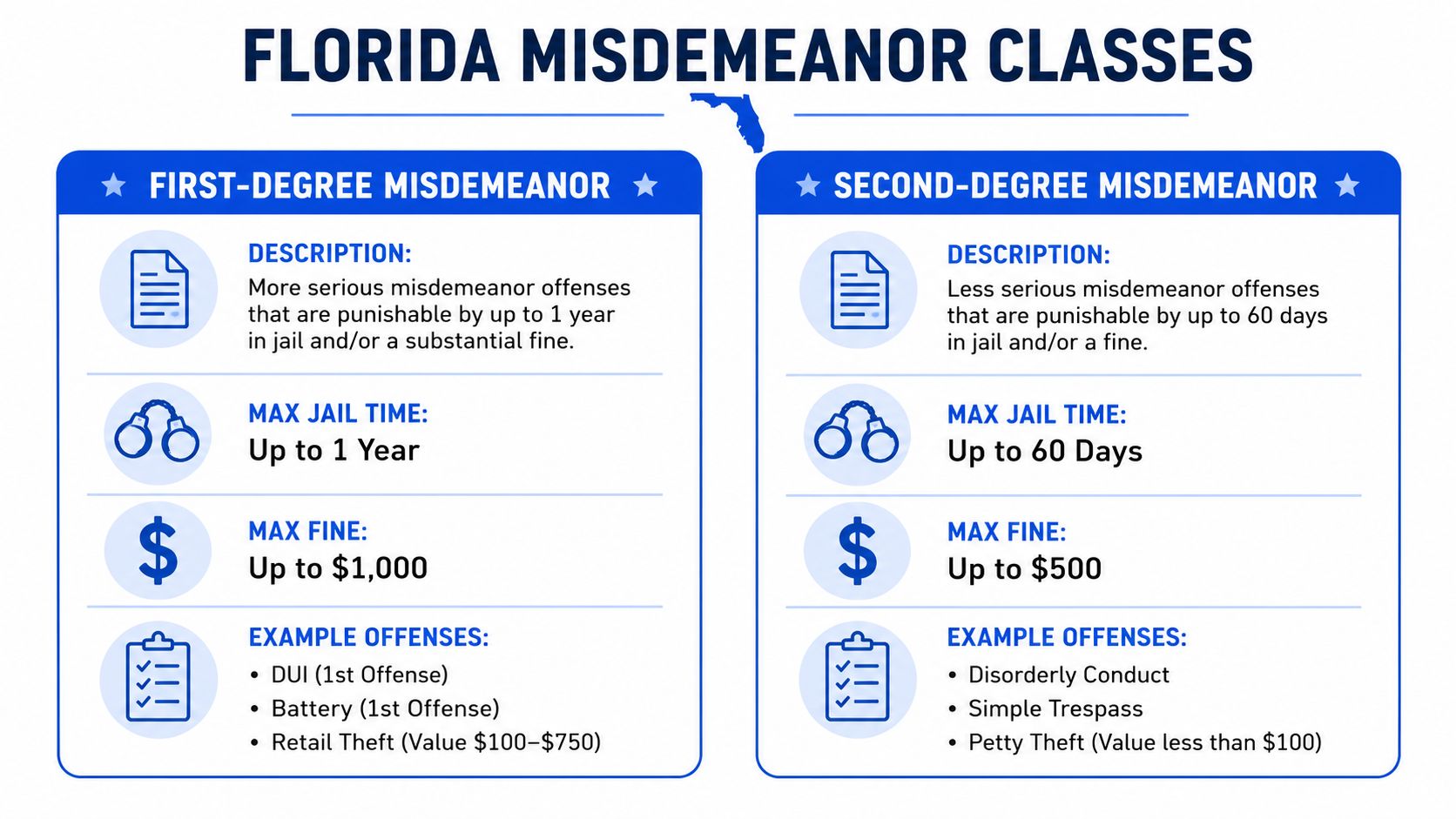
Florida divides misdemeanors into two main levels. That distinction matters because the class of the charge tells you the ceiling the court can consider, even though the final result depends on the facts, your history, and the defense strategy.
First degree misdemeanors
A first-degree misdemeanor in Florida is punishable by up to 1 year in county jail and a fine of up to $1,000, as noted in this discussion of Florida misdemeanor crimes and sentences.
That's the highest misdemeanor level in Florida. Many people are surprised by how much authority the court still has in a first-degree case. Even when jail isn't imposed, the court can still order conditions that interrupt your life in very real ways.
Common concerns in first-degree misdemeanor cases include:
Jail exposure
Probation terms
Court-ordered classes or treatment
No-contact orders
Driver's license consequences in some case types
A permanent public case history if the result is not handled carefully
Second degree misdemeanors
Florida also recognizes second-degree misdemeanors. They are the lower misdemeanor level, but they still place you in criminal court and still require a defense plan. For many clients, the mistake is assuming a lower-level charge should be pled out to “get it over with.”
That approach can backfire.
A second-degree misdemeanor may look manageable on the citation, but the critical question is whether the evidence is strong, whether the officer acted lawfully, whether the witness can be challenged, and whether a non-conviction outcome is available.
Key point: The maximum penalty tells you the outer limit of risk. It does not tell you what result is achievable with the right defense work.
If you've been charged in Broward County, Fort Lauderdale, Miami-Dade, Palm Beach, or elsewhere in South Florida, the class of the offense is one of the first things defense counsel should evaluate. It shapes negotiations, motion practice, and the way the case should be presented from the start.
Common Misdemeanor Charges in South Florida
County courts in South Florida see the same categories of misdemeanor charges over and over. The facts differ. The human problems don't. People want to know whether they can keep their record clean, avoid jail, protect a driver's license, and stop the case from spilling into work and family life.
Charges people see every week in county court
A few examples come up constantly:
DUI and traffic-related offenses. Many people searching for a Fort Lauderdale DUI lawyer are dealing with a first criminal case in their lives. They're often worried about driving, court appearances, and whether a single arrest defines them.
Petit theft. A shoplifting allegation can look minor on paper and still create serious employment and reputation problems. If you're dealing with that kind of accusation, this guide on petit theft in Florida helps explain how these cases are commonly charged and defended.
Simple battery and Florida domestic violence defense issues. An argument at home, in a parking lot, or outside a bar can produce a battery charge quickly. In domestic settings, the court may impose immediate no-contact conditions that affect living arrangements and parenting.
Drug possession allegations. A person looking for a Broward County drug crime attorney often starts with a misdemeanor possession concern and then realizes the case may also involve search and seizure questions.
Disorderly conduct and related public-order offenses. These cases often turn on officer observations, witness accounts, and whether the report really matches the available evidence.
Why the label alone doesn't tell the whole story
The charge title doesn't answer the hard question, which is how defensible the case is.
A misdemeanor DUI may involve issues with the traffic stop, roadside exercises, or the way evidence was collected. A theft charge may hinge on intent. A battery case may rise or fall on credibility, injuries, self-defense, or whether the alleged victim wants to proceed. A drug case may become a search issue before it becomes a possession issue.
That's why experienced defense lawyers don't begin with “How bad is this charge?” They begin with “What can the State prove, and what legal weaknesses can be used to protect the client?”
Navigating the Criminal Court Process in Florida
Often, the court process is the most unsettling part of a misdemeanor charge. The paperwork uses unfamiliar terms. Hearings happen quickly. The State appears organized while you feel behind.
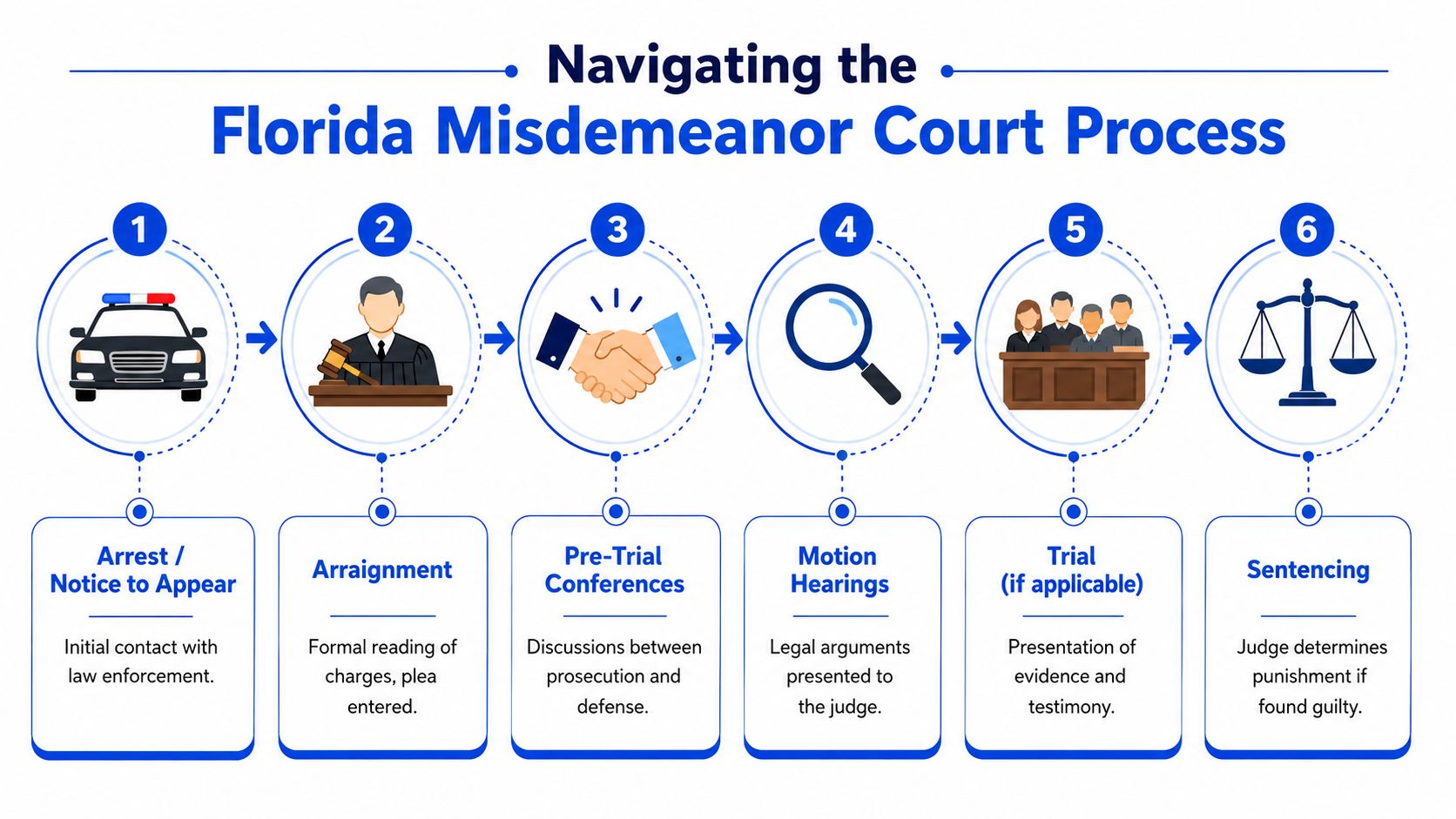
This is the basic path most misdemeanor cases follow in Florida.
What happens first
A case usually starts with an arrest or a Notice to Appear. Either way, you receive a court date and a formal allegation. If conditions were imposed at release, follow them exactly. In domestic violence and injunction-related cases, that can include strict no-contact terms.
Here is the general sequence:
Arrest or Notice to Appear
This is the start of the case, not the end of it. What you say and do after this point matters.Arraignment
During arraignment, the charge is formally addressed and a plea is entered. For a closer look at that hearing, review this explanation of what happens at arraignment in Florida.
Here is a visual overview of the process many county court defendants face:
Pre-trial conferences
These hearings are often where negotiations, evidence review, and strategic positioning happen.
Where cases are often won or improved
Many people think the case is decided at arraignment. It usually isn't. Much of the work often happens after the initial hearing, once defense counsel has the reports, videos, witness statements, testing records, and body camera footage.
At that stage, a lawyer may:
Challenge the stop or search. Search and seizure issues can change the entire case.
Test witness reliability. A shaky witness may look strong only on paper.
Push for diversion or a reduction. In the right case, early advocacy can improve options.
Set hearings on motions. Suppression issues and evidentiary problems can pressure the State's case.
Later, the case may go to motion hearings, trial, or resolution by agreement.
This video gives a useful general introduction to how the misdemeanor process unfolds in Florida courts:
The strongest early move is often not talking more. It's getting the evidence, reading the statute carefully, and deciding whether to fight the charge, negotiate it, or pursue a non-conviction path.
For many clients, relief starts once the process becomes concrete. Court is still serious, but it stops feeling random.
The Hidden Costs Long Term Consequences of a Conviction
The biggest misunderstanding about misdemeanor meaning is that the punishment ends when court ends. For many people, the longer penalty starts afterward.
The case may end but the record remains
A misdemeanor conviction is still a criminal conviction. While misdemeanors are considered lesser crimes, a conviction creates a permanent criminal record that generally cannot be expunged, as described in this explanation of misdemeanor classification and lasting record consequences.
That's why a quick plea can be expensive in ways the courtroom doesn't immediately show.
A conviction may affect:
Employment background checks for office work, sales, healthcare, education, finance, and government-related positions
Housing applications when landlords screen for criminal history
Professional licensing in fields where boards review criminal records
School and career planning when an applicant must disclose a criminal case
Driving and insurance concerns in traffic-related or DUI cases
Why people fight misdemeanor charges hard
Former prosecutors know something defendants often don't realize at first. In many misdemeanor files, the State has enough to charge the case but not enough to present it cleanly once the defense starts testing the facts.
That's where the stakes become practical.
A conviction for theft can follow you into retail, banking, and office hiring. A battery conviction can create severe perception problems. A DUI or drug-related result can affect driving, screening, and future opportunities. If your goal is to keep doors open, the focus is often avoiding a conviction in the first place.
For readers thinking ahead to cleanup options, this overview of record sealing in Florida is a good next step, because eligibility depends heavily on how the case ends.
A misdemeanor isn't “just a misdemeanor” when a background check turns it into the first thing an employer or landlord sees.
This is why defense strategy should be tied to your future, not just your next court date.
Your Defense Strategy Options to Protect Your Future
A good misdemeanor defense does more than react to the charge. It builds a path toward the result that best protects your record, your license, and your credibility.

What actually helps
The best strategy depends on the case type. DUI defense often centers on the stop, officer observations, and testing issues. Drug cases may turn on unlawful searches. Theft and violent crime allegations often depend on witness credibility, intent, and inconsistent statements.
Strong misdemeanor defense work commonly includes:
Evidence review. Police reports are only the start. Body camera footage, dispatch records, civilian video, and witness interviews often matter more.
Motions practice. If officers searched unlawfully or seized evidence improperly, suppression may become a central issue.
Strategic Negotiation. Prosecutors are more flexible when the defense can identify legal problems in the file.
Diversion analysis. In the right case, a pretrial diversion route can be the smartest way to avoid a conviction. If that option may fit your situation, read about the PTI program in Florida.
What usually does not help
People under stress often make the same mistakes:
Calling the alleged victim or witness to fix the case
Posting about the incident online
Assuming a first offense guarantees leniency
Taking the first plea just to end the anxiety
Waiting until the court date to think seriously about defense
Those choices can remove options that were available earlier.
From a former prosecutor's perspective, the most effective defense work is disciplined and specific. Identify what the State must prove. Test whether the officers followed the law. Look for diversion if it fits. Negotiate from facts, not fear. And if the case should be tried, prepare it that way from the beginning.
A smart defense strategy can also include planning for the end of the case. In some situations, the goal isn't only dismissal or reduction. It's also preserving eligibility for sealing or other record-protection options later.
Frequently Asked Questions About Florida Misdemeanors
Do I really need a lawyer for a misdemeanor
If the case can affect your record, freedom, license, immigration status, job prospects, or housing, legal help is worth serious consideration. Misdemeanor courts move quickly, and many defenses are strongest when raised early. That is especially true in DUI, domestic violence, theft, drug, weapons, and probation violation cases.
Could I go to jail for a first offense
Yes, jail can still be legally possible even on a first offense, depending on the charge and the facts. That doesn't mean jail is inevitable. It means you shouldn't assume a first arrest will automatically be treated lightly.
How long do prosecutors have to file or pursue a misdemeanor in Florida
The statute of limitations for a first-degree misdemeanor in Florida is 2 years from the date of the offense, and for a second-degree misdemeanor it is 1 year, according to this discussion of Florida criminal sanctions and limitation periods.
That deadline issue can matter, but it should never be guessed at. Dates, filing history, and charge level all need to be checked carefully.
How long will a misdemeanor case take
There isn't one universal timeline. Some cases resolve quickly. Others take longer because the defense needs discovery, video, witness interviews, motion hearings, or negotiations over diversion or reduced charges.
What usually helps most is acting early. Early case review gives your lawyer time to protect evidence, evaluate defenses, and decide whether the right move is contesting the charge, negotiating a better outcome, or pursuing a resolution that protects your future.
If you've been charged with a misdemeanor in Broward County, Fort Lauderdale, Miami-Dade, Palm Beach, or anywhere in South Florida, Ticket Shield, PLLC can review the facts, explain your options, and help you make a clear next move. Attorney Jason S. Goldsmith is a former prosecutor who understands how the State builds these cases and how to challenge them. Contact the firm for a confidential consultation if you need guidance on DUI, drug crimes, domestic violence, theft charges, violent crimes, gun offenses, probation violations, traffic crimes, record sealing, or related criminal defense matters.
A misdemeanor is still a criminal charge. Learn what it means in Florida, the penalties by degree, and how to protect your record.