
How to Get DUI Charges Dropped in Florida in 2026
Jason Goldsmith, Esq
A DUI arrest in South Florida is terrifying, but it is not an automatic conviction. It's absolutely possible to get a DUI charge dropped in Florida, but it doesn't happen by magic. A successful dismissal almost always comes down to an experienced attorney finding the legal cracks in the prosecution's case and prying them wide open.
Table of Contents
Can a Florida DUI Really Be Dropped?
If you've been charged with a DUI in Broward County, Miami-Dade, or Palm Beach County, you're probably feeling completely overwhelmed. People across Fort Lauderdale, Miami, and surrounding areas often worry about their license, their job, and their reputation, assuming a conviction is unavoidable once the cuffs go on. That’s a common—and costly—misconception.
The reality is, the state carries the entire burden of proof. They must prove every single element of their case against you beyond a reasonable doubt. This gives a sharp criminal defense attorney numerous opportunities to challenge their evidence and dismantle their arguments.

A skilled Fort Lauderdale DUI lawyer—especially one with a deep understanding of local court procedures—knows exactly what to look for when scrutinizing every detail of your arrest. The most successful challenges often zero in on a few key areas:
The initial traffic stop: Did the officer have a legal reason to pull you over in the first place?
Field sobriety exercises: Were the exercises administered correctly under Florida law, and were you a good candidate for them?
The breathalyzer: We always examine the machine's calibration and maintenance records. These devices are not infallible.
Procedural mistakes: Law enforcement must follow strict protocols during a DUI investigation. Any misstep can be grounds for a challenge.
One of the most powerful strategies is to attack the very foundation of the stop. If an officer cannot articulate a valid "reasonable suspicion" for pulling you over, any evidence they collected afterward—the breath test, your statements, everything—can be thrown out. Without evidence, the state's case often crumbles, leading to a dismissal.
Ultimately, the goal is to get the prosecutor to file a "nolle prosequi," a formal notice that they are dropping the charges. This is an achievable outcome when your attorney demonstrates that the state's evidence is simply too weak to stand up in a Broward County court. Understanding that an arrest is just the start of the legal process is the first, crucial step toward building a strong defense.
Challenging the Initial Traffic Stop and Arrest
Every DUI case starts somewhere, and that's usually with the flashing lights in your rearview mirror. But here’s something crucial to understand: the entire case against you can fall apart if that initial traffic stop wasn't legal. This is often the first, and most powerful, line of defense.
For an officer in Florida to pull you over, they can’t just have a hunch. They need what the law calls "reasonable suspicion"—a legitimate, fact-based reason to believe you have violated a traffic law. A minor drift within your lane usually isn't enough. However, clear violations like weaving across the centerline, running a red light, or driving with a broken taillight are classic justifications police will use.

Scrutinizing the Officer's Justification
As criminal defense attorneys, we never just take the police report at its word. The first thing we do is obtain every piece of evidence tied to that stop, especially any dashcam or body camera video. We are looking for one thing: does the video match the officer’s report?
It's surprising how often they don't line up. An officer might write that you were "weaving erratically," but the footage shows your vehicle driving straight. This isn't just a small discrepancy; it's a direct contradiction that can completely gut the prosecution's case.
This legal strategy comes from a principle called the "fruit of the poisonous tree." If the stop itself (the "tree") was illegal, then any evidence gathered because of it (the "fruit") is considered tainted and may be suppressed by the court.
How an Illegal Stop Can Lead to a Dismissal
Proving the stop was invalid is a game-changer. When we can show a judge that the officer had no legal right to pull you over, we file a specific legal challenge to get the evidence thrown out. You can learn more about how we use a Motion to Suppress evidence to dismantle the state's case.
So, what does this look like in a real South Florida courtroom?
Invalid Stop: An officer pulls you over based on an anonymous 911 call about a "drunk driver" but never personally observed you commit any traffic violation.
Valid Stop: An officer observes you speeding and then sees you drift onto the shoulder.
When a judge agrees the stop was illegal, the prosecutor's case often evaporates. Without the officer's observations, the field sobriety tests, or the breathalyzer results, they may have nothing left. At that point, they may have little choice but to drop the charges entirely.
When you're facing a DUI, it's easy to feel like the evidence is stacked against you, especially if there’s a breath, blood, or field sobriety test involved. Many people believe a high test result is an automatic conviction, but as an experienced criminal defense attorney, I can tell you that’s far from the truth.
This so-called "scientific" evidence is often the most vulnerable part of the prosecution's case. It is our job to dig in and find the flaws, because they are almost always there.
Challenging DUI Test Accuracy
Take the breathalyzer, for instance. These machines are incredibly sensitive and must be maintained and calibrated perfectly according to Florida law. If they aren't, the results are unreliable. In Florida, the rules are crystal clear: the officer must conduct a 20-minute continuous observation period before you provide a breath sample. This means they must watch you to ensure you don't burp, regurgitate, or put anything in your mouth that could contaminate the sample. Did they actually watch you for the full 20 minutes? Were their eyes on you the whole time? If not, that test result could be suppressed.
Even if the officer follows protocol, the machines themselves can be unreliable. Medical conditions like acid reflux, certain diets, or even environmental factors can create a false positive.
A blood alcohol concentration (BAC) reading over 0.08 is not an automatic conviction. It is a piece of evidence that must be proven to be accurate and legally obtained. If we can create reasonable doubt about the test, we create doubt about the state's entire case.
The same applies to Standardized Field Sobriety Tests (SFSTs), which are notoriously subjective. These are not simple tests of intoxication; they are roadside exercises designed to test balance, coordination, and the ability to follow complex instructions while you are nervous, on an uneven surface, and with police lights flashing in your eyes.
Poor performance can be attributed to many factors other than impairment, including medical conditions, age, weight, or even confusing directions from the officer. We have a whole article dedicated to this topic, and you can learn more about how you can contest the results of a Florida field sobriety test on our blog.
Blood tests also have their own strict set of rules. A crucial aspect here is the chain of custody. We must be able to track that blood sample from the moment it was drawn, to the lab, and to the person who tested it. Was it stored properly? Was it labeled correctly? Any gap or potential for contamination can make the result completely inadmissible in court.
Common Defenses Against DUI Evidence in Florida
To successfully challenge a DUI, a defense attorney will scrutinize every piece of evidence for technical and procedural errors. The table below outlines some of the most common vulnerabilities we look for.
Evidence Type | Potential Defense Strategy | Legal Justification |
|---|---|---|
Breath Test | Scrutinize calibration logs and maintenance records. Challenge the 20-minute observation period. | Florida Administrative Code requires strict machine maintenance and pre-test observation. Failure to comply can render results invalid. |
Field Sobriety Tests | Argue that poor performance was due to medical conditions, age, weight, fatigue, or environmental factors (e.g., uneven ground). | SFSTs are not definitive proof of impairment; they are subjective tests of physical ability that can be influenced by many factors other than alcohol. |
Blood Test | Investigate the chain of custody. Question the qualifications of the phlebotomist. Check for improper storage or contamination. | A broken chain of custody or improper handling of the sample creates reasonable doubt about the accuracy and integrity of the blood test result. |
All Tests | File a motion to suppress if the initial traffic stop lacked reasonable suspicion. | Evidence obtained as a result of an illegal stop (a "fruit of the poisonous tree") is inadmissible in court under the Fourth Amendment. |
Ultimately, a BAC reading over the 0.08% legal limit doesn't mean the fight is over. It's just the beginning. As legal experts often find, attorneys can successfully challenge a case by finding "sloppy records" or procedural mistakes that get the evidence thrown out. If you'd like to find additional information on how DUI cases are dismissed, there are many resources available online.
Getting a Second Chance: Florida's DUI Diversion Programs
Even if the evidence against you feels overwhelming, a DUI conviction isn't inevitable. For many people facing a first-time DUI in Florida, there's a path forward that can lead to the charges being dropped entirely. The most common option is a county-specific pretrial diversion program.
These programs, which are available for certain first-time DUIs in places like Broward County, are a valuable opportunity. Think of it as a contract with the prosecutor's office. You agree to complete a list of requirements, and in return, the state agrees to drop the case against you. This allows you to protect your record and move forward.
While every county has its own specific rules, the conditions usually involve things like:
Attending DUI school and a substance abuse evaluation.
Completing a certain number of community service hours.
Paying for the program and any associated court costs.
Sometimes, installing an Ignition Interlock Device (IID) on your car.
Staying out of trouble and not getting arrested again while in the program.
The Power of Skilled Negotiation
But what if you don't qualify for one of these programs? The fight is not over. This is where a sharp negotiation strategy becomes your most powerful weapon. An attorney who knows the local prosecutors in Broward, Miami-Dade, and Palm Beach, and understands how they build their cases, can spot weaknesses that others might miss.
By digging into the details—like a flimsy reason for the initial traffic stop or conflicting statements in the police report—a good lawyer can create leverage. This pressure often convinces a prosecutor that their case isn't as solid as they thought, opening the door to a much better deal.
One of the best possible outcomes here is getting the DUI charge reduced to what we call a "wet reckless"—a reckless driving charge that notes alcohol was involved. This is a huge win. It helps you avoid the mandatory driver's license suspension, crushing fines, and the permanent stigma of a DUI conviction on your record.
It's important to know that Florida's pretrial programs are exceptionally good. Some states require you to plead guilty before you can even enter a diversion program, which is a massive gamble. To learn more about these differences, you can read about how DUI diversion programs work in various states.
In Florida, successfully finishing a pretrial intervention (PTI) program means the state drops the charges, which is the best outcome you can ask for. To see what's typically required, take a look at our detailed guide on the PTI program in Florida.
Act Now to Protect Your Rights and License
After a DUI arrest in Florida, the clock starts ticking immediately. You're actually facing two separate legal battles at once: the criminal case in court and an administrative process with the DMV that could automatically suspend your license.
Here's the problem: you only have 10 calendar days from the moment you're arrested to challenge that automatic license suspension. This is a hard-and-fast deadline. If you miss it, you forfeit your right to fight for your driving privileges, a critical mistake we see people make far too often.
This is why you cannot afford to wait. Getting an experienced DUI lawyer involved right away is the single most important thing you can do. It allows us to immediately jump in to preserve evidence, find weaknesses in the state's case, and most importantly, protect your driver's license while we build your defense strategy.
Beyond going to a full trial, there are often two main pathways we can pursue to get you a better outcome.
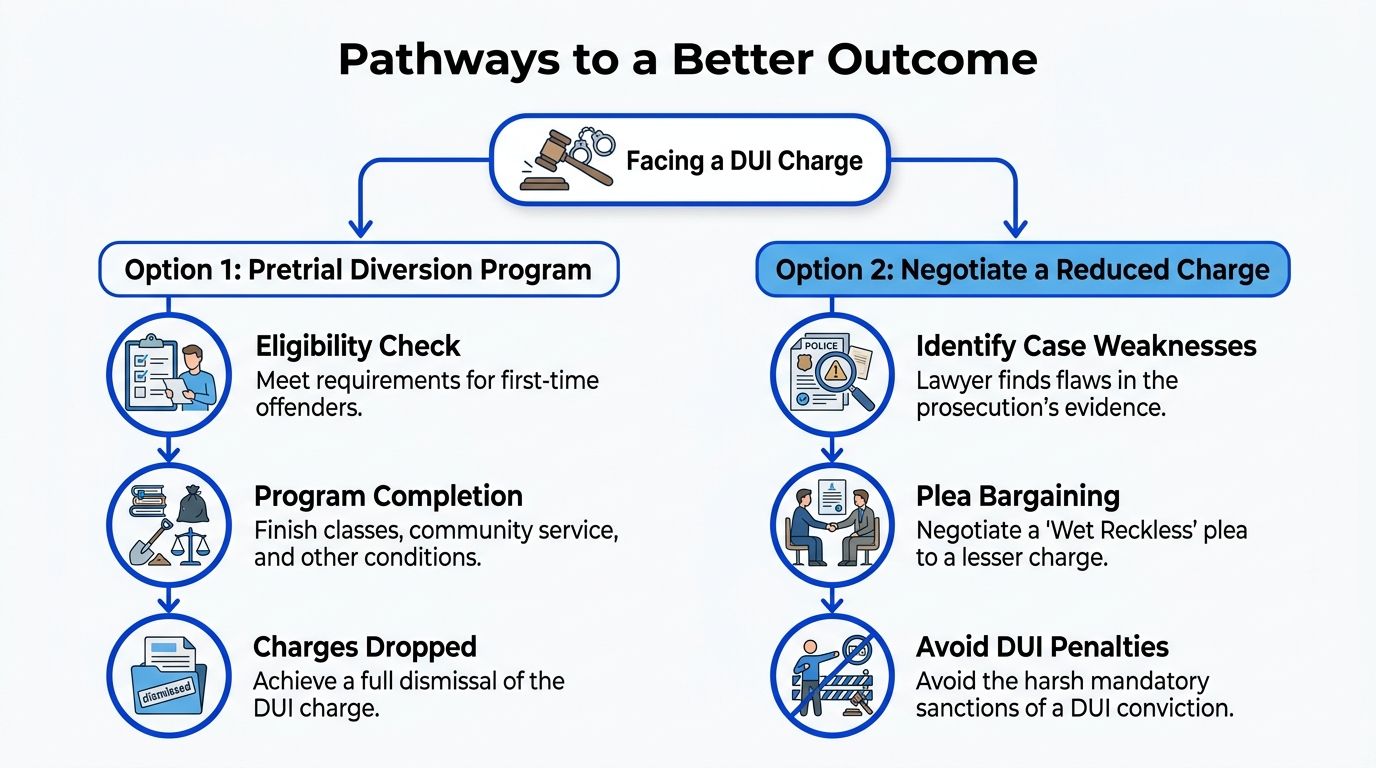
As you can see, getting into a diversion program or negotiating the charge down to something less severe, like a "wet reckless," can help you sidestep the mandatory penalties that come with a full-blown DUI conviction.
Your first phone call after being released from jail should be to a criminal defense attorney. Our team is available 24/7 to provide a free, confidential case review when you need it most. That first step is your best defense.
Frequently Asked Questions About Florida DUI Cases
If you’ve been arrested for a DUI in South Florida, your mind is probably racing with questions. Let's cut through the confusion and get you some straight answers to the most common concerns we hear every day.
What Is the 10-Day Rule for a Florida DUI?
This is one of the first and most critical deadlines you'll face. After a DUI arrest, the clock starts ticking. You have exactly 10 calendar days to request a formal review hearing with the Florida Department of Highway Safety and Motor Vehicles (DHSMV).
Why is this so important? This hearing is your one and only opportunity to challenge the automatic suspension of your driver's license. If you let that 10-day window close without acting, your license will be suspended, regardless of what happens later in your criminal case. It is absolutely essential to get an attorney involved right away to file the necessary paperwork and fight to protect your driving privileges.
Can I Get a DUI Dropped if I Refused the Breathalyzer?
It’s a common misconception that refusing the breathalyzer automatically sinks your case. Yes, a refusal triggers an administrative license suspension and the prosecution can mention your refusal in court. But think about what you’ve denied them: their single best piece of scientific evidence.
Without a specific BAC number, the state’s entire case hinges on the arresting officer's personal opinions and your performance on the field sobriety tests. A good defense attorney knows how to pick apart these subjective observations. We can argue that the officer's "clues" do not add up to proof of impairment beyond a reasonable doubt, which often forces the prosecutor's hand and opens the door for a dismissal or a favorable plea offer.
A "wet reckless" is a strategic plea bargain where a DUI is reduced to a reckless driving charge. This is a significant win because it helps you avoid the harshest mandatory penalties of a DUI conviction, like a lengthy license suspension and a permanent DUI on your record.
Is a Wet Reckless the Same as a Dismissal?
Not exactly, but both are excellent outcomes compared to a DUI conviction. A dismissal is the ideal result—the charge is dropped completely, and the case is closed. A "wet reckless," however, is a negotiated plea to a lesser charge.
While it's not a complete dismissal, securing a wet reckless is a major strategic victory. It keeps a DUI off your permanent criminal record. The penalties are significantly less harsh, and you avoid the social and professional stigma that follows a DUI conviction for years.
Navigating the legal system after a DUI arrest is incredibly complex, and your future is on the line. You need a law firm that understands Florida DUI law and is committed to protecting your rights.
Contact us for a free, confidential consultation to start building your defense today. You can learn more at mycriminaldefense.com.
Getting a DUI dropped is possible with the right strategy. Learn the proven approaches Florida defense lawyers use to win dismissals.