
Define Fugitive from Justice: A Florida Legal Guide
Jason Goldsmith, Esq
You might be reading this because you missed court in Broward County, learned there's a warrant out of Fort Lauderdale, or you're thinking about leaving Florida until things cool down. That instinct is common. It's also dangerous.
A lot of people think a fugitive is someone hiding under a fake name, crossing borders, and dodging police every day. In real life, the label can attach much faster than that. A missed hearing. A probation problem. A move out of state after learning charges may be coming. A DUI case you planned to deal with later.
If you're trying to define fugitive from justice, the most important point is simple. This isn't movie language. It's a legal status with consequences that can follow you across South Florida and across the country.
Table of Contents
A Florida Warrant Follows You Everywhere
A driver leaves Broward County after a DUI arrest and heads north for work. Months later, he's stopped for a routine traffic issue in another state. The officer runs his information, sees an active Florida warrant, and the stop changes instantly. What felt like a local court problem becomes handcuffs, jail, and a return to Florida.
That scene isn't unusual in criminal defense practice. People with theft charges, probation violations, domestic violence accusations, gun cases, or unresolved court dates often assume distance buys time. It usually does the opposite. Once a warrant is active, the problem can surface during a traffic stop, a background check, or any police contact.
Florida warrants don't stay neatly inside Broward County, Miami-Dade, or Palm Beach. They can lead to an arrest far from the courthouse where the case started. If you already have a pending case and you're trying to decide whether to stay away, that's the moment to slow down and get legal advice.
Practical rule: If you know a court date was missed or a warrant may exist, don't gamble on travel. Treat it like an emergency legal issue.
Some people make this mistake while they're out on bond or trying to sort out release conditions. If that's your situation, it helps to understand how pretrial release works in Florida, because the rules attached to your case matter long before an out-of-state arrest happens.
What Legally Defines a Fugitive From Justice
The legal definition is narrower and more technical than commonly expected. To define fugitive from justice correctly, you have to start with federal law, not slang.
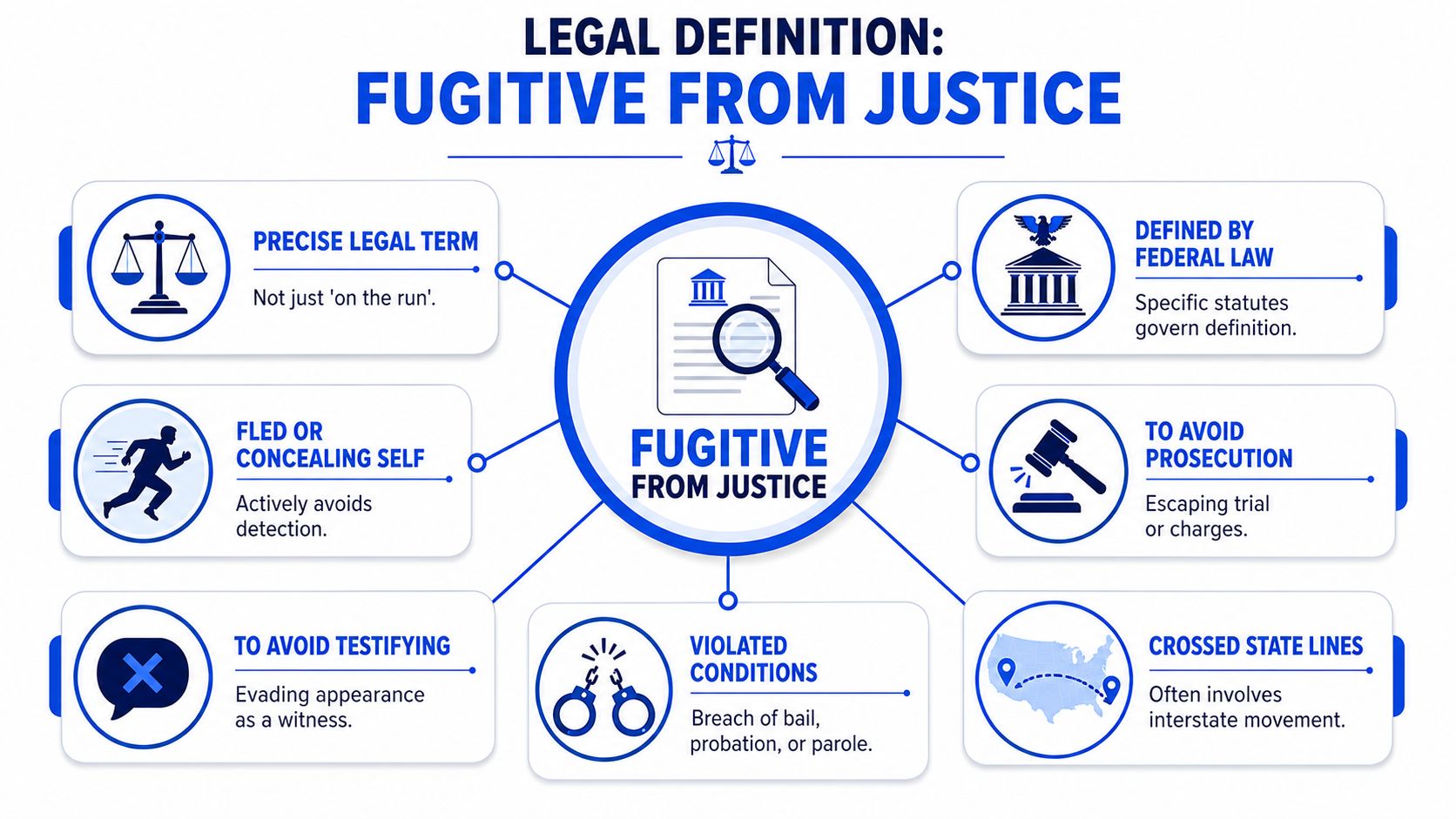
The federal definition in plain English
Under federal law, specifically 18 U.S. Code Chapter 49, a fugitive from justice is any person who moves or travels in interstate or foreign commerce with the intent to avoid prosecution, custody, or confinement after conviction for a crime punishable by death or classified as a felony under the law of the place they fled from, as described in this discussion of 18 U.S. Code Chapter 49.
In plain English, that means the law focuses on movement and intent. A person doesn't need to be living like a movie outlaw. The issue is whether the person traveled from one state to another to avoid the legal process.
A few points matter:
Crossing state lines matters. The classic federal concern is interstate flight.
Intent matters. The question is whether the person left to avoid prosecution, custody, or punishment.
It isn't limited to post-conviction cases. Fugitive status can also involve avoiding testimony or lawful process in a criminal matter.
The label can grow out of ordinary criminal cases. A Broward County theft case, a Miami-Dade drug charge, or a Palm Beach violent crime allegation can all raise fugitive issues if the person leaves and avoids court.
What the law is really looking for
Courts and law enforcement aren't just asking, "Did this person move?" They're asking a more practical question: did the person leave in a way that frustrated the criminal process?
That can include behavior people don't always recognize as flight:
Situation | Why it raises fugitive concerns |
|---|---|
Leaving Florida after learning prosecution is likely | It can look like an effort to avoid arrest or court |
Missing a scheduled hearing and staying out of state | It can show avoidance of a pending case |
Escaping custody or violating parole or probation by leaving | It can trigger a separate interstate problem |
For people searching terms like Fort Lauderdale DUI lawyer, Broward County drug crime attorney, or probation violation lawyer, confusion often starts at this stage. They think the underlying charge controls everything. It doesn't. The decision to leave can create a new layer of exposure.
Federal Laws vs Florida Fugitive Statutes
A lot of Florida clients assume there must be one single "fugitive law." There isn't. Two layers are at work at the same time.
The federal layer creates the duty for states to cooperate when someone charged in one state is found in another. Florida law supplies the step-by-step process for arrest, detention, and return. That distinction matters because confusion starts here. People often focus only on the original charge, such as DUI, theft, or a missed court date, and miss the separate interstate problem that begins once they are outside Florida.
The federal layer
Federal law sets the ground rules between states. The basic idea is simple. A person cannot avoid a Florida case by being physically present in Georgia, Texas, or anywhere else in the country.
That rule comes from the Constitution's extradition framework and related federal law. In plain English, if Florida says you are wanted and another state finds you there, that second state does not get to treat the warrant like Florida's problem alone. It has a legal duty to respond.
This is the point many people misunderstand. Leaving Florida before a warrant is issued does not automatically protect you. If charges are filed later and you are found in another state, the interstate machinery can still start.
Federal law can also create added exposure in narrower cases involving unlawful flight. That does not happen in every state case. But it is one reason a person should not treat travel as a harmless delay tactic.
The Florida layer
Florida law handles the mechanics. It governs how the warrant is entered, how a governor's warrant may be pursued, and how Florida asks another state to hold and return someone.
A Florida warrant works like a claim ticket attached to your case. The underlying charge might be local. The reach of the warrant is not. Once the case is active in the system, another state can detain you based on Florida's request while the extradition process plays out.
That is why a missed hearing in a DUI case, or a violation in a Florida probation violation case, can turn into far more than a local court problem. The issue is no longer just what happened in Broward, Miami-Dade, or Palm Beach County. The issue becomes whether another state will hold you until Florida comes to get you.
Here is the practical split:
Federal law answers why states must cooperate
Florida law controls how Florida pursues return of the person
The state where the person is found handles the local arrest and holding process
Florida remains the demanding state asking for that person's return
Clients often tell me, "I moved, so Florida has less control now." Usually, the opposite is true in practical terms. The move adds extradition risk, added jail time while waiting, and fewer chances to fix the case through counsel before an arrest happens.
How Common Actions Can Make You a Fugitive
Most fugitive cases don't begin with a dramatic escape. They begin with a bad decision made under stress.

The mistake people make before charges are filed
One of the biggest misconceptions in Florida is this: "If I leave before a warrant is issued, they can't call me a fugitive."
That belief is shaky. The Extradition Clause doesn't require the person to have been charged before leaving. What matters is that the person is later charged and found in another state, making the reason for leaving legally immaterial, according to the Constitution Annotated discussion of Article IV, Section 2.
That's the point many online guides miss. A person may leave Broward County for family, work, or panic. Later, charges are filed. If that person is then located in another state, the legal system may still treat the case as a fugitive matter.
Everyday South Florida examples
A few real-world patterns come up again and again:
The DUI example. A person arrested in Fort Lauderdale for DUI decides to move out of state and deal with it later. Under Florida Statute § 316.193, a first DUI with a BAC of 0.08% to 0.14% carries a fine of $500 to $1,000 and up to 6 months in jail, while a BAC of 0.15% or higher or the presence of a minor raises the fine to $1,000 to $2,000 and up to 9 months in jail, as summarized by this Florida DUI penalty guide. What began as a DUI defense problem can turn into a warrant problem if the court date is missed.
The probation example. A person on probation for a drug crime takes a job in another state without permission and stops reporting. That can quickly become a violation case. If you're in that position, review how probation violations are handled in Florida, because leaving first usually makes the defense harder, not easier.
The investigation example. A domestic violence suspect hears detectives want to speak with him and leaves Miami-Dade before formal filing. He later learns charges were filed while he was gone. The timing of departure may not protect him.
Here's another trap. Florida also imposes mandatory vehicle impoundment after DUI convictions: 10 days for a first conviction, 30 days for a second conviction within 5 years, and 90 days for a third conviction within 10 years, with limited hardship exceptions, according to this summary of Florida DUI impoundment rules. People worried about license issues, towing, and job loss sometimes flee instead of facing court. That reaction can multiply the damage.
Leaving Florida doesn't freeze your case. The court keeps moving, and your options often shrink.
The Fugitive Arrest and Extradition Process
You move to Georgia after missing a Florida court date for DUI. Months later, you get pulled over for a broken taillight. The officer runs your name, sees the Florida warrant, and what felt like a routine stop turns into handcuffs, a jail hold, and a court hearing in a state where your original case is not even pending. That is how extradition often begins in real life.
Florida does not need to catch up with you at home or at work. A fugitive arrest usually starts with ordinary police contact in another state, then shifts fast into a formal return process based on one basic rule: the state where you are found can hold you so Florida can seek your return.
A visual summary helps:
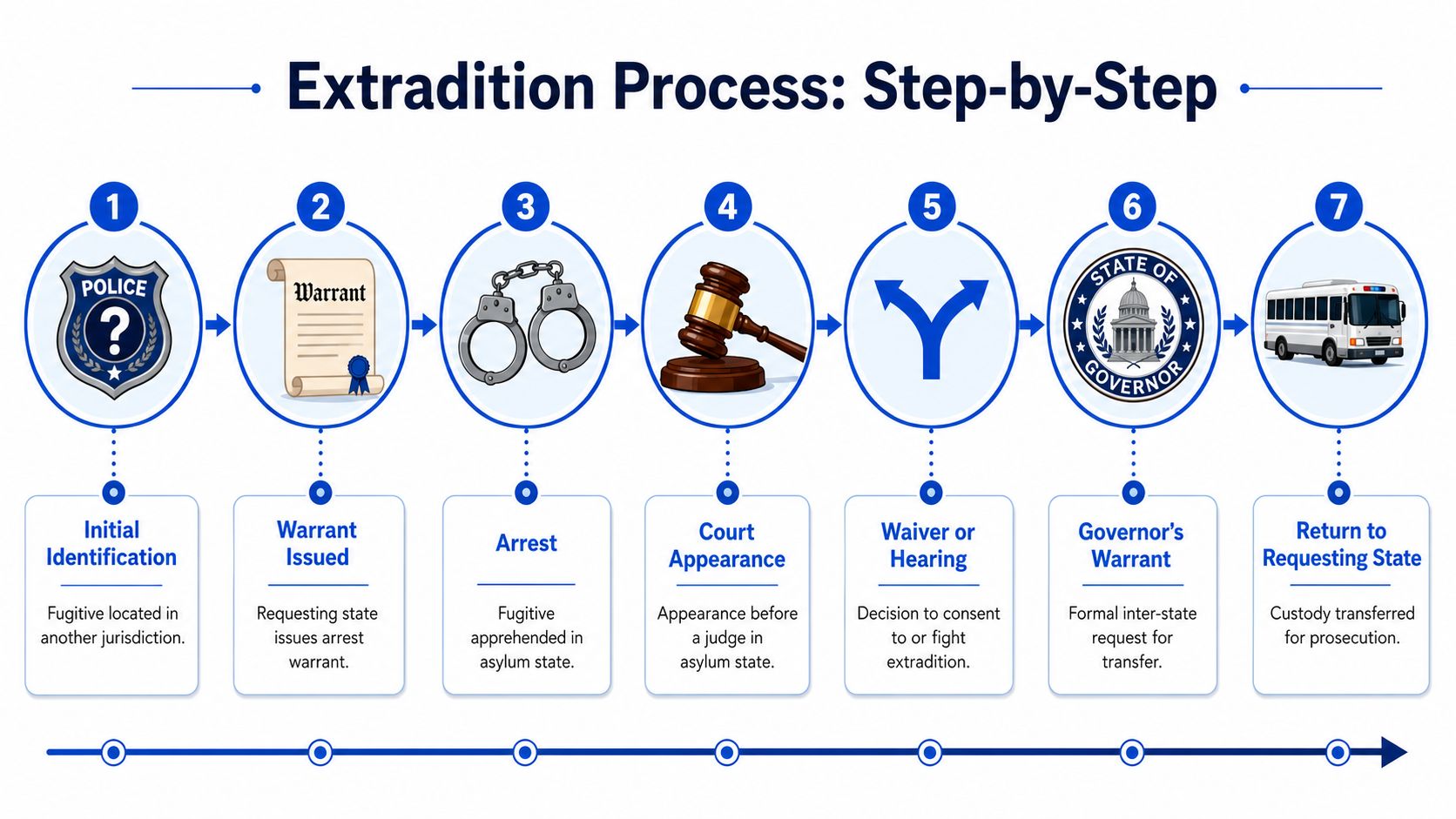
What usually happens first
The trigger is often something small. A traffic stop. A call for service. Booking on a local charge. Even an ID check can expose an active Florida warrant.
Once law enforcement confirms the warrant, the person can be arrested as a fugitive in the state where he or she is found. That state is often called the asylum state. A simple way to understand it is this: the asylum state handles the temporary custody piece, while Florida handles the case that caused the warrant.
The sequence usually looks like this:
Police confirm the warrant and identity. Name matches are not enough by themselves. Birth date, fingerprints, photos, and other identifiers matter.
The local jail books the person on fugitive status. Bond may be limited or unavailable, depending on the warrant and local rules.
The person appears before a local judge. The court generally addresses who the person is and whether Florida is requesting return.
Florida decides whether to pick the case up. If Florida pursues extradition, paperwork moves between states and transport is arranged.
This short video gives a general sense of how that legal handoff works in practice.
The decision that can change the timeline
At some point, you may be asked whether you want to waive extradition. That means agreeing to return without forcing Florida to complete every formal step.
Some people hear "waive" and assume faster is always better. Sometimes it is. Sometimes it is not. If there is an identity problem, a defect in the paperwork, or a strategy issue on the Florida side, agreeing too quickly can give up time your lawyer could have used to prepare for bond, address the warrant, or start working on the underlying case.
A few practical points often confuse people:
The out-of-state judge is not deciding guilt or innocence on the Florida charge. That hearing is usually narrow.
Identity disputes matter immediately. If the wrong person is being held, that issue needs to be raised at once.
Florida may still need time to act. Arrest does not mean transport happens the same day.
The original case is still the primary problem to solve. Extradition only decides where the case will be handled.
That last point is where many Florida clients get blindsided. They focus on the ride back, but the more important question is what is waiting once they arrive. If return to Florida is likely, it helps to understand what happens at arraignment in Florida criminal court, because the next hearing can come quickly and early choices can affect the rest of the case.
The Severe Consequences of a Fugitive Status
Fugitive status doesn't just mean "they'll make me come back." It can alter rights, create fresh criminal exposure, and damage parts of life that have nothing to do with the original allegation.
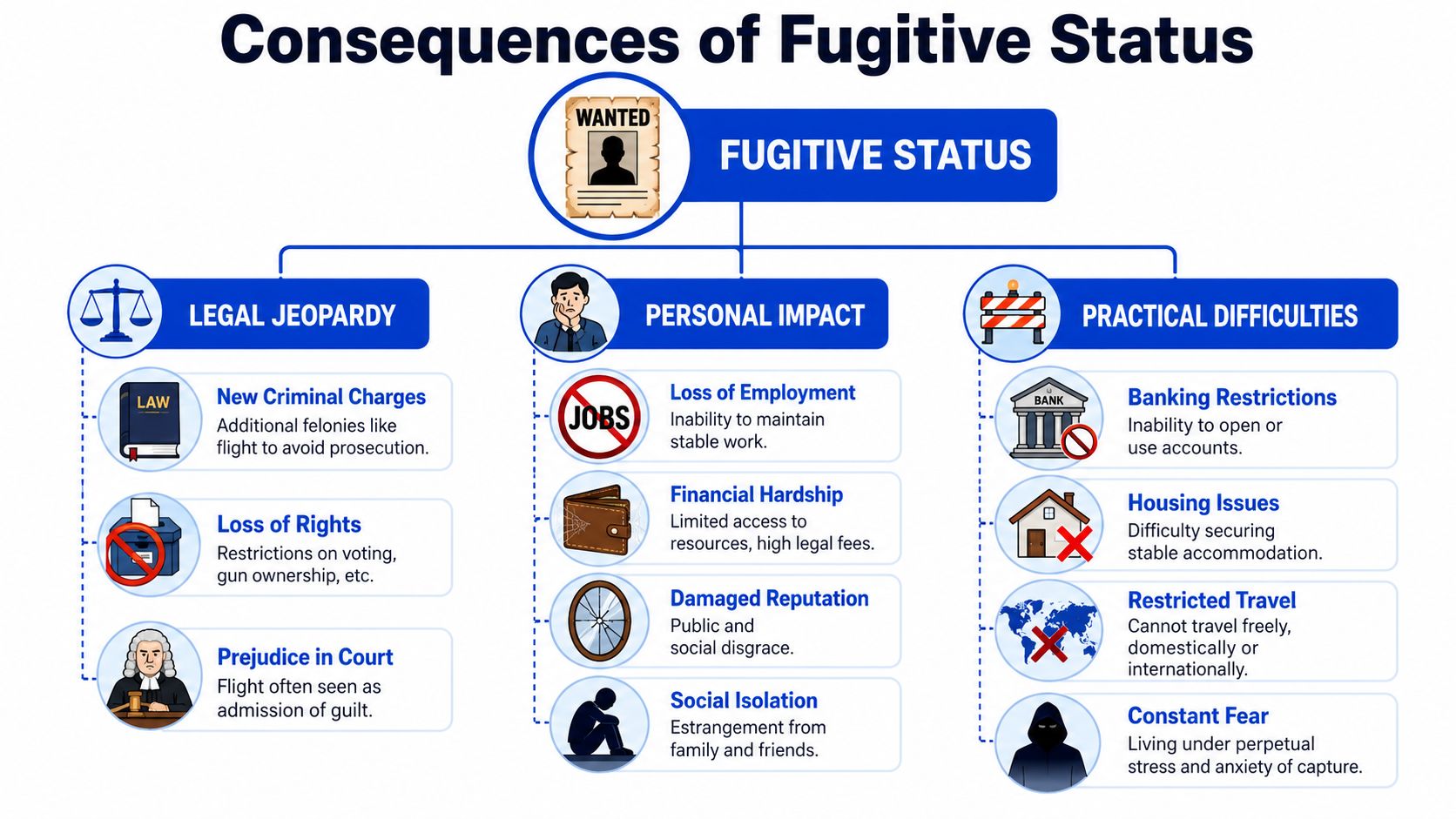
The legal damage goes beyond the original case
One of the hardest consequences is the firearm ban. Under 18 U.S.C. § 922(g)(2), a fugitive from justice can't purchase, possess, or transport a firearm or ammunition, and that prohibition applies even if the underlying charge is a misdemeanor, as explained in this discussion of the federal firearm disqualification for fugitives.
That matters for people dealing with Florida gun charge defense issues, hunting firearms, home protection concerns, or any case where a weapon is already part of the allegation. It also surprises people with misdemeanor cases who assume only felonies trigger federal firearm consequences.
Other legal effects can include:
A separate layer of criminal exposure. Flight itself can create new problems apart from the original charge.
A worse negotiating position. Prosecutors and judges may see flight as a sign the person won't return voluntarily.
Tighter release conditions. Once someone has left, courts may worry they'll do it again.
The real life fallout
Outside the courtroom, fugitive status can appear on background checks and complicate work, housing, and professional licensing. People dealing with record sealing Florida issues, theft crime penalties in Florida, or white collar allegations often underestimate how quickly an unresolved warrant spills into everyday life.
The social reality is just as serious. Travel becomes stressful. Routine police contact becomes risky. Family members live with uncertainty about when the next call will come.
When a warrant is active, waiting rarely improves the case. It usually gives the prosecution one more argument about avoidance.
Defending Against a Fugitive Warrant in Florida
A fugitive warrant is serious, but it isn't hopeless. Good defense work starts by separating panic from legal facts.
The key extradition test requires three elements: the person must have been charged or convicted of an extraditable offense in the demanding state, must have been physically present there on the date of the alleged crime, and must have voluntarily left or been forcibly removed afterward, as described in this attorney general opinion discussing the extradition threshold.
Where extradition can be challenged
That three-part test gives a defense lawyer places to look for problems.
If the identity is wrong, the case may be challenged immediately.
If the person wasn't physically present in the demanding state when the alleged offense occurred, that fact can matter.
If the charging documents or supporting paperwork are flawed, counsel may be able to attack the process.
If the warrant grew out of a missed court date, violation allegation, or old case that can be addressed directly, the best move may be solving the source of the warrant rather than fighting only the transport.
A strong lawyer also looks beyond extradition mechanics. The goal isn't just to argue about paperwork in another state. The goal is to improve the final result in the Florida case.
How strategic action helps
In many cases, the smartest move is proactive contact with the Florida court or prosecutor. That can include negotiating the terms of a surrender, seeking bond consideration, or trying to reduce the damage from a failure to appear or probation problem.
For someone facing DUI, drug crimes, domestic violence charges, juvenile crimes, sex crimes, traffic crimes, or federal crimes in South Florida, strategy matters more than speed. The person who acts early often has more room to work with than the person arrested unexpectedly in another state.
If you're trying to resolve the warrant before it escalates, review the firm's Florida criminal defense services and get advice tied to the exact county, judge, and charge involved.
Frequently Asked Questions About Fugitive Warrants
Does leaving Florida before a warrant is issued make me safe
No. As discussed earlier, leaving before formal charges doesn't automatically shield you. A person can still be treated as a fugitive if charges are later filed and the person is found in another state.
Can a DUI case really lead to fugitive problems
Yes. A DUI case can lead to a missed court date, an active warrant, and then an out-of-state arrest. That's one reason people searching for a Fort Lauderdale DUI lawyer should take every notice and hearing date seriously.
Is a fugitive from justice only someone charged with a felony
Not always in the way people assume. The term is used in several legal contexts, and some consequences tied to fugitive status can apply even when the underlying case is a misdemeanor. That's one reason people shouldn't rely on casual advice from friends or internet forums.
Will the other state decide whether I'm guilty of the Florida charge
No. The extradition process usually focuses on identity, warrant status, and whether the legal requirements for return are met. The underlying criminal charge is handled back in Florida court.
Can I be arrested during a normal traffic stop
Yes. That's one of the most common ways warrants surface. A broken taillight or speeding stop can expose a Broward County or Miami-Dade warrant immediately.
What if I left because of work or family, not to run
That explanation may matter in how a lawyer presents your situation, but it doesn't automatically prevent fugitive treatment. The legal analysis can be stricter than people expect.
Should I wait to see if Florida really pursues me
That's a risky approach. Waiting can lead to arrest at the worst possible time, often far from home, family, and your preferred lawyer. Early action usually gives the defense more control.
What's the first smart step
Confirm whether a warrant exists and speak with a criminal defense attorney before traveling, surrendering, or speaking to law enforcement about the case. That advice applies whether the issue involves DUI, theft, gun charges, probation violations, or another Florida criminal matter.
If you're worried that a Broward County, Fort Lauderdale, Miami-Dade, or Palm Beach case has turned into a fugitive warrant, contact Ticket Shield, PLLC for a confidential consultation. Early action can help you protect your rights, address the underlying warrant strategically, and avoid making a stressful situation worse.
An out-of-state warrant can make you a fugitive from justice in Florida. Learn what that means and how to resolve it before an arrest.