
Out of County Warrant in Florida What Happens Next
Jason Goldsmith, Esq
You're driving through Broward County after a routine traffic stop in Fort Lauderdale when the officer returns with unexpected news: a Florida court in another county has issued a warrant in your name. You may not know the case number, the original charge, or whether the issuing county still wants to pursue the matter. You only know that you're no longer free to leave.
That situation creates real stress, but an out of county warrant in Florida doesn't automatically mean the same thing as interstate extradition, an immediate trip to another jail, or a permanent loss of your freedom. The details matter. The charge, the warrant's status, the county where you're arrested, bail eligibility, and the issuing court's willingness to arrange transport can all affect what happens next.
This guide explains the process in plain English, including how Florida county-to-county holds work, when a judge in the arresting county may set bail, why a person might remain detained while another county arranges transport, and how proactive legal planning can reduce surprises in Broward County, Miami-Dade, Palm Beach, Fort Lauderdale, and other South Florida courts.
Table of Contents
Introduction Why an Out of County Warrant Feels Urgent
A warrant often appears at the worst possible time. You may be pulled over for an unrelated traffic issue on I-95, stopped at a courthouse, or booked after another allegation. The officer runs your information, confirms an active warrant from a different Florida county, and tells you that you're being detained.
The confusion usually starts with simple questions. What did I supposedly do? Why didn't anyone contact me? How long will I be held in Broward County? Will I be sent to the county that issued the warrant? Can I post bail locally?
Those questions have different answers depending on the warrant and the underlying case. An old failure-to-appear warrant may require a different response from a felony arrest warrant. A misdemeanor warrant may result in a local hold while officials decide whether transport is worthwhile. A serious felony warrant may receive broader law-enforcement attention and may be entered into a national information system.
Florida county practice treats these matters as an active custody issue, not merely a clerical problem. Sheriff's offices describe warrant units as operating continuously to confirm active warrants for local and out-of-state agencies, and Orange County has reported approximately 21,158 active warrants, with roughly 1,300 to 1,500 new warrants entered each month and 600 to 700 served each month. Those figures appear in the Florida warrant and law-enforcement records reference, and they illustrate why an unresolved warrant can surface long after the original court date.
You still have options. A defense lawyer can help confirm the warrant, identify the issuing court, evaluate bail eligibility, communicate with the clerk or prosecutor, and plan a surrender or custody strategy. The objective is to replace uncertainty with a lawful plan that protects your rights, license, record, and ability to return home.
What an Out of County Warrant Means in Florida
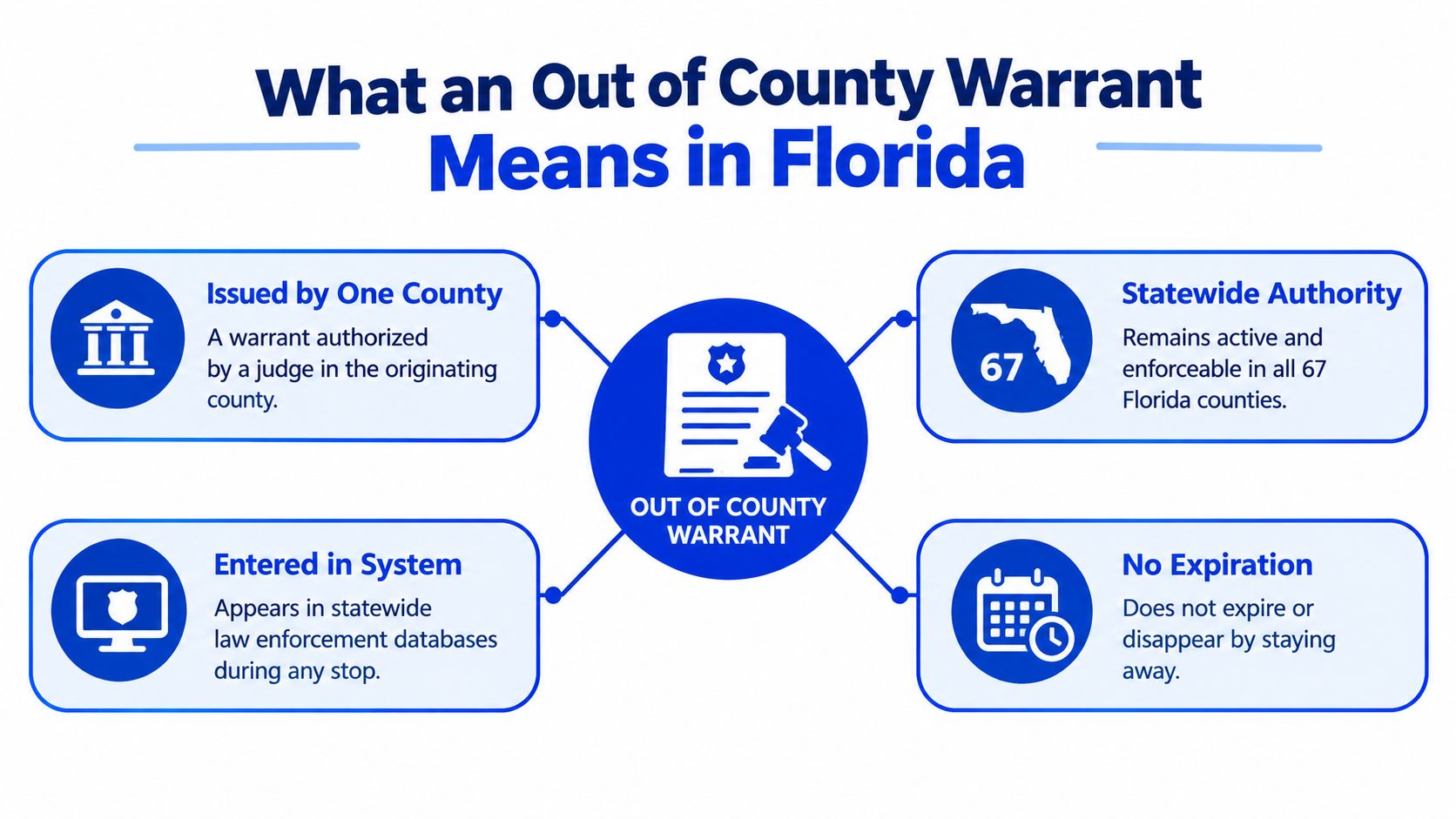
An out of county warrant is generally a warrant issued by one county that can be enforced when law enforcement finds you in another county within the same state. It isn't a new criminal charge created merely because you crossed a county line. The underlying case remains tied to the issuing county, while the arrest may occur wherever officers confirm the warrant.
The warrant follows the case
Moving from Palm Beach County to Broward County doesn't cancel a warrant issued in another Florida court. The warrant typically remains active until an authorized court recalls it, officers serve it, or the underlying case is otherwise resolved. There's no inherent expiration just because time passes or you live somewhere else.
That distinction matters for people who assume an old ticket, probation matter, theft allegation, drug case, or missed court appearance has disappeared. A person may not receive another notice before the warrant is discovered. A routine traffic stop in Fort Lauderdale or a visit to a South Florida courthouse can bring the issue to the surface.
Why county lines don't provide protection
Florida law treats an out-of-county arrest as a cross-county execution problem. The arresting agency may contact the issuing county, confirm the warrant, process the booking, and place a hold while officials determine the next step. You can be detained locally even though the original court is elsewhere.
The system also connects local warrants with broader law-enforcement databases. Florida felony warrants are commonly entered into the National Crime Information Center, or NCIC, so officers in other jurisdictions may see and act on them. The historical development of warrant-sharing and extradition systems is discussed in the national criminal justice database record.
If you're trying to understand whether an arrest warrant differs from a bench warrant, or how probable cause affects warrant validity, review this explanation of probable cause for an arrest warrant. The important practical point is simple: being outside the issuing county usually doesn't make an active warrant inactive.
What Happens If You Are Arrested in Another County
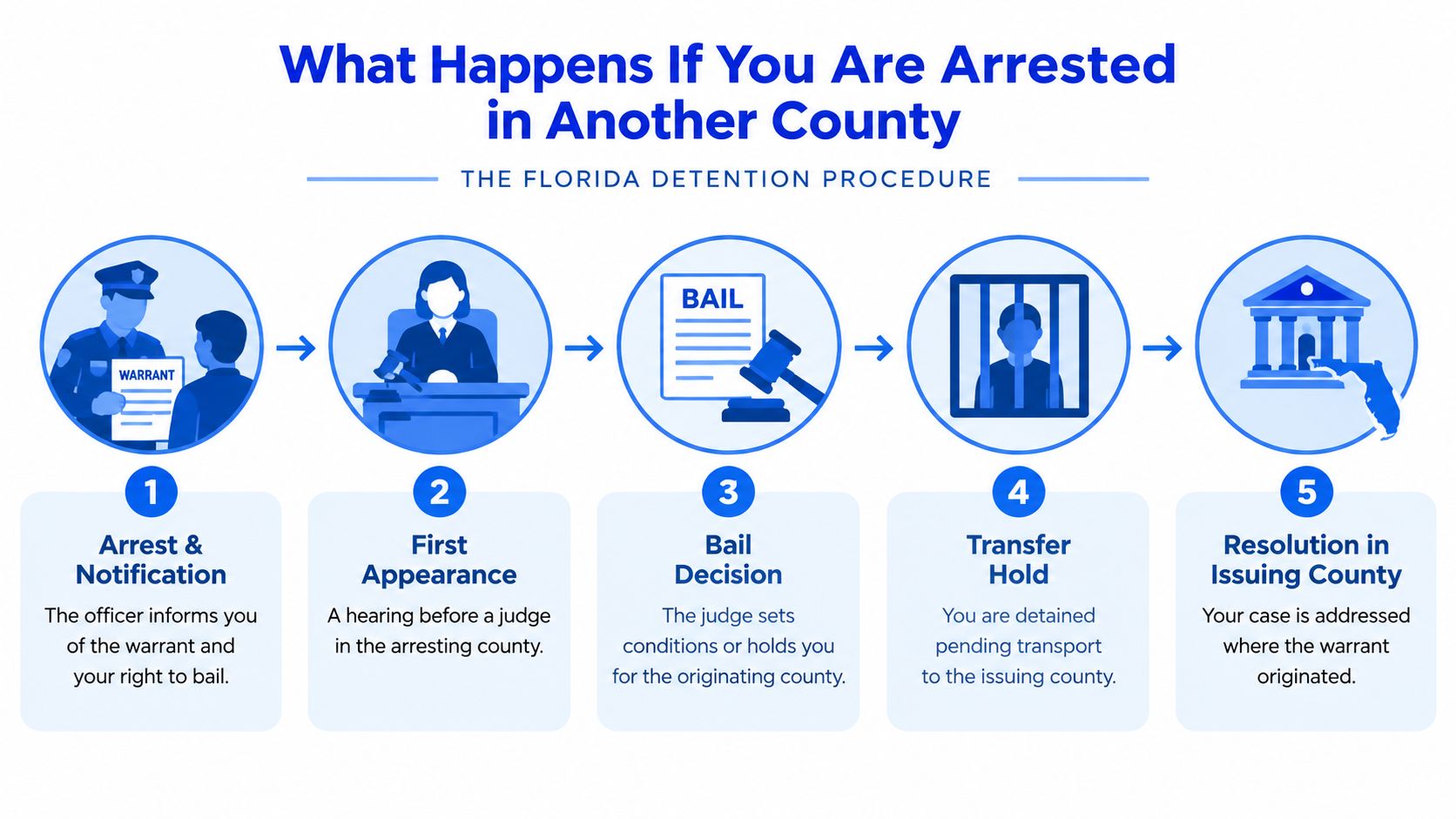
Once officers confirm the warrant, the immediate issue becomes custody. In Florida, a person arrested in a county different from the county where the alleged offense occurred has a right to bail when the warrant and charge permit bail. The arresting officer must inform the person of that right.
Florida law also provides that, if the person requests bail, a judge or authorized official in the arresting county may set bail for appearance before the judge who issued the warrant. The Florida Senate text of Section 901.08 describes this local bail pathway.
Bail matters immediately: Ask clearly about your right to bail, but don't discuss the underlying facts of the case before speaking with counsel.
The usual custody sequence
The process can vary by county, but the practical sequence often looks like this:
Arrest and confirmation: Officers identify you, verify the warrant, and contact the issuing agency or court.
Booking in the arresting county: You may be processed at a Broward, Miami-Dade, Palm Beach, or other local facility.
First appearance or bail review: A judge or authorized official may address bail when the offense and warrant allow it.
Local hold or transfer decision: The issuing county may arrange transport, request continued custody, or decide not to retrieve you.
Return to the issuing court: If transferred, the original court handles the warrant and underlying case.
Why the hold may not end quickly
A local bail hearing doesn't necessarily resolve the underlying case. It may provide a way to secure your appearance in the issuing county, but the conditions depend on the warrant, the charge, and the judge's authority. If bail isn't available, you may remain in custody while the issuing county evaluates transport.
The waiting period depends on state procedure, county communication, distance, charge level, transportation resources, and whether the issuing county wants to spend resources retrieving you. That's why two people with warrants from different counties can have very different custody experiences.
This Florida arrest procedure resource provides broader context about booking, first appearance, and the early stages of a criminal case. During the warrant hold, protect yourself by providing basic identifying information, asking for counsel, and avoiding explanations about why you missed court or what happened in the original case.
In State Transfer Versus Interstate Extradition
People often use “extradition” to describe any warrant-related transfer. That wording can cause serious confusion. A Florida county-to-county arrest and an out-of-state extradition are different legal tracks.
If Broward County officers arrest you on a warrant issued in another Florida county, local magistrate and bail rules generally control the first stage. The issuing county may request that you be held or transported, but the matter remains within Florida's court system.
An out-of-state arrest raises a different set of questions. Florida's Chapter 941 addresses extradition, including procedures for seeking the return of a person believed to be in another state after escape from confinement or an alleged breach of bail, probation, or parole. The broader history of fugitive custody and interstate return is addressed in this discussion of the definition of fugitive from justice.
Factor | In-State County Transfer | Out-of-State Extradition |
|---|---|---|
Governing process | Florida county arrest, local magistrate, and bail procedures | Florida extradition law and related interstate procedures |
Initial court | A judge or authorized official in the arresting county may address eligible bail | The arresting state and Florida authorities may handle separate extradition steps |
Transport issue | The issuing Florida county decides how to arrange county-to-county custody | Return may involve interstate coordination and executive or statutory procedures |
Felony significance | A felony can lead to broader database visibility and a serious hold | Felony warrants are more likely to support interstate extradition |
Misdemeanor significance | A misdemeanor may still cause arrest or an in-state hold | Misdemeanor extradition is often more limited and discretionary |
Resource decision | County officials weigh transport, distance, and case priorities | Authorities weigh legal authority, cost, severity, and interstate cooperation |
Florida felony warrants are commonly entered into NCIC, which can make a local case visible beyond Florida. That doesn't mean every warrant triggers automatic interstate pickup. It means the warrant may become a multi-jurisdiction custody issue, particularly when the alleged offense is a felony.
For lesser offenses, resource decisions can matter. An issuing county may decide that transporting someone for a minor misdemeanor isn't worthwhile, even though the warrant remains unresolved. Release from a particular hold therefore doesn't necessarily erase the warrant.
How to Resolve an Out of County Warrant in Florida
The safest resolution strategy usually begins before an unexpected arrest. You don't need to guess whether a warrant exists or walk into a jail without understanding the consequences. Start by confirming the court, case number, charge, warrant type, bail status, and any pickup or transport instructions.
Build a plan before contacting the court
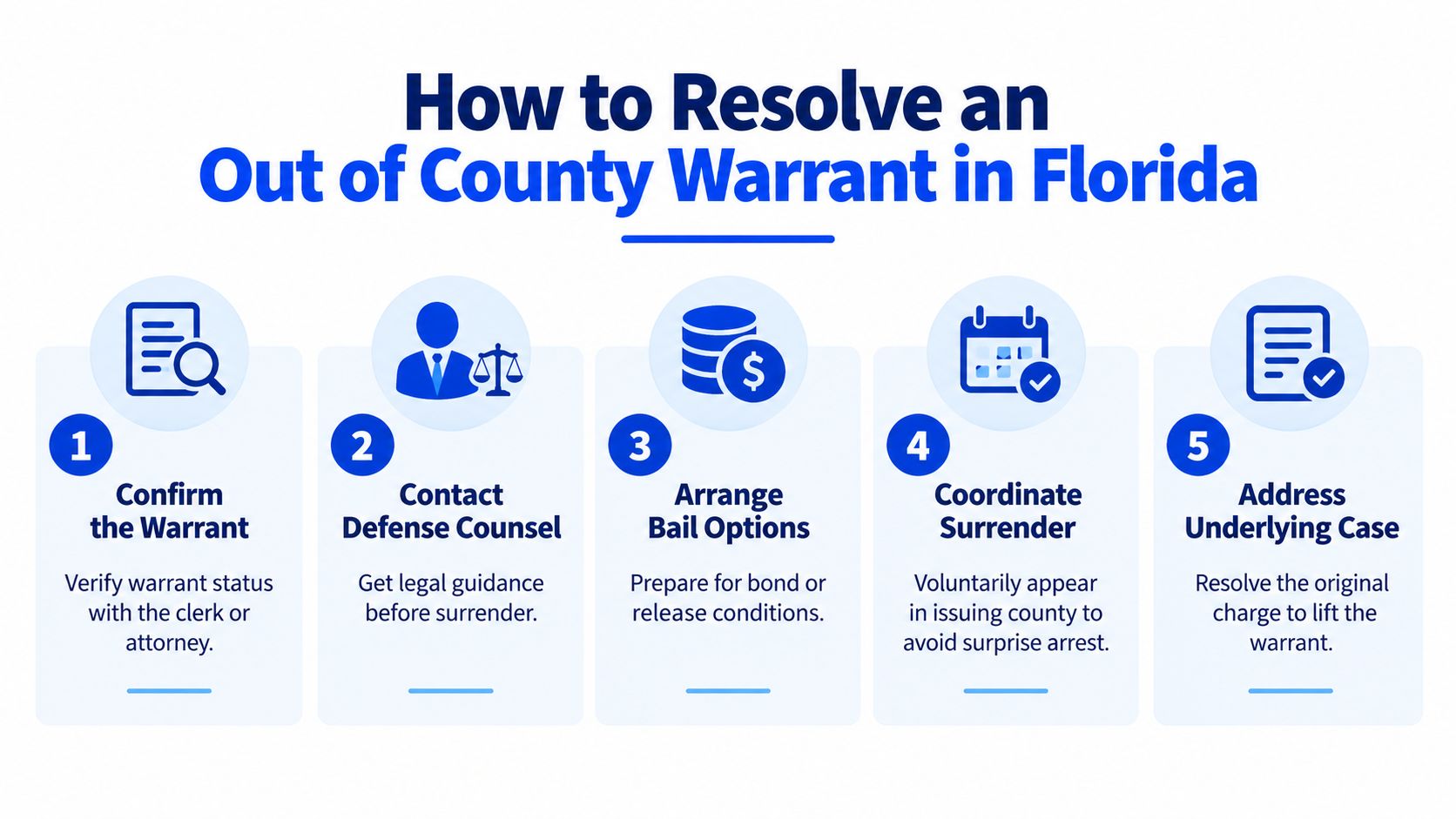
Use a focused checklist:
Confirm the warrant. Check with the clerk or have counsel verify the record. Public warrant information may be incomplete, outdated, or difficult to interpret, so confirmation should include the issuing court.
Gather case documents. Collect notices, prior court paperwork, probation records, traffic citations, payment information, and anything explaining a missed appearance.
Speak with defense counsel. A lawyer can evaluate whether the warrant may be recalled, whether a motion to quash is appropriate, and whether voluntary surrender is realistic.
Ask about bail. Determine whether the charge permits bail and whether a local or issuing-county judge must address it.
Coordinate surrender. A planned appearance in the issuing county may be preferable to an unexpected arrest in Broward County, Miami-Dade, or Palm Beach County.
Address the underlying case. Clearing the warrant is only part of the work. The original criminal, traffic, probation, theft, drug, DUI, or other matter still requires a legal response.
Surrender versus waiting for arrest
Voluntary surrender can give counsel an opportunity to coordinate with the clerk, prosecutor, jail, and court. It may also allow the defense to prepare identification, bond arrangements, transportation, and documents supporting a request for release. That doesn't guarantee a particular result, but it can reduce avoidable confusion.
Waiting creates less control. An arrest may occur during a traffic stop, at a courthouse, or during booking on an unrelated allegation. You may then face a local hold without access to the records or people needed to explain the situation quickly.
In some cases, the jurisdiction issue itself creates a procedural avenue. Florida law allows a court that concludes it lacks jurisdiction because the offense occurred in another county to hold the defendant or admit the defendant to bail for a reasonable time while awaiting a warrant from the proper county. The clerk must notify the prosecutor in the proper county, and if no warrant is served within the time set by the court, the defendant must be discharged. The Florida jurisdiction and warrant procedure should be reviewed with counsel because the court's order and deadline control the practical result.
If someone you know is already detained, this guide to how to bail someone out may help you organize the immediate questions for the jail and court. Don't pay or arrange a bond without confirming which warrant the bond addresses and what appearance it secures.
Common Misconceptions That Put You at Risk
The warrant will expire if I stay away
An active warrant generally doesn't disappear because you moved from the issuing county to South Florida or avoided contact with law enforcement. It typically remains active until served, recalled, or resolved. Waiting can preserve the risk without improving your legal position.
A different county can't arrest me
Florida county boundaries don't create immunity. Officers in Broward County may act on a warrant issued elsewhere in Florida, and the person may be held locally while the issuing county decides whether and how to retrieve them.
A misdemeanor warrant is harmless
A misdemeanor warrant may be less likely to produce interstate extradition, but it can still lead to arrest, booking, and a jail hold within Florida. The issuing county may later decide not to spend resources on transport, yet that decision isn't guaranteed and may not happen before you spend time in custody.
The first arrest ends the problem
The arrest addresses custody, not necessarily the underlying case. You may still need to appear before the issuing court, comply with release conditions, defend the original allegation, resolve a probation violation, or challenge the basis for the warrant.
The practical risk is often unexpected detention, not an automatic conviction. Public-access records can reveal an old warrant before an officer finds it, giving you a chance to investigate and seek controlled resolution instead of discovering it during a traffic stop.
Take Control of Your Warrant With Trusted Florida Defense
An out-of-county warrant creates two separate problems. First, you need to manage custody, bail, and transport. Second, you need to defend or resolve the original case in the county that issued the warrant. Treating only the first problem may leave the legal exposure in place.
A Florida defense lawyer can review the warrant record, identify whether bail is available, communicate with the issuing court, and assess whether a motion to recall or quash is appropriate. The same preparation can matter in a DUI, drug crime, domestic violence, theft, violent crime, gun or weapons charge, sex offense, juvenile case, white collar matter, federal case, probation violation, or traffic crime.
Ticket Shield, PLLC serves clients in Broward County, Fort Lauderdale, Miami-Dade, Palm Beach, and other Florida jurisdictions. The firm describes direct attorney communication, 24/7 availability, planned court appearances, and assistance with traffic warrants, capias or warrant motions, and controlled surrender planning. You can submit your case for review so counsel can evaluate the warrant, the underlying charge, and the most practical next step.
Don't assume the warrant is minor, expired, or impossible to resolve from another county. Early advice can help protect your freedom, driver's license, record, and reputation while giving you a clearer plan for Florida courts.
Ticket Shield, PLLC can review an out-of-county warrant, explain bail and surrender options, and help coordinate a response with the issuing court. Visit Ticket Shield, PLLC to request a confidential consultation and discuss your situation with a Florida defense team.