Open Carry Florida Law: Your 2026 Rights and Defense Guide
Jason Goldsmith, Esq
Open carry in Florida became lawful for people who can legally possess a firearm on September 25, 2025, after the First District Court of Appeal struck down the ban in McDaniels v. State. That change did not erase the prohibited-places list, and that is where many individuals still get hurt.
You're probably reading this because you want a straight answer, or because an officer stopped you, a store manager called police, or you've already been charged and the old rules keep showing up in search results. The bad advice online is obvious now. The issue is narrower and more dangerous, lawful carry can still turn into an arrest if you are in the wrong place, are otherwise disqualified, or run into an officer who hasn't caught up.
Table of Contents
What Just Changed With Open Carry in Florida
A Broward deputy sees a handgun on a man's hip outside a gas station, makes contact, and treats it like a straight weapons arrest. The man is calm, licensed, and not breaking the law the way the officer thinks he is. That's the post-2025 problem: the law changed, but the street-level habit did not change overnight.
Florida Statute § 790.053 had long said open carry was unlawful, and the statute classified a violation as a second-degree misdemeanor. That older rule is the reason so many websites still answer the question the old way. Today, that answer is wrong for people who can legally possess firearms, but the prohibited-places restrictions still control what happens next. See the older statute text in Florida Statute § 790.053 and compare it with the practical local guidance in this Broward-area open-carry notice.
Why outdated answers keep causing trouble
Many people still search “open carry Florida law” and land on pre-September-2025 explanations. Those pages can be dangerous because they make lawful conduct sound criminal. They also miss key questions clients ask after the stop, whether the officer knew the rule, whether the agency is following the new guidance, and whether the location itself creates the case.
Practical rule: If the officer says the gun itself is illegal, stay calm and argue later. If the location is restricted, that's the issue prosecutors will use.
The right defense posture is simple. First, confirm whether you're a person who can legally possess a firearm. Second, identify exactly where you were standing. Third, preserve every detail of the stop before memory gets fuzzy or video disappears. If your situation involves a weapons allegation, this Florida firearm-possession defense resource is the kind of issue that now sits beside open-carry cases.
The Statutory Framework Behind the 2025 Ruling
A man stops at a gas station in Jacksonville with a holstered handgun visible on his hip. An officer who has not caught up with the new rule may still treat the gun itself as the problem, even though the essential question is whether the man is in a place where open carry is allowed and whether he can legally possess the firearm at all. That is the part clients get burned on now, the statute no longer works the way it did before the court ruling, but the enforcement habits often lag behind.
Florida got to that point through a direct collision between the old statute and a constitutional challenge. For years, Florida Statute § 790.053 made open carry a crime. The Florida First District Court of Appeal later ruled in McDaniels v. State that the ban was unconstitutional, and after the Attorney General declined to appeal, open carry was treated as lawful statewide by September 25, 2025. The First District covers 32 Florida counties, so the ruling immediately affected a large part of the state's courts and population.
How the change became operative
The legal sequence still matters because officers and prosecutors will reach for the old prohibition if their training has not caught up. The court struck down the ban. The Attorney General did not keep the fight going. State guidance then moved enforcement away from the old rule for people who may legally possess firearms. For a defendant, the date that matters is the stop date, the arrest date, and whether the agency was still acting like open carry was forbidden after September 25, 2025.
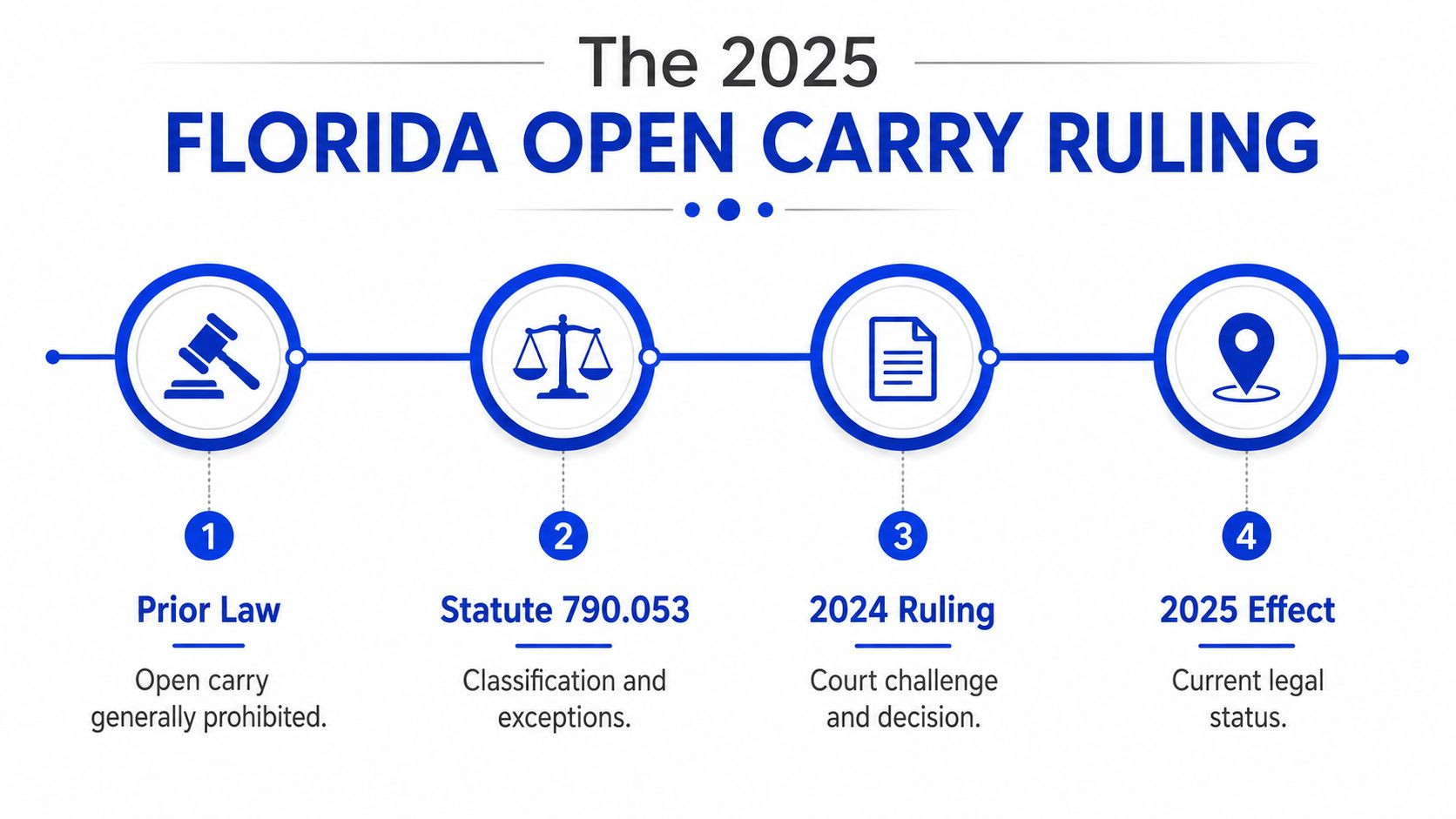
That sequence explains why stale printouts cause real trouble. A deputy in a county that still relies on old roll-call notes may make an arrest that should never have been filed as an open-carry case. The defendant then has to fight a charge built on yesterday's rule, not today's law. In practice, that usually means the first argument is not about whether a gun was visible, it is about whether the person was in a lawful place and whether the arresting agency understood the change.
Florida's gun cases often turn on timing. A client can be right on the law and still get arrested because the stop happened during a transition period or because the officer was working from outdated training.
If the arrest report says the gun itself was illegal, that report is already out of step with the ruling. The next fight is usually over the location, the officer's understanding, and the prosecutor's willingness to keep pushing a case that no longer fits the statute. For the concealed-carry statute that still gets confused with open carry, see Florida Statute § 790.06.
Open Carry vs Concealed Carry in Florida
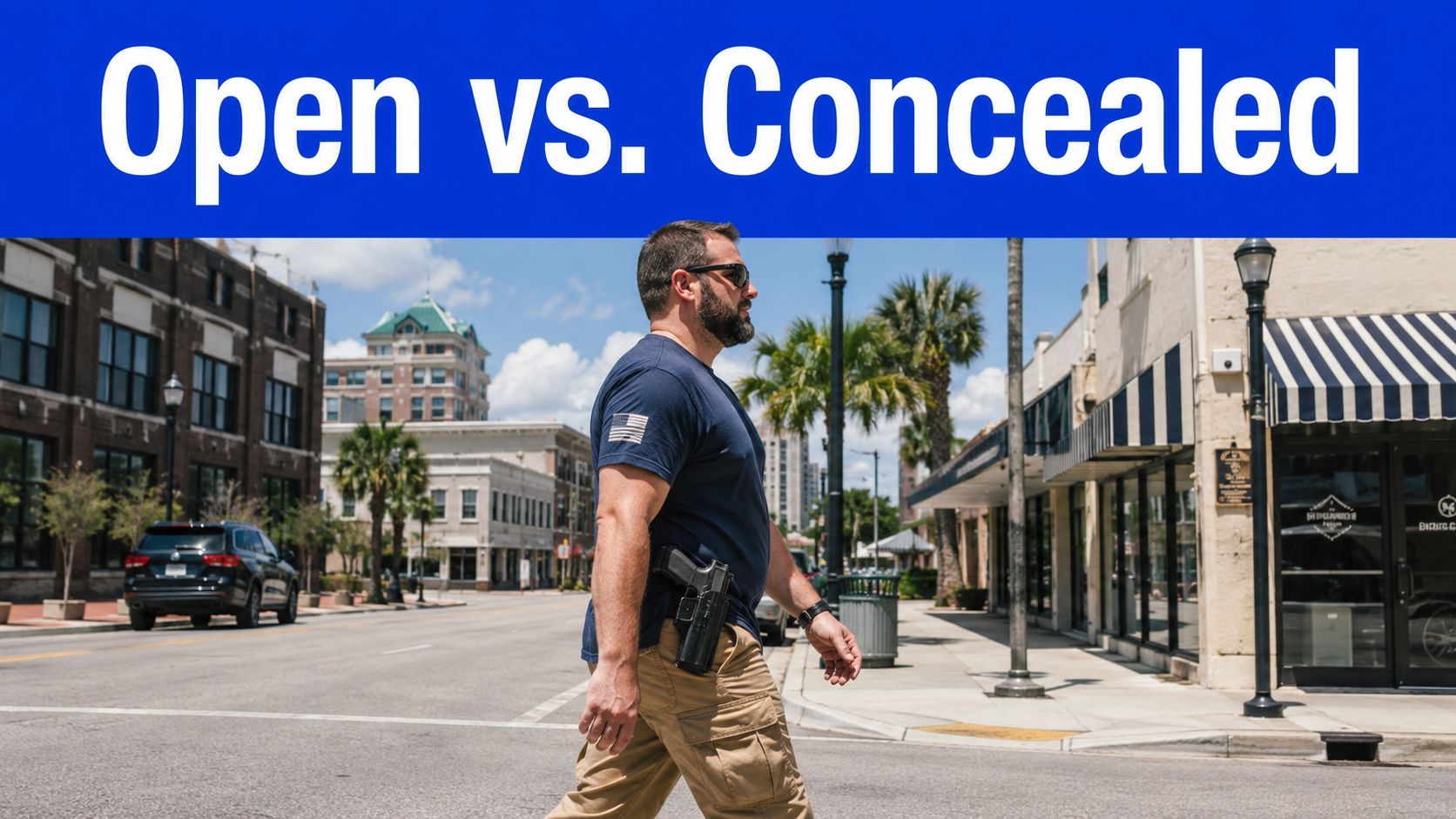
Open carry and concealed carry are not the same thing, and the choice between them can matter when police decide how to approach you. Concealed carry is still tied to its own statutory rules, licensing structure, and eligibility requirements. Open carry is now lawful for qualified people, but that does not make it the better tactical choice in every setting.
Side by side, the legal risk looks different
With open carry, the firearm is visible, so the stop usually starts with location, conduct, or eligibility. With concealed carry, the issue often begins when an officer discovers the weapon during a stop or search and then checks whether the person had authority to carry it that way. Either way, prosecutors look for a way to frame the facts that survives the constitutional change.
For practical purposes, police and judges still react differently to visible versus hidden firearms. A visible gun can trigger a faster call to law enforcement, especially in crowded or sensitive places. A concealed weapon can create a different problem, because once discovered, the case may hinge on whether the stop or search itself was lawful.
Carry method | Core question | Common point of failure |
|---|---|---|
Open carry | Was the person in a lawful place and legally eligible? | Prohibited location, officer confusion, or additional conduct |
Concealed carry | Was the person authorized to carry concealed? | Licensing, eligibility, or search issues |
The practical lesson is blunt. Open carry is now a lawful option, not a guarantee of a clean encounter with police. In South Florida, the smartest defense position is still to think about the whole stop, not just whether the gun was visible.
Where Open Carry Is Still Prohibited in Florida
The law changed on carry posture, not on place. A gun that is lawful in public can still create an arrest, a trespass case, or a separate weapons charge the moment someone carries it into a restricted location. Florida's restricted-location rules still control police stations, jails, courthouses, polling places, school property, many school-related venues, and certain alcohol-serving premises. The local summary in this Broward-area open-carry guidance tracks that point, and the current text of Florida Statute § 790.053 shows how the prohibited-place framework still fits into Florida carry law.
The location list that still matters
Open carry does not flatten every public space into the same legal risk. Some places still draw immediate enforcement, and officers know it.
Police and sheriff's offices: Walking into a law-enforcement building armed is a fast way to turn a carry question into an arrest question.
Courthouses and polling places: These are classic restricted zones, and deputies usually treat them that way.
Schools, school buses, and school-sponsored events: K-12 property remains a hard stop.
Colleges and universities: Campus rules and state restrictions still matter, even after the carry change.
Bars and premises primarily devoted to alcohol service: The line between a normal restaurant and an alcohol-focused venue still matters.
Airport sterile areas: Security-controlled areas remain off limits.
Private property creates a separate problem. A business owner can order you out, and if you refuse, the case can shift from gun law to trespass law in a hurry. Being allowed to possess a gun is not the same thing as being allowed to stay on someone else's property with it.
Bottom line: Open carry did not erase the prohibited-places regime. If the venue is restricted, the firearm can become evidence instead of protection.
The defense fight often turns on location proof. Photos, receipts, bodycam, and witness statements can decide whether the State can prove the place was prohibited under the facts. If the officer or prosecutor gets the location wrong, the case can collapse. In a possession case tied to a prior record, the separate eligibility issue can matter just as much, and a defense lawyer should be looking at the underlying record in the same way a prosecutor would. See the focused overview in this felon-in-possession resource.
Eligibility Rules That Override the Open Carry Change
The 2025 ruling changed carry posture, not firearm eligibility. That distinction is critical. The legal summaries tied to the change make clear that open carry applies only to people who are legally allowed to possess firearms, and that means age and status still control the case. See the defense-focused overview in this felon-in-possession resource.
The disqualifiers prosecutors still use
Some people cannot lawfully carry a firearm at all, no matter whether they open carry or conceal it. The most common disqualifiers are:
Under 21: Age still matters, and prosecutors will test it quickly.
Prior felony convictions: A prior felony can create a separate possession problem.
Violent career criminal designation: This can make the case much more serious.
Domestic-violence injunctions: Active injunctions are a major red flag.
Federal-law bars: Federal law can still prohibit possession even if a person thinks state law is enough.
That means a defense lawyer should never start with “open carry is legal now.” The first question is always whether the person is legally eligible to possess the firearm in the first place. If eligibility is weak, the State will use that weakness to rebuild the charge even when the open-carry theory itself is gone.
Why this matters in real cases
A client with a prior record can have a very different exposure than a clean-record adult stopped in the wrong place. The prosecutor may not be able to rely on the old open-carry ban, but they may still press possession, injunction, or federal-overlay theories. That is where the defense has to be sharp and specific, because the new rule does not wash away older bars.
If you're dealing with a gun case in Broward, Miami-Dade, or Palm Beach, eligibility gets examined before anyone talks about posture or politics. That's not theory. It's how the case is charged.
How Open Carry Charges Get Built and How to Fight Them
After the 2025 change, many open-carry cases are no longer built on the act of carrying alone. They're built on the stop, the place, the officer's interpretation of what happened, or the client's status. That means the defense has to attack the weakest factual link, not the headline issue.

The charge stack prosecutors reach for
In a post-change arrest, the charging mix can include trespass, disorderly conduct, resisting without violence, or carrying in a prohibited place. Officers may also turn a routine contact into a weapons investigation if the client is nervous, argumentative, or in the wrong venue. That is why conduct during the stop can matter as much as the firearm itself.
The defense levers are straightforward:
Illegal stop: If the stop lacked legal basis, everything that followed gets weaker.
Location dispute: If the State cannot prove the venue was prohibited, the case loses force.
Lawful possession: If the client was eligible and in a lawful place, that fact should be front and center.
Trespass versus criminal charge: A business dispute is not always a weapons crime, and the distinction matters.
Suppression motion: Unlawful searches and seizures can knock out key evidence. See what a motion to suppress does in Florida cases.
Prosecutors like clean narratives. Defense lawyers should break the narrative apart, piece by piece, until the State has to prove more than a visible gun and a bad assumption.
This is also where plea bargaining power changes. If the State overcharges because the officer misunderstood the rule, the defense can often use that gap to push for dismissal, reduction, or a better resolution. Open carry is legal now, but the arrest process still rewards fast legal action.
What to Do in the First 24 Hours After a Stop or Charge
Stay calm and stop explaining yourself. The fastest way to turn a bad stop into a worse case is to give officers a story they can twist later. Whether you were stopped in Fort Lauderdale or arrested in Miami-Dade, the playbook is the same.
Your first moves matter
Do not consent to searches. Say it clearly and politely.
Do not volunteer explanations. Answers given in panic usually help the State, not you.
Ask if you are free to leave. If you are not, that tells you the stop is still active.
Get the officer's name and agency. Write it down immediately.
Save every video you can find. Bodycam, Ring footage, phone video, and witness clips can disappear fast.
Stay off social media. Posts and comments get copied into reports.
Call a defense lawyer before any recorded statement. Once you speak on the record, the damage is hard to undo.
If someone saw the stop, get their name and number while the memory is fresh. If you were in a business, ask whether cameras were recording. Small details often become the most important defense evidence.
Short version: Don't argue the law on the sidewalk. Preserve the facts, then let counsel force the State to prove its case.
Questions People Are Asking After the Rule Change
If an officer says open carry is still illegal, don't turn the encounter into a debate. Be respectful, ask for a supervisor if needed, and preserve the stop for later review. Officers can be wrong about a recent rule change, and that mistake can matter.
Uneven enforcement is still a real problem. Some agencies adapt quickly, others lag behind, and that creates risk even when the law is on your side. If you were detained in Broward, Palm Beach, or Miami-Dade, the local facts and the venue still matter more than the statewide headline.
Could the legal status shift again if appellate review happens later? That's possible in any fast-moving gun case, which is why clients shouldn't rely on internet summaries or social media clips. If you already have a pending criminal case or a prior record, the open-carry change does not erase those problems, and prosecutors will use every existing issue they can find.
Ticket Shield, PLLC handles Florida gun charges, stop-and-search issues, and the criminal fallout that follows a mistaken weapons arrest. If you need a calm, experienced defense strategy after an open-carry stop or charge, visit Ticket Shield, PLLC for a confidential consultation and get a lawyer who knows how Florida prosecutors build these cases.