Illegal Firearm Possession: Rights & Defenses 2026
Jason Goldsmith, Esq
A lot of gun cases in South Florida start the same way. A traffic stop. A glove box opened for registration. A firearm under a seat, in a console, in a bag, or on a passenger. Then the questions start coming fast, and by the end of the night someone is in handcuffs wondering how a routine stop turned into a felony case.
If that's where you are right now, you're probably dealing with two problems at once. First, you're trying to understand what the police say you did wrong. Second, you're trying to figure out how much danger you're in. Both matter, because firearm charges move quickly, prosecutors take them seriously, and what seems like a simple possession case often turns on small facts that the general public doesn't know are legally important.
From a former prosecutor's perspective, illegal firearm possession cases are rarely as straightforward as the arrest report makes them sound. The State still has to prove possession, prove knowledge, and in many cases prove that you were legally barred from having the firearm at all.
Table of Contents
A Florida Gun Charge Can Happen to Anyone
In Broward, Miami-Dade, Palm Beach, and across South Florida, gun arrests don't just happen after dramatic police operations. They happen during traffic stops, domestic disturbance calls, arguments outside bars, probation checks, and routine street encounters. One bad decision, one misunderstood situation, or one firearm in the wrong place can put an otherwise ordinary person into the criminal system.
That matters because law enforcement stays focused on weapon offenses. In 2019, state and local police made over 153,000 arrests for weapon offenses across the United States, and that was up 9% from 2014, according to Duke Firearms Law's analysis of illegal firearm possession and enforcement trends. If you've been arrested for a gun charge, you're dealing with an area of law that officers and prosecutors actively pursue.
Why these arrests feel so confusing
Many clients expect a gun case to be simple. They think the issue is whether the gun was loaded, whether they threatened anyone, or whether they intended to use it. Sometimes those facts matter. Often they don't decide the charge.
A possession case can be built around issues like:
Where the gun was found in the vehicle, home, or on your body
Who had access to that area
Whether you knew it was there
Whether your legal status barred possession
What you said before or after arrest
The arrest is only the beginning of the case. The report tells the police version. It doesn't decide what the State can actually prove in court.
What a former prosecutor looks for
When prosecutors review these files, they don't just ask whether a firearm was recovered. They ask whether they can connect that firearm to a specific person and satisfy every required element of the statute charged.
That's good news for the defense, because weak links show up all the time. The car was borrowed. The gun belonged to someone else. The search was questionable. The statements were sloppy, incomplete, or taken after pressure. Those are real issues, not technicalities.
Defining Illegal Firearm Possession in Florida
Illegal firearm possession in Florida usually turns on two basic questions. Did the person possess the gun? And was that possession unlawful under the person's status or the surrounding circumstances?
That sounds simple until you see how these cases are charged. Florida prosecutors often rely on either actual possession or constructive possession, and the difference matters.
Actual possession
Actual possession is the easier concept. The firearm is on you or in your immediate physical control.
Common examples include:
On your person in a waistband, pocket, purse, or holster
In your hand during an encounter with police
Within immediate reach in a way the State claims amounts to direct control
If officers say they recovered a gun from your body or from something you were carrying, the case usually starts here.
Constructive possession
Constructive possession is where many Florida gun cases become worth fighting. This is the idea that you can possess a firearm without physically touching it, if the State claims you knew it was there and had the ability to control it.
Think of it this way. A gun in your pocket is actual possession. A gun in a closed center console of a car you're driving may become a constructive possession argument. A gun under the passenger seat of a car with multiple people inside becomes much harder for the State if access and ownership are unclear.
Constructive possession cases often rise or fall on details such as:
Issue | Why it matters |
|---|---|
Exclusive control | If you alone controlled the car, room, or bag, prosecutors have an easier argument. |
Shared access | If multiple people had access, the State usually needs more than proximity. |
Knowledge | The government must tie you to awareness of the firearm, not just physical closeness. |
Statements | A few words at the scene can become the centerpiece of the prosecution. |
Practical rule: Being near a gun isn't always the same as legally possessing it.
Status matters as much as location
The other major issue is legal status. As explained in this discussion of Florida concealed weapon licensing issues, firearm legality isn't just about having a gun. It also depends on whether the law allows you to have it in that moment and in that way.
A key reality in these cases is that the law often focuses on the person more than the firearm itself. As noted in this analysis of unlawful firearm possession and prohibited status issues, charges can depend on facts such as a prior conviction, probation status, a restraining order, or the nature of the weapon itself, including untraceable firearms. That's why two people standing in the same room with the same gun can face very different legal exposure.
For someone just arrested in Fort Lauderdale or Broward County, this is often the first surprise. Simple possession isn't always simple.
Common Types of Florida Gun Possession Charges
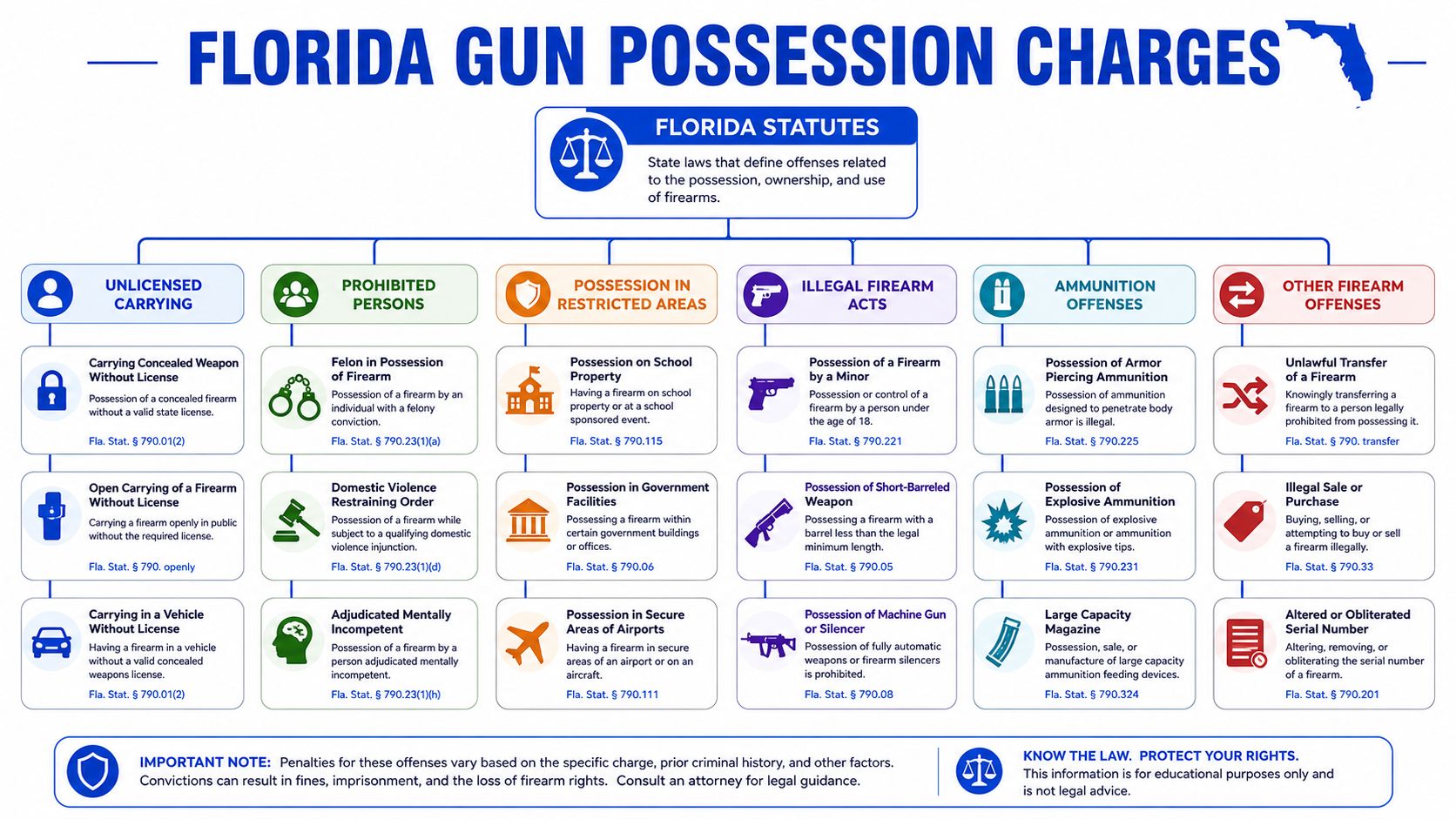
Florida doesn't have just one firearm possession offense. Prosecutors charge different statutes depending on where the gun was found, whether it was concealed, whether the person had a disqualifying record, and whether the setting created an additional violation.
One pattern shows up repeatedly in serious gun prosecutions. According to federal sentencing research from the U.S. Sentencing Commission, 88.8% of offenders sentenced under U.S.S.G. §2K2.1 were legally barred from possessing a firearm. That tells you something important about how these cases are built. Very often, the fight isn't only about the gun. It's about whether the State can prove prohibited status.
Possession by a convicted felon
This is one of the most heavily prosecuted firearm charges in Florida. The allegation is straightforward. The State claims you have a qualifying felony record and knowingly possessed a firearm or ammunition.
These cases often look strong on paper, but they still create defense opportunities:
Record problems can arise if the prosecution hasn't correctly established the prior disqualifying conviction.
Possession issues become critical when the firearm was found in a shared car, house, or bag.
Knowledge disputes matter if the weapon belonged to someone else.
For a closer look at this specific offense, see Florida felon in possession charges.
Carrying a concealed firearm unlawfully
A concealed firearm case usually centers on whether the gun was hidden from ordinary sight and whether the person was lawfully allowed to carry it in that manner. Many arrests come from vehicle stops, nightclub areas, public encounters, or security screenings.
The prosecution typically tries to prove:
The firearm was concealed
You had possession or control of it
No legal exception applied
What makes these cases tricky is that concealment and lawful transport are highly fact-dependent. A firearm in a vehicle doesn't automatically mean guilt. Placement, accessibility, and the officer's observations all matter.
Improper exhibition of a firearm
Not every gun arrest is based on hidden possession. Some start because someone displayed a firearm during an argument, road rage incident, or neighborhood dispute. The State then claims the display crossed the line from lawful possession into unlawful exhibition.
These cases often depend on witness credibility. One person says you threatened. You say you showed the firearm defensively or never displayed it at all. Surveillance video, 911 timing, and prior relationships between witnesses can make or break the charge.
Possession on school property
Firearms near schools create immediate concern for police and prosecutors. These cases can involve cars in school parking lots, adults picking up children, older students, or items found during an unrelated investigation.
The legal analysis usually turns on:
Exact location
How the firearm was stored
Whether any exception applies
Who had control over the vehicle or container
A small factual difference can change the charge dramatically.
Possession while subject to a domestic violence order or disqualifying status
This category is broader than many people realize. A person may believe the gun was lawfully owned and properly stored, yet still face a possession charge because a court order, probation condition, or other legal disability removed the right to possess it.
In real cases, people get arrested because they relied on what they thought was common sense instead of checking their legal status. Firearm law punishes that mistake harshly.
That's one reason gun cases need close legal review early. The paperwork behind your status may matter as much as the firearm itself.
Penalties and Lifelong Consequences of a Conviction
A Florida gun conviction can expose you to jail or prison, probation, a permanent criminal record, and restrictions that follow you long after the case ends. The exact penalty depends on the charge, your record, the facts of the arrest, and whether prosecutors allege an enhancement or mandatory minimum.
The immediate sentence matters. But clients often underestimate everything that comes after sentencing.

Criminal penalties are only part of the problem
Some firearm offenses are charged as misdemeanors. Others are serious felonies. In South Florida courts, prosecutors often treat gun cases as public-safety cases, which can make plea negotiations harder and diversion less likely.
That doesn't mean every case is hopeless. It does mean you shouldn't walk into court assuming the prosecutor will see your side automatically.
For related offenses and broader context, review Florida weapons crimes defense.
A conviction can lead to consequences such as:
Incarceration or probation depending on the level of offense and your prior history
Strict court conditions including no-contact orders, travel limits, and firearm prohibitions
A lasting felony record that changes how future prosecutors and judges view you
Collateral damage follows people for years
The courtroom sentence is only one layer. A gun conviction can affect daily life in ways judges don't spend much time discussing from the bench.
Common long-term consequences include:
Area | Possible effect |
|---|---|
Employment | Background checks can block hiring or promotion. |
Housing | Landlords may deny applications based on pending or prior gun charges. |
Licensing | Professional licenses can be delayed, denied, or disciplined. |
Immigration | Non-citizens may face serious immigration consequences. |
Civil rights | Firearm rights and other rights may be lost or restricted. |
A gun case isn't only about avoiding jail. It's about protecting your ability to work, rent, travel, and move forward without a permanent barrier attached to your name.
This is why early defense matters. The right strategy isn't just aimed at the next hearing. It's aimed at the record you will live with later.
How We Defend Illegal Firearm Possession Charges
A strong defense starts by refusing to accept the police version of events at face value. In illegal firearm possession cases, the State often depends on assumptions. The gun was in your car, so it must have been yours. You were near it, so you must have known. You answered a few questions on the roadside, so the rest of the case fills itself in.
That isn't how a real defense works.

Start with the stop and the search
One of the first defense questions is whether police had the right to stop, detain, frisk, search, or extend the encounter. Recent enforcement has focused on illegal carrying in vehicles and public spaces, which makes traffic-stop and vehicle-search litigation especially important, as described in Justice Department youth gun enforcement research discussing illegal carrying in vehicles and public areas.
If the officer lacked a valid basis for the stop, or if the search went beyond constitutional limits, the defense may file a motion to suppress. If the judge suppresses the firearm, the prosecution's case can collapse.
Common search issues include:
The reason for the stop wasn't legally valid
The detention lasted too long without lawful justification
The search exceeded consent or happened without proper legal grounds
The officer's report and body camera don't match
For cases involving public or vehicle carry allegations, see Florida carrying a concealed firearm defense.
Attack possession and knowledge
Constructive possession defenses are often the center of the case. When a gun is found in a shared vehicle, house, or bag, prosecutors still need to connect that weapon to you with evidence that holds up in court.
That can involve challenging:
Access by others who could have owned or placed the firearm
Lack of fingerprints or other links where the facts support that argument
Inconsistent witness statements
Your alleged admissions and whether they were voluntary, accurate, or misunderstood
The State doesn't win because a firearm was found nearby. It wins only if it can prove knowing possession under the law.
A former prosecutor's perspective proves helpful. The charging theory usually reveals what evidence the State thinks is enough. Once you know that theory, you can attack the weak point instead of arguing in circles.
A short overview of these issues is below.
Force the State to prove prohibited status
In many possession cases, especially felon-in-possession style prosecutions, the case depends on proving you were legally disqualified from possessing a firearm at the time of the arrest. That may involve prior judgments, injunction records, probation documents, or other status evidence.
Defense review often focuses on questions like these:
Is the prior record legally sufficient for the charged disability?
Do the dates line up with the alleged possession?
Did the State charge the right statute based on the facts?
Can prosecutors authenticate the records they need?
The prosecution still has to do the work. When it cuts corners, the defense should expose it.
Your Action Plan After a Florida Gun Crime Arrest
The first few days after a gun arrest matter more than is commonly understood. Statements get locked in. Evidence gets harder to find. Family members panic and start talking. Meanwhile, prosecutors begin shaping the case before the defense has even entered the room.
You need a controlled response.
What to do immediately
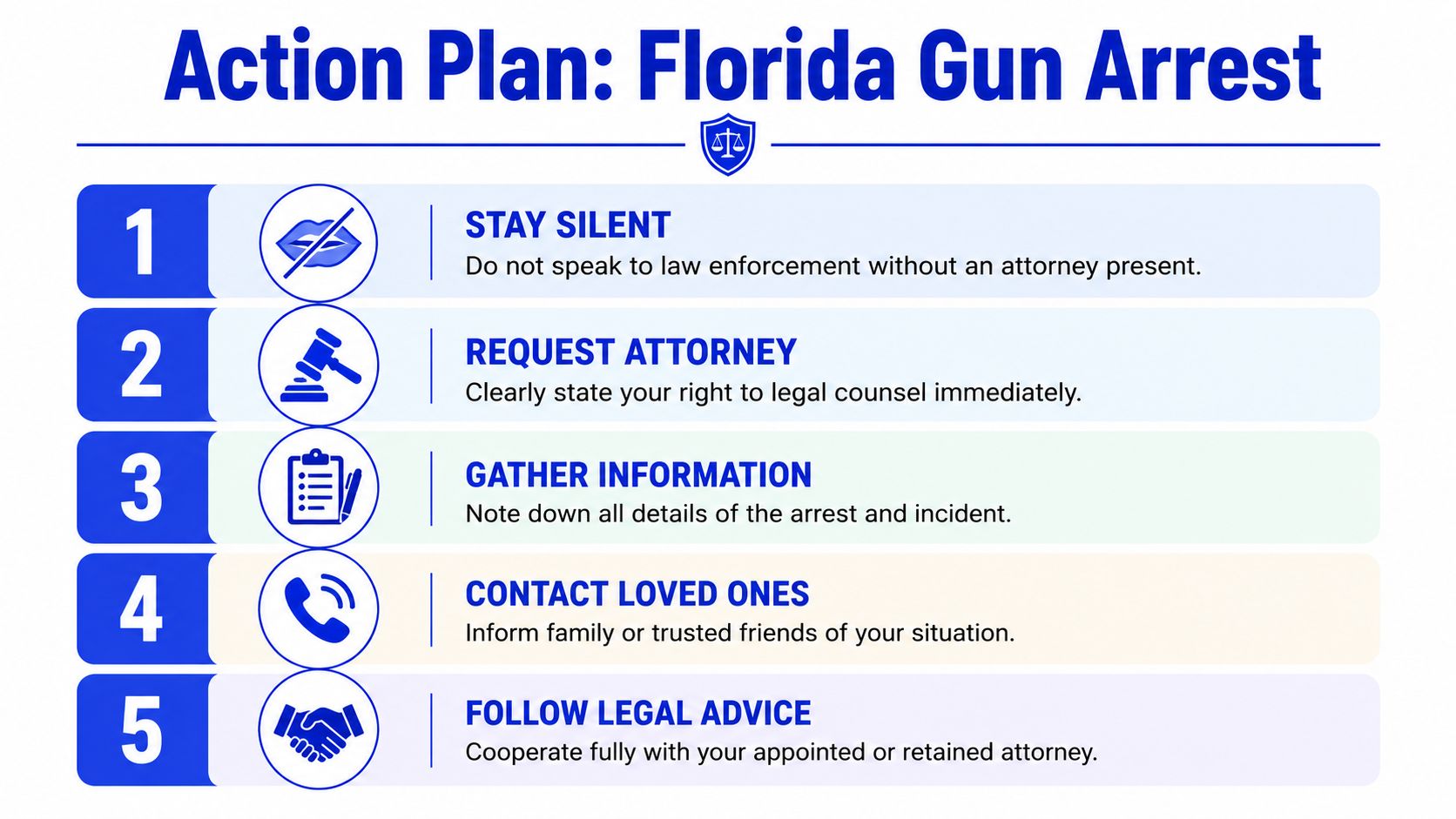
Stay silent. Give identifying information if required, but don't try to explain the gun, the stop, the vehicle, or who owned what. People often talk themselves into charges they might have beaten.
Don't consent to searches. If officers ask, you can refuse politely. If they search anyway, your lawyer can challenge it later. Consent can erase an important defense issue.
Ask for a lawyer clearly. Once you request counsel, stop answering substantive questions. Don't assume casual conversation with police is off the record.
Save documents and details. Keep bond paperwork, property receipts, court dates, towing information, and screenshots of any relevant messages. Write down what happened while it's still fresh.
Don't discuss the case with anyone except your attorney. That includes friends, family, coworkers, cellmates, and social media.
What families should do
If you're helping a loved one after an arrest, focus on organization instead of speculation.
Gather and preserve:
Case paperwork from the jail, clerk, or bond process
Vehicle information if the arrest happened during a stop
Names of possible witnesses before people disappear or forget details
Relevant digital evidence such as texts, call logs, location history, or photos
Families help most when they collect records, avoid public discussion, and get counsel involved early.
Don't call witnesses trying to straighten things out. Don't post about the arrest online. Don't try to coach a story. Those moves create new problems fast.
Protecting Your Future and Your Record
Being charged with illegal firearm possession doesn't mean you're destined for a conviction. Cases get dismissed. Charges get reduced. Some defendants win suppression motions. Some are acquitted because the State can't prove possession, knowledge, or prohibited status beyond a reasonable doubt.
The key is to treat the case as a legal problem that can be worked, not as a label you have to accept.
A charge is not a conviction
Good outcomes usually come from targeted work, not broad arguments. In one case the right move is attacking the stop. In another, it's dismantling constructive possession. In another, it's challenging status evidence or negotiating from a weakness in the State's proof.
What doesn't work is waiting and hoping the prosecutor will see the case your way.
A practical defense strategy often includes:
Early evidence review before narratives harden
Motion practice when police crossed constitutional lines
Focused negotiation when the State has proof problems
Trial preparation when a weak offer isn't worth the risk of pleading
A favorable result may still require cleanup
Even when a case ends well, your public record may still need attention. If charges are dropped or the case resolves in a qualifying way, sealing or expungement may be worth exploring under Florida law. That step can matter for employment, housing, and reputation.
People often think the case disappears automatically once it's over. It usually doesn't.
If you were arrested in Fort Lauderdale, Broward County, Miami-Dade, Palm Beach, or elsewhere in South Florida, get advice specific to the actual facts of your case. Gun cases turn on details, and the best defense usually starts long before trial.
If you're facing a gun charge in Broward County, Fort Lauderdale, Miami-Dade, Palm Beach, or anywhere in South Florida, Ticket Shield, PLLC can review the arrest, explain the risks clearly, and build a defense strategy based on how prosecutors really evaluate these cases. A confidential consultation can help you protect your rights, your record, and your future before the State gets too far ahead.
Illegal firearm possession charges carry harsh penalties in Florida. Learn your rights and the defense strategies that can protect your freedom.