Domestic Violence Charges Florida: Guide to Defenses 2026
Jason Goldsmith, Esq
The call usually comes late. A spouse, partner, or family member calls after an argument. Police arrive. Someone gets separated, questioned, and taken to jail. By the next morning, you're staring at release conditions, a no-contact order, and a court date you didn't expect.
If that's where you are right now in Broward County, Fort Lauderdale, Miami-Dade, Palm Beach, or nearby South Florida courts, slow down and get organized. A domestic violence case moves fast, and the early mistakes are often the most damaging. Talking when you should stay quiet, contacting the other person because “they want to fix it,” or assuming the case will disappear if they change their story can make things worse.
You need a clear view of how Florida handles these cases from arrest to resolution. You also need to treat the accusation seriously without panicking. If you need to get your facts together for a confidential case review, use the secure case submission form and start documenting what happened while it's still fresh.
Table of Contents
Facing Domestic Violence Charges in Florida?
A lot of people charged with domestic violence in Florida have never been arrested before. They think the officer will calm things down, maybe separate everyone for the night, and leave. Instead, one person goes to jail, a judge imposes conditions, and the case immediately becomes a criminal prosecution.
That shock matters because panic leads to bad decisions. Clients often want to text an apology, explain their side to police, or ask the alleged victim to “drop the charges.” All three can hurt you. In South Florida courts, domestic violence cases are handled as serious public-safety matters. Even when emotions cool down the next day, the paperwork and recorded statements remain.
What you need right now is discipline.
The first priority is control
Start with the facts you can control:
Stay silent about the incident. Don't discuss the facts with police, family, friends, or on social media.
Follow every release condition. If there's a no-contact order, obey it exactly.
Preserve evidence early. Save texts, call logs, photos, videos, location history, and names of witnesses.
Write your timeline now. Memory fades quickly, especially after a stressful arrest.
Practical rule: The strongest domestic violence defense often starts in the first day or two, not the month before trial.
This charge is serious, but it can be challenged
A charge isn't a conviction. It is an accusation that the State still has to prove. In many cases, the main contention isn't about the argument itself. It's about whether the State can prove the correct offense, with reliable evidence, under Florida law.
That's especially true in domestic violence charges Florida courts see every day. The allegation may sound dramatic in an arrest report, but the actual proof can be thin, inconsistent, or incomplete. A careful defense starts by testing each stage of the case, from the officer's first observations through filing, arraignment, negotiation, and trial preparation.
Understanding Florida's Domestic Violence Laws
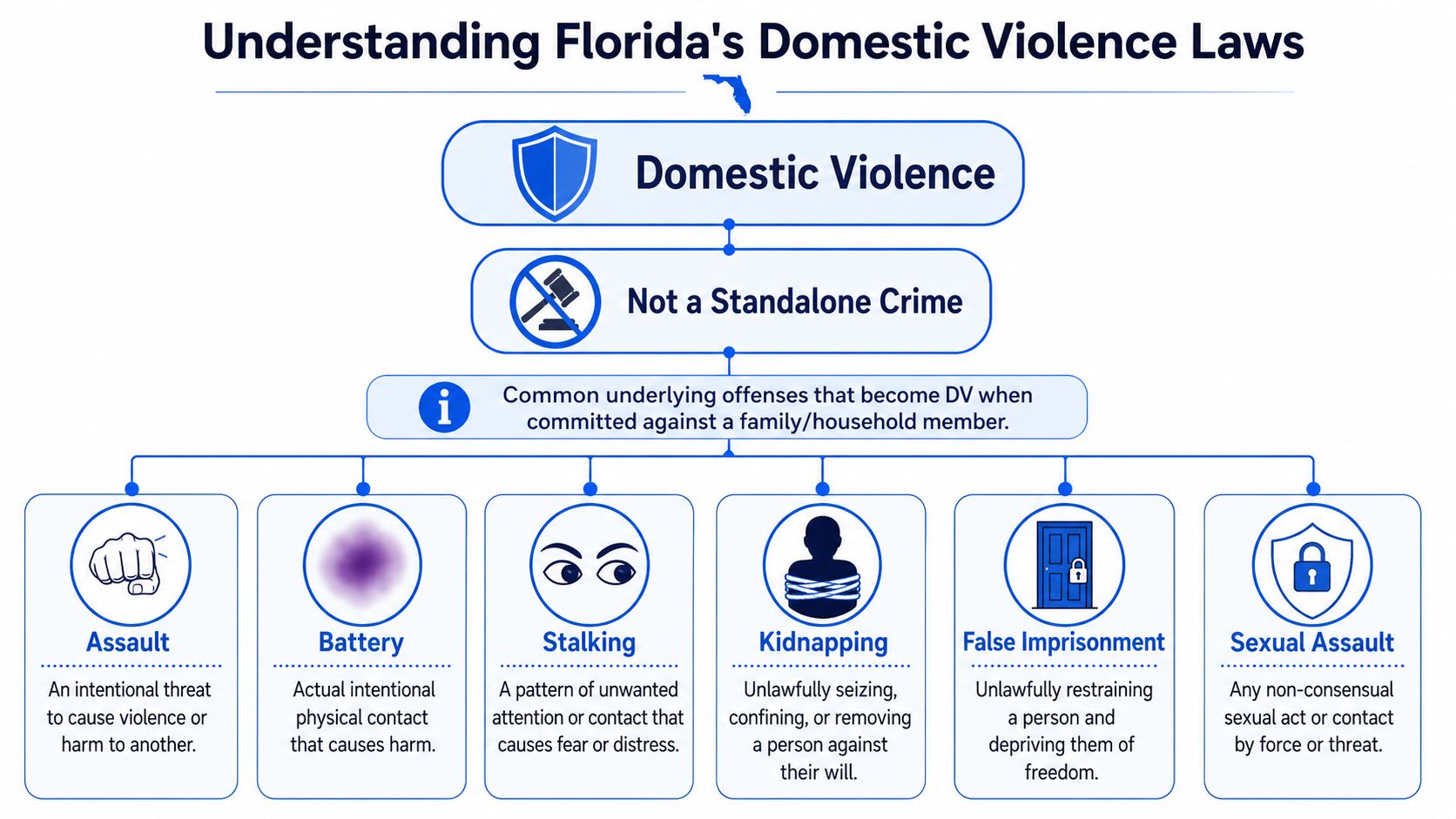
Florida law treats domestic violence as a designation applied to certain criminal acts when they happen between family or household members. It isn't a standalone charge by itself. That distinction matters because the prosecution still has to prove the underlying offense and the qualifying relationship.
Domestic violence is a legal label
Florida's domestic-violence definition is broad. It covers assault, battery, aggravated battery, stalking, kidnapping, false imprisonment, and any criminal offense causing physical injury or death between family or household members under Florida Statute 741.29.
That broad definition gives prosecutors room at intake. The same argument can be described very differently depending on statements, visible injuries, recordings, and witness accounts. That's one reason early defense work matters. Classification drives advantage.
What family or household member means
In plain English, the State usually has to show more than an argument and more than physical contact. It has to place the people involved inside the domestic relationship category.
That often includes:
Current or former spouses
People related by blood or marriage
People who live together as a family, or used to
Parents who share a child
This relationship issue can look obvious, but don't assume it is. Living arrangements, timing, and the nature of the relationship can become contested. When the State stretches the relationship label, the defense should push back.
A domestic violence case can weaken quickly when the State overstates either the relationship or the underlying offense.
Why charge classification matters early
Some clients focus only on whether they “hit” anyone. That's too narrow. The charging decision can be based on how police and prosecutors classify the alleged conduct. A shove, grab, threat, repeated contact, confinement, or injury allegation may be sorted into very different offense categories.
Florida law also requires officers investigating a domestic violence incident to prepare a written report whether or not an arrest occurs. That report must address observed injuries, grounds for arrest or no arrest, victim-witness statements when obtainable, and, if used, a lethality assessment. From a defense standpoint, that requirement creates pressure points. If the report is thin, inconsistent, or unsupported by actual documentation, the State's narrative may be weaker than the charging language suggests.
Navigating the Arrest and Court Process
Domestic violence cases in Florida move into the system quickly. According to Florida domestic violence reporting data, the state recorded 106,515 reported crimes in fiscal year 2023–2024 and 63,217 arrests, which is about 59.3% by a simple arrest-to-report ratio. In practice, that means police and prosecutors handle these allegations routinely, and they won't treat your case as an informal family dispute.
Start with the process. It gets easier to make good decisions when you know what comes next.
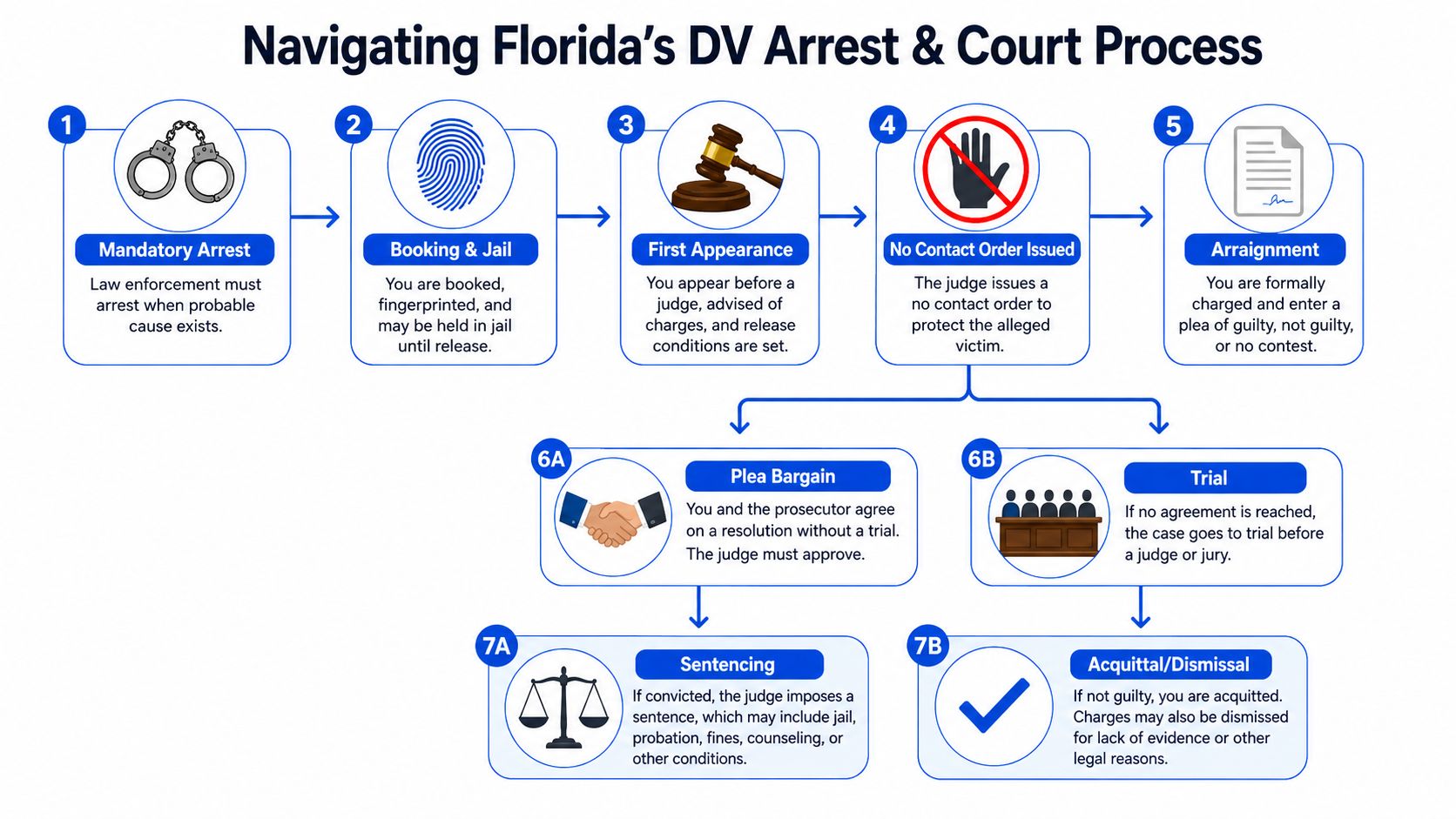
For a visual overview, this timeline helps:
What happens right after arrest
After arrest, you're usually booked into jail and held for first appearance. The judge reviews the charge, addresses bond, and sets release conditions. In many cases, that includes a no-contact order.
That order isn't symbolic. It can block calls, texts, messages through third parties, in-person contact, and sometimes even contact with children or access to the home. Clients violate these orders all the time because the other person reaches out first. That is still dangerous. If the court order says no contact, follow the order.
A lot of defendants also ask whether they're eligible for diversion. In some situations, early resolution options may be available, and it's worth reviewing how pretrial intervention works in Florida before making assumptions about a plea.
When the State decides whether to file
After the arrest paperwork reaches the prosecutor, the State Attorney's Office reviews the evidence and decides what formal charges to file. That review should include police reports, witness statements, recordings, photographs, and any visible injury documentation.
Disciplined defense work can matter most:
Reports get tested for omissions. If the officer claims an injury but failed to document it clearly, that matters.
Statements get compared. If the story changed, the prosecutor should have to deal with it.
Recordings get reviewed in full. A 911 call or body-cam clip may help the State, but it may also undercut the arrest narrative.
Release conditions can be challenged. A no-contact order isn't always permanent in its original form.
Here's the practical reality in Broward and Miami-Dade courts. The case feels personal to you, but to the system it's another file moving through intake. That's why your side has to be organized early and presented clearly.
Why the first weeks matter most
The first appearance is only the beginning. After charges are filed, the case moves toward arraignment, discovery, motions, negotiation, or trial. If your defense waits until months later to review evidence, you've already lost ground.
The best early move is simple. Treat the first weeks like the foundation of the case. Save evidence, comply with court orders, and force the State to prove what it charged.
Later in the process, some cases resolve through negotiation. Others need aggressive pretrial litigation. A few should be tried. What matters is choosing that path after a real evidence review, not out of fear.
For a deeper look at the early court stages, this video is useful:
Florida Domestic Violence Penalties
If you're facing domestic violence charges in Florida, you need a hard answer to one question. What can happen if the case goes badly?
The short answer is that exposure ranges from misdemeanor punishment to felony prison time, depending on how the State classifies the facts. Florida domestic violence penalty guidance notes that domestic battery is commonly a first-degree misdemeanor with up to one year in jail and a $1,000 fine, while felony domestic battery variants can carry up to five years in prison. The same source also notes that Florida imposes mandatory minimum jail terms for some domestic-violence convictions and a 26-week Batterers' Intervention Program in many cases.
Misdemeanor exposure versus felony exposure
A first-degree misdemeanor is still serious. It can mean jail, probation, court costs, classes, counseling, and a permanent criminal record if the case isn't resolved properly.
A felony changes the stakes quickly. Prison exposure rises. Bond conditions often tighten. The prosecution usually negotiates from a harder position. If the accusation includes aggravating facts, your defense has to challenge those facts directly rather than hoping the label will soften on its own.
Florida Domestic Violence Penalties at a Glance
Offense Level | Example Offense | Maximum Incarceration | Maximum Fine | Common Mandatory Conditions |
|---|---|---|---|---|
First-degree misdemeanor | Domestic battery | Up to 1 year in jail | $1,000 | Batterers' Intervention Program in many cases, probation, no-contact conditions |
Felony variant | Felony domestic battery variant | Up to 5 years in prison | Qualitative only | Batterers' Intervention Program in many cases, possible mandatory minimum jail terms, probation conditions |
Don't evaluate a plea offer by jail time alone. In domestic violence cases, the attached conditions can change your life long after the court date ends.
One more issue matters strategically. Filing deadlines can influence one's strategic position. Misdemeanor domestic-violence charges generally must be filed within two years, felony charges generally within three years, and some first-degree-felony domestic-violence offenses have no statute of limitations under Florida law, as noted in the same Florida penalty discussion linked above. That doesn't help every case, but it can matter when accusations surface late or the charging decision drags.
Consequences That Extend Beyond the Courtroom
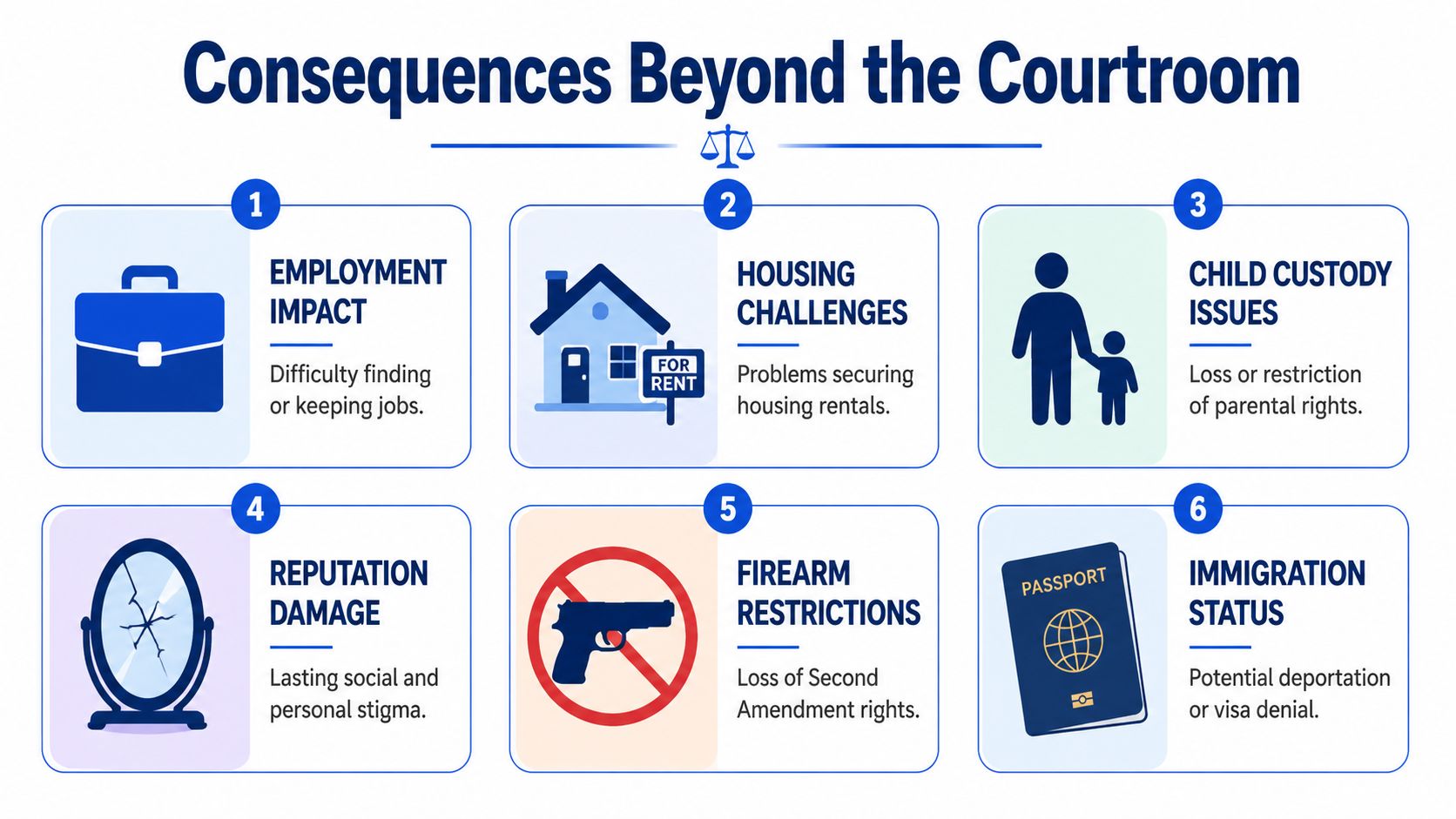
A domestic violence case doesn't stay in a courtroom box. It spills into work, housing, parenting, professional licensing, and day-to-day movement. That's why pleading just to “get it over with” is often a mistake.
In a major Florida jurisdiction, Miami-Dade County reported 9,357 domestic-violence cases in 2016, the most of any Florida county cited there. High volume means these cases affect thousands of people in real, practical ways. Judges, employers, landlords, licensing boards, and family courts see the label and react.
The damage usually spreads into daily life
Some consequences are immediate. Others show up months later when you apply for a job, renew a license, or deal with a custody dispute.
Here are the consequences clients underestimate most:
Employment problems: Employers may hesitate when they see a violent-charge history, even before a case is fully understood.
Housing barriers: Landlords often treat domestic violence allegations as risk issues.
Parenting restrictions: Temporary court orders and related family-court filings can affect time-sharing and decision-making.
Professional licensing trouble: Nurses, teachers, contractors, and other licensed professionals may face reporting obligations or disciplinary review.
Probation exposure: If you're already on probation, a new arrest can create a second legal problem. If that's your situation, review how a probation violation lawyer evaluates new-law allegations.
Why these cases affect family and future decisions
Domestic violence cases can also produce long-term rights issues, including firearm restrictions after certain convictions. They can fuel injunction proceedings and offer a strategic advantage in divorce and custody litigation. Even when the criminal case resolves better than expected, the allegation may continue to influence related proceedings.
The court file is only one part of the problem. The larger fight is protecting your record, your family position, and your future options.
This is why experienced defense lawyers don't treat domestic violence charges Florida clients face as simple misdemeanor calendar cases. They evaluate the full impact. A weak criminal plea can become a strong weapon against you somewhere else.
Strategic Defenses Against Domestic Violence Charges
Good domestic violence defense isn't built on generic denial. It is built on pressure points. You identify what the State must prove, compare that to the actual evidence, and attack the gap.
A lot of these cases are evidence-sensitive. Florida defense analysis on domestic violence cases notes that prosecutions often proceed on officer observations and 911 calls even when the complainant later recants or refuses to cooperate. That makes evidentiary sufficiency central.
Strong defenses usually attack proof
Defense strategy often starts with one or more of these issues:
Self-defense: If you acted to protect yourself, that issue needs to be developed early through witness statements, injuries, and recordings.
Lack of injury proof: If the report claims violence but there are no documented injuries, that can matter.
Conflicting statements: A changing story doesn't automatically kill the case, but it can create reasonable doubt or an advantage in negotiations.
Motive to exaggerate: Divorce, jealousy, custody conflict, and housing disputes can affect credibility.
Weak relationship proof: If the domestic relationship element is shaky, the classification may be vulnerable.
Bad police work: Missing photos, incomplete reports, and selective witness collection can all help the defense.
A former prosecutor will usually look at the case the same way the State should have. What can be proven? What's unsupported? What sounds strong in an affidavit but weakens under full review?
A recanting witness doesn't end the case
This is one of the most common misunderstandings. The alleged victim doesn't control the prosecution. If the State believes it has enough evidence through body camera footage, 911 audio, officer testimony, medical records, or excited utterance statements, it may continue.
That doesn't mean a recantation is useless. Far from it. It can reshape negotiations, expose inconsistencies, and limit the State's confidence at trial. But you need to approach it carefully. Coaching, pressure, or contact in violation of court orders can create new problems.
If the complaining witness changes position, your lawyer's job is to turn that fact into admissible, strategic leverage. Not chaos.
How a Former Prosecutor Defends Your Rights
A former prosecutor doesn't guess how the State evaluates these cases. He already knows. That's the practical advantage.

The advantage is knowing where the case can break
In domestic violence charges Florida prosecutors review, weak points usually appear in familiar places. The officer overreached on probable cause. The alleged injury isn't documented well. The witness statements don't line up. The recording tells a different story than the report summary. The charge selected at intake is more aggressive than the evidence supports.
A lawyer with prosecutorial experience also understands office habits in places like Broward, Miami-Dade, and Palm Beach. He knows what facts tend to move a prosecutor, what weaknesses matter in negotiation, and which cases need motions instead of conversation.
What effective early defense work looks like
Strong defense work is practical and specific:
Immediate evidence review: police reports, 911 audio, body-cam, photos, messages, and dispatch records
Condition management: seeking lawful modification of no-contact conditions when appropriate
Witness development: identifying neutral witnesses early, before memories shift
Targeted motions: challenging bad evidence, unsupported allegations, or weak procedural steps
Negotiation from strength: pushing for reduction, diversion, or dismissal when the proof doesn't support the filed charge
Trial preparation: being ready to try the case if the State refuses a sensible resolution
If you want more Florida-specific information about what defense counsel looks for in these cases, review this related discussion of a domestic violence lawyer's role in Florida defense strategy.
The bottom line is simple. If you're charged, don't wait for the system to become fair on its own. Build your defense early, obey court orders, and make the State prove every part of its case.
If you're facing domestic violence charges in Broward County, Fort Lauderdale, Miami-Dade, Palm Beach, or anywhere in South Florida, contact Ticket Shield, PLLC for a confidential consultation. Attorney Jason S. Goldsmith is a former prosecutor who understands how these cases are built, where they fail, and how to protect your rights at every stage.
Domestic violence charges in Florida move fast and carry lasting consequences. Learn the process, penalties, and your strongest defenses.