
Domestic Violence vs Assault: Understand Charges & Defenses
Jason Goldsmith, Esq
The police have left. Someone was taken into custody, or maybe you were. Your phone is full of missed calls, the court date is coming, and the paperwork uses words that sound similar but carry very different consequences.
That confusion is common in South Florida courts. A person may think, “I was accused of an argument that got out of hand. How is this now a domestic violence case?” Another person may ask, “If nobody was seriously hurt, why am I facing conditions that feel much harsher than a regular assault charge?”
That's the heart of domestic violence vs assault in Florida. The physical conduct may look similar on paper, but the legal treatment often is not. The relationship between the people involved can change bond conditions, contact rules, firearm consequences, court handling, and long-term damage to your record.
A lot is at stake, especially in Fort Lauderdale, Broward County, Miami-Dade, Palm Beach, and surrounding South Florida communities where prosecutors move quickly in these cases. Understanding the difference is the first step toward protecting yourself.
Table of Contents
Facing an Arrest What to Know First
It often starts with something ordinary. Two people argue at home. A neighbor hears yelling. One person calls 911 to calm things down or gain an advantage in the moment. Officers arrive, separate everyone, ask fast questions, and make a quick decision based on what they see, what they hear, and whether they believe someone feared violence or suffered unwanted contact.
By that point, you may already feel like the story has been decided without you.
In Florida, that first police decision matters. If the accusation involves a spouse, former spouse, someone you live with, someone you used to live with as a family, a co-parent, or another qualifying household relationship, the case may be treated as domestic violence instead of a standard assault case. The act itself might involve the same shove, threat, or attempted strike. But the case you now have to fight can look very different.
Practical rule: Don't assume the word “domestic” is just a label that sounds worse. In Florida court, it can change release conditions, communication rules, firearm issues, and the path of the case.
Many people accused in Broward County or elsewhere in South Florida make the same mistake in the first day or two. They focus only on whether they meant to hurt anyone. Prosecutors and judges also focus on the relationship, the setting, any prior history, witness statements, body camera footage, visible injuries, 911 audio, and whether a no-contact order should stay in place.
That's why a scared person reading an arrest report often feels blindsided. They expected a misunderstanding charge. Instead, they're facing court restrictions that affect where they live, who they can call, and whether they can go home.
A fast side-by-side overview
Issue | Assault | Domestic violence case |
|---|---|---|
Core question | Was there a threat or act that meets the offense elements? | Was there a qualifying offense plus a qualifying domestic relationship? |
Main focus | Conduct | Conduct and relationship |
Court concern | Whether the offense can be proven | Whether the offense can be proven and whether protective conditions are needed |
Immediate fallout | Criminal charge | Criminal charge plus family, housing, and contact consequences |
If you're dealing with this now, the key point is simple. An arrest is not a conviction. But the difference between assault and domestic violence needs to be understood early, because early decisions can affect the rest of the case.
What Is Assault Under Florida Law
Before you can understand domestic violence in Florida, you need a clear handle on assault itself. Assault is the underlying offense in many of these cases.
Simple assault in plain English
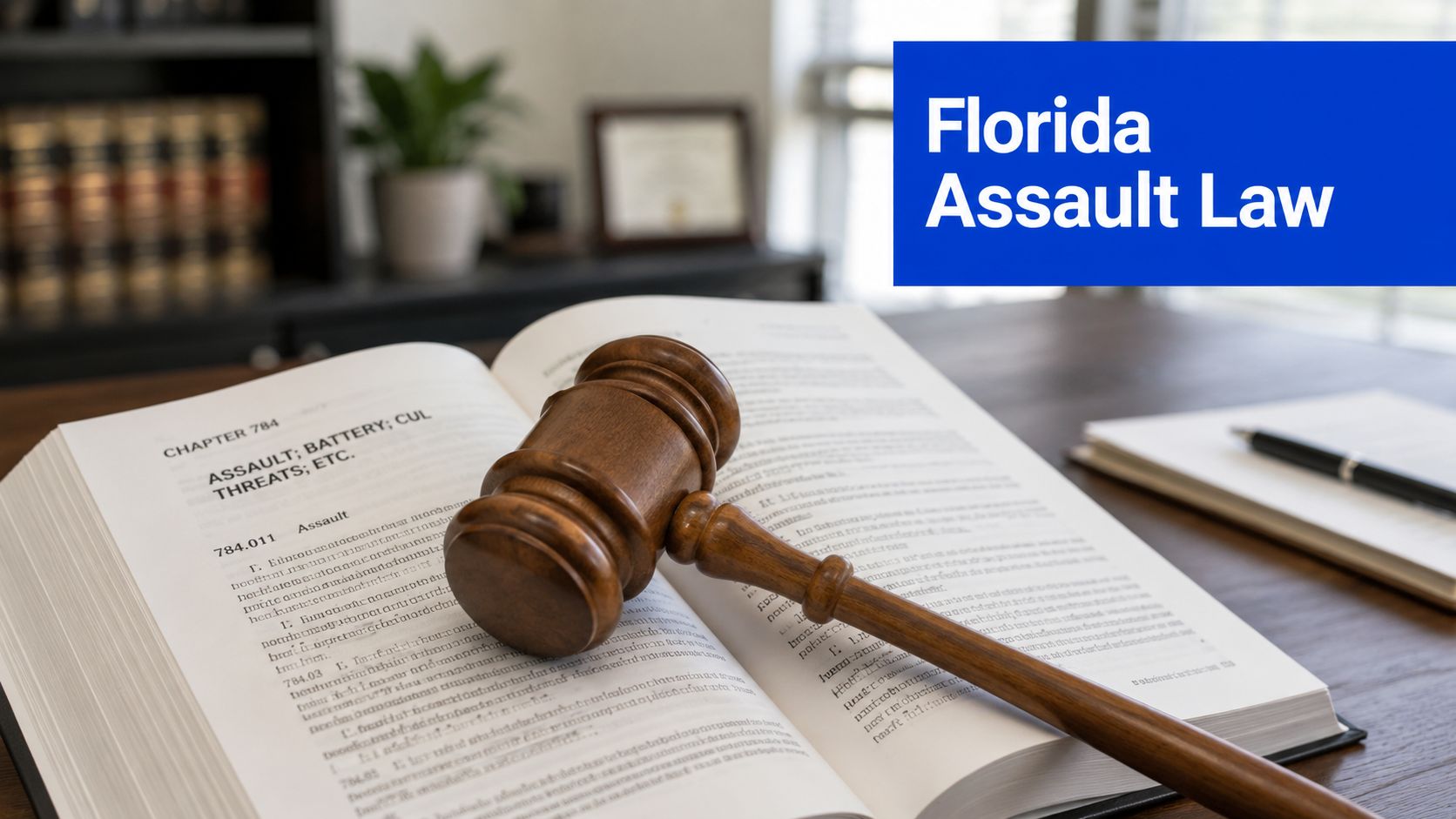
Under Florida Statute section 784.011, simple assault generally means an intentional, unlawful threat by word or act to do violence to another person, coupled with an apparent ability to carry out that threat, and doing something that creates a well-founded fear in the other person that violence is about to happen.
That sounds technical. In plain language, prosecutors usually need to show three practical ideas:
There was an intentional threat: It can be spoken, physical, or a combination of both.
The threat seemed real in the moment: The person accused appeared able to carry it out.
The other person reasonably feared immediate violence: Not a vague future concern. A present fear that something was about to happen.
A common misunderstanding is that assault always requires physical contact. It doesn't. If contact occurs, that may move the case toward battery or another charge. Assault can exist even without a punch landing.
For example, if someone raises a fist, steps forward, and threatens to hit another person in a way that creates immediate fear, prosecutors may argue assault occurred even if nobody was struck.
A threat alone isn't always enough. The state still has to prove that the threat was intentional, that it appeared capable of being carried out, and that it created real fear of immediate harm.
When assault becomes aggravated assault
Florida Statute section 784.021 addresses aggravated assault. This is a more serious form of assault. It generally involves either a deadly weapon without intent to kill, or an assault committed with intent to commit a felony.
That's a major jump in exposure because aggravated assault is usually treated as a felony rather than a misdemeanor. Cases can turn on details such as:
What object was involved
How it was displayed or used
Distance between the people
Words spoken during the incident
Whether video, texts, or witnesses support the accusation
A bottle, knife, firearm, or even another object can become central to the state's theory depending on the facts. The issue often isn't just what the object was, but how the prosecution says it was used or threatened.
If you're trying to understand where your case fits, it may help to read more about aggravated assault charges in Florida.
How Florida Defines Domestic Violence
Two people can be accused of the same shove, the same threat, or the same heated argument. In one case, prosecutors treat it as a standard assault or battery case. In the other, the relationship turns it into a domestic violence case, and the rules can change almost immediately.
That is the part many frightened clients do not expect. They focus on the incident itself. Florida law also focuses on who the other person is.
The relationship changes the legal category
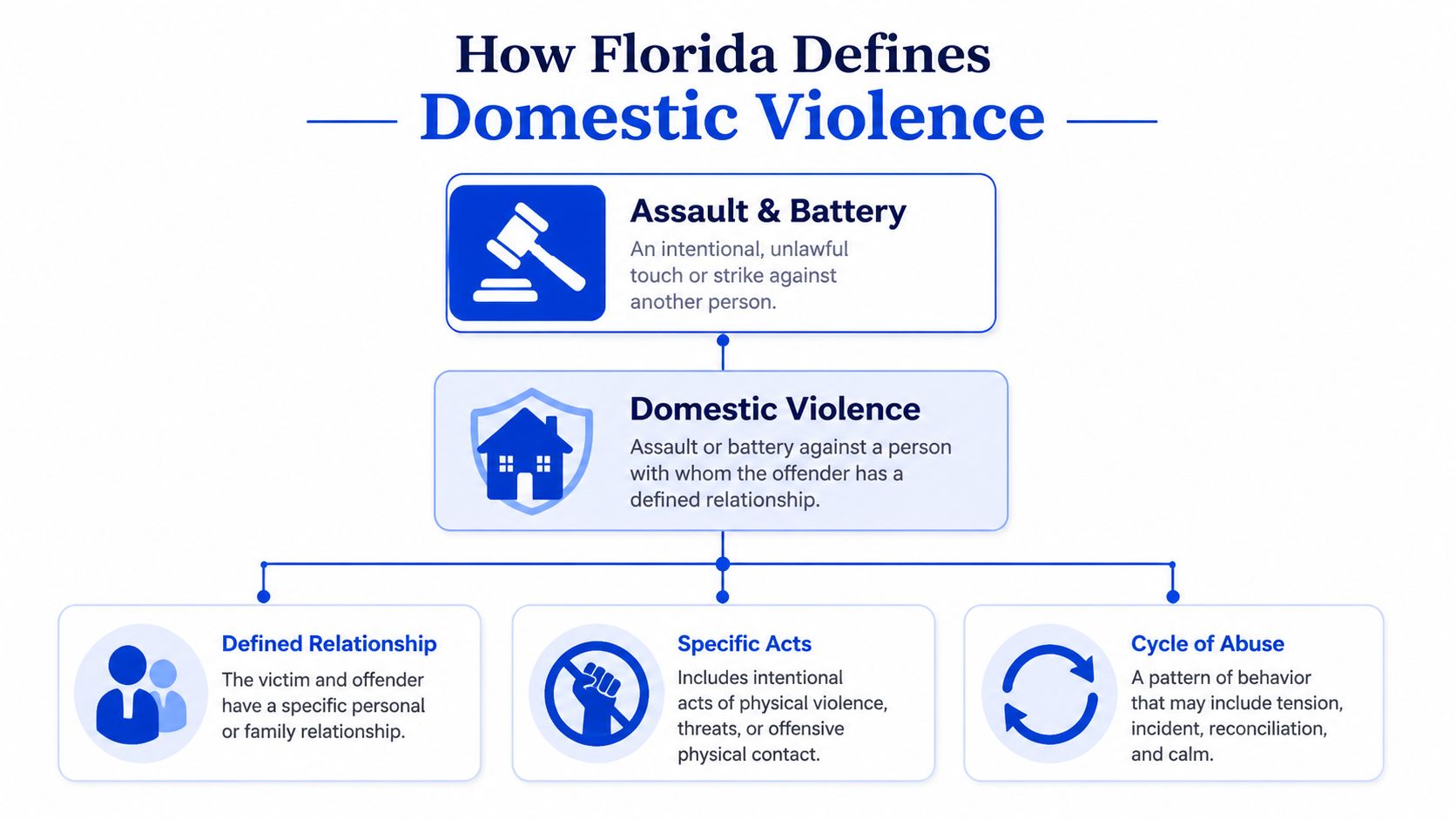
Under Florida law, domestic violence usually means an underlying offense, such as assault, battery, stalking, or another qualifying act, committed against a family or household member. The conduct still matters. But the relationship is what places the case into the domestic violence category.
A simple way to understand it is this: assault describes the alleged act. Domestic violence describes the act plus the relationship.
That distinction sounds technical, but it affects real life fast. A case involving a stranger and a case involving a spouse, former partner, relative, co-parent, or person living in the same home may start from similar facts and still move through court very differently.
Florida courts look closely at whether the people involved fit the statutory definition of family or household members. That may include spouses, former spouses, people related by blood or marriage, people who live together as a family or have lived together as a family, and parents who share a child. If the state believes that relationship exists, the same allegation can carry the domestic violence label even before the full facts are sorted out.
Why that label matters so much
Clients often ask a fair question: if the act is the same, why does the case feel completely different?
Because in practice, the domestic violence designation changes the fight. It can affect first appearance conditions, contact with the other person, where you can live, whether you can return home, and how the judge views risk at the beginning of the case. Later, it can affect firearm rights, plea options, counseling requirements, and the long-term record people see.
In other words, the label does more than describe a relationship. It changes the procedure around the charge.
Courts and prosecutors also tend to look at domestic cases through a wider lens than a single moment. The U.S. Department of Justice explains domestic violence as abusive behavior used to gain or maintain power and control over an intimate partner, including physical acts, threats, emotional abuse, and other coercive conduct, as described by the Office on Violence Against Women overview of domestic violence. That does not mean every accusation proves a larger pattern. It does explain why judges may treat these cases with added caution from day one.
What people often misunderstand
Confusion usually comes from treating "domestic violence" as if it were always a separate act. In many Florida cases, it is better understood as a legal designation attached to an underlying offense.
For example:
Assault asks: Was there an intentional threat or act that created fear of imminent violence?
Battery asks: Was there an intentional unwanted touching or strike?
Domestic violence asks: Did that alleged offense involve a qualifying family or household relationship?
That is why an allegation involving a dating partner, spouse, or co-parent can become a different legal battle than an identical allegation involving a coworker or neighbor.
If the accusation involves physical contact that prosecutors believe goes beyond a minor touching, it may help to read how Florida treats more serious violent accusations such as felony battery charges in Florida.
The practical takeaway
The core distinction is simple, even if the consequences are not. Assault focuses on the alleged conduct. Domestic violence focuses on the alleged conduct plus the relationship between the people involved.
And that added relationship finding is not a side issue. It is a key factor that can reshape the entire case before you ever get to trial.
Comparing Penalties Assault vs Domestic Violence
For many clients, this is the section that changes how they see the case. The issue isn't just what the charge is called. The issue is what the domestic violence designator can do to your life while the case is pending and after it ends.
Assault vs Domestic Violence Assault in Florida
Consequence | Standard Assault | Domestic Violence Assault |
|---|---|---|
Basic structure | Usually charged by the underlying offense alone | Underlying offense plus domestic violence treatment because of the relationship |
Bond conditions | May be less restrictive depending on facts | Often includes stricter release terms and contact restrictions |
Contact with alleged victim | Case-specific | No-contact conditions are common and can affect living arrangements and parenting time |
Court approach | Standard criminal handling | Greater concern about safety, repeat conflict, and protective conditions |
Programs and special conditions | Depends on offense and outcome | Domestic violence specific counseling or intervention may apply |
Firearm consequences | Depends on the exact offense and disposition | Domestic violence convictions can trigger serious firearm consequences under federal law |
Long-term impact | Serious, but more offense-specific | Serious plus family court, employment, housing, and reputation fallout tied to the domestic label |
In Florida practice, a domestic violence allegation often creates a much tougher early court environment than a standard assault allegation. A judge may bar contact with the alleged victim even when both people want to communicate. That can mean you can't return home, can't discuss the case, and can't try to smooth things over yourself.
For someone in Fort Lauderdale or Broward County, that often creates immediate real-world damage before guilt is ever decided. Housing gets disrupted. Child exchanges become harder. Work performance suffers. Family members get involved. A single arrest can quickly turn into several legal problems at once.
The same physical allegation can become a very different legal battle once the state classifies it as domestic violence.
Florida law can also impose consequences after conviction that many people don't expect. Depending on the charge and outcome, a domestic violence conviction may come with mandatory conditions, treatment requirements, and restrictions that don't usually carry the same force in a standard assault case. The domestic label itself becomes a central defense issue, not just a background detail.
If the accusation involves actual physical contact instead of only a threat, related offenses may enter the picture. You can compare that with broader discussions of felony battery in Florida.
Why prosecutors handle domestic cases more aggressively
The legal system often treats domestic violence allegations as a public safety matter, not merely a private dispute. That shows up in prosecution patterns and outcomes. State Court Processing analysis found that domestic violence cases involving sexual assault had a 98% conviction rate compared with 87% for non-domestic sexual assault cases, according to the State Court Processing study on domestic violence case outcomes.
You shouldn't read that as meaning every domestic violence case is unwinnable. You should read it as a warning that prosecutors often scrutinize these cases closely and pursue them aggressively.
That's also why the phrase domestic violence vs assault matters in practice. It isn't just a vocabulary question. It can affect:
How quickly the state files
Whether the court keeps no-contact rules in place
How plea negotiations unfold
What collateral consequences follow a conviction
When a client asks, “Why are they treating this so seriously if the facts are disputed?” the answer is often that the domestic classification changes the prosecution posture from day one.
Common Defenses for Assault and Domestic Violence Charges
A charge can feel like the case is already decided, especially if the arrest report makes the situation sound simple and one-sided. It is not decided. In these cases, defense work often starts by pulling apart two different questions that people blend together under stress: did the alleged act happen the way police wrote it, and does the case qualify as domestic violence under Florida law?

Defenses that challenge what happened
Many domestic violence cases are built on the same core allegation as an ordinary assault case: a threat, an argument, a sudden movement, and a claim that someone feared immediate harm. Earlier in this article, we noted that simple assault appears often in family violence reporting. That matters because the defense analysis usually begins with the same building blocks. What was said, what was done, what the other person perceived, and whether the fear was reasonable and immediate.
A useful way to understand this is to picture the state's case like a chain. If one link is weak, the whole theory can fail. Prosecutors still have to prove intent, credibility, and the surrounding context. They do not get a free pass because the allegation arose inside a family or dating relationship.
A lawyer may test defenses such as:
Self-defense: You used reasonable force because you believed harm was about to happen to you.
Defense of others: You acted to protect a child, relative, or another person nearby.
No intentional threat: Harsh language, mutual yelling, or emotional statements do not automatically equal assault.
No well-founded fear: The state must show the alleged victim had a reasonable fear of immediate violence, not a vague fear or anger after the fact.
False or exaggerated accusation: Breakups, jealousy, divorce disputes, and parenting conflicts can distort what gets reported.
Insufficient proof: The accusation may rest on inconsistent statements, missing video, unclear audio, or a timeline that does not hold together.
That review often turns on small details. A text sent five minutes before the call. A Ring camera clip with no sound. A witness who heard part of the argument but not the beginning. In domestic cases, those details can decide whether the court sees a criminal threat, mutual arguing, self-protection, or a report shaped by emotion after the fact.
Digital evidence often matters more than people expect. Texts, call logs, location data, photos, and voicemail timestamps can confirm or contradict the version in the police report.
If you want a fuller explanation of how these cases are defended, review this guide on defending domestic violence charges in Florida.
Defenses that challenge the domestic label
Sometimes the strongest defense does not focus only on the argument itself. It focuses on the legal label attached to it.
That label matters because an assault case and a domestic violence case can start from similar facts but lead to very different consequences. The domestic violence designator can bring stricter bond conditions, no-contact orders, batterers' intervention requirements, immigration concerns, firearm consequences, and in some situations mandatory jail time. So one defense question is straightforward: did the state correctly classify the relationship?
That issue comes up more often than people think. The state may assume the required family or household relationship exists when the facts are less clear. Maybe the parties dated briefly but never lived together. Maybe they were separated long before the accusation. Maybe the police report simplified a living arrangement that matters legally.
Common points of dispute include:
Whether the parties shared the kind of relationship Florida law requires
Whether they lived together in the way the statute contemplates
Whether the alleged victim fits the legal category the state is claiming
Whether the paperwork overstated or misunderstood the relationship history
This is not a technical side issue. It can change the whole posture of the case. If the domestic designation does not fit, the defense may be able to challenge conditions and consequences that would not apply in a standard assault prosecution.
Credibility also becomes more complicated in these cases because the people involved usually know each other well. They may share children, a home, finances, or a breakup history. That background can explain motive, but it can also explain inconsistency. A change in the story does not automatically prove the accusation is false, and it does not automatically prove it is true. It has to be examined carefully against the evidence.
One warning matters here. Do not try to contact the alleged victim to straighten things out yourself. That can create a bond violation, support a witness tampering allegation, or damage a defense that might otherwise be strong.
The best defense is usually early, disciplined, and built on documents, digital records, and a careful review of what the state can prove in court.
What to Do Immediately if You Are Charged
When someone is arrested or learns charges may be coming, the first few decisions matter more than is often understood.
The first hours matter
The broader context explains why police and prosecutors move fast. The Hotline reports that an average of 24 people per minute are victims of rape, physical violence, or stalking by an intimate partner, amounting to more than 12 million women and men in a single year. The same page also cites CDC-based figures stating that more than 10 million adults experience domestic violence annually in the United States, according to The Hotline domestic violence statistics page.
That doesn't prove your case. It does explain why Florida law enforcement treats these calls as urgent from the first report onward.
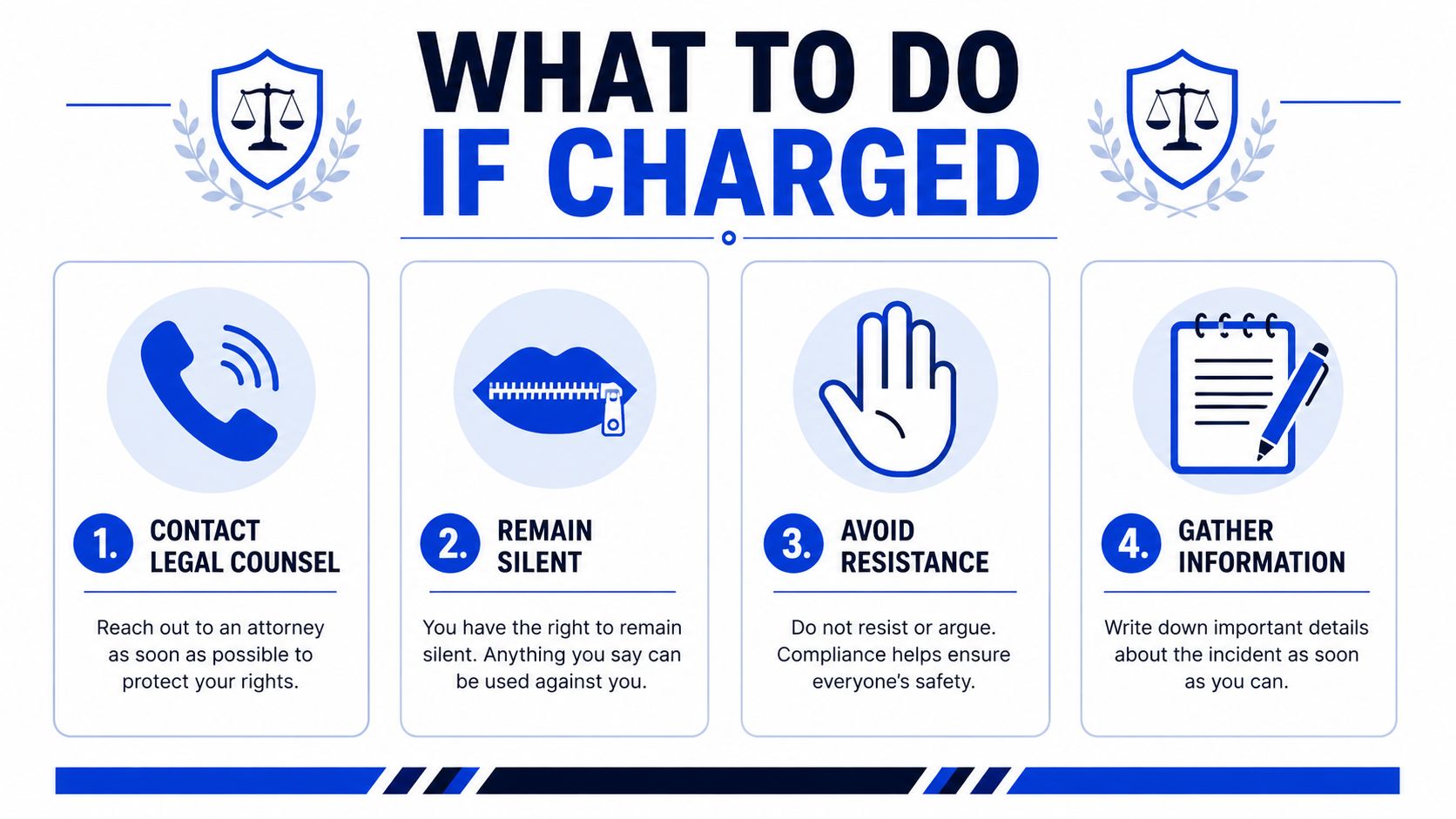
If you've been charged in Broward County, Fort Lauderdale, Miami-Dade, Palm Beach, or anywhere in South Florida, take these steps immediately:
Stay silent about the facts
Give identifying information if required, but don't try to explain, justify, or argue your side with police. People often think they can talk their way out of a misunderstanding. Instead, they fill gaps in the state's case.Follow every court order exactly
If the judge entered a no-contact order, obey it strictly. Don't call. Don't text. Don't send messages through family or friends. Even friendly contact can create a new problem.Preserve evidence now
Save texts, voicemails, photos, videos, social media messages, and call logs. Screenshot what could disappear. Write down the timeline while it's fresh.
A short video can help reinforce the urgency of those early choices.
Mistakes that make cases worse
People under stress often do the same harmful things:
Trying to reconcile too soon: This can violate release conditions.
Posting online: Social media posts get misread, saved, and used.
Deleting messages: That can look like consciousness of guilt.
Talking to everyone except counsel: Friends and relatives can become witnesses.
If you're looking at alternatives that may exist in some cases, you may want to learn how pre-trial intervention in Florida can work, depending on the charge, the facts, and the jurisdiction.
The safest move is simple. Stop talking about the facts with anyone except your lawyer, protect your evidence, and take every court condition seriously.
Florida Domestic Violence vs Assault FAQs
Can the alleged victim drop the charges?
No. In Florida, the prosecutor decides whether to continue or dismiss a criminal case. The alleged victim's wishes can matter, but they don't control the prosecution.
If the other person wants me back home, can I return?
Not unless the court allows it. If there's a no-contact or stay-away order, violating it can create a separate legal problem. Verbal permission from the other person doesn't override a judge's order.
Is domestic violence a separate crime from assault?
Usually, the more accurate way to think about it is this: assault is the underlying offense, and domestic violence is the legal classification triggered by the relationship and facts. That classification can change the way the case is handled and punished.
Will I lose my gun rights if I'm convicted?
A domestic violence conviction can have serious firearm consequences under federal law. That issue needs to be reviewed carefully with counsel before any plea or sentencing decision.
What if nobody was injured?
A lack of injury doesn't automatically end the case. Assault may be based on threats and fear of immediate violence. Other related charges may depend on alleged contact, visible marks, witness statements, or recordings.
Can I seal or expunge a domestic violence conviction in Florida?
A conviction creates long-term record consequences, and domestic violence outcomes often create serious limits on record relief. This is one of the reasons early defense strategy matters so much.
Why are these cases handled so aggressively?
Courts and prosecutors often see domestic cases as carrying risks that go beyond a single incident. That affects bond conditions, contact restrictions, and plea discussions from the start.
What's the biggest mistake people make after arrest?
Trying to “fix” the case themselves. They call the other person, post online, delete messages, or give long explanations to police. Those choices usually help the prosecution, not the defense.
If you're facing assault or domestic violence allegations in Fort Lauderdale, Broward County, Miami-Dade, Palm Beach, or elsewhere in Florida, Ticket Shield, PLLC can help you understand the charge, protect your rights, and build a strategy based on the actual facts. A confidential consultation can help you act quickly, avoid common mistakes, and start defending your future.
Domestic violence and assault sound similar but are treated very differently under Florida law. Here's what separates the two charges.