Domestic Violence Lawyer Tampa: Protect Your Rights
Jason Goldsmith, Esq
An argument at home got loud. Someone called the police. Officers separated everyone, asked fast questions, and then one person left in handcuffs. If that's where you are right now, the confusion is usually worse than the paperwork. You're worried about jail, your job, your kids, your home, and whether one night is about to change your record forever.
That reaction is normal. Domestic violence cases in Tampa move quickly, and they often involve two different court problems at the same time. One is the criminal case. The other may be a civil injunction for protection. People often focus on only one and miss the other until a deadline is already in front of them.
A search for a domestic violence lawyer Tampa usually starts in that first wave of panic. What matters now is getting clear about what happens next, what can hurt you, and what helps. The law gives the State powerful tools in these cases, but an accusation is not a conviction. Good early decisions can protect your rights and keep a bad situation from getting worse.
Table of Contents
Answering the Call When Your World is Turned Upside Down
Most clients don't call after a calm, orderly day. They call from the edge of a crisis. Maybe they were booked into jail. Maybe a family member is trying to figure out first appearance. Maybe they're standing outside a home they can't return to because a judge has already entered a no contact order.
Domestic violence allegations also escalate fast because the system treats them as urgent from the start. In 2020, Florida law enforcement agencies reported 106,515 domestic-violence crimes, which led to 63,217 arrests, according to the Florida domestic violence statistics page. That volume helps explain why officers, first appearance judges, and prosecutors move quickly and often make early decisions with limited context.
What usually doesn't help is trying to fix the situation yourself. Calling the other person from jail, asking a relative to "straighten it out," sending texts to apologize, or assuming the case will disappear by morning often creates a worse record for the prosecution to use later.
Practical rule: The first goal is not to argue your whole case to everyone involved. The first goal is to avoid making new problems.
A useful first consultation focuses on immediate damage control:
Release conditions: Find out whether bond, supervised release, or a no contact order is already in place.
Communication limits: Stop all direct and indirect contact if a court order prohibits it.
Evidence preservation: Save texts, call logs, photos, videos, and names of witnesses before they disappear.
Case separation: Identify whether you're dealing with only a criminal case, only an injunction, or both.
When your world feels upside down, clarity matters more than speeches. The path forward starts with understanding exactly what you're charged with.
Understanding Florida Domestic Violence Charges
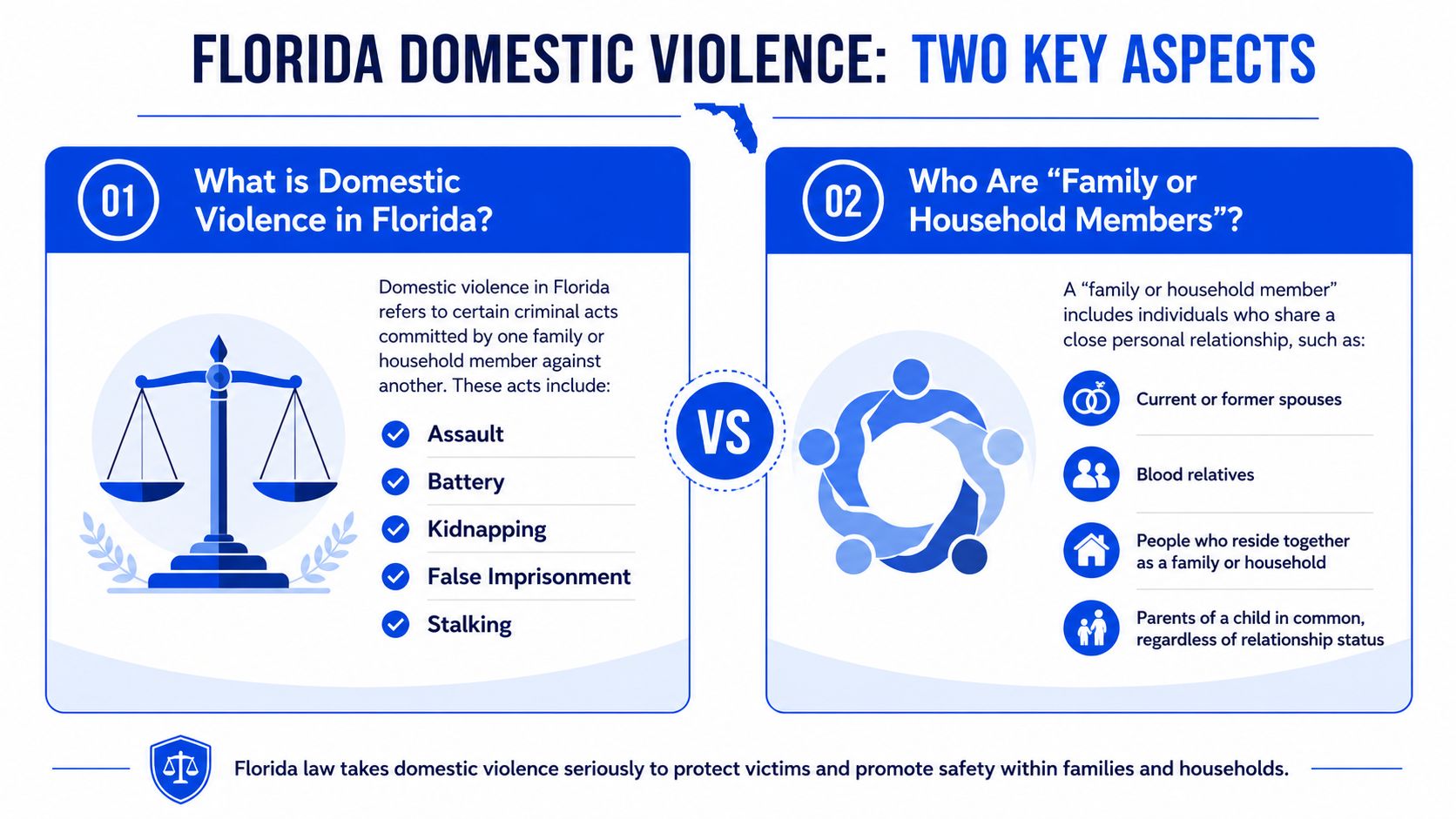
Florida uses a legal definition that is broader than many people expect. Under Florida Statute §741.28, domestic violence includes certain criminal offenses committed by one family or household member against another, including offenses such as assault, battery, sexual assault, stalking, kidnapping, false imprisonment, or any criminal offense resulting in physical injury or death, as described by this Florida domestic violence legal overview.
What the law actually covers
The relationship between the people involved matters just as much as the alleged conduct. In practice, these cases aren't limited to married couples living together. The category can include spouses, former spouses, relatives, people who reside together as a family, people who previously resided together as a family, and parents who share a child.
That broad relationship definition is one reason arguments that might otherwise look like a standard battery case are charged as domestic violence instead.
If the allegation involves physical contact, the underlying offense may be charged as a misdemeanor or a felony depending on the facts. A first offense misdemeanor may expose a person to up to 12 months in jail and a $1,000 fine, while aggravating facts such as strangulation may raise the charge to a third-degree felony with up to 5 years' imprisonment and a $5,000 fine, as outlined in this Florida domestic violence defense discussion.
For readers dealing with allegations involving serious force, related information about violent crime defense in Florida can also help frame how prosecutors evaluate these cases.
Why the label matters so much
A domestic violence case is not just about whether the prosecutor can prove a brief incident in a home or relationship. The label changes the long-term stakes. A conviction for a domestic violence offense is not eligible for sealing or expungement under the legal summary linked above from Tampa Criminal Attorneys. That means the outcome can stay on your record permanently.
A bad plea entered just to get out of immediate pressure can create years of consequences in employment, housing, family court, and civil rights.
There is also a compliance component people often overlook. A court may order a 26-week Batterers' Intervention Program in the right case, which turns the case into more than a question of jail or no jail. It becomes a question of long-term conditions, supervision, and how much control the court maintains over your daily life.
That is why the first defense conversation should be specific. What offense is charged. What relationship category applies. What facts make it a misdemeanor or a felony. And what result protects your future, not just your weekend.
What to Expect After a Tampa Domestic Violence Arrest
The first day after an arrest is usually the most chaotic. People want one simple answer about what happens next, but the better answer is a sequence. If you know the sequence, you stop guessing.
Early stages often include booking, a first appearance before a judge, bond conditions, and restrictions on contact. In many cases, the practical damage starts before the formal evidence fight does.
The first hours matter most
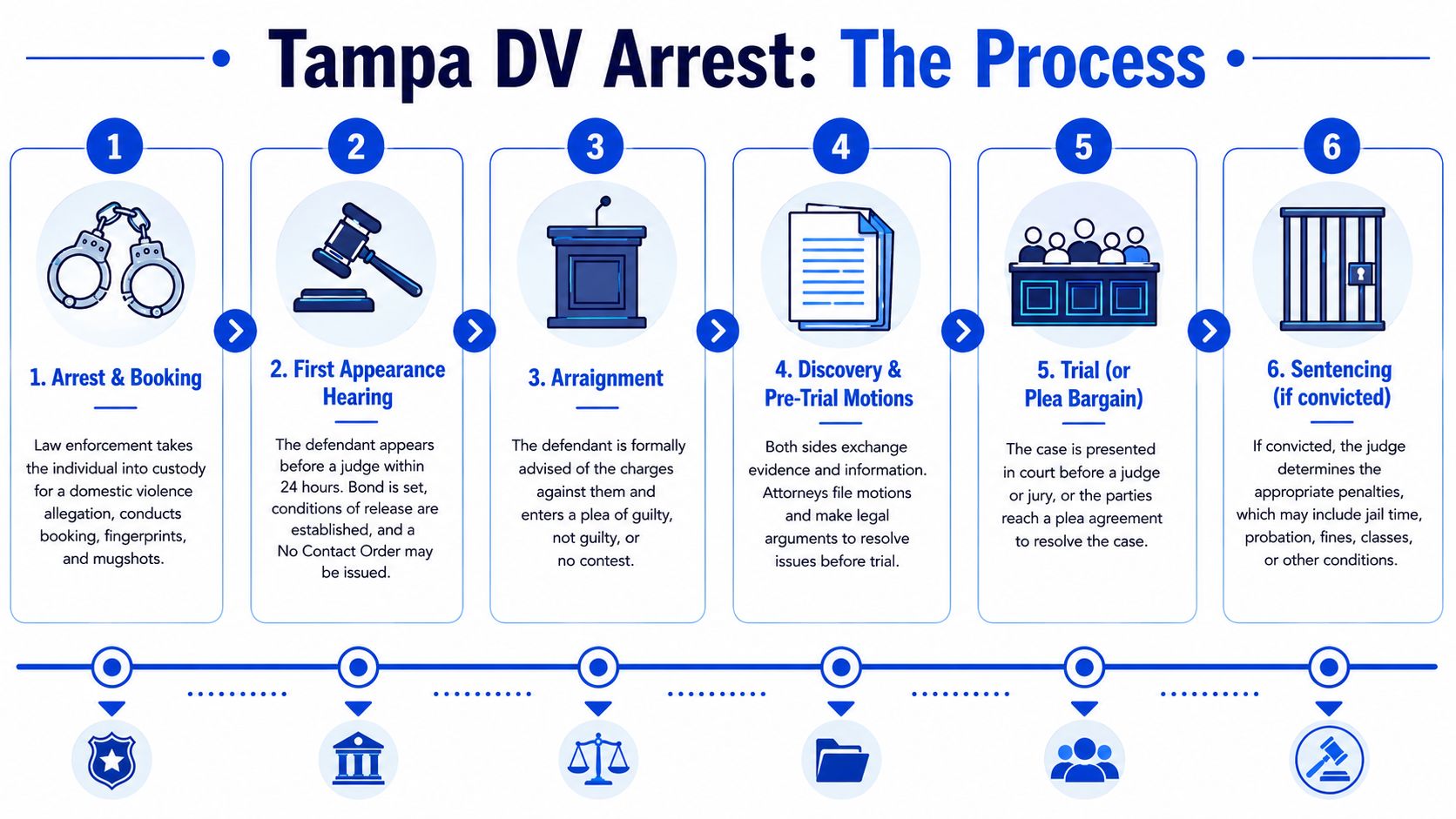
A typical Tampa domestic violence case unfolds like this:
Arrest and booking
Officers take the accused into custody, complete reports, collect identifying information, and enter the person into the jail system. This is not the time to explain the whole relationship history to law enforcement. Statements made here can come back later in reports or testimony.First appearance
A judge reviews the arrest, considers release, and sets conditions. This is often where the court addresses bond and orders no contact.Arraignment and charging stage
The State decides how it wants to proceed. The earlier the defense can identify weaknesses, the better chance there is to shape that decision before the case hardens.
A useful related read, especially where the allegation involves more serious touching or injury, is this page on felony battery in Florida.
This short video gives a general picture of the court process many families are trying to understand right away.
What a no contact order means in real life
The court's no contact order is where many people make avoidable mistakes. If the judge says no contact, treat that language strictly. It usually means no calls, no texts, no messages through friends or relatives, no social media contact, and no returning home if the protected person is there unless the court changes the order.
People get tripped up because real life doesn't pause. There may be children, clothing, medicine, work tools, pets, rent, or a shared mortgage. None of that changes the order unless the court modifies it.
If the other person reaches out first, that usually does not give you permission to respond.
Here are the most common immediate missteps:
Trying to apologize: An apology can be used as an admission.
Trying to negotiate the facts: That creates more statements and more evidence.
Using third parties: Courts often treat indirect communication as a violation too.
Returning home without permission: Even if your name is on the lease or deed, a court order still controls.
The cases that go better usually have one thing in common. The accused gets legal guidance before making emotional decisions.
The Two Fronts Criminal Charges and Civil Injunctions
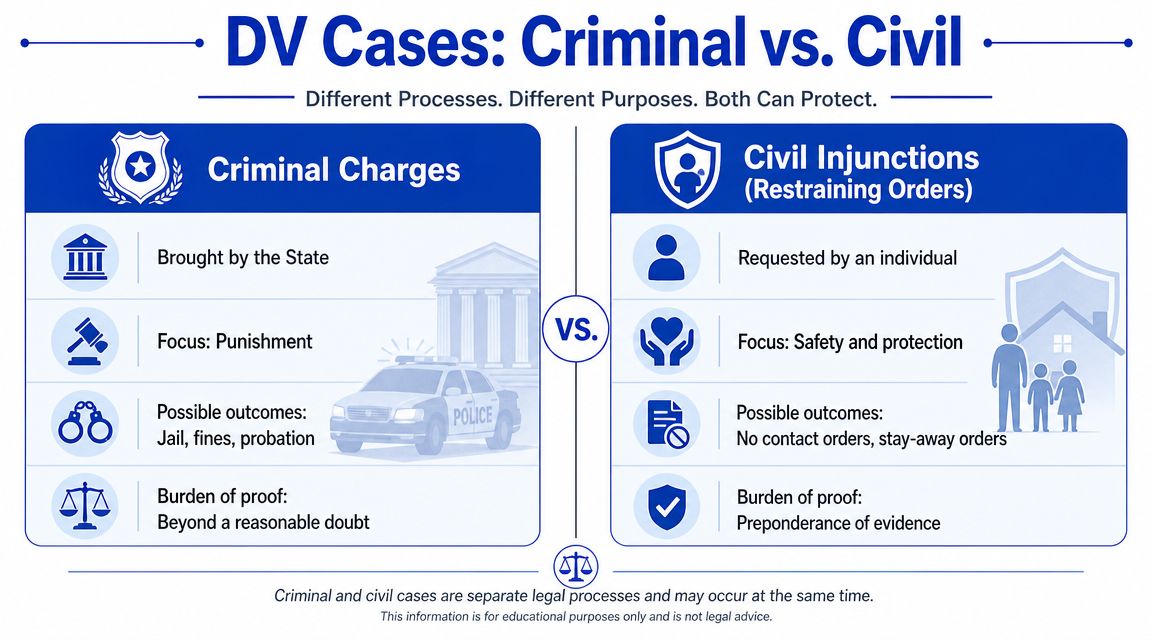
Many domestic violence cases involve two separate court battles at the same time. One is the criminal prosecution brought by the State. The other is a civil injunction case filed by the other party. People often assume they are the same proceeding. They aren't.
That distinction matters because each case has different goals, different rules, and different risks.
How the cases differ
Issue | Criminal case | Civil injunction |
|---|---|---|
Who files it | The State of Florida | The petitioner |
Main purpose | Punishment and prosecution | Protection and restrictions |
Proof standard | Beyond a reasonable doubt | Lower standard of proof |
Possible result | Jail, probation, conviction, plea, dismissal | Stay-away orders, contact restrictions, firearm-related consequences |
Florida family-law guidance notes that many people are surprised to learn they must defend against a civil injunction for protection even if no criminal charges are filed, or at the same time as a criminal case. It also explains that these cases move quickly and use a lower standard of proof, which is why early defense work is important to protect rights, including firearm rights, as discussed in this Florida domestic violence injunction overview.
The list of allegations that can support an injunction can overlap with criminal allegations, including conduct that may also appear in cases involving false imprisonment allegations in Florida.
Why strategy has to cover both
What helps in one courtroom can hurt in the other if you handle it carelessly. A rushed statement in an injunction hearing can affect the criminal case. Silence in the criminal case may be legally smart, but it can feel uncomfortable in the civil case if you don't have a plan.
A person can avoid a criminal conviction and still end up with a final injunction. The reverse can also happen.
That is why these cases should be approached as one coordinated defense problem, not two unrelated files. The questions are practical:
Should you testify anywhere yet
What records should be gathered first
Which witnesses help both cases
What facts should be developed without locking you into harmful testimony
The strongest early strategy usually comes from understanding where the cases overlap and where they don't.
Common Defenses Against Domestic Violence Allegations
Domestic violence cases are often won or improved by disciplined evidence work, not dramatic courtroom speeches. In many files, the central issue is credibility. What exactly happened, who saw it, what was documented, what was left out, and whether the evidence supports the charge.
The defense starts by testing the State's proof instead of accepting the police version as final.
Where strong defenses usually begin
A practical defense review usually looks at the evidence in layers.
Physical evidence: Are there injuries, and if so, do they match the story being told?
Statements: Did the complaining witness give conflicting versions?
Corroboration: Is there any independent support beyond accusation alone?
Collection problems: Were 911 calls, photos, medical records, and sworn statements gathered and preserved properly?
According to the Goldman's Wetzel page already cited earlier, key defense arguments include the absence of injury, contradictory witness statements, and lack of corroboration. That same source also notes that prosecutors may continue even when the accuser later recants, which is why the timing of the defense matters.
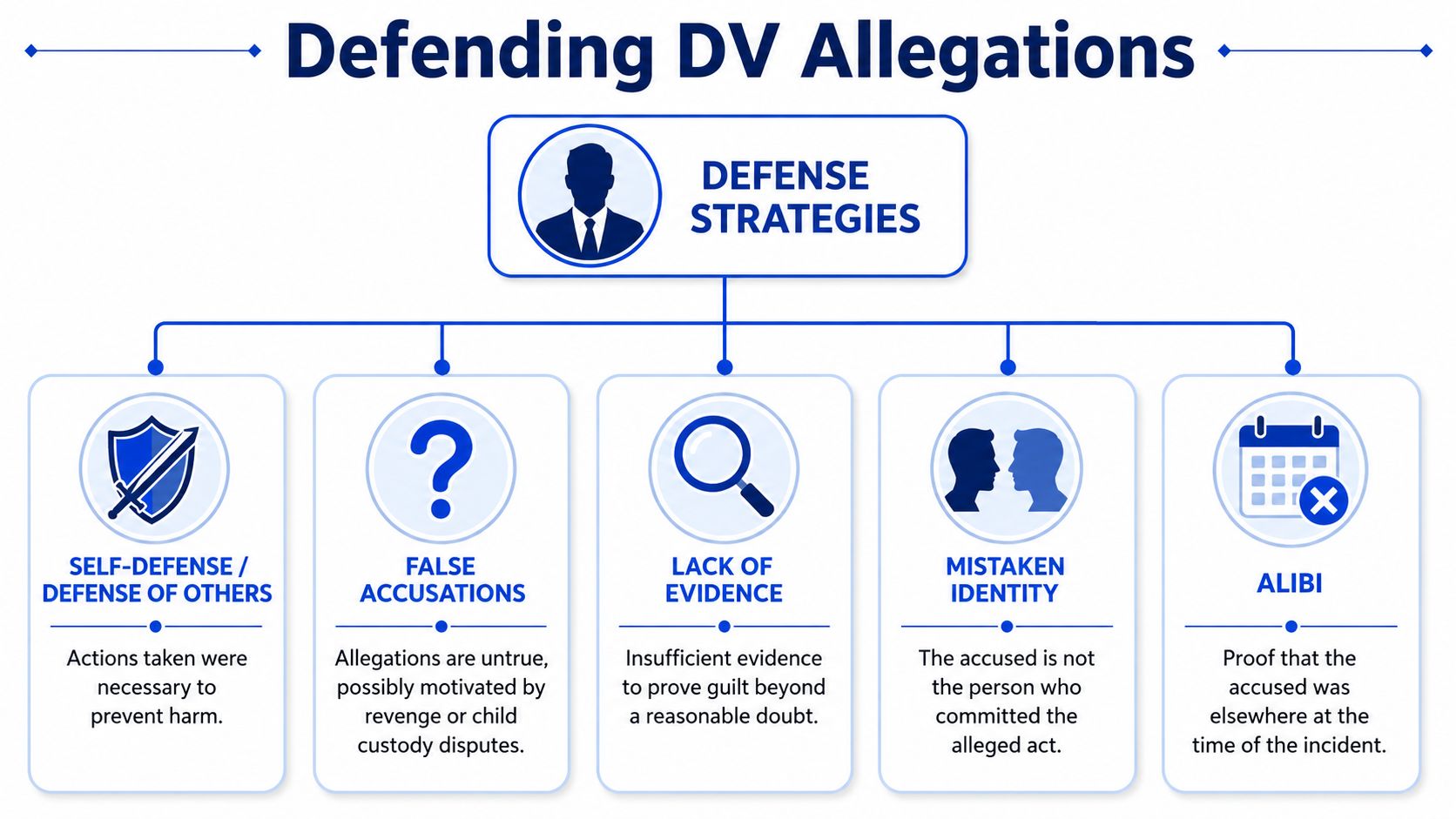
Self-defense can also be a valid issue in the right facts. So can defense of others, false allegation, accident, or a theory that the incident has been exaggerated during a breakup, custody conflict, or household dispute. But those defenses only help if the evidence supports them.
Defenses that work and mistakes that don't
What tends to work:
Fast evidence preservation: Save texts, video, photos, and call history before phones are replaced or messages disappear.
Independent witness development: Neutral witnesses often matter more than family members who seem aligned with one side.
Careful timeline building: A clean timeline exposes contradictions better than broad denials.
Focused motion practice: If evidence was collected improperly, that issue should be identified early and litigated correctly.
What usually doesn't work:
Relying on recantation alone: Prosecutors often keep going.
Emotional messaging to the accuser: This often creates new evidence.
Assuming visible injury decides the case: Lack of injury helps, but it doesn't automatically end the prosecution.
Giving repeated informal statements: Every new version gives the State another comparison point.
Good defense work narrows the case to provable facts. Bad defense work multiplies side issues and admissions.
Experience matters. A former prosecutor knows what charging lawyers look for in these files, where reports tend to overstate certainty, and which weaknesses effectively move a case toward dismissal, reduction, or a defensible trial posture.
Choosing and Working With Your Tampa Defense Lawyer
Not every criminal defense consultation tells you what you need to know. In a domestic violence case, you need a lawyer who can deal with fast-moving hearings, restrictive pretrial conditions, and the possibility of a parallel injunction. You also need clear communication, because confusion creates violations.
The first meeting should feel less like a sales pitch and more like case triage.
Questions worth asking in a consultation
Bring the police paperwork if you have it. Bring your bond paperwork, any injunction documents, screenshots, and names of witnesses. Then ask direct questions.
What are the immediate risks: Ask what could happen in the next few days, not just the long-term outcome.
How do you handle injunction overlap: If there's a civil injunction hearing, the lawyer should be able to discuss how testimony in one case may affect the other.
What evidence should I preserve today: A useful lawyer gives specific examples, not vague advice.
Who will communicate with me: You need to know whether you will speak with the lawyer directly or mainly through staff.
What does representation usually include: Ask about hearings, motions, negotiations, and whether the lawyer appears for you where permitted.
If you're ready to start that process, you can use Ticket Shield's case submission form to share the basic facts before a consultation.
What good representation looks like
A good working relationship is built on speed, honesty, and discipline. Your lawyer should tell you when a fact helps, when it hurts, and when silence is smarter than explanation. You don't need false reassurance. You need a plan.
Here is what clients should expect from the process:
What to expect | Why it matters |
|---|---|
A document request early | Cases are easier to defend when evidence is preserved immediately |
Direct instructions about contact | Prevents new charges or bond violations |
A realistic assessment | Helps you weigh trial risk, negotiation, and injunction strategy |
Preparation before each hearing | Reduces surprises and careless testimony |
Fees are usually structured as either a flat fee for defined stages or a retainer arrangement depending on the case. The exact model matters less than knowing what is included, what would trigger additional work, and how communication will happen when the case gets stressful.
Tampa Domestic Violence FAQ and How We Can Help
Can charges be dropped if the other person wants them dropped
Not necessarily. In domestic violence cases, the prosecutor decides whether to continue. The complaining witness's wishes matter, but they don't control the State's decision.
Will this affect firearm rights
It can. Firearm issues often arise through criminal case conditions, injunction orders, and the consequences that follow certain case outcomes. This is one reason clients need immediate advice before agreeing to terms they don't fully understand.
Do I have to complete a Batterers' Intervention Program
Possibly. In the right case, the court may order a 26-week Batterers' Intervention Program. Whether that becomes part of the outcome depends on how the case is resolved and what the court orders.
What should I do first after release
Follow every court condition exactly. Do not contact the protected person if contact is barred. Save evidence. Get legal advice before you try to explain the incident to anyone connected to the case.
A Tampa domestic violence case can feel personal, but the defense has to stay precise. The court will look at allegations, evidence, procedure, credibility, and compliance. Early mistakes can make a defensible case harder. Early strategy can do the opposite.
If you're facing a domestic violence allegation in Tampa or anywhere in Florida, Ticket Shield, PLLC offers confidential consultations to review the charge, bond conditions, and any related injunction issues. The firm is led by a former prosecutor and handles criminal defense matters across Florida, helping clients evaluate the evidence, protect their rights, and make informed decisions early.
Facing domestic violence allegations in Tampa? Learn your rights, what to expect, and how an experienced defense lawyer can protect you.