
Charged with Drunk and Disorderly: What to Do
Jason Goldsmith, Esq
You're home after an arrest, citation, or night in booking, trying to understand how a few drinks turned into a criminal case. The phrase “drunk and disorderly” sounds straightforward, but Florida law doesn't make ordinary public intoxication a crime by itself. The State must prove specific conduct, and the label in an arrest report isn't a substitute for those legal elements.
That distinction matters in Broward County, Fort Lauderdale, Miami-Dade, Palm Beach, and throughout South Florida. Police officers decide how to describe an encounter and which charge to pursue, but prosecutors still must prove the offense beyond a reasonable doubt. The first priorities are protecting your right to remain silent, preserving evidence, and determining whether the alleged facts actually fit the statute.
Table of Contents
Understanding Florida Disorderly Intoxication Laws
Florida's comparable offense is disorderly intoxication, governed by Florida Statute § 856.011. The statute doesn't criminalize the mere fact that someone consumed alcohol or appeared visibly drunk in public. It requires proof of intoxication plus additional conduct that creates a legally recognized danger or disturbance.
The State must prove one of two theories:
Endangerment: The person was intoxicated and endangered the safety of another person or property.
Public disturbance: The person was intoxicated or consuming alcohol in a public place or public conveyance and caused a public disturbance.
A person walking home, waiting for a rideshare, sitting outside a business, or speaking with an officer isn't automatically guilty because an officer noticed alcohol on their breath. The prosecution must connect the intoxication to endangerment or an actual public disturbance. That connection becomes the central issue in many defenses.
The arrest label is not the legal test
An arrest report may describe someone as “drunk and disorderly,” but Florida law separates the officer's characterization from the elements that must be proved in court. A defense review should identify what the person allegedly did, who was endangered, what property was at risk, which members of the public were disturbed, and how the officer knows intoxication caused that conduct.
The report's wording also matters. Vague statements about being loud, unsteady, argumentative, or emotional may not establish the statutory theory without more factual detail. Witness accounts, body-worn camera footage, dispatch records, photographs, and nearby surveillance can expose a gap between an officer's conclusion and the underlying conduct.
For broader context on how Florida offenses are defined and prosecuted, review this overview of Florida criminal laws. The practical lesson is simple: alcohol consumption is a fact, not automatically a conviction. The State must prove the legally required behavior beyond a reasonable doubt.
Disorderly Intoxication Versus General Disorderly Conduct
Florida's disorderly intoxication statute and its general disorderly conduct statute address different legal theories, even though police reports sometimes blur them together. Disorderly intoxication under § 856.011 requires intoxication plus endangerment or a public disturbance. Disorderly conduct under § 877.03 focuses on conduct that affects public peace, public decency, or the quiet of people who witness it, including brawling, fighting, or another breach of the peace.
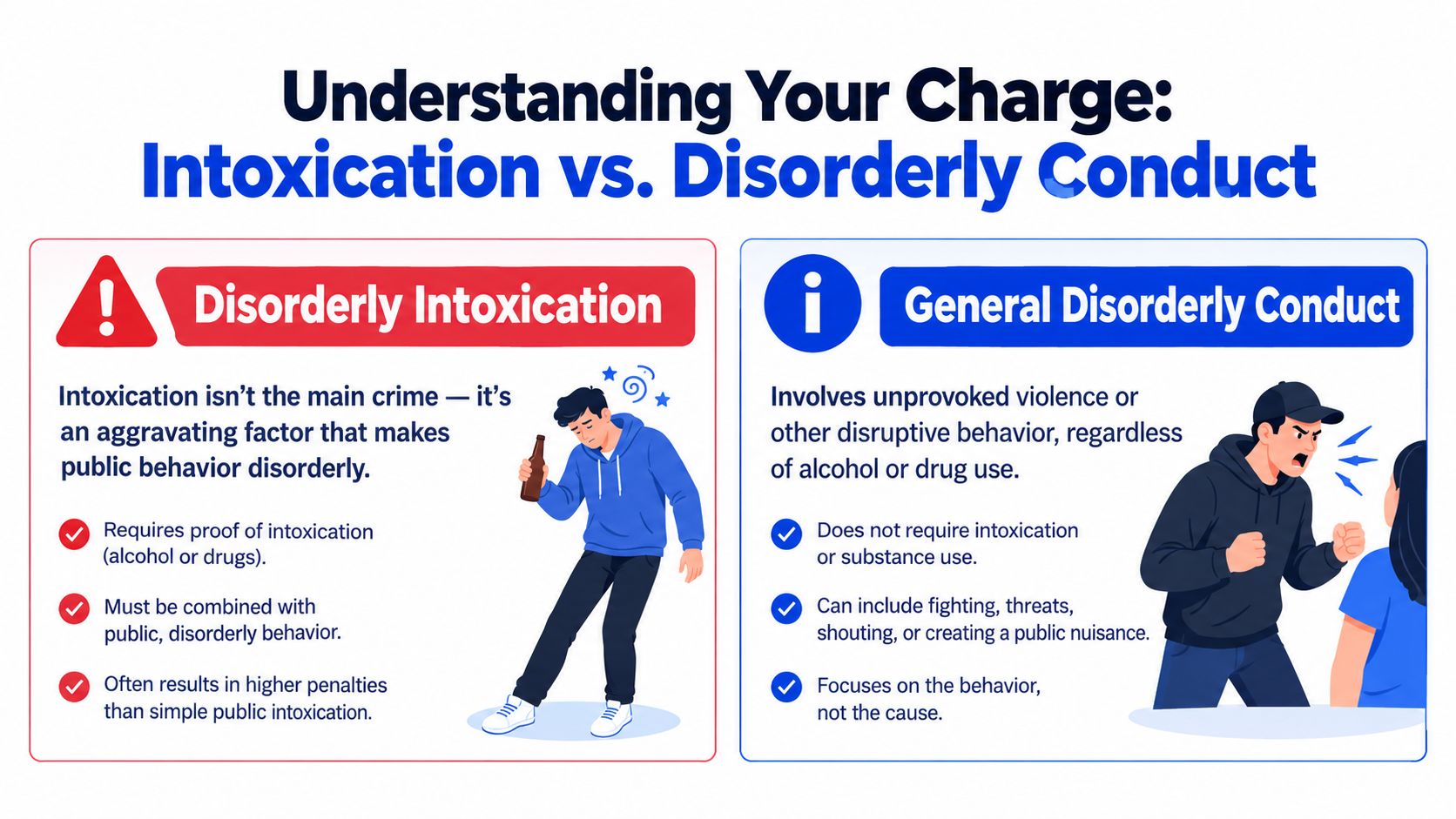
Both offenses are classified as second-degree misdemeanors in Florida. Under the statutory maximums in sections 775.082 and 775.083, a second-degree misdemeanor carries up to 60 days in jail and a fine of up to $500. Those are maximums, not automatic sentences, but the classification still affects the case strategy.
Issue | Disorderly intoxication | General disorderly conduct |
|---|---|---|
Alcohol required | Yes, intoxication or alcohol consumption is part of the State's theory | No |
Additional conduct | Endangerment or public disturbance | Breach of peace, fighting, brawling, offensive conduct, or another statutory form of disorder |
Main defense question | Did intoxication cause the danger or disturbance? | Did the alleged behavior meet the disorderly-conduct standard? |
Offense level | Second-degree misdemeanor | Second-degree misdemeanor |
Why the charging document matters
A prosecutor can't obtain a conviction merely by proving that an encounter looked unpleasant or chaotic. The charging document should identify the offense and provide enough factual substance to show what conduct allegedly violated the statute. If the facts support neither endangerment nor a public disturbance, a disorderly-intoxication charge may be vulnerable.
The same careful review applies to disorderly conduct. A disagreement, rude language, or visible frustration doesn't automatically establish a breach of the peace. The defense should compare the allegations with video, neutral witnesses, and the exact statutory wording rather than accepting the arrest label.
Immediate Steps to Protect Your Rights After Arrest
The safest approach after an arrest is controlled and limited communication. Don't try to explain the entire night to the arresting officer, booking staff, or anyone else connected to the investigation. Statements intended to provide context often give the State admissions about drinking, location, movements, or disputed interactions.

Use a short, respectful statement that you want to remain silent and speak with a lawyer. Don't argue about whether you were drunk, challenge the officer's honesty, or volunteer medical information without legal advice. You may need to provide basic booking information, but that doesn't mean you should answer investigative questions.
A practical post-arrest checklist
Invoke silence clearly. Say that you're exercising your right to remain silent and want an attorney. Don't assume that staying quiet without saying anything will always communicate your intention.
Don't sign investigative documents casually. Read release conditions and court paperwork carefully, but ask counsel to review waivers, statements, consent forms, and admissions before signing whenever possible.
Record the facts as soon as you're free. Write down the time, location, people present, officer names, exact words you remember, injuries, medical symptoms, transportation details, and any nearby businesses with cameras.
Preserve evidence before it disappears. Ask potential witnesses for contact information, save messages and location records, and tell your lawyer about bars, hotels, stores, garages, transit stations, or residences that may have surveillance footage.
This guide to what happens after arrest can help you understand the early procedural steps. Early representation also gives counsel an opportunity to communicate with prosecutors, address release issues, and evaluate whether intervention is possible before the case develops into a routine plea.
The booking process is not the time to prove your innocence. It's the time to avoid creating new evidence for the prosecution.
Challenging Police Observations and Field Evidence
Many alcohol-related public-order cases depend heavily on an officer's description of speech, balance, coordination, odor, eye appearance, and behavior. Those observations can matter, but they're not immune from challenge. Fatigue, anxiety, injury, illness, medication, heat, lighting, crowd noise, and the stress of an arrest can affect how a person appears and behaves.
The prosecution must still prove the statutory connection between intoxication and the alleged danger or disturbance. A defense attorney should ask whether the officer made contemporaneous notes, whether the body camera supports the report, whether independent witnesses saw the same conduct, and whether the officer considered explanations other than alcohol.
Screening devices are not the whole case
Handheld breathalyzers used in the field generally function as screening instruments. A reading may influence an officer's decision, but it doesn't automatically prove the statutory elements of disorderly intoxication or establish that alcohol caused a public disturbance.
Investigative reliability problems are well documented in alcohol-related interviews. A Swedish study of 133 police investigators found that 87% commonly or very commonly encountered intoxicated suspects, while 68% of respondents who answered a related question reported using an additional intoxication-assessment method beyond ordinary observation. The study also explains why calibration, timing, mouth-alcohol controls, repeat testing, and the distinction between screening and evidentiary devices matter. The study's findings support careful scrutiny, not automatic conclusions.
Practical rule: A breath screening result may support an investigation, but it doesn't replace proof of what happened in public.
Independent Australian Institute of Criminology data involving 161 people detained for disorderly conduct found that 85% had consumed alcohol during the preceding 48 hours, and 49% said alcohol contributed to the alleged offense. Among those who had been drinking, that contribution figure was 62%. Those figures show an association, not proof that every intoxicated person committed a crime or that alcohol caused a particular incident. The defense should test the actual evidence in the individual case.
Counsel may also examine whether officers had lawful grounds to detain, search, or obtain statements. A motion to suppress evidence can become important when constitutional violations affected the State's proof.
Penalties and Collateral Consequences of a Conviction
A disorderly-intoxication or disorderly-conduct conviction is a criminal conviction, even though both offenses are misdemeanors. Under Florida law, each is a second-degree misdemeanor carrying a maximum of 60 days in jail and a fine of up to $500. The court may also impose probation, conditions, costs, or other requirements depending on the facts and the person's record.
The maximum penalty isn't the only concern. A conviction can affect how employers, landlords, licensing authorities, schools, and professional organizations evaluate an applicant. Background checks don't always reflect the short duration of the alleged incident. They reflect the case outcome and the offense classification.
Why a quick plea can be expensive
Paying a fine or accepting a standard disposition may feel like the fastest way to move on, especially for someone with work, family, travel, or school obligations. But speed can come at the cost of a conviction that remains relevant long after the court date.
A defense lawyer should examine:
Record impact: Whether the proposed resolution creates a conviction and how it may appear on background checks.
Professional consequences: Whether the client holds or seeks a license that requires disclosure of criminal cases.
Immigration concerns: Whether a noncitizen should obtain specialized advice before entering a plea.
Future cases: Whether the outcome could affect sentencing, credibility, or diversion eligibility later.
Sealing or expungement: Whether Florida law may permit relief after a dismissal or qualifying disposition.
A conviction isn't inevitable, and a second-degree misdemeanor doesn't mean jail is automatic. The State must prove its case, and the defense can pursue dismissal, reduction, diversion, trial, or another lawful resolution based on the evidence.
More information about charge levels and procedural considerations appears in this discussion of Florida misdemeanor charges. Treating the case as insignificant before reviewing the record can create consequences that the original arrest didn't require.
Exploring Pretrial Diversion and Civil Citation Options
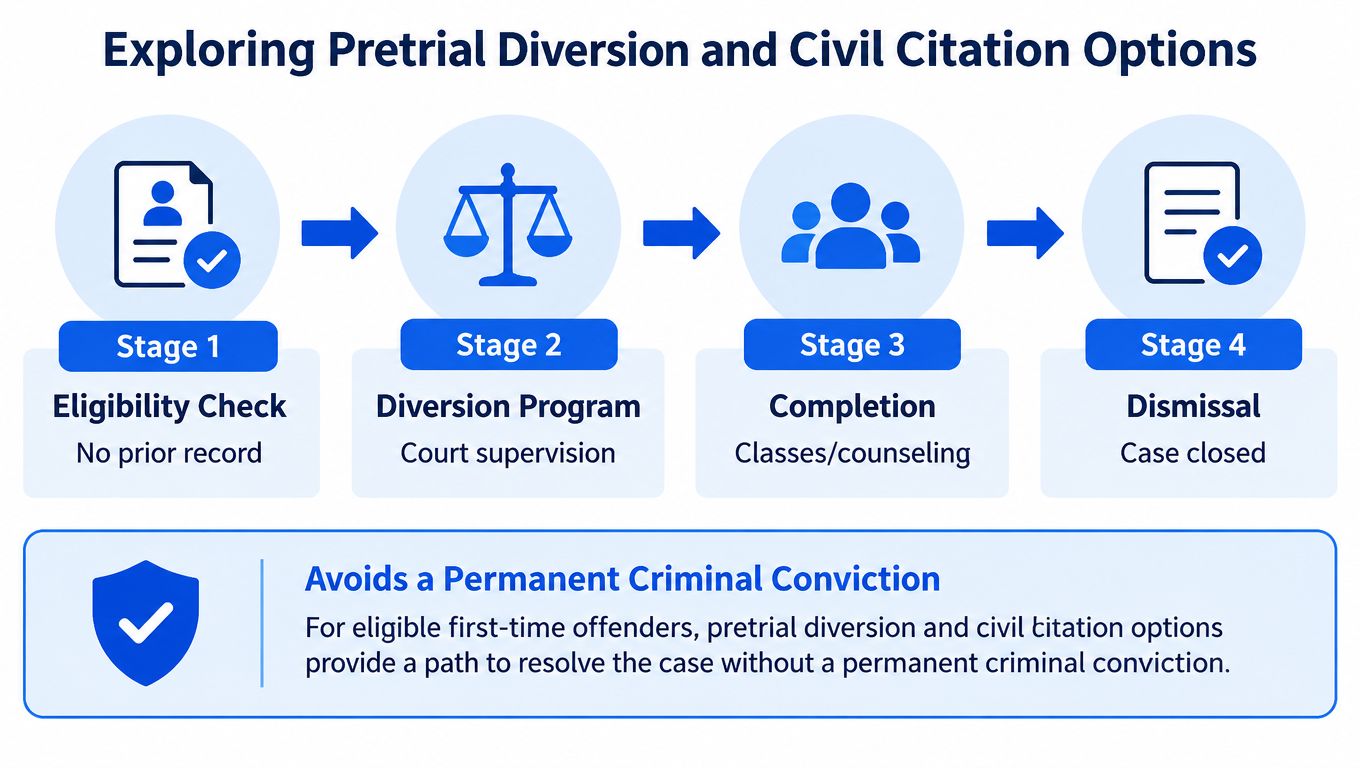
Not every Florida public-order case needs to end with a traditional conviction. Depending on the county, the client's record, the alleged conduct, and the prosecutor's policies, a defense attorney may explore pretrial intervention, diversion, civil citation, or another negotiated resolution.
These programs aren't automatic rights. Eligibility can depend on prior history, the specific charge, victim or property issues, cooperation requirements, and the State Attorney's discretion. The defense should confirm the written terms before accepting them.
What participation may require
A diversion agreement can include community service, counseling, educational classes, substance-use evaluation, court reporting, or compliance with no-new-law conditions. Completion may lead to dismissal, but the client must understand deadlines, documentation requirements, testing provisions, and what happens after an alleged violation.
A civil citation or diversion offer also isn't a substitute for reviewing the evidence. If the police report fails to establish endangerment or a public disturbance, accepting conditions may not be preferable to pursuing dismissal or a contested defense. The right decision depends on the strength of the State's case and the client's priorities.
For a practical overview of eligibility and possible conditions, review this guide to the Florida pretrial diversion program. The broader objective is to avoid an unnecessary conviction while addressing the prosecutor's concerns in a controlled and documented way.
Ticket Shield, PLLC handles Florida misdemeanor defense, reviews police evidence and constitutional issues, communicates with prosecutors, and develops case-specific strategies for clients in Broward County, Fort Lauderdale, Miami-Dade, Palm Beach, and surrounding South Florida communities. Visit Ticket Shield, PLLC to request a consultation about a drunk-and-disorderly allegation before entering a plea or accepting a resolution.
Facing a drunk and disorderly charge in Florida? Learn the penalties, your rights, and the steps to take to protect your record.