What Is Wet Reckless? a Florida DUI Defense Guide
Jason Goldsmith, Esq
A DUI arrest in South Florida usually hits all at once. Your car may have been towed. Your license may feel at risk. You're worried about work, your family, your insurance, and whether one bad night is about to leave you with a permanent criminal record.
That's often when people first hear the phrase wet reckless. A friend mentions it. Someone online calls it a “better deal” than DUI. A court clerk or another defendant uses the term like everyone should already know what it means.
In Florida, a wet reckless is not a separate DUI statute with its own formal name. It's common legal shorthand for a plea bargain where a DUI charge is reduced to reckless driving with an alcohol or drug-related notation. For many people in Broward County, Fort Lauderdale, Miami-Dade, Palm Beach, and across South Florida, that can be a meaningful improvement over a standard DUI conviction. But it is not automatic, and it is not always a simple win.
It's not just what wet reckless is. Instead, the question is whether taking that plea protects your freedom, your driver's license, and your future better than the other options in your case. That depends on the evidence, the weaknesses in the stop or arrest, and whether the long-term trade-off makes sense for you.
Table of Contents
An Introduction to the Wet Reckless Plea in Florida
At 2 a.m., after a DUI arrest in Broward, Miami-Dade, or Palm Beach, many people ask the same question: “Can this be reduced to a wet reckless?” That question makes sense, but it can mislead people into treating a wet reckless like an automatic win. It is a negotiated reckless driving result tied to an alcohol or drug related arrest, and the value of that deal depends on what you give up to get it.
In Florida practice, a wet reckless usually means the State agrees to resolve a DUI case as reckless driving instead of a DUI conviction. The term is common in court, even though it is not a separate charge listed by that name in the statute. The underlying offense is reckless driving under Florida's reckless driving statute, with plea terms shaped by the facts of a DUI arrest.
That distinction matters for strategy. A wet reckless can reduce the immediate punishment and avoid the label of a DUI conviction. It can also carry long-term risk that clients do not always see at first, especially the risk that it may be treated as a prior alcohol-related driving offense later. I tell clients this early because a deal that helps today can complicate a future case if they get arrested again.
What the term really means
“Wet” refers to the allegation that alcohol or drugs were involved. “Reckless” refers to the reduced offense. In plain terms, the State is saying: we will not require a DUI conviction if you plead to reckless driving under negotiated conditions that reflect the impaired-driving allegations.
Whether that option is available depends on the evidence, the county, and the prosecutor handling the file. In South Florida, these offers tend to appear when the DUI proof has problems. That may involve a disputed traffic stop, weak field sobriety evidence, breath test issues, a close factual call on impairment, or evidentiary gaps that make trial risk real for the State. A skilled defense lawyer does not get this result by asking for mercy. The lawyer gets it by showing the prosecution where the case is vulnerable.
Why clients ask about it so often
The first concern is usually practical, not technical. People want to protect their ability to drive, keep their job, and avoid carrying a DUI conviction on their record if there is a lawful way to do that.
The second concern is the one that requires more careful advice. A wet reckless often sounds cleaner than it really is. For many clients, it is still the right result. For others, especially professionals, commercial drivers, or anyone with prior history, the better question is not “Can I get a wet reckless?” but “What does this plea solve, and what does it leave behind?”
That is where local judgment matters. The same plea can look very different depending on the facts, the judge, and the courthouse culture in Fort Lauderdale, Miami, or West Palm Beach. Good advice does not come from the name of the deal. It comes from weighing the immediate benefit against the record consequences, future exposure, and whether the State's case is weak enough to demand more.
Wet Reckless vs DUI A Head-to-Head Comparison
At 2:00 p.m., a DUI conviction can look like a number on a plea form. By 2:15 p.m., it can mean a suspended license, a problem getting to work in Broward or Miami-Dade, and mandatory penalties the judge has little room to soften. A wet reckless changes that picture, but it does not erase the case. It is a negotiated reckless driving result that can reduce the immediate hit while still leaving a criminal conviction behind.
How the two outcomes differ on paper
A first DUI in Florida is charged as a first-degree misdemeanor. A wet reckless resolves the case as reckless driving through plea negotiation, usually because the State sees proof problems or trial risk. That shift matters because reckless driving is governed by a different statute, with different penalty ranges and fewer automatic consequences.
Here is the practical comparison clients usually care about first.
Consequence | Standard DUI (Fla. Stat. 316.193) | Wet Reckless Plea (Fla. Stat. 316.192) |
|---|---|---|
Offense level | First-degree misdemeanor DUI conviction | Reckless driving conviction entered as a negotiated plea |
Fines | Higher statutory fine range, with DUI-specific penalties | Lower reckless driving fine range in many first-offense cases |
Jail exposure | Greater exposure, with DUI penalties controlled by statute | Lower maximum exposure under reckless driving law |
License impact | DUI conviction carries mandatory license consequences | No automatic DUI suspension tied to the conviction itself |
Vehicle impoundment | DUI law can require impoundment | Reckless driving plea does not carry the same mandatory DUI impoundment rules |
The word that often matters most is "mandatory."
With a DUI conviction, some penalties are triggered by law whether the judge likes them or not. With a wet reckless, the court often has more room to shape a result that protects a client's ability to keep working, avoid unnecessary jail, and limit short-term disruption.
Why clients in South Florida focus on the immediate consequences
In real practice, the difference is rarely abstract. A nurse in Palm Beach County may be focused on getting to hospital shifts. A sales professional in Fort Lauderdale may be focused on avoiding a conviction that causes a suspension and wrecks a travel schedule. A parent in Miami-Dade may be focused on school pickup, probation terms, and whether a car will be unavailable after sentencing.
Those are not small details. They are often the reason a wet reckless has real value.
As a defense attorney and former prosecutor, I tell clients to judge the offer by what it changes. If it removes mandatory DUI penalties, lowers sentencing exposure, and gives the defense a cleaner position on licensing and employment, it may be a smart resolution. If the State's case is weak enough to press for a better outcome, or if the client has career or future-record concerns that make any conviction costly, then the analysis gets more demanding.
Why a wet reckless is better, but not automatically the right deal
A wet reckless usually gives the defense more room to manage damage. It is often easier to handle than a straight DUI conviction from a scheduling, licensing, and sentencing standpoint. For many first-time offenders, that is a meaningful result.
It is still a criminal disposition. It still requires a careful review of the statute, the facts, and the county-specific plea culture before anyone should call it a win.
If you want the broader statutory background, Florida's reckless driving statute and related penalties help explain why this negotiated outcome can be materially different from a DUI conviction.
The Long-Term Consequences and Hidden Risks
A Broward driver takes a wet reckless to avoid the full hit of a DUI. Two years later, another arrest turns what looked like a manageable resolution into a much more dangerous case. That is why this plea has to be evaluated as a long-term record decision, not just a short-term escape hatch.

The part many people miss
A wet reckless is still a criminal offense. It can appear on background checks, trigger questions from employers and licensing boards, and affect insurance underwriting.
The issue that deserves the closest attention is priorability. In Florida, a wet reckless can be treated as a prior DUI if you pick up another DUI later. From a defense standpoint, that changes the value calculation immediately. A plea that softens the present case may also give the State more advantage in a future one.
That trade-off matters in South Florida. Clients in Miami-Dade, Broward, and Palm Beach often focus on getting through the current case with the least disruption possible. That is understandable. The harder question is whether the result protects them if they ever face another alcohol-related driving charge, even years later.
Record, insurance, and licensing problems
A wet reckless usually creates less damage than a DUI conviction, but "less damage" is not the same as harmless. Insurance companies may still treat it as a meaningful risk marker. Professional boards may still require disclosure. Employers may still see a criminal traffic-related conviction and make their own assumptions.
I tell clients to look at this from three angles at once:
Your criminal record: A reduced charge still leaves a record that can follow you in job applications, housing reviews, and professional screening.
Your future sentencing exposure: If there is another DUI arrest later, this resolution may make that next case far more serious.
Your practical life: Insurance costs, company driving privileges, commercial licensing, and internal workplace reporting can all be affected.
For nurses, teachers, CDL holders, real estate professionals, and people with security-sensitive jobs, these side effects can matter more than the courtroom sentence. A person may avoid some of the immediate penalties tied to DUI and still spend years dealing with administrative consequences outside the criminal case.
That is why a plea offer should be measured against the full range of penalties for DUI in Florida, not just the line item you are avoiding today.
A wet reckless can be smart and still carry risk
As a former prosecutor, I can say this plainly. A wet reckless is often a good result when the evidence problems are real and the alternative is a DUI conviction with harsher mandatory consequences. As a defense lawyer, I also know clients get into trouble when they treat any reduction as an automatic win.
The right question is practical. Does this plea improve your position enough today to justify the long-term risk it leaves behind?
For some people, the answer is yes. For others, especially clients with licensing concerns, prior history, immigration issues, or a job that depends on a clean record, the analysis has to be much tighter.
How a Florida DUI Charge Gets Reduced
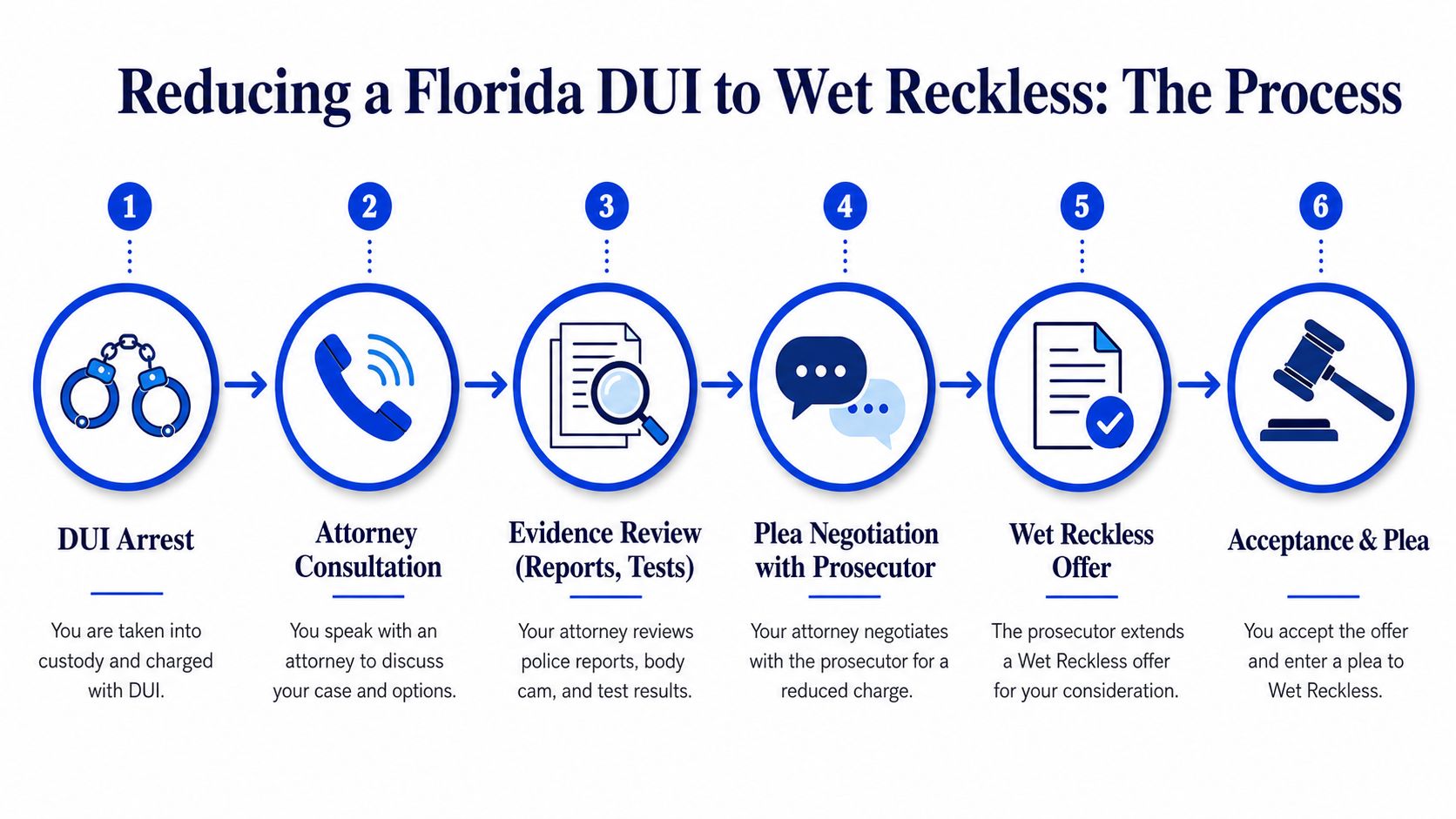
A wet reckless offer usually doesn't appear out of nowhere. It comes from pressure. The defense identifies weak spots, forces the prosecutor to value the case more realistically, and then negotiates from that position.
What prosecutors usually look at
In South Florida, prosecutors commonly evaluate whether the evidence proves impairment beyond a reasonable doubt. That review often includes:
The driving pattern: Was there dangerous driving, or just a minor traffic infraction?
The stop itself: If the stop was weak or unlawful, the State has a problem before it even reaches intoxication evidence.
Field sobriety exercises: These tests are often challenged because road conditions, footwear, weather, physical limitations, and officer instructions can affect performance.
Breath or blood evidence: Cases with lower readings are often negotiated differently than cases with stronger chemical evidence.
Video quality: Body camera, dash camera, and booking-room footage can help or hurt both sides.
The verified Florida guidance notes that prosecutors typically consider this plea when evidence of intoxication is weak or the BAC is relatively low, including the 0.08% to 0.10% range, which is why case review matters so much in early negotiations.
What actually helps in negotiations
Not every good defense argument wins a reduction. The arguments that tend to move a case are the ones that affect proof.
A defense lawyer may focus on whether the officer had a valid reason for the stop, whether the roadside investigation was handled properly, whether the chemical testing process can be challenged, and whether the client's conduct on video matches the report. In many cases, the prosecutor's confidence drops when the file looks less trial-ready than the arrest paperwork suggested.
When the State sees a real suppression issue, a weak impairment narrative, or a proof problem with testing, the value of a reduction changes fast.
Some clients also benefit from addressing practical issues early, such as treatment, evaluation, or proactive compliance. That won't fix a weak legal case for the State, but it can help present the client as someone worth negotiating with.
For anyone facing this process, a focused DUI defense review matters more than generic internet advice. Firms that handle these cases, including Florida DUI defense services through Ticket Shield, PLLC, typically start with the reports, videos, testing records, and timeline because that's where strategic advantages are identified.
Why State Laws Matter Florida vs California and Others
People often assume a wet reckless means the same thing everywhere. It doesn't.
Florida does not stand alone
Florida recognizes the practice as an informal plea shorthand in DUI cases. California also uses the term, but under a different statutory structure. According to this discussion of California Vehicle Code section 23103.5, a wet reckless conviction in California is legally treated as a prior DUI for any subsequent DUI within ten years.
That is a major point because it shows the “priorable” concept is not unique to Florida. It also shows why copying advice from another state can be dangerous. The phrase may sound familiar, but the statute, procedure, and sentencing effects may be very different.
The verified Florida and national background also note that some states do not recognize wet reckless in the same way. New York explicitly forbids wet reckless pleas, while Colorado and Ohio may use the phrase informally without a dedicated statute. Cornell's overview of wet reckless as a legal shorthand across jurisdictions captures that state-by-state variation.
Why local knowledge changes strategy
A person charged in Fort Lauderdale, Miami, West Palm Beach, or anywhere in South Florida needs Florida-specific advice. That means knowing:
How local prosecutors evaluate marginal DUI cases
How local judges handle plea reductions and sentencing
Which weaknesses matter in that courthouse
Whether a negotiated reckless plea fits the client's long-term goals
A California article may explain priorability well. It won't tell you how Broward County prosecutors assess a borderline breath test, or how a Palm Beach courtroom treats a suppression issue tied to the stop.
That's true beyond DUI too. Search-and-seizure issues, domestic violence allegations, gun charges, juvenile matters, federal cases, and injunction hearings all depend on state law and local court practice. Criminal defense is always jurisdiction-specific. Wet reckless is one of the clearest examples.
Practical Steps After a DUI Arrest in South Florida
The first days after a DUI arrest matter. What you do next can affect your license, your defense, and whether a favorable resolution remains available.
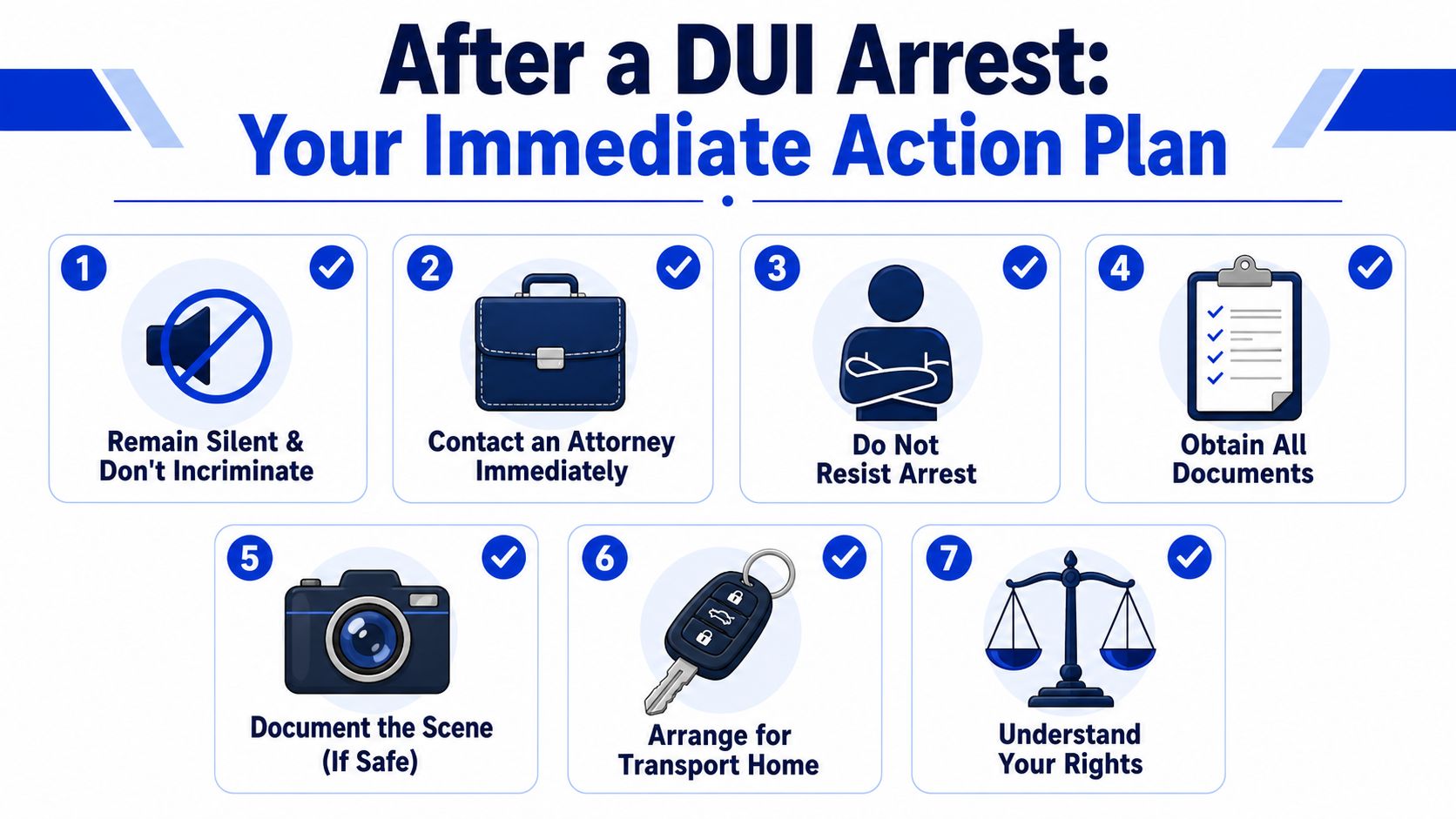
A quick visual checklist can help you stay focused under stress.
What to do in the first days
Start with the basics.
Stay quiet about the facts: Don't explain, justify, or apologize to law enforcement after the arrest. Statements that feel harmless can become evidence.
Call a lawyer quickly: Early intervention matters in DUI cases because deadlines and evidence issues move fast.
Keep every paper you received: Citation, notice of suspension, bond paperwork, towing information, and court date documents all matter.
Write down what happened: Do it while your memory is fresh. Include where you were, why you were stopped, what the officer said, whether tests were requested, and whether video may exist.
Do not miss the license deadline: Florida's administrative license suspension process has a short challenge window, and delay can cost you options.
South Florida drivers also need to think about transportation right away. If your case is pending in Broward County, Miami-Dade, or Palm Beach, practical planning matters as much as legal planning.
What to bring to your lawyer
This video gives a useful overview for people trying to understand the next phase after a DUI arrest.
Bring whatever you have, even if the file feels incomplete.
Arrest documents: Citation, complaint, bond papers, and any notice about your license.
Your timeline: A simple written account of the stop, arrest, and testing process.
Medical information: Conditions, injuries, or medications that may have affected roadside exercises or observations.
Work concerns: Driving needs, travel obligations, and licensing issues can shape strategy.
The clients who help themselves most early on are the ones who preserve paperwork, stop talking about the case, and get legal advice before making assumptions about guilt, defenses, or plea offers.
If license issues are already affecting your job or daily life, Florida drivers often also need guidance on license reinstatement after DUI.
Frequently Asked Questions About Wet Reckless Pleas
Can a wet reckless be sealed in Florida
Sometimes, yes.
The answer usually turns on the final disposition, not the shorthand people use to describe the deal. If adjudication is withheld and the rest of your record qualifies, a wet reckless may be eligible for sealing or expungement under Florida law. A DUI generally is not. That difference matters to people applying for jobs, housing, professional licenses, or school programs, because the long-term record impact often matters more than the immediate fine or probation terms.
Is a wet reckless always the right answer
A wet reckless is a strategy choice, not an automatic win.
I tell clients across Broward, Miami-Dade, and Palm Beach to look past the reduced label and ask a harder question. What are you giving up, and what are you avoiding? A wet reckless can reduce the stigma of a DUI conviction and often improves the outcome on paper. It can also carry a serious long-term risk. If you pick up another DUI later, that prior wet reckless can still be used against you for enhancement purposes. Florida courts treat that history seriously.
That is why the right answer depends on the evidence, your record, your license issues, your employment concerns, and your tolerance for future risk. If the stop, arrest, breath test, or officer observations have real weaknesses, pushing harder may make more sense than taking the first reduction offered.
Will I have to go to court, and what about insurance
Some court appearances can be handled by counsel. Some cannot. The answer depends on the judge, the county, and the stage of the case, so no one should assume a lawyer can appear for everything without checking the local practice first.
Insurance is rarely simple. A wet reckless is often better for underwriting purposes than a DUI conviction, but insurers still see it as alcohol-related driving conduct. For some drivers, the premium impact is manageable. For others, especially people with prior issues or limited coverage options, it can still be expensive.
Can a wet reckless help with background checks
Usually, yes, but only in a relative sense.
A reduced reckless driving disposition is generally better than a DUI conviction on a background check. Still, it remains a criminal case unless it is later sealed or expunged and you qualify for that relief. Employers and licensing boards do not all read records the same way. Some focus on the exact conviction. Others focus on the underlying arrest and the surrounding facts.
Does a wet reckless matter if I am charged again later
Yes. This is one of the most misunderstood parts of the deal.
Clients sometimes hear "reckless" and assume the DUI issue disappears for good. It does not. In Florida, a wet reckless can function like a prior DUI for sentencing purposes if you are arrested for DUI again. That can mean harsher penalties in the later case, including greater exposure on jail, license consequences, and mandatory conditions. Anyone considering this plea should weigh the immediate benefit against that future risk with a lawyer who handles DUI cases regularly.
Does this issue only come up in DUI cases
No. The larger lesson applies across criminal cases.
Good defense work is not just about getting a charge reduced. It is about choosing the outcome that does the least damage over time. In practice, that means looking at record consequences, licensing problems, immigration exposure, future enhancement rules, and whether a better result is available through motion practice or negotiation.
If you were arrested for DUI in Fort Lauderdale, Broward County, Miami-Dade, Palm Beach, or nearby South Florida courts, get legal advice before deciding whether a wet reckless plea is the right move. Ticket Shield, PLLC helps clients assess plea offers, challenge weak evidence, protect driving privileges, and make informed decisions in confidential consultations.
A wet reckless plea can mean lighter penalties than a DUI conviction. Learn how this reduction works in Florida and when it's possible.