
Florida Law: Driving with Suspended License Guide 2026
Jason Goldsmith, Esq
A lot of people find out about a suspension the worst possible way. They're stopped for a broken taillight, a rolling stop, expired registration, or a routine checkpoint, and a simple traffic stop suddenly turns into a criminal case.
If that's where you are right now, take a breath. A charge for driving with suspended license in Florida is serious, but it isn't automatic proof that you'll be convicted of a crime. In many cases, the fight turns on one issue more than any other: whether the State can prove you knew your license was suspended.
That distinction matters in Fort Lauderdale, Broward County, Miami-Dade, Palm Beach, and throughout South Florida. It can affect whether you're dealing with a traffic citation or a misdemeanor, whether jail is on the table, and whether you walk away with a criminal record. It also matters for people already dealing with related issues such as DUI, probation violations, or other Florida criminal defense problems where a license suspension often follows the underlying case.
Table of Contents
What Happens When You're Caught Driving on a Suspended License
The Critical Difference Between a Ticket and a Crime in Florida
How an Experienced Defense Attorney at Ticket Shield Can Help
What Happens When You're Caught Driving on a Suspended License
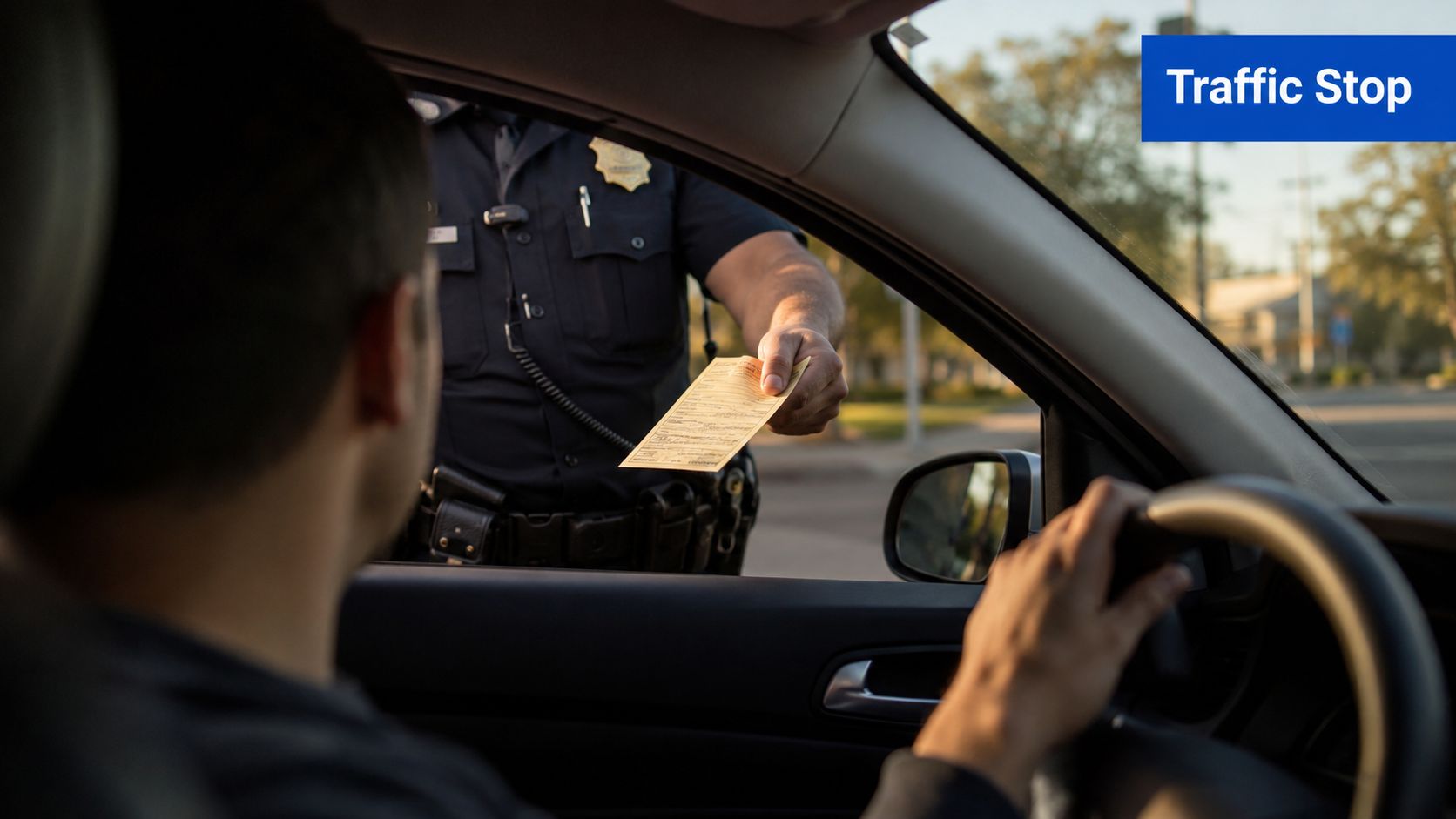
Most drivers remember the moment the stop changes tone. The officer goes back to the patrol car, runs the license, then returns with a different set of questions. What started as a minor roadside encounter now feels a lot heavier. You're wondering if you'll be arrested, whether your car will be towed, and what this means for your job or family.
That reaction is common. So is the underlying problem. Approximately 5.5% to 17% of all licensed drivers in the United States have a suspended license at any given time, and 91% of those suspensions are for non-driving-related events, primarily failure to pay fines or court debts according to this review published by the National Library of Medicine. In plain English, many suspended license cases don't start with dangerous driving. They start with paperwork, missed payments, missed court dates, or an issue the driver didn't fully understand.
What usually happens at the stop
The officer may issue a citation, make an arrest decision based on the charge level, or refer the case to court. The exact outcome depends on the reason for the suspension, whether the officer believes you had knowledge, and whether you have prior history.
For many people in South Florida, the first mistake is talking too much at the roadside. A driver says, "I thought that was taken care of," or "I knew I had to pay it but just hadn't gotten around to it." Statements like that can become evidence on the knowledge issue later.
Practical rule: Be polite, provide required documents, and don't guess or explain your legal status to the officer.
Why early action matters
A suspended license charge doesn't exist in isolation. It can overlap with DUI matters, unresolved traffic cases, probation issues, or court compliance problems. That's why the first days after the stop matter. The sooner you identify the reason for the suspension and the State's theory of knowledge, the more room there is to protect your record and your license.
The Critical Difference Between a Ticket and a Crime in Florida
In Florida, the key issue isn't just whether your license was suspended. The key issue is knowledge.
A lot of people charged with driving with suspended license assume the case is open and shut. It often isn't. Florida treats cases differently depending on whether the State can prove you knew about the suspension. That single element can be the line between a noncriminal traffic matter and a criminal prosecution.
Knowledge is the dividing line
If the State can't prove knowledge, the case may remain a noncriminal traffic offense rather than a misdemeanor crime. If the State can prove knowledge, then you're exposed to criminal penalties, a court appearance, and the risk of a record that can follow you long after the traffic stop is over.
That is why defense work in these cases starts with the file, not the panic. A lawyer looks for the paper trail, mailing records, prior courtroom notices, prior citations, and anything the prosecutor plans to use to say you knew your privilege to drive had already been suspended.
A court appearance in a traffic-related criminal case can be confusing if you've never been through one before. If you want a practical overview of how these appearances work, this guide on what happens in traffic ticket court gives useful background.
How prosecutors try to prove knowledge
Prosecutors usually don't rely on one piece of evidence alone. They try to build knowledge from circumstances such as:
Mail notice from the DMV: If the State has records showing notice was sent to the address on file, it may argue that you were legally on notice.
Prior court proceedings: If a judge told you in open court that your license was suspended, the State may use that.
Prior citations or admissions: A previous ticket for the same issue, or your own statements during the stop, can become evidence.
Case history: Sometimes the underlying suspension comes from a DUI, missed hearing, or unresolved traffic matter that the State says you already knew about.
The strongest Florida DWLS defenses often don't deny the stop happened. They challenge whether the State can prove the one element that turns the case criminal.
People often harm their own interests by dismissing this charge as 'just traffic.' It may involve criminal procedure, constitutional issues, and evidentiary disputes that look more like a misdemeanor prosecution than a routine citation.
Florida's Penalties for Driving With a Suspended License
A lot of DWLS cases turn on one question first. Can the State prove you knew the license was suspended? If the answer is yes, the penalties can move from a traffic problem into a criminal case quickly.

First offense with knowledge
In Florida, a first offense for driving while license suspended with knowledge is usually a second-degree misdemeanor. That carries up to 60 days in jail and a $500 fine, as outlined in Florida Statutes section 322.34.
For many drivers, the surprise is not the fine. It is the criminal record risk. Even in a first case, prosecutors and judges can treat the matter more seriously if the driving history shows unpaid tickets, missed court dates, or a suspension that has been sitting unresolved for a long time.
Second offense with knowledge
A second offense within five years can be charged as a first-degree misdemeanor. Florida courts can impose up to 1 year in jail and a $1,000 fine, as summarized in this discussion of Florida DWLS penalties and defenses.
At that point, the case often becomes less about the stop itself and more about your record, the reason for the suspension, and whether there is any realistic path to reinstatement before court. Those details affect plea offers and sentencing arguments.
Third or later offense in serious cases
Some repeat cases expose a driver to felony charges. Under Florida Statutes section 322.34, a third or subsequent conviction can become a third-degree felony if the current or most recent prior suspension was tied to DUI, refusal to submit to testing, a traffic offense causing death or serious bodily injury, or fleeing and eluding.
That can mean up to 5 years in prison, a $5,000 fine, and probation. It also changes how the defense should be handled. In some cases, the better strategy is to challenge the stop itself through a motion to suppress evidence in a traffic case. In others, the strongest argument is narrower. The State still has to prove the knowledge element that makes the charge criminal.
Florida DWLS penalties at a glance
Offense Level | Maximum Jail Time | Maximum Fine | Potential Consequences |
|---|---|---|---|
First offense with knowledge | Up to 60 days | $500 | Criminal misdemeanor charge, court supervision, pressure to fix the underlying suspension |
Second offense with knowledge within five years | Up to 1 year | $1,000 | Higher misdemeanor exposure, tougher plea posture from the State |
Third or subsequent qualifying offense | Up to 5 years | $5,000 | Felony record risk, prison exposure, probation, serious effects on driving privileges |
From a defense standpoint, the penalty chart matters less than the proof. If the State cannot prove knowledge, the case may stay out of criminal territory.
Strategic Defenses to a DWLS Charge in South Florida
A charge is not a conviction. That's especially true in driving with suspended license cases, because the prosecution usually has to prove more than "you were driving" and "the license was suspended."
In Broward, Miami-Dade, Palm Beach, and surrounding courts, the defense is often about narrowing the case to what the evidence shows. Prosecutors may start with a criminal theory. A careful review sometimes reveals notice problems, record gaps, or stop issues that weaken the case substantially.

Challenging notice and DMV proof
One of the strongest defense approaches is to attack the State's proof of notice. A critical but often overlooked defense is the State's failure to prove you were properly notified of your suspension. In many Florida cases, if the DMV cannot provide evidence that a suspension notice was mailed to your correct address on file and not returned, it can be argued that you did not have the required knowledge for a criminal conviction as discussed in this notice-focused discussion.
That issue sounds simple, but it usually isn't. The defense may need to compare DMV records, address history, prior court paperwork, and the timing of any alleged notice. If the State's evidence is incomplete or inconsistent, the knowledge element may be vulnerable.
Attacking the stop and the evidence
Not every DWLS case starts with a lawful stop. If the officer lacked a valid legal basis to pull you over, the defense may be able to challenge the stop itself and seek suppression of the evidence that followed.
If you're not familiar with suppression practice, this overview of motions to suppress evidence in Florida criminal cases explains why the legality of the stop matters so much.
A few examples of defense questions that matter:
Reason for the stop: Was there an actual traffic infraction, equipment issue, or lawful checkpoint basis?
Identity of the driver: Can the officer clearly identify who was driving?
Status records: Were the license records accurate on the date of the stop?
Officer testimony: Do the report, body camera, and courtroom testimony line up?
Using mitigation the right way
Mitigation isn't the same as a legal defense, but it still matters. Many people charged with driving while suspended were trying to get to work, pick up a child, or handle an urgent family issue. Courts hear those explanations often. Standing alone, they usually won't erase the charge.
What can help is using mitigation strategically. If the license is reinstated quickly, the underlying issue is fixed, and the defense presents the case as a solvable compliance problem rather than defiance, negotiations often become more productive.
Judges usually respond better to documented action than to promises. Bring proof that you've started fixing the suspension.
Immediate Steps to Take After a DWLS Citation
The hours after a citation matter more than commonly understood. Good decisions early can prevent a bad situation from getting worse.
Your first priority
Stop driving until you know your status. Another stop can create a new case, strengthen the State's argument that you knew about the suspension, and complicate any pending criminal or traffic matter.
Then verify exactly why your license is suspended. Don't rely on memory, what an officer said at the roadside, or what someone told you months ago. The suspension reason controls both the defense analysis and the reinstatement process.
What to gather before court
Start building your file immediately:
Citation and court paperwork: Keep the ticket, notice to appear, and any bond or release documents together.
DMV notices and old mail: Save every letter you have, even if it seems minor.
Proof of address history: If notice is disputed, address records may matter.
Court records from related cases: DUI cases, missed hearings, unpaid tickets, or probation matters can all connect to the suspension.
Proof you are fixing the issue: Receipts, course enrollment, payment records, and compliance documents can help.
Don't miss your court date. Missing court creates a separate problem and often leads to warrants or additional license consequences.
If your suspension traces back to a DUI-related matter, this guide on Florida license reinstatement after DUI is a useful place to start. Even when the current charge is DWLS, the underlying suspension often comes from an older DUI case.
How to Get Your Florida Driver's License Reinstated
A lot of clients come in focused on the court date and assume the license problem will sort itself out later. In Florida, that approach usually backfires. If the suspension stays in place, another stop can turn the "knowledge" issue into a bigger problem for the defense, because each notice, prior ticket, and failed attempt to fix the license gives the State more to work with.
Fix the reason before you fix the card
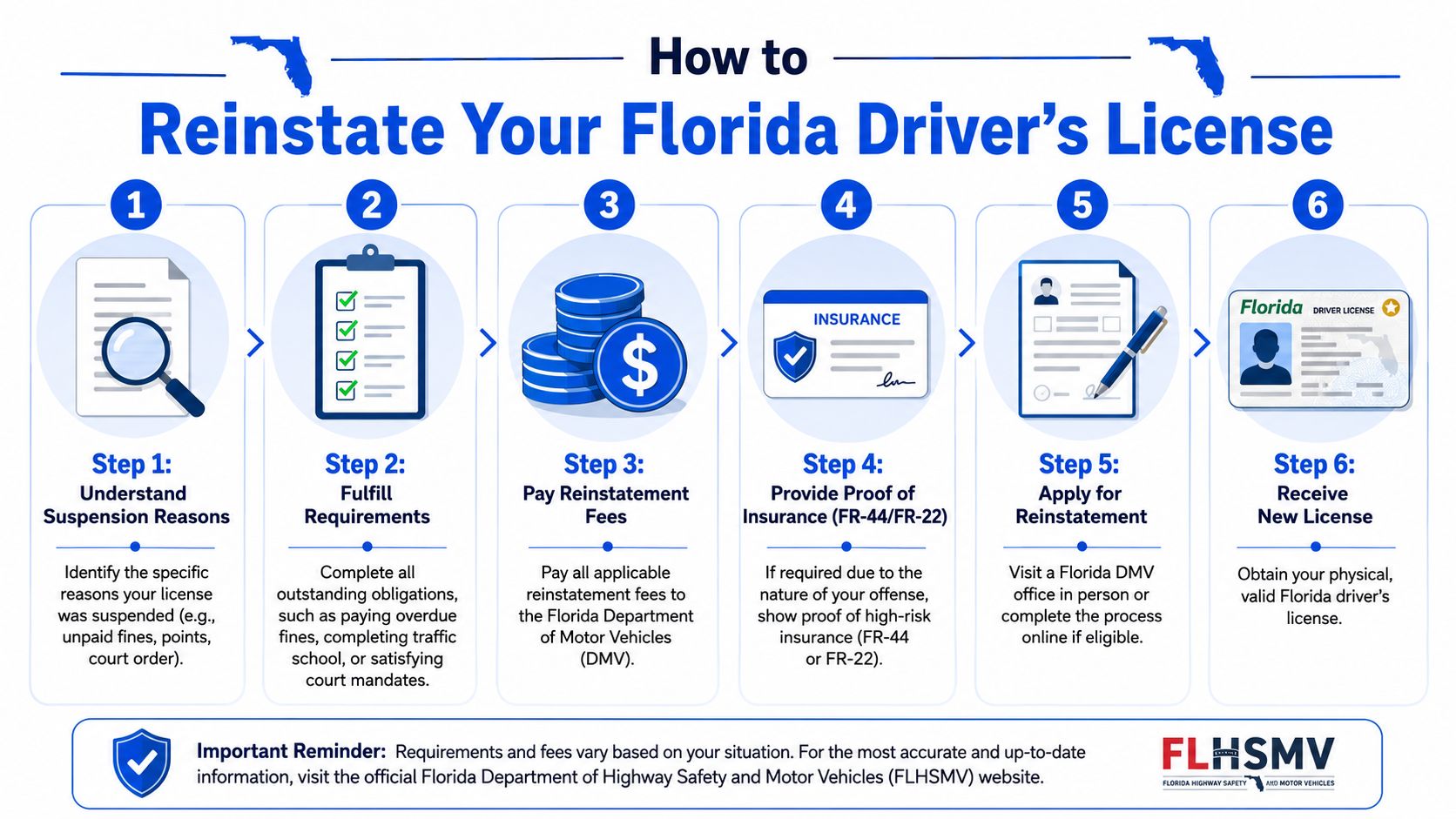
Reinstatement starts with the reason for the suspension. An unpaid-ticket suspension is handled one way. A DUI-related suspension, points suspension, missed-court suspension, or court-ordered suspension can require different documents, different offices, and different timing.
The practical rule is simple. Clear the underlying hold first, then deal with the license itself.
That may involve paying a case, filing proof of insurance, completing a required course, appearing in court, or satisfying a prior order. If more than one hold exists, all of them must be cleared before the Department will restore driving privileges. That is why people sometimes pay one fee and still show as suspended.
This walkthrough on how to reinstate a suspended Florida license explains the administrative process in more detail.
Here is a helpful overview:
What reinstatement usually requires
Florida Highway Safety and Motor Vehicles explains that reinstatement depends on the basis for the suspension and may require proof that the underlying case has been resolved, along with payment of reinstatement and licensing fees through the Department's process, as described on the official FLHSMV license reinstatement page.
In practice, the total cost often includes more than the state reinstatement charge. Clients also run into court fines, clearance fees, class costs, insurance filing requirements, or separate obligations tied to the original case. A general discussion of Florida DWLS reinstatement issues appears in this explanation of driving while license suspended matters, but the actual amount depends on why the license was suspended in the first place.
Before paying anything, confirm the exact hold you are trying to clear. That step matters in the criminal case too. If the State is trying to prove you knew about the suspension, the paper trail around notices, payments, prior clearances, and unresolved holds often becomes part of the evidence.
A practical reinstatement checklist looks like this:
Pull your current driving record: Check every active suspension, not just the one you already know about.
Match each hold to the required fix: Pay the case, complete the course, file the document, or appear in the correct court.
Confirm whether FR-44, SR-22, or other insurance proof is required: Some suspensions do not clear without it.
Pay reinstatement and licensing fees after the hold is ready to release: Paying too early does not solve the underlying problem.
Keep proof of every step: Receipts, clearance letters, course certificates, and an updated record can help both with reinstatement and with the defense.
Reinstatement does not erase the charge. It does put you in a better position. Prosecutors and judges are more willing to discuss practical resolutions when the license issue has already been addressed, and it reduces the chance that a new stop will make the knowledge argument harder to fight.
How an Experienced Defense Attorney at Ticket Shield Can Help
A DWLS case often turns on one point. Can the State prove you knew your license was suspended?
That is where defense work starts. I do not treat these cases like routine traffic matters, because they are not. A proper review covers the stop, the driving record, the DHSMV notice history, prior case paperwork, and the timeline of what you knew and when you knew it. In many cases, the difference between a civil citation and a criminal charge is not the driving itself. It is the State's ability to prove knowledge.
That issue is often less clean than the arrest paperwork suggests. Notices get mailed to old addresses. Clients pay one case and assume the hold is cleared, while a separate suspension remains active. Court records, clerk records, and DMV records do not always line up neatly. From a former prosecutor's perspective, those gaps matter because they often show where the State's proof is strongest and where it is vulnerable.
An experienced Florida criminal defense attorney should also look at the practical side of the case. That includes whether the stop can be challenged, whether the charge can be reduced, whether reinstatement has already begun, and what steps will help in negotiations. Judges and prosecutors usually respond better when there is a clear plan to fix the underlying license problem.
Local practice matters too. A case in Broward may be handled differently than one in Miami-Dade or Palm Beach, even when the statute is the same. Knowing how a particular courthouse approaches first offenses, prior DWLS history, compliance, and plea offers can affect the result.
That same disciplined approach applies in other criminal cases, from DUI and drug charges to felony matters involving violence, weapons, or probation issues.
If you're dealing with a suspended license charge in Fort Lauderdale, Broward County, Miami-Dade, Palm Beach, or elsewhere in South Florida, early action gives your lawyer more room to challenge the knowledge element, correct the record, and work toward a better outcome.
If you're dealing with driving with suspended license charges and need a calm, strategic review of what happened, contact Ticket Shield, PLLC for a confidential consultation. The firm represents clients across Broward County, Fort Lauderdale, Miami-Dade, Palm Beach, and throughout Florida, and can help you evaluate the knowledge issue, review the stop, address reinstatement, and build a defense plan suited to your case.
Driving while suspended can quickly snowball into criminal charges. Learn Florida's penalties and how to get back on the road legally.