
What Is Habeas Corpus: Your 2026 Florida Rights Guide
Jason Goldsmith, Esq
Habeas corpus is a legal action that forces the government to prove it has a lawful reason to detain someone, and it is often called the Great Writ of Liberty. In Florida, a person who is in custody can petition for the writ, and if the petition shows probable cause that the detention is unlawful, a judge must grant the writ forthwith and make it returnable immediately.
If you're reading this after getting a call from the Broward County jail, Turner Guilford Knight, or a holding cell somewhere in South Florida, you're probably not looking for a history lesson. You want to know one thing. Can the court make the government explain why your loved one is being held, and can that happen fast?
Sometimes yes. However, many people receive incorrect information. In real Florida criminal practice, what is habeas corpus is not the same as “instant release,” especially in misdemeanor, DUI, theft, and probation cases. In many Broward, Miami-Dade, and Palm Beach cases, the faster and smarter move is a bond motion, a motion for release, or another targeted filing rather than a formal habeas petition.
That distinction matters when every hour counts.
Table of Contents
Your Loved One Is in Jail What Happens Now
The first hours after an arrest feel chaotic. A family member may know the person was picked up in Fort Lauderdale, Hollywood, Miami, or West Palm Beach, but not know the actual charge, the bond amount, or when the first court appearance will happen. That lack of information makes people start searching for any legal tool that sounds powerful.
Habeas corpus is one of those tools. In plain English, it is the legal way to ask a judge, “Why are you holding this person, and what lawful authority do you have to keep them there?”
That's a real right, not a slogan. It exists to challenge unlawful detention. But if your loved one was just arrested for DUI, domestic violence, a drug offense, theft, a probation violation, or another South Florida criminal charge, the practical question isn't just whether habeas exists. The practical question is which filing gets in front of the right judge fastest.
The first questions that matter
When someone is in custody, focus on these issues first:
Where is the person being held: The location affects which court is involved and how quickly a hearing can happen.
What is the legal basis for detention: A warrant, a new arrest, an alleged probation violation, a hold from another jurisdiction, or something else.
Has the person seen a judge yet: That often determines whether the best move is a first appearance issue, a bond motion, or a habeas filing.
Is the person still in custody: That matters because Florida habeas is generally for people who are detained, not people already out on bond.
If the case is moving toward arraignment, it also helps to understand what happens at arraignment in Florida courts, because that stage affects strategy and timing.
Practical rule: In urgent South Florida detention cases, the legal remedy that sounds most dramatic isn't always the remedy that works fastest.
The Great Writ of Liberty What Habeas Corpus Really Means
The phrase sounds old because it is old. But the basic idea is simple. The government doesn't get to lock someone up and refuse to justify it.

The writ of habeas corpus has a historical foundation dating back to the Magna Carta in 1215, which established that “No man shall be arrested or imprisoned...except by the lawful judgment of his peers and by the law of the land.” It was later protected in the U.S. Constitution, which states that “The Privilege of the Writ of Habeas Corpus shall not be suspended” except in the narrow circumstance set out in Article I, Section 9, as discussed in this historical overview of habeas corpus.
Why this writ matters
A lot of people think habeas corpus is about proving innocence. It isn't.
It tests the legality of detention. That means the judge is asking whether the jailer, the sheriff, the State, or another custodian has valid legal authority to keep holding the person. The proceeding is closer to “show your work” than “decide the whole case.”
A useful way to think about it is this. If the government is holding someone, it has to show the legal receipt for that detention. If it can't, the court can order release.
For related civil liberty issues involving unlawful restraint, many people also look into false imprisonment in Florida, although that is a different legal issue from a criminal habeas petition.
What the judge is actually deciding
The federal courts describe habeas corpus as a writ of inquiry that tests only the legality of the detention, not guilt or innocence, and requires the custodian to justify confinement under law in response to the petition, as reflected in the U.S. courts glossary definition of habeas corpus.
That distinction matters in real cases:
A strong habeas issue can exist even if the State thinks the person committed the offense.
A weak habeas issue can exist even if the person insists they did nothing wrong.
The question is not “Did they do it?” The question is “Can the government lawfully keep them in custody right now?”
That's why habeas corpus remains one of the clearest constitutional checks on government power. It forces the detention itself into court.
Federal Habeas vs Florida Habeas A Crucial Distinction
Often, many clients get tripped up. They search “what is habeas corpus,” find federal language online, and assume it's the same process that applies to a loved one sitting in jail on a Broward DUI or a Miami-Dade theft case.
It usually isn't.
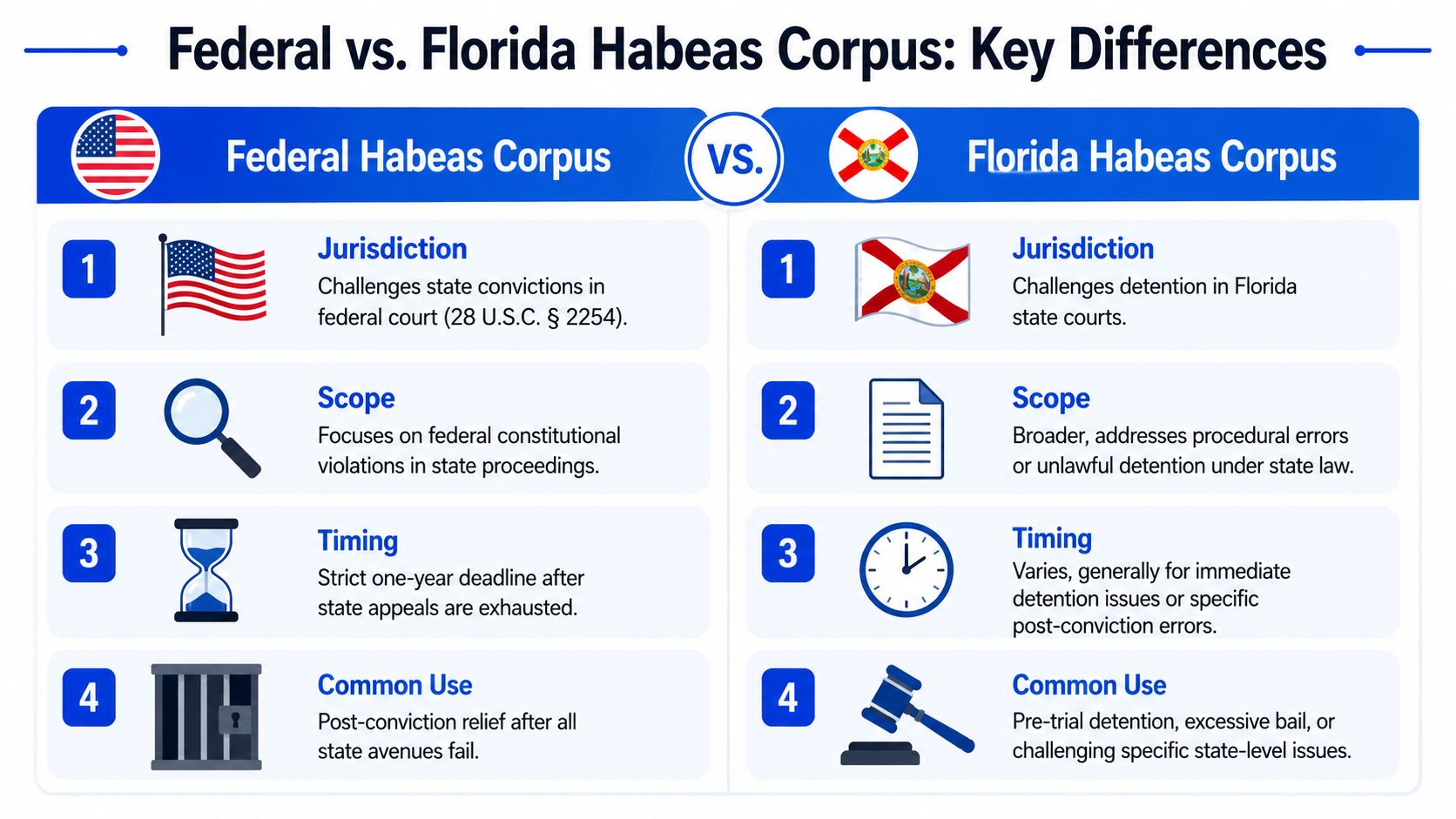
Federal habeas is usually not the fast answer
In the modern federal system, state prisoners file between 16,000 and 18,000 habeas cases annually in federal district courts, which is about 1 out of every 14 civil cases filed there, and more than 6,000 proceed to the U.S. Courts of Appeals, according to the ICPSR study on federal habeas litigation. That tells you federal habeas is important. It also tells you it is a large, formal, heavily litigated process.
For Florida criminal defendants, the key point is different. Federal habeas under 28 U.S.C. § 2254 generally applies only after a state conviction is final and direct appeals are exhausted, as shown in the federal habeas statute materials.
That means federal habeas is usually a post-conviction remedy. It is not the tool individuals typically need when someone has just been arrested in Fort Lauderdale, Pembroke Pines, Hialeah, Boca Raton, or Miami Beach.
If your detention problem also involves how police obtained evidence, it may be just as important to evaluate illegal search and seizure issues in Florida, because those arguments often shape the broader defense strategy even when habeas is not the right immediate filing.
What works faster in South Florida courts
For pretrial misdemeanor and many felony detention issues, local practice matters more than internet folklore.
In South Florida courts, a person held on a DUI, misdemeanor theft, domestic violence allegation, drug possession case, or probation issue often gets faster results through:
Issue | Often faster tool in practice | Why |
|---|---|---|
Bond too high | Motion to reduce bond | Targets the actual release condition |
No bond hold dispute | Motion for release or detention hearing request | Puts the detention question directly before the court |
Probation violation hold | Targeted motion and hearing request | Matches the procedural posture of the case |
Early post-arrest confusion | First appearance advocacy | The first hearing may solve the immediate problem faster than a separate writ |
That's the Florida reality many people don't hear. A formal habeas petition may be technically available in some situations, but it is not automatically the best first move for a pretrial defendant.
“Can we file habeas today?” is sometimes the wrong question. The better question is, “What filing gets this person before the right judge fastest?”
Common Grounds for Filing a Writ in South Florida
A family usually calls with the same fear: “He's still in jail, and nobody is telling us why.” In South Florida, that can mean several different legal problems. The right filing depends on which one is keeping the person in custody.
Habeas corpus is most useful when the detention itself is the problem. If the issue is bond, a probation hold, or a hearing that has not been set quickly enough, a different motion may get faster results in Broward or Miami-Dade. That distinction matters because time gets wasted when families chase the phrase “habeas corpus” instead of the fastest lawful route to a judge.
Situations that can justify urgent court review
Several custody problems can support serious habeas review in Florida state court:
Detention without lawful authority: This is the core use of habeas. The question is simple. What legal basis is keeping this person in jail right now, and can the State or custodian support it?
Probation or parole custody disputes: A person held on an alleged violation may have grounds to challenge the legality of that custody, especially where the hold, paperwork, or timing does not match what the law requires. The Jailhouse Lawyer's Manual chapter addressing Florida habeas rules discusses that distinction, including why custody status matters.
Delayed prosecution after arrest: Florida law provides a procedure for a confined defendant to seek a preliminary hearing through habeas when the case has stalled after arrest, as reflected in Florida Statute 907.045.
Those categories sound technical, but the practical question is always the same. Is the person in custody because the law clearly authorizes it, or because nobody has forced the issue into the right courtroom yet?
What these cases often look like in practice
In Broward, I sometimes see probation violation cases where the family assumes the hold is automatic and cannot be challenged until much later. That is not always true. Some cases call for immediate review of the legal basis for detention, while others call for a targeted hearing request rather than a habeas petition.
In Miami-Dade, the problem may be less dramatic but just as serious. A person can sit in custody because of a charging delay, a paperwork defect, or confusion about what authority supports the hold. Habeas can be the right tool when the detention itself lacks a sound legal foundation.
Families also mix up evidence issues with custody issues. If a parent says, “My daughter was never read her rights,” that may matter to the defense, and it helps to understand what a Miranda rights violation can mean in a Florida case. But Miranda usually affects statements and suppression issues. Habeas addresses whether the government has lawful authority to keep someone jailed.
The filing has to match the problem. In real South Florida practice, that is what gets results.
Challenging Your Detention How the Process Works in Florida
Your brother is sitting in the Broward jail on a low-level case, and the family has heard the same phrase from three different people: “file habeas.” Sometimes that is the right move. Often, it is not the fastest one.
In Florida practice, the first job is to identify the actual custody problem. If the issue is that no one can explain the legal basis for the hold, habeas may force the court to address it. If the issue is a bond amount that makes release impossible, a bond motion or an emergency hearing request usually gets to the point faster in Miami-Dade and Broward.

Who can file and where
A habeas petition is for a person who is in custody. The filing asks a judge to require the jailer or other custodian to justify the detention and show lawful authority for keeping that person locked up.
That point matters more than families expect. If someone has already posted bond or been released on their own recognizance, habeas is usually not the tool. At that stage, the legal fight shifts to the criminal case itself, not the immediate legality of physical detention.
Florida courts can hear these petitions quickly, but speed depends on getting the filing right. The petition has to identify the custodian, explain why the detention is unlawful, and include enough factual support to justify immediate review. A vague filing can lose time you do not have.
What the process usually looks like
In real cases, the process is usually less dramatic than people expect:
Counsel confirms the current hold: That means identifying who is holding the person and under what authority, such as a capias, probation warrant, no-bond hold, or another court order.
The legal issue is narrowed: The question is not whether the case is weak. The question is whether the present detention is legally defective.
The petition is drafted with supporting facts: The court needs a clear record, not just family frustration or jail rumors.
The petition is filed in the court with authority to act: Filing in the wrong court can delay review.
The custodian must respond: The state or the jail has to state the basis for the detention.
The judge decides whether relief is warranted: Relief can mean release, a corrected custody order, or denial if the hold is legally supported.
Sometimes the primary value of habeas is not instant release. It is forcing a clear answer, on the record, about why the person is still in custody.
Florida law also gives the writ teeth. If the person served with the writ fails to make the required return or produce the prisoner promptly, the statute provides consequences, including a monetary forfeiture to the prisoner under the habeas chapter, as noted earlier in this article. In practice, that matters less than families think. The bigger point is that habeas is designed to make the custodian justify the detention without delay.
I tell clients this all the time. Habeas is a precise tool. On the right facts, it can stop an unlawful detention. On the wrong facts, it burns hours that would have been better spent setting an emergency bond hearing or attacking the hold directly in the trial court.
When to Call a Florida Criminal Defense Attorney Immediately
Some detention issues cannot wait. Families often lose time because they keep calling the jail for updates instead of getting a lawyer to identify the correct court remedy. In criminal cases across Broward County, Fort Lauderdale, Miami-Dade, Palm Beach, and the rest of South Florida, delay can harden bad detention decisions.

Red flags that should trigger an immediate call
Call a Florida criminal defense attorney right away if any of these are happening:
No clear legal basis for the hold: If the family still can't get a straight answer about why the person is being detained, the case needs immediate review.
The person remains in custody and hasn't had a meaningful chance to challenge detention: That can point to a release issue, a bond issue, or a habeas issue depending on the facts.
The case involves a probation violation hold: These cases often move on their own track and require targeted action quickly.
The bond is set so high that release is functionally impossible: The answer may be a bond motion rather than a habeas filing, but it needs legal attention now.
The person has immigration-related detention concerns tied to the criminal case: Habeas can play a distinct role in detention review in some immigration settings, and the law is technical.
The Constitution's Suspension Clause gives only Congress, not the executive branch, authority to suspend the writ in the narrow circumstances described by Article I, Section 9. That matters in detention cases and is part of why recent public confusion about presidential power over habeas has been legally incorrect, as discussed in the American Immigration Council analysis of habeas corpus and executive power.
Why fast legal action changes the case
Early intervention can affect more than release. It can shape how the court views the file from the start.
A lawyer who handles Florida domestic violence defense, DUI arrests, drug charges, theft allegations, violent crimes, gun and weapons charges, juvenile cases, white collar matters, federal crimes, traffic cases, search and seizure issues, injunctions, and probation violations knows that detention strategy is never one-size-fits-all. The right move in a Fort Lauderdale DUI case may be very different from the right move in a Broward County drug crime case or a probation violation in Miami-Dade.
If you're searching for a Fort Lauderdale DUI lawyer, a Broward County drug crime attorney, help with Florida domestic violence defense, guidance on theft crime penalties in Florida, a probation violation lawyer, Florida gun charge defense, or record sealing Florida, what you really need first is a clear diagnosis of the custody problem and a plan that matches it.
When someone is in custody, legal accuracy matters more than dramatic language. The fastest path to release is the one that fits the actual reason the court is holding them.
If you or your loved one is being held in Broward County, Fort Lauderdale, Miami-Dade, Palm Beach, or anywhere in South Florida, Ticket Shield, PLLC can review the detention, explain whether habeas corpus is the right tool or whether a bond motion or another filing will work faster, and help you act quickly. Contact the firm for a confidential consultation and a clear assessment of your Florida criminal defense options.
Habeas corpus is a last line of defense against unlawful imprisonment. Learn how this constitutional remedy works in Florida.