Florida Domestic Violence Assault Charges: A 2026 Guide
Jason Goldsmith, Esq
One argument. One 911 call. Then the patrol cars, the questions, the handcuffs, and a night in jail that you didn't see coming.
By morning, you may already be dealing with a no-contact condition, a court date, and the fear that one accusation could affect your home, your children, your job, and your future in Broward County, Fort Lauderdale, Miami-Dade, Palm Beach, or anywhere else in South Florida. That panic is real. So is the confusion. Many people charged with domestic violence assault charges have never been arrested before and don't understand why the case seems to move forward even when the other person says they don't want to press charges.
The State takes these cases seriously because domestic violence is common and often dangerous. In the United States, approximately 24 people per minute, totaling over 12 million men and women annually, are victims of physical violence, rape, or stalking by an intimate partner, with nearly 1 in 3 women (35.6%) and 1 in 4 men (28.5%) experiencing it in their lifetime according to these compiled domestic violence statistics.
As a former Florida prosecutor now defending the accused, I can tell you this much. An arrest is the start of a process, not the end of your case. The right strategy early often matters more than anything you say in panic after release.
Table of Contents
The Shock of a Domestic Violence Arrest
Most domestic violence arrests don't happen in a calm setting. They happen at home, in front of family, after neighbors hear yelling, or after one person leaves and calls police from a parking lot or a friend's house.
The accused often expects the officers to sort everything out on the spot. That usually isn't what happens. In Florida, once officers think they have probable cause, the arrest can happen fast. They don't need the full story to make a charging decision. They need enough to justify taking you in.
As a former prosecutor, I've seen the same first mistakes over and over. People call the alleged victim from jail. They send apologetic texts that get read as admissions. They show up at the house because they believe “we worked it out.” Those choices can make a manageable case much harder to defend.
Practical rule: The first goal is control. Stop talking about the facts with anyone except your lawyer, follow release conditions, and assume every text, voicemail, and social media message can become evidence.
The emotional shock also causes people to misunderstand the stakes. They hear “misdemeanor” and think it's minor. In South Florida courts, that's a bad assumption. Even a first-time accusation can lead to jail exposure, strict pretrial conditions, court-ordered classes, firearm consequences, and serious family-court fallout.
If you're reading this because you were just arrested in Fort Lauderdale, Broward County, Miami-Dade, Palm Beach, or a surrounding county, you need a plan more than reassurance. The system is built to move quickly. Your defense should too.
What Legally Constitutes Domestic Violence in Florida
In Florida, domestic violence isn't a single standalone act like many people assume. It's a label tied to an alleged offense and the relationship between the accused and the complaining witness. That relationship changes how police respond, how judges set conditions, and how prosecutors evaluate risk.

The relationship matters
Florida domestic violence cases usually involve people who fit the legal category of family or household members. That often includes:
Spouses and former spouses
People related by blood or marriage
People who live together as a family, or used to
Parents who share a child
That's why a fight between strangers isn't a domestic violence case, but the same alleged conduct between dating partners who share a home or co-parents may be treated very differently by the court.
The underlying charge matters too
The underlying accusation may be assault, battery, aggravated assault, aggravated battery, stalking, or another offense. Many clients confuse assault and battery, but Florida treats them differently. If you want a clearer breakdown, see this explanation of domestic violence vs. assault in Florida.
In plain terms:
Charge | What prosecutors focus on |
|---|---|
Assault | An intentional threat or act creating fear of imminent violence |
Battery | An unwanted touching, strike, or physical contact |
Aggravated forms | Weapons, serious injuries, or other facts that increase severity |
Stalking-related conduct | Repeated following, harassment, or intimidation |
Modern domestic violence cases also aren't limited to bruises or visible injury. The U.S. Department of Justice describes domestic violence as a “pattern of coercive behavior” used to gain power and control, including psychological, economic, and technological abuse, as outlined by the Office on Violence Against Women.
That matters in real cases. Prosecutors may look at phone records, GPS tracking, repeated messages, account access, threats to damage property, or conduct intended to isolate or intimidate. A case can become much broader than the single incident listed on the arrest report.
A domestic violence case is often charged around one event, but tried around the whole relationship.
That's one reason early defense work matters. If the State is trying to frame the accusation as part of an ongoing pattern, the defense has to challenge both the event and the narrative around it.
The Florida Arrest and Prosecution Process Explained
After an arrest in Broward County, Miami-Dade, Palm Beach, or another South Florida county, many individuals feel like the system is moving without them. It is. The key is understanding who does what and where the strategic pressure points are.
What happens first
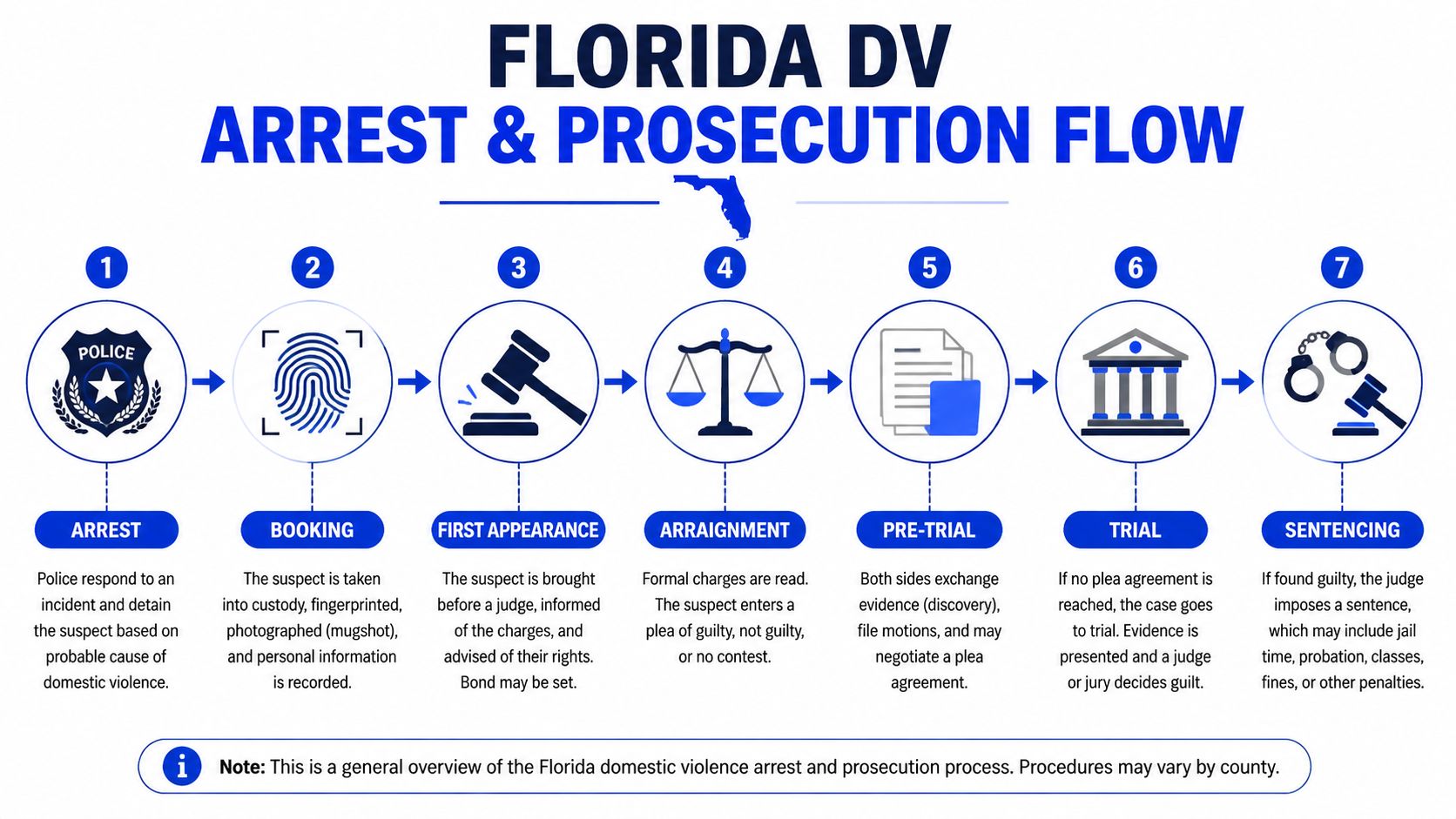
The sequence usually looks like this:
Arrest and booking
Police take you to jail, collect fingerprints, photograph you, and prepare reports. If there are visible injuries, damaged property, body camera footage, or witness statements, those get logged early.First appearance
A judge reviews probable cause and release conditions. In many domestic violence cases, the judge enters a no-contact order right away, even if the alleged victim wants contact.Formal filing review
The State Attorney's Office reviews the reports, recordings, photos, witness statements, and criminal history. Prosecutors decide what charge to file, whether to reduce, maintain, or sometimes decline the case.Arraignment and pretrial hearings
The court addresses the formal charge and the case moves into discovery, motions, negotiation, and trial preparation.
Who actually decides whether the case continues
Many people get blindsided by this. The alleged victim doesn't control the filing decision. The prosecutor does.
As a former prosecutor, I can tell you that domestic violence units often move forward even when the complaining witness becomes reluctant, stops answering calls, or asks that the case be dropped. The office may rely on:
Recorded 911 calls
Body camera footage
Photographs of injuries or the scene
Excited utterances or other statements made close in time
Jail calls, texts, and social media messages
Don't assume reconciliation ends the case. In Florida courts, it usually doesn't.
That's why “I'll just ask her to tell them she wants this dismissed” is usually a failed strategy. It can also create new problems if contact violates a court order.
A stronger approach is procedural and evidence-based. Defense counsel can move fast to preserve surveillance footage, identify neutral witnesses, gather favorable texts, challenge weak identification, and present mitigation before the State hardens its position.
Here's the trade-off. Waiting feels safer, but waiting often helps the prosecution. Early action can expose holes in probable cause, inconsistent statements, weak proof of injury, or motives that police didn't fully investigate.
Misdemeanor Domestic Violence Penalties and Sentences
Many Florida domestic violence assault charges are filed as misdemeanors at the start. That doesn't mean the consequences are light.
A misdemeanor domestic violence conviction can carry jail, probation, court costs, treatment requirements, and conditions that affect where you live and who you can see. Judges also take these cases seriously because the allegation involves violence within a family or household setting.

What a misdemeanor conviction can bring
Florida law includes mandatory minimum jail exposure in some domestic violence convictions involving intentional bodily harm. Under Florida Statute 741.283, a first offense carries a mandatory minimum of 10 days in county jail, a second offense carries 15 days, and a third or subsequent offense carries 20 days, as summarized in this discussion of Florida domestic violence penalties.
Other consequences can include:
Probation conditions that restrict travel, require reporting, and impose counseling or evaluations
No-contact or limited-contact restrictions that affect your home and family life
Court-ordered classes, often including a Batterers' Intervention Program
A permanent criminal record unless the case is resolved in a way that preserves sealing eligibility
Why these cases must be defended early
The biggest mistake I see is treating a misdemeanor domestic violence charge like a simple county court case that can be cleaned up later. In practice, these files often influence family court, immigration issues, firearm rights, housing applications, and professional licensing.
A strategic defense looks at more than the plea offer. It asks:
Question | Why it matters |
|---|---|
Is the evidence strong enough to prove an unlawful touching or threat? | Weak facts may support a reduction or dismissal |
Was the client defending himself or someone else? | Self-defense can change the entire analysis |
Did officers document only one side of the story? | Incomplete investigation creates leverage |
Will the result block sealing later? | Record consequences can outlast the sentence |
The courtroom penalty is only one part of the sentence. The record often does the longer damage.
That's why an experienced Florida domestic violence defense strategy in Fort Lauderdale or Broward County has to focus on the charge, the facts, and the long-term outcome at the same time.
When Charges Escalate to a Felony in Florida
Some domestic violence assault charges in Florida move from serious to life-changing based on one allegation. No prior record is required for that to happen.
Strangulation changes the case immediately
Florida treats domestic battery by strangulation as a felony. If the allegation is that the accused impeded normal breathing or circulation, the charge is automatically a third-degree felony, even on a first offense, with exposure of up to 5 years in state prison and a $5,000 fine, according to this explanation of felony domestic violence penalties in Florida.
From a defense standpoint, strangulation cases require immediate attention because the allegation often depends on statements, photographs, medical observations, and how officers describe marks on the neck, voice changes, or breathing complaints. Jurors also react strongly to this accusation.
If you need a broader explanation of how Florida law treats physical-contact offenses, this guide to battery charges in Florida is a useful companion.
Other facts that can increase exposure
Felony charging can also come from allegations involving a deadly weapon, serious bodily injury, or other aggravating facts. In real practice, prosecutors often review the file for details that support a tougher count even when the initial arrest affidavit seems brief.
Here's what usually makes the case more dangerous:
Weapon allegations such as a knife, firearm, or blunt object
Serious injury claims supported by medical records or photographs
Repeated conduct that allows the State to argue a more violent pattern
Witness corroboration from children, neighbors, or independent observers
The trade-off in felony cases is clear. A quick plea may limit risk in some files, but moving too fast can also lock in a conviction before the defense has tested causation, intent, injury evidence, and witness reliability. In a felony domestic violence case, that review can't be rushed.
Collateral Consequences on Your Family and Future
Many clients come into court focused on avoiding jail. That's understandable. But in domestic violence cases, the collateral consequences often hit first and last longer.

The criminal case is only part of the problem
A domestic violence arrest can trigger a separate civil injunction case. That means you may be dealing with two court systems at once. One is criminal. The other can restrict where you live, whether you return home, and how you communicate with the other person.
If the judge enters a no-contact order in the criminal case, violating it can create a fresh arrest and a stronger position for the prosecution. This overview of a Florida no-contact order violation explains why even “peaceful” communication can backfire when a court order says otherwise.
Other consequences can reach well beyond the courthouse:
Family impact
You may be forced out of the home, blocked from seeing children except on limited terms, or face new arguments in family court about timesharing and decision-making.Employment problems
Some employers react to violent-crime allegations before the case is resolved. Professional license holders face extra scrutiny.Housing issues
Landlords and property managers may deny applications or react to arrests involving alleged violence.Firearm consequences
Domestic violence outcomes can affect the right to possess firearms under federal law and related court orders.
What clients underestimate most
Clients often think they can separate the criminal case from the rest of life. They usually can't. One court file can influence custody negotiations, work discipline, security clearances, and immigration screening.
This short video gives a practical look at how serious the ripple effects can become:
A favorable outcome isn't just about avoiding jail. It's about protecting your home life, your record, and your ability to move forward.
That's why defense strategy should start with a full map of consequences, not just the next hearing date. In Fort Lauderdale, Broward County, and throughout South Florida, the smartest approach is coordinated. Criminal defense decisions should account for injunctions, family-court exposure, and employment fallout from day one.
Strategic Defenses Against Domestic Violence Charges
A domestic violence accusation is not a conviction. That sounds obvious, but people forget it once they've been arrested, photographed, and ordered to stay away from home.
The State still has to prove the case. In many files, that proof is weaker than it first appears.
How the State usually builds the file
As a former prosecutor, I can tell you most domestic violence cases are built around a handful of recurring evidence points:
The first statement made at the scene or on the 911 call
Officer observations such as redness, scratches, broken items, or demeanor
Digital evidence including texts, calls, and social media messages
Follow-up statements that the prosecutor argues are consistent over time
That approach has weak points. Officers often arrive after the incident is over. They may speak to one person more than the other. They may mistake emotional behavior for guilt or credibility. They may also miss context that matters, especially in a relationship with prior arguments, mutual intoxication, or a custody dispute.
Where the defense finds leverage
Strong defense work is specific. It doesn't rely on broad denial alone. It tests each piece of the State's theory.
Common defense paths include:
Self-defense or defense of others
If you used reasonable force to protect yourself or another person, the case may look very different once all injuries, witness accounts, and prior threats are reviewed.False allegation or motive to exaggerate
Some accusations arise during breakups, divorce fights, custody disputes, or housing conflicts. That doesn't make every allegation false, but it does mean motive matters.Lack of proof
If the State has inconsistent statements, unclear photos, no independent witnesses, or weak evidence of intent, the defense may push for reduction, diversion where available, or dismissal.Accident or noncriminal contact
Not every physical interaction is a crime. Context matters. So does intent.Witness credibility problems
Prior inconsistent statements, selective memory, and contradiction by neutral evidence can reshape the case.
A good lawyer also does what the police often didn't. Interview all witnesses. Preserve Ring footage. Pull phone records. Review body camera carefully. Compare injuries on both sides. Challenge assumptions in the arrest report. Through these actions, an experienced review of domestic violence charges in Florida becomes useful as part of a larger defense plan.
The best defense theory is the one supported by evidence, not the one that sounds best in conversation.
What doesn't work? Contacting the alleged victim to “fix it.” Posting online. Assuming the prosecutor will lose interest. Showing up in court without a plan. Domestic violence defense in Florida is usually won through disciplined evidence work and early strategic pressure, not hope.
FAQs About Florida Domestic Violence Cases
Can the victim drop the domestic violence charges in Florida
Usually, no. The alleged victim can tell the prosecutor their wishes, but the State Attorney's Office decides whether to continue. Prosecutors may proceed even if the complaining witness wants the case dismissed, especially if they believe the file contains enough other evidence.
What is the Batterers Intervention Program
The Batterers Intervention Program, often called BIP, is a court-ordered program that may be required as part of sentencing or probation in domestic violence cases. Judges often treat it as a standard condition in cases that resolve with a conviction or certain negotiated outcomes. Whether it applies in your case depends on the charge, the facts, and the final disposition.
Will I lose custody of my children
Not automatically, but a domestic violence charge can affect family court quickly. Judges handling custody and timesharing disputes care about allegations of violence, court orders, and contact restrictions. If children were present, named in reports, or affected by a no-contact condition, the issue becomes more serious.
How can I get a no-contact order modified
You don't modify it by private agreement with the other person. You need the court to change it.
That usually means your lawyer files a motion, gathers facts showing why modification is appropriate, and addresses safety concerns the judge may have. In some cases, the court may consider moving from no contact to peaceful contact. In others, the judge won't modify the order early.
Should I talk to police after my arrest to clear things up
Usually, no. Once you've been accused, “explaining” often gives the State more statements to use against you. If police want to reinterview you, speak with defense counsel first.
Can a domestic violence case be dismissed
Yes, some can. Dismissal may happen because the evidence is weak, witnesses become unavailable, the defense exposes inconsistencies, or the State determines it can't prove guilt beyond a reasonable doubt. But it never happens just because everyone wants to move on.
What should I do right now if I was arrested in Broward County or Fort Lauderdale
Take these steps immediately:
Follow every release condition exactly, especially no-contact language
Preserve evidence such as texts, photos, videos, call logs, and witness names
Stop discussing the facts with friends, family, or online
Get defense counsel involved early before the State locks into its theory of the case
If you're facing domestic violence assault charges in South Florida, early strategy matters. So does having counsel who understands how prosecutors screen these files, where they overcharge them, and how to challenge the evidence without making your situation worse.
If you were arrested for domestic violence in Fort Lauderdale, Broward County, Miami-Dade, Palm Beach, or anywhere in South Florida, Ticket Shield, PLLC can help you build a clear defense plan. Attorney Jason S. Goldsmith is a former prosecutor who now defends the accused, using that insider perspective to identify weaknesses in the State's case, protect constitutional rights, and pursue the best available outcome. Call for a confidential consultation and get practical guidance on what to do next.
Domestic violence assault cases are handled differently in Florida. Learn the penalties, the process, and your strongest defenses.