
What Is a Mistrial in Florida and What Happens Next
Jason Goldsmith, Esq
A mistrial is the termination of a criminal trial before a verdict because the proceeding can no longer continue fairly. It is not an acquittal, and a retrial is often still allowed.
You're sitting at counsel table in Fort Lauderdale, Miami, or West Palm Beach after days of testimony, and the judge calls the lawyers to the bench. A juror did outside research, a witness mentioned evidence the jury was never supposed to hear, or deliberations have stalled. Then you hear the word mistrial, and everyone around you starts guessing whether you won, lost, or get to go home.
Stop guessing. That one word tells you almost nothing by itself. Your future depends on why the trial stopped, who asked for it, whether you objected or consented, and what the judge put on the record before ending it. Get those answers before you celebrate, relax your bond compliance, or talk to anyone about the case.
Table of Contents
A Mistrial in Florida Explained in Plain English
The courtroom moment looks abrupt. The judge excuses the jury, hears argument outside their presence, and announces that the trial can't continue. The jury is discharged without deciding guilt or innocence, and the court moves to scheduling, bond, and what the State intends to do next.
That speed creates confusion for families. A trial suddenly ends, but nobody says "not guilty," nobody says "guilty," and the charges haven't magically vanished. Your lawyer's focus shifts immediately from cross examination to protecting the record for a possible retrial fight.
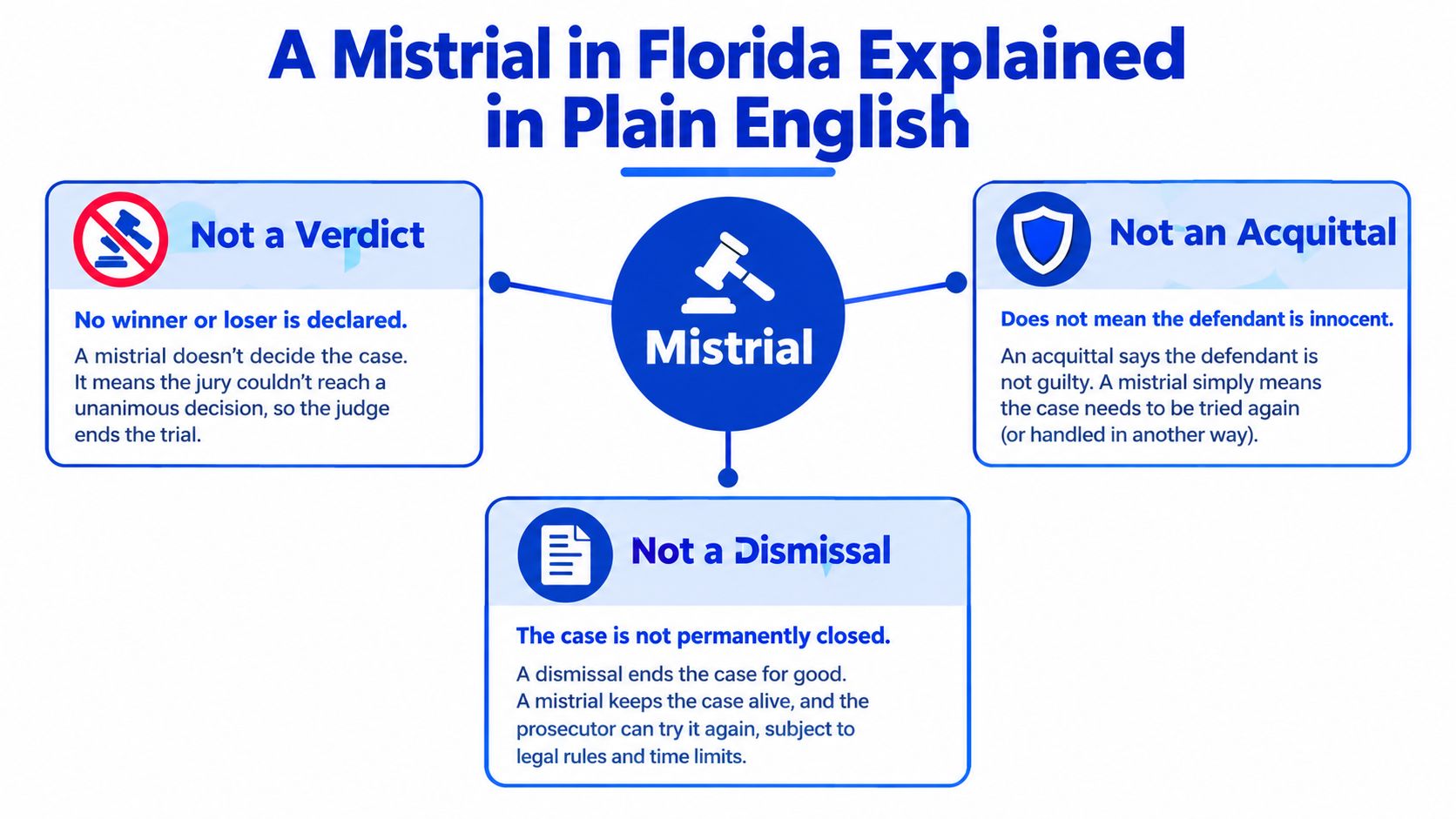
What the definition actually means
When people ask what is a mistrial, the plain answer is this. It's the termination of a trial before a verdict because the proceeding can no longer fairly or properly continue, and the case ends without a decision on the merits under the federal rule describing mistrial procedure. You weren't acquitted, and you weren't convicted.
Think of it as the judge stopping a contest because the process broke down. The court hasn't decided the evidence proves or fails to prove the charge. The court has decided this particular trial can't produce a fair, legally usable verdict.
Do not treat a mistrial as a victory until your lawyer reads the judge's stated reason and the transcript of who objected.
The questions that matter in the first hour
Did the judge state a specific cause: A vague reference to fairness is weaker than findings about deadlock, prejudice, or misconduct.
Who requested the mistrial: Your request, the State's request, and the judge's own decision lead to different retrial rules.
Did you consent or object: Silence and agreement can damage a later double jeopardy argument, so counsel must state your position clearly.
What alternatives did the judge reject: The record should show whether a lesser fix could have saved the trial.
That record controls the next fight. If the State can retry you, preparation starts again with a new jury. If retrial is barred, counsel should move quickly to enforce that protection instead of waiting for the State to reset the case.
Common Grounds That Trigger a Florida Mistrial
Not every courtroom mistake ends a trial. Judges see improper questions, emotional witnesses, and scheduling problems every week. A mistrial becomes realistic when the problem creates substantial prejudice that the court can't repair without stopping the proceeding.
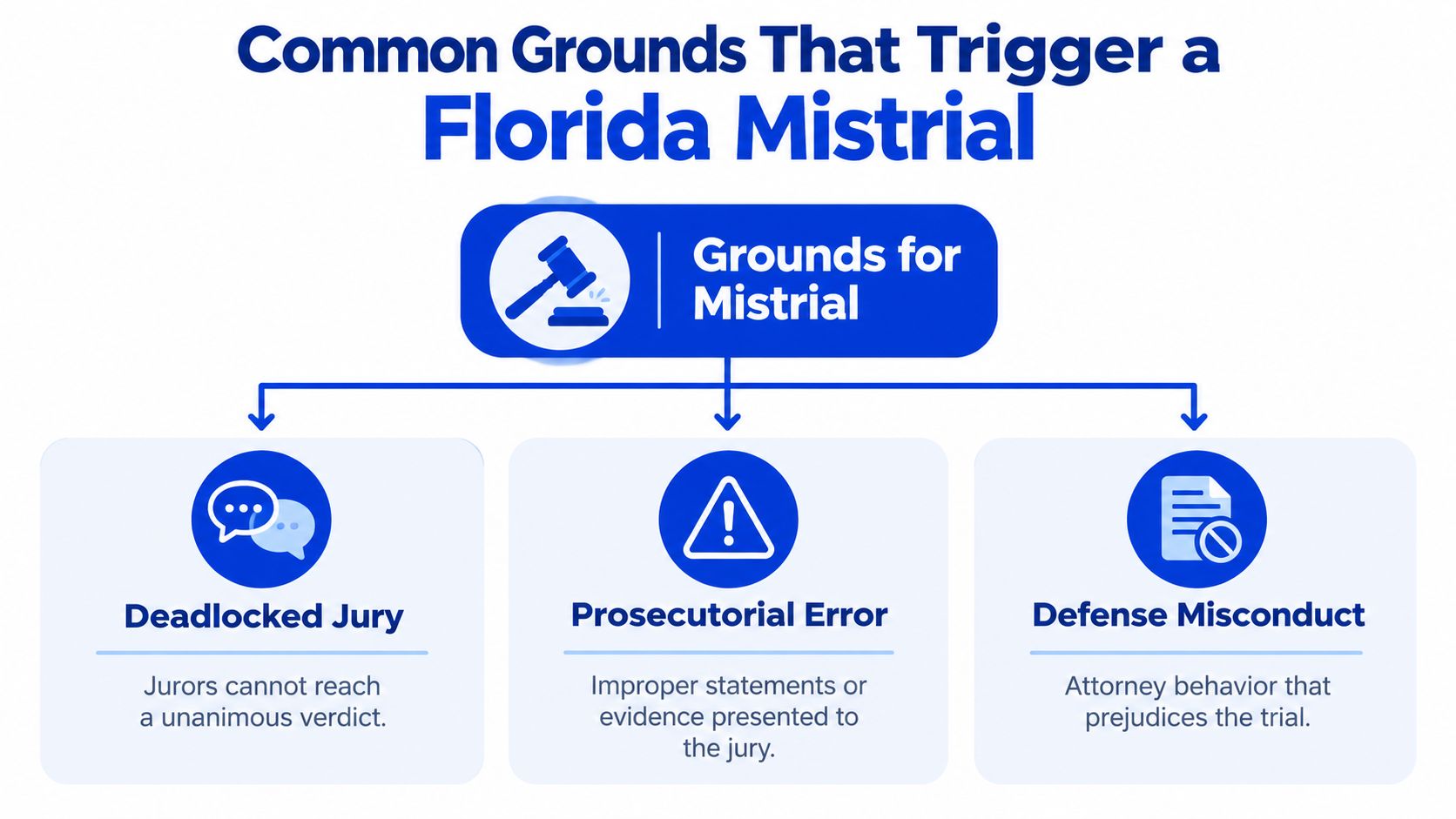
Deadlock and jury problems
A deadlocked jury is the cleanest example. Jurors deliberate, report they can't reach the required agreement, and the judge determines further deliberation won't produce a verdict. That jury has failed to perform its central function.
Juror misconduct is messier. A juror researches the defendant online, discusses the case with outsiders, hides bias during selection, or brings outside information into deliberations. The judge must determine who was exposed, whether other jurors were tainted, and whether an alternate can solve the problem.
Prejudicial evidence and attorney conduct
A witness may blurt out a prior conviction the judge had excluded, mention suppressed evidence, or reveal a statement the State promised not to use. Once jurors hear that material, defense counsel has to decide whether an instruction to ignore it is realistic or whether the damage is permanent.
Attorney misconduct can create the same problem. Improper argument, repeated violations of court rulings, or conduct that creates a substantial risk of an unfair trial may force the judge to intervene. If you're trying to understand where aggressive advocacy crosses the line, review how prosecutorial misconduct is analyzed in criminal cases before assuming every improper comment requires a mistrial.
The video below gives useful courtroom context for how these disputes unfold in real time, before a judge decides whether the trial can be saved.
Courts don't start with the most drastic remedy. A mistrial is generally reserved for situations in which a fair and impartial trial cannot continue, while narrower options may come first, including a curative instruction, replacing a juror, sanctions, or contempt under the North Carolina prosecutors manual discussion of mistrial remedies.
That's the trap. The seriousness of the mistake alone doesn't compel a mistrial. The defense must connect the event to actual prejudice and show why anything short of ending the trial won't protect you.
How Double Jeopardy Shapes a Florida Mistrial
Double jeopardy is where most mistrial advice falls apart. The protection doesn't mean the State automatically loses its only chance whenever a trial stops early. It means the reason for stopping, and your position on stopping, decide whether the State gets another trial.
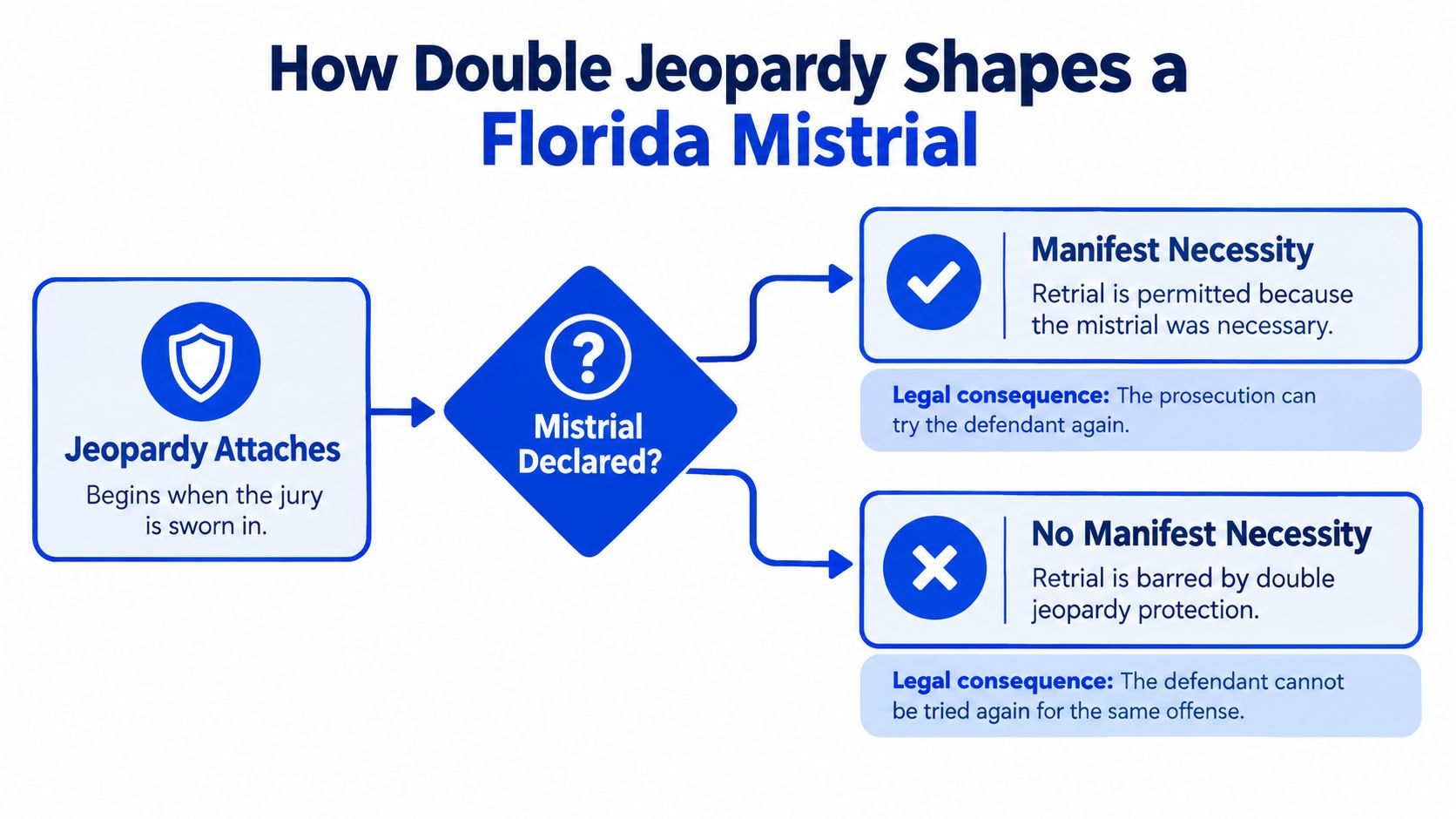
When jeopardy attaches
In a jury trial, jeopardy generally attaches when the jury is sworn. In a bench trial, it generally attaches when the first evidence is presented under Cornell's constitutional summary of reprosecution after mistrial. From that point forward, the prosecution ordinarily gets one opportunity to obtain a conviction.
That timing is why a judge can't casually discharge a jury and start over. Once jeopardy has attached, ending the case over your objection requires a legally sufficient justification. The State doesn't get a free rehearsal.
Manifest necessity over your objection
Florida uses the manifest necessity standard when a mistrial is declared without your consent. The State must establish an urgent, legally sufficient reason, and the judge must conduct a careful inquiry and consider and reject all reasonable alternatives such as a continuance, recess, or excluding prejudicial evidence in the Florida Supreme Court's 1993 mistrial decision.
Read that sequence carefully. Inquiry first, alternatives second, mistrial last. If the judge jumps straight to a mistrial without examining lesser remedies, your lawyer has a serious argument that double jeopardy bars retrial.
Practical rule: If you object to a mistrial, make the judge explain why every reasonable alternative fails. That explanation can become your motion to bar retrial.
When you request the mistrial
Your own request changes the analysis. In Oregon v. Kennedy, decided in 1982, the U.S. Supreme Court held that when a defendant requests and receives a mistrial, double jeopardy generally doesn't prevent a second trial in the Supreme Court's Oregon v. Kennedy opinion. The narrow exception applies when prosecutorial conduct was intended to provoke you into requesting it.
Improper conduct alone isn't enough. The court examines the prosecutor's intent from objective facts and circumstances. That's a demanding showing, and it's why you shouldn't blurt out a mistrial request without counsel weighing the waiver risk.
For the broader protection behind these rules, read an explanation of double jeopardy and repeated prosecution. In a mistrial, the doctrine is intensely practical. Who ended the trial, why it ended, and what the judge considered will matter more than slogans about being tried twice.
Defense-Requested, Prosecution-Requested, and Judge-Initiated Mistrials
Three mistrials can look identical on a court docket and produce three different results. The source of the request tells an experienced defense lawyer where to attack first. Don't ask only whether a mistrial happened. Ask who caused it.
How the source changes the fight
Type of Mistrial | Double-Jeopardy Risk | What the Record Must Show |
|---|---|---|
Defense requested | Retrial usually allowed because you chose to end the proceeding | Why you requested it and whether the State intended to provoke the request |
Prosecution requested over objection | Highest scrutiny for the State | Manifest necessity and rejection of reasonable alternatives |
Judge initiated over objection | Retrial depends on legal necessity | Careful inquiry, specific cause, and why lesser remedies were inadequate |
Hung jury | Retrial ordinarily allowed | Genuine inability to reach a verdict |
A defense request usually permits retrial because you affirmatively chose termination over continuing with a damaged jury. That's sometimes the right tactical call. A poisoned jury can be worse than starting over, but counsel must make that choice knowing retrial is the likely price.
A prosecution request over your objection deserves aggressive resistance. The State shouldn't benefit from its own error by getting a cleaner second presentation. Counsel should force the State to prove necessity and should propose specific alternatives the judge must address.
A judge initiated mistrial sits between those poles. Judges have authority to protect the proceeding, but they don't have unlimited authority to discharge a sworn jury. The Florida Supreme Court has explained that an unauthorized discharge without consent, legal necessity, or a sufficient reason can operate like an acquittal in Florida's unauthorized jury discharge precedent.
The hung jury exception people misunderstand
A hung jury is the leading example of a mistrial that ordinarily permits a new trial, because genuine inability to reach a verdict is treated as manifest necessity in Cornell's summary of the federal hung jury rule. You haven't been cleared. The State may generally present the case to a new jury.
The distinction between a jury trial and a judge decided trial also affects when jeopardy attaches and how a breakdown is handled, which is why defendants should understand the difference between a jury trial and a bench trial before trial begins. Once you're sworn in, every objection needs a retrial strategy behind it.
Curative Alternatives a Florida Judge Must Try First
Demanding a mistrial at the first sign of trouble is often a mistake. Florida judges are expected to examine narrower remedies before dismantling a trial, and defense counsel should use that expectation to build advantage. Sometimes exclusion, an instruction, or a replacement juror protects you better than a reset that lets the State improve its case.
Remedies short of ending the trial
Curative instruction: The judge tells jurors to disregard specific testimony or argument and explains that it can't support their verdict.
Replace the juror: If one juror is biased or committed misconduct, an alternate may preserve the panel without ending the case.
Recess or continuance: A pause can allow counsel to investigate a disclosure, locate a witness, or reduce the effect of a disruption.
Exclude tainted evidence: The court can strike testimony, exclude an exhibit, or limit how the State may use problematic material.
Sanctions or contempt: The judge can punish misconduct directly when punishment, rather than termination, repairs the proceeding.
Your lawyer shouldn't merely ask for those remedies in passing. Counsel should state why each one works, or why each one fails, and get a ruling. If the judge later declares a mistrial over your objection, that sequence becomes central to challenging retrial.
Build the record while the problem is fresh
Object promptly and specifically. Identify the exact statement, exhibit, juror conduct, or ruling that caused prejudice. Explain why jurors can't realistically ignore it if you're seeking a mistrial, or propose a lesser remedy if you want the trial to continue.
Don't assume the dramatic remedy is the strongest remedy. Dismissal based on double jeopardy, exclusion of the State's key evidence, or preservation of a favorable jury can be worth far more than starting over. The word mistrial sounds powerful in the hallway. In practice, it often means the State gets to repair mistakes you exposed during the first trial.
What Changes for a Defendant After a Mistrial
The trial ends. Your case usually doesn't.
That's the first reality to accept for a violent crime, weapons, drug, theft, or probation related prosecution in Broward County, Miami-Dade, or Palm Beach. Unless the judge separately dismisses charges or the State announces it won't proceed, you remain an accused person waiting for the next decision.
Conditions that may stay in place
Custody and bond: Don't assume release conditions disappear because the jury was discharged. Confirm your status before leaving court.
No contact and protective orders: Restrictions involving alleged victims or witnesses may remain enforceable until a court modifies them.
Travel, testing, and supervision terms: Pretrial release and probation related conditions need express clarification, not guesswork.
Evidence preservation: Both sides should preserve exhibits, notes, recordings, and witness information for a possible retrial or appeal related motion.
Firearms and other specific prohibitions: Any condition tied to the charge should be treated as active until counsel confirms otherwise in writing.
A prosecutor may seek retrial, reduce or resolve charges through negotiation, or decline to proceed. A formal decision not to prosecute is different from a mistrial, and defendants often confuse the two. Review what nolle prosequi means in a criminal case so you don't mistake silence from the State for a dismissal.
Your immediate to do list
Get counsel to review the transcript, jury notes if available, objections, sidebar discussions, and the judge's findings. Identify whether you consented, objected, or said nothing. Pin down whether the court considered alternatives and whether prosecutorial or judicial conduct caused the breakdown.
Say nothing about the facts to witnesses, family group chats, social media, or anyone who could repeat your words at a retrial. Follow every release condition exactly. The fastest way to turn an unresolved trial into a new arrest is to act as if the case ended when the jury left.
Mistrial Misconceptions That Can Hurt Your Case
I hear the same assumptions after almost every mistrial, and several of them can damage an otherwise strong defense position. The most dangerous is calling a mistrial a win before anyone has analyzed retrial. A stopped trial is an opening for legal argument, not a guaranteed outcome.
Beliefs to discard
"The charges were dropped": A mistrial ends that trial. It doesn't, by itself, dismiss the prosecution.
"Double jeopardy always bars retrial": Hung juries, defense requests, and manifest necessity often permit another trial.
"I should always ask for a mistrial": Your request can waive the strongest double jeopardy argument you'd otherwise preserve by objecting.
"Any prejudicial mistake forces a mistrial": Judges may use instructions, juror replacement, exclusion, recesses, or sanctions first.
"A mistrial only helps the defense": The State may use the first trial as a preview of your strategy, witnesses, and cross examination.
That last point deserves emphasis. A mistrial can sometimes benefit the prosecution rather than the defense because the government may receive another opportunity to present its case, refine witnesses, or address weaknesses exposed during the first proceeding under the Michigan criminal benchbook discussion of mistrial consequences.
A mistrial can also create negotiation pressure for both sides. The State has seen its witnesses tested, and you've seen where reasonable doubt may exist. Before rejecting any resolution, understand how plea bargaining works in criminal cases and compare that option against the risk of a stronger retrial presentation.
Your protection isn't optimism. It's a precise record of consent, objection, necessity, alternatives, and prosecutorial responsibility. Two cases can both be called mistrials and end in opposite results because those five facts differ.
Frequently Asked Questions About Florida Mistrials
Can the State retry the same charges after a hung jury
Yes, generally. A hung jury is a recognized basis for a Florida mistrial that generally permits a retrial, because Florida double jeopardy protection doesn't ordinarily prevent the State from presenting the case to a new jury when jurors can't reach a unanimous verdict under the Florida Supreme Court's hung jury decision. Your lawyer should still verify the jury was deadlocked.
Does a mistrial change my bond or no contact order
Don't count on it. Bond, custody status, protective orders, and no contact restrictions don't necessarily disappear when a trial ends. Get the judge's direction on the record and follow the existing conditions until counsel confirms a modification.
Can double jeopardy ever stop a Florida retrial
Yes. Retrial may be barred when a mistrial was declared over your objection without manifest necessity, or when the State intentionally provoked your mistrial request. Florida courts recognize the intentional goading exception in Florida Supreme Court material on defense requested mistrials. The transcript and the judge's findings will drive that argument.
What should I do this week
Meet counsel, order the transcript, preserve your objection history, and map the State's likely retrial position. Don't discuss the facts publicly, violate release terms, or contact witnesses. Speed matters because the next hearing can arrive before your family has processed the first trial.
If your Florida trial just ended in a mistrial, get your transcript, the judge's findings, and your consent or objection reviewed before the State decides its next move. Ticket Shield, PLLC helps defendants across Broward County, Fort Lauderdale, Miami-Dade, Palm Beach, and surrounding South Florida evaluate retrial exposure, preserve double jeopardy arguments, and prepare for dismissal motions, negotiations, or a second trial. Contact the firm now for direct guidance on what happens next in your misdemeanor or felony case.