
Failure to Appear Traffic Court: Next Steps in Florida
Jason Goldsmith, Esq
You just missed your traffic court date and now the phone is ringing in your head even if the clerk hasn't called yet. That panic is normal, but don't turn it into a second mistake by freezing, driving around on a possibly flagged license, or assuming the ticket will disappear if you ignore it. In Florida traffic court, a missed date can become a warrant problem, a license problem, and sometimes a new criminal exposure if you wait too long.
The fix starts with the same mindset I gave clients when I was a prosecutor and now give them as a defense lawyer. Move fast, get the case status, and handle the court issue and the licensing issue as two separate tracks. If you clean up only one, the other one can still bite you at the next traffic stop, at the DMV, or when the clerk sends the next notice.
Table of Contents
You Missed Your Traffic Court Date in Florida, Now What
The worst part is the moment you realize the date passed and the stack of reminders is still sitting there untouched. Don't tell yourself it's too late to fix. In traffic court, delay is what turns a manageable problem into a mess with a warrant, a license hold, and a harder conversation with the judge.
Florida traffic cases often split into two separate problems after a missed appearance. One is the court side, where the judge can treat the missed date as a failure to appear issue, with a warrant or other enforcement step depending on the county and charge. The other is the administrative side, where the state can flag your driving record and create a suspension or hold that outlives the original ticket.
That split matters because people often panic and focus on the wrong thing. They pay the original ticket, or they call the wrong office, and the failure-to-appear piece stays alive in the background. If the court record still shows an open nonappearance, you have not really fixed the case.
For a plain-English breakdown of traffic ticket court dates and what usually comes next, see this Florida traffic court guide. Keep that in mind, but don't overthink the legal theory right now. Your first goal is simple. Confirm the status, stop making the situation worse, and get the matter in front of the right person before a roadside stop does it for you.
Practical rule: if you missed the date, assume the case is active until the clerk or a lawyer proves otherwise.
The reverse path is straightforward in concept, even if it's annoying in practice. Contact the court, protect your license, avoid new charges, and get counsel involved if the county has already turned the missed date into a warrant or a separate criminal issue.
What Happens Automatically When You Fail to Appear
A missed traffic date doesn't sit there politely. The clerk marks the nonappearance, and from there the case can move into enforcement mode. In many systems, that means the court starts treating the case as more than an ordinary unpaid ticket.
The immediate consequence is often a court-side enforcement step. Depending on the county and the charge, that can be a bench warrant or a capias, which is just the court's way of saying the case is now carrying arrest risk. If you're lucky, the court hasn't processed it yet. If you're not, the warrant is already entered and you'll find out at the worst possible time, usually during a stop or a routine records check.
The court track and the licensing track move separately
That's the part many overlook. The judge's office and the licensing system are not the same thing, and fixing one doesn't automatically fix the other. The court can still have an open failure-to-appear entry even after the original fine is paid, and the licensing agency can still show a hold even after you've spoken to the clerk.
Florida courts also treat a missed traffic appearance more seriously than a harmless calendar mistake. In some cases, failing to appear can create a new criminal exposure, not just a civil penalty attached to the ticket. If you want a good example of how seriously courts take missed dates, California courts warn that failing to appear for a traffic or minor offense can trigger a warrant, a civil assessment, a collections referral, a license hold, and even trial in absentia, and federal court guidance says failure to pay or appear can lead to a summons or arrest warrant plus reporting to motor vehicle agencies California traffic court guidance on failure to appear and federal court guidance on ticket nonpayment or nonappearance.
The mistake isn't just missing court. The mistake is assuming the case will stay still while you wait.
The timeline varies. Some courts move the same day, others take longer. That's why a caller's guess about whether a warrant exists is useless. You need a real status check, not wishful thinking.
The bottom line is simple. One missed date can create two live problems at once, and both matter. If you clear the court but ignore the license issue, you can still be driving into a suspension problem. If you focus only on the license but leave the warrant unresolved, you can still be arrested.
Your First 48 Hours After a Missed Court Date
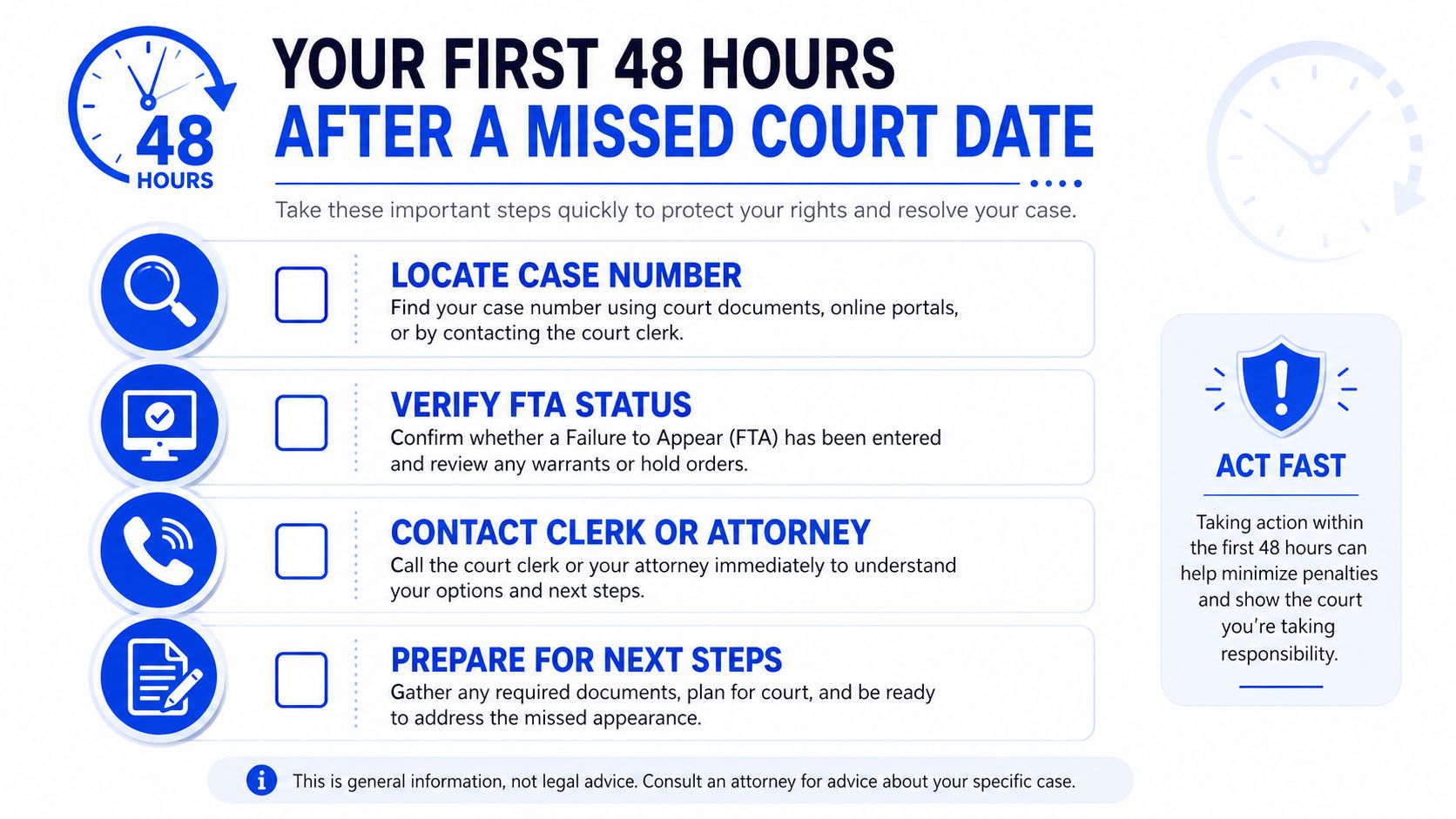
The first two days are about control. Don't wander around the internet reading horror stories. Get the case number, confirm the status, and find out whether the court has already taken formal action.
Start with the citation and the clerk, not the officer
Pull the citation, the court notice, and anything that shows the court date. If you have the portal access number, use it. Then call the clerk of court for the county where the ticket was filed and ask whether the case shows a failure to appear, a warrant, or a reset date.
Do not call the officer who wrote the ticket and do not spend the morning leaving messages for the prosecutor. They usually can't fix the docket entry themselves. The clerk can tell you the current posture of the case, and that is the starting point for every sane solution.
Stop creating new problems
If you think the warrant or hold may already be in the system, don't keep driving like nothing happened. That's how a ticket becomes a stop, and a stop becomes a second case. Also, don't mail in the original fine and assume that solves the missed appearance. It might pay the ticket, but it does not necessarily clear the failure-to-appear issue.
An older but still useful lesson from traffic defense work is simple. Paying the ticket is not the same as clearing the missed appearance. If the court still has you marked as absent, the problem stays alive even if your check clears.
Gather these documents right away:
Citation and case number. You need the exact filing information so the clerk can pull the right record.
Court notices and reminders. Save every envelope, text, email, or printed notice.
Proof of why you missed court. Medical records, travel delays, work records, childcare conflicts, or any other real documentation can matter.
Driver's license and registration information. If the court or DMV has already flagged your record, you need the exact status.
A missed appearance caused by forgetfulness, a notice problem, or a real logistical failure is still a problem, but it's a much better problem than deliberate avoidance. Recent CJ Institute research found the most common reasons for failure to appear were forgetting the court date and not knowing about the appearance, with transportation barriers also commonly reported CJ Institute paper on what prevents court appearance.
If the clerk says there's already a warrant, don't go shopping for courage. Call a lawyer before you walk into the courthouse. A self-resolved path sometimes works for a simple reset, but once the warrant is live, the wrong move can put you in custody when all you wanted was a new date.
Four Realistic Paths to Clear the Warrant
No two counties handle this exactly the same way, but the practical options tend to fall into four buckets. I've seen all four. The right one depends on the county, the charge, and whether the warrant is already active.
A reset by motion or quick clerk intervention
For a first-time missed appearance that looks non-willful, some courts will reset the case after a phone call and a written request. That's common when the defendant moved quickly, has no prior history of blowing off court, and can document a decent reason. In a good county, the clerk can help identify what filing or hearing is needed, and a lawyer can often package the request so the judge sees a responsible explanation instead of a shrug.
A bond or forfeiture route
Some warrants or capias issues can be handled by posting what the court requires to recall the warrant and put a fresh date on the calendar. This is not a free pass. It is a trade. You pay to get the case back in motion, then you still have to deal with the underlying ticket.
A formal surrender through counsel
If the warrant is active, a lawyer can often arrange a surrender that avoids the chaos of getting picked up during a traffic stop. That matters because nobody wants to turn a fixable traffic issue into a roadside arrest. In a lot of counties, the defense lawyer can coordinate the appearance, manage the paperwork, and keep the client from sitting in lockup over a ticket.
A global resolution on the original charge and the FTA
Sometimes the smartest move is not to fight the missed date in isolation. It's to attack the original traffic case and the failure-to-appear problem together. That can open the door to a better outcome, especially if the underlying citation has weaknesses and the nonappearance was not intentional.
Realistic advice: the county's procedure controls the path, not your preference. You need the route that gets the warrant off your back with the least exposure.
If you want a concise explanation of how that kind of court-appearance problem is treated in criminal practice, see this Florida fugitive-from-justice guide. The label matters less than the fix. Get the case back on the docket, make sure the warrant is recalled, and confirm the license hold is lifted.
How an FTA Hits Your License, Insurance, and Record
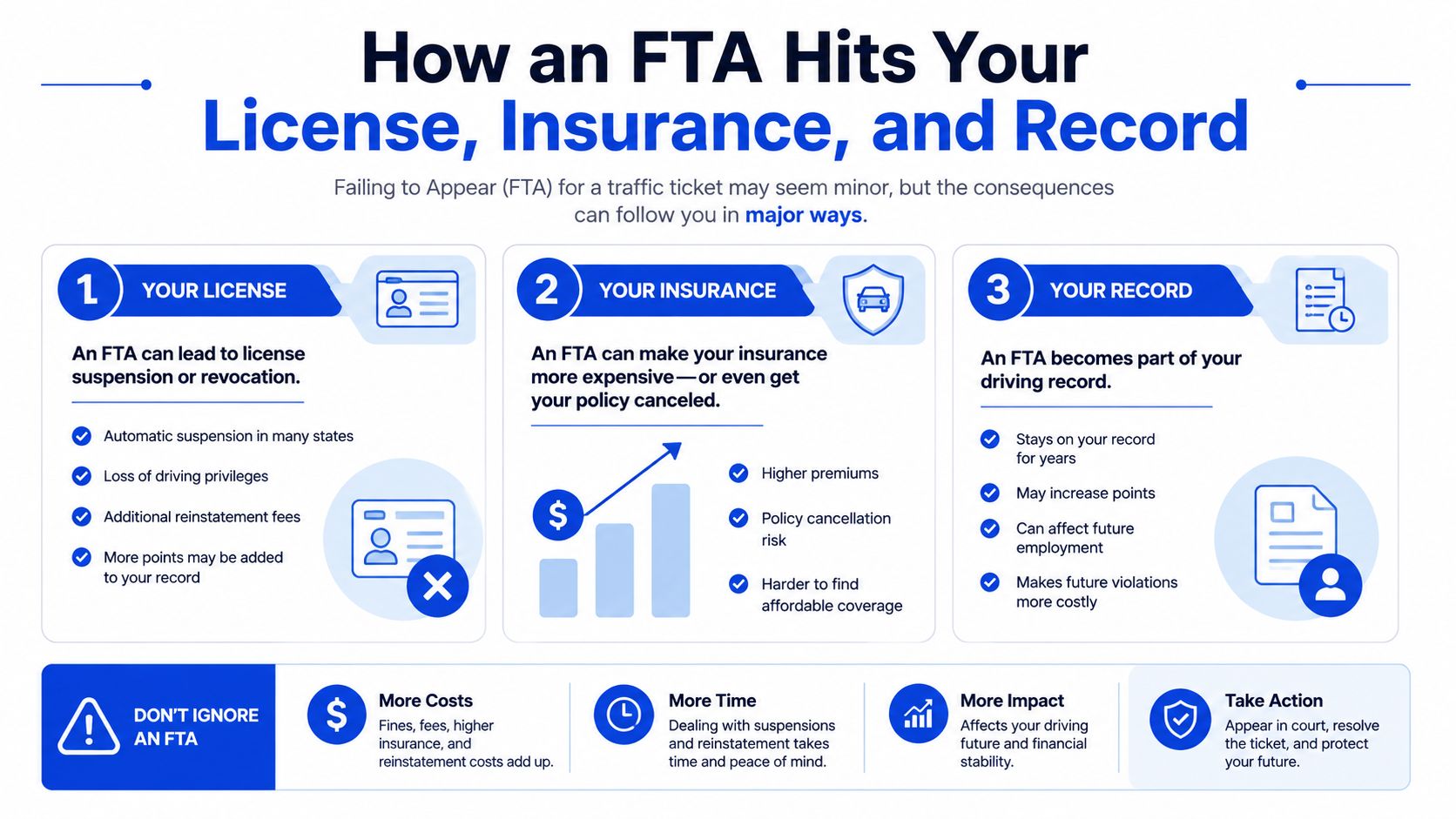
A missed traffic date does not stay inside the courthouse. The first place many drivers feel it is at the DMV or tag office, where a renewal, a reinstatement, or a routine status check suddenly stops working the way it should. By the time that happens, the case has already moved beyond the original ticket.
The license issue is the part that keeps punishing you
Traffic-court nonappearance can turn into a licensing problem that follows you until both the court and the state clear the record. The UNC Court Appearance Project report is a blunt example of how fast a missed appearance becomes a long-term driving problem. It found about 1 million active driver's license suspensions in 2018, with 800,000 tied solely to missing court. The same report found that the statewide nonappearance rate ranged from 7% in Yancey County to 35% in Robeson County, with an average of 15% across the counties studied.
Florida drivers should take that warning seriously. The exact process varies by state, but the consequence chain is familiar. A missed traffic date can become a hold, then a suspension, then another enforcement problem when you try to renew your license or registration. If you need the cleanup steps after a suspension, use this Florida license reinstatement guide and follow it closely.
Insurance and record consequences follow the court result
An FTA can also leave a mark on your background record and your driving history. Insurance companies care about patterns, not excuses. Once a missed court date turns into a new offense or a suspension, the file looks worse even if the original citation was minor.
That hidden fallout matters more than the original ticket. A small traffic case can spill into your driving privileges, your job search, and any screening that shows court history. If your job depends on a clean driving record, you need the FTA fixed, not just explained.
California and Houston show how stacked the consequences can become
Courts do not shy away from piling on consequences. California court guidance says failure to appear in traffic or minor cases can trigger a $100 civil assessment, collections referral, warrant issuance, DMV hold, license suspension, and inability to renew registration Solano County court traffic failure-to-appear guidance. Houston Municipal Courts say that, in certain cases effective January 1, 2026, the warrant fee rises to $75, a separate failure-to-appear fine is $244, collection referrals can add a 30% fee, and there can be denial of license issuance or renewal plus denial of vehicle registration Houston Municipal Courts traffic consequences page. Those examples are outside Florida, but they show the same basic truth. Missing traffic court can turn into a financial trap and a licensing trap at the same time.
Defenses and Mitigation Strategies That Actually Work
A missed appearance is not the same thing as a guilty plea. Judges care whether the absence was willful, whether notice was proper, and whether the driver moved quickly to correct it. That's where defense work matters.
Non-willful absence is the key distinction
If the court date was missed because of a real emergency, a bad notice address, transportation failure, or another documented breakdown, that is a different case than someone who just blew off court. The law and the practical reality both recognize that distinction. A lawyer can present the reason in a way that sounds organized and credible instead of emotional and scattered.
Transportation barriers matter more than many realize. So do address problems, childcare failures, and medical issues. If you have proof, bring it. If you don't, don't invent it.
Courts respond better to documentation than apology alone.
The mitigation goal is bigger than avoiding a jail call
A smart lawyer is not just trying to make the bench warrant go away. The goal is to protect the original record, reduce the chance of a new criminal entry, and keep the licensing side from spiraling. Sometimes that means asking for a reset. Sometimes it means negotiating the underlying citation down. Sometimes it means taking a global resolution that closes both files together.
The same idea applies if the court has a path to a reduced disposition, traffic school, or a civil-only resolution. Those options depend on the county and the posture of the case, but they're worth pursuing if they keep the original problem from turning into a bigger one. If the missed date was the only issue, good defense work can often keep it from becoming the story that follows you.
Why counsel usually does better than a solo explanation
Judges see self-filed excuses all the time. They also see messy, incomplete stories that don't tell them what they need to know. A defense lawyer can separate the legal issue from the emotional noise, show up with the right paperwork, and push for the narrowest fix that clears the case.
Ticket Shield, PLLC, led by Attorney Jason S. Goldsmith, can handle Florida traffic and criminal matters in that style, including missed court date problems and the related licensing fallout. For a broader sense of how a Florida criminal defense lawyer approaches these cases, see this Florida defense lawyer overview. The point is not marketing fluff. The point is getting the docket corrected before the case gets worse.
When to Hire a Lawyer and What Ticket Shield Does Next
If there's no warrant, no new charge, and the clerk can reset the date, you may be able to handle it yourself. If there's an active warrant, an out-of-county ticket, a commercial driver issue, or any hint of a new criminal exposure, hire counsel. That's the line.
A lawyer earns the fee when the problem is more than a simple phone call. In a missed court case, that usually means the office can contact the clerk, ask about the docket status, file the right motion, and appear on your behalf where allowed. It also means the lawyer can keep you from making a bad roadside decision while the case is still live.
Before the consultation, have your citation, the missed date, any court notices, and any proof of why you missed it. Ask two direct questions, whether the warrant is active, and what it will take to clear the license side once the court issue is handled. If you want the case fixed efficiently, don't start with excuses, start with facts.
Ticket Shield, PLLC handles missed traffic court dates, failure-to-appear issues, and the related license problems for drivers across Florida. If you're dealing with a traffic warrant or a court date you missed, visit Ticket Shield, PLLC and get a confidential consultation before the next notice turns a fixable problem into a bigger one.