
DUI Attorney Fort Lauderdale FL: Your Defense Guide
Jason Goldsmith, Esq
You just got out of the car, or out of the jail hallway, and the whole thing still feels unreal. Maybe the stop started with a taillight issue. Maybe the deputy said your eyes looked red, asked you to walk a line, then asked for a breath test. Now there's a criminal charge, a license problem, and a clock that started running before you even got home.
A DUI arrest in Fort Lauderdale is never just one problem. It's two cases moving at once, one in Broward County court and one with your driver's license, and both can move fast if you wait. If you're looking for a dui attorney fort lauderdale fl, the first thing to understand is that the next few days matter more than you might realize, especially because Florida's 10-day hearing deadline can decide whether you keep a shot at fighting the suspension early through the administrative process. Florida DUI and license deadline overview
Table of Contents
The First 24 Hours After a Fort Lauderdale DUI Arrest
The arrest usually doesn't feel dramatic in the moment. It feels confusing. A deputy asks more questions than you can answer cleanly, you're handed paperwork, and you're trying to figure out whether you're going home, losing your license, or facing jail.
That confusion is exactly why the first day matters. Once the arrest is made, Florida treats the situation as a real criminal case, not a roadside misunderstanding, and the administrative license process starts moving in the background. One missed decision early can shrink your options later, especially when the State is already building a record around the stop, the arrest, and whatever testing it collected at the scene. If breath testing became part of the arrest, this guide on refusing a breathalyzer in Florida helps explain one of the most common issues people ask about after the fact.
What the officer already has
By the time you leave the scene, the officer may already be relying on the stop itself, your driving pattern, your speech, your balance, and any test result or refusal. Those details matter because Florida DUI law turns on both impairment and measured alcohol level, not just whether someone “felt fine” before driving.
Practical rule: the arrest report usually tells the State's story first. Defense work starts by testing that story before it hardens into the only version anyone sees.
The moment you're home or at the jail release desk, start treating the case as live. Save the paperwork, don't guess at deadlines, and don't assume the license issue can wait until the criminal court date. It can't.
Why the next move matters
A DUI case in Broward County is not only about what happens in court. It's also about preserving the right to challenge the suspension while the criminal case is still developing. That's why immediate legal review matters more than waiting to see what the prosecutor offers later.
The 10-day window is the pivot point. Miss it, and the administrative fight can disappear before the criminal case even gets its first real hearing. That's why a dui attorney Fort Lauderdale FL clients call early is usually focused on paperwork, deadlines, and evidence preservation before they even start talking about plea negotiations.
How Florida Defines DUI and Actual Physical Control
Florida law does not require a car to be moving before a DUI case can begin. The State can charge someone who is in actual physical control of a vehicle while impaired, or someone whose blood-alcohol concentration is 0.08% or higher. Those are the two main paths prosecutors use in Fort Lauderdale, and they often overlap with the license fight that starts right after an arrest. An infographic illustrating two legal paths to receiving a DUI charge in the state of Florida.
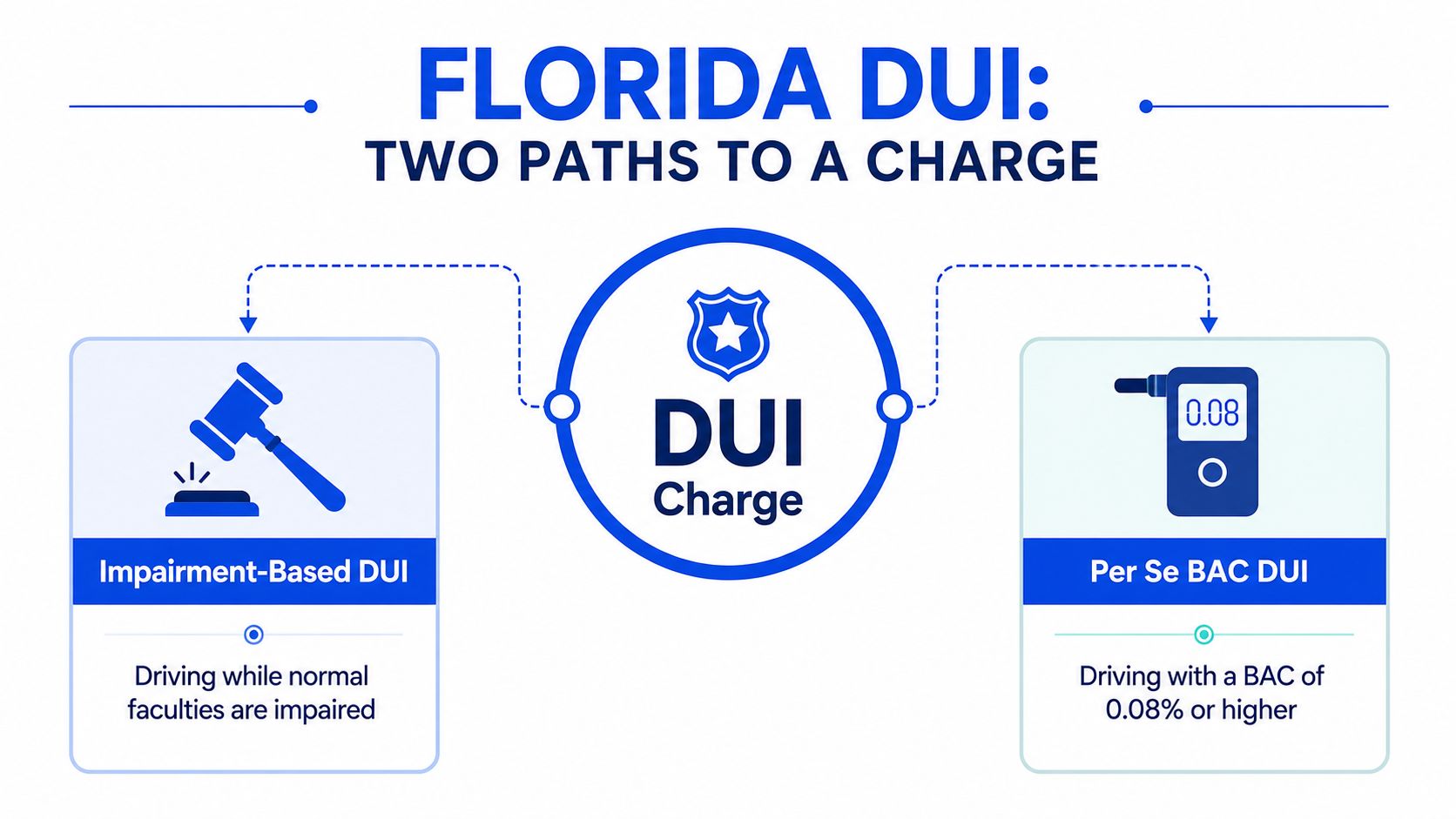
What actual physical control really means
“Actual physical control” reaches beyond driving in motion. It can include a parked car if the person is positioned so the vehicle could be put into operation. That is why statements like “I wasn't driving” or “I was just sitting there” do not end the case on their own. Prosecutors look at access to the keys, where the person was seated, whether the engine was running, and whether the vehicle could be driven.
The adult BAC rule is only one path. If the State believes normal faculties were impaired, it can still file a DUI charge even when the test number is disputed or incomplete. The defense has to examine the stop, the observations, the testing, and the paperwork together, because a printout by itself does not tell the full story. For a broader look at related alcohol and drug allegations, see the firm's overview of DUI crimes.
The under-21 rule surprises people
Florida is stricter for younger drivers. A driver under 21 can face DUI exposure at a BAL as low as 0.02%, along with an automatic 6-month suspension. Florida under-21 DUI rule Families are often caught off guard because that threshold sits far below the adult per se limit.
A parked car, a low reading, or a short drive does not clear the case by itself. It changes which facts matter most.
An under-21 arrest needs quick review because the license problem can start before the driver understands what was tested and why. The criminal case and the DMV track run at the same time, and both need attention right away. Florida's DUI law turns on control, impairment, age, and how the State proves each piece.
Florida DUI Penalties by Offense Level
A DUI conviction in Florida is expensive, disruptive, and often built to follow you for a long time. For a first conviction, Florida defense sources commonly describe a $500 to $1,000 fine, up to 6 months in jail, a license suspension of 180 days to 1 year, DUI school, possible community service, probation, and possible ignition interlock installation. Florida first-offense DUI penalties Those consequences are why a DUI is not treated like a routine traffic ticket.

Offense Level | Fine Range | Maximum Jail | License Suspension |
|---|---|---|---|
First DUI | $500 to $1,000 | Up to 6 months | 180 days to 1 year |
Second DUI | $1,000 to $2,000 | Up to 9 months | Not stated in the verified data |
Later offenses | Higher exposure | Higher exposure | Higher exposure |
Why the punishment tier matters
The difference between a first offense and a repeat case is more than the sentence. It changes bargaining power, negotiating position, and whether the case stays in misdemeanor territory or heads into a more serious lane. That's where prior record, aggravating facts, and the State's proof of the stop or test start shaping the whole defense.
In practice, the court often cares about the same facts the defense cares about, whether there was a crash, whether someone refused testing, whether the arrest was cleanly documented, and whether the State can prove impairment beyond a one-line report. Those facts influence the likely path of the case long before sentencing becomes the focus.
What people miss about collateral consequences
The penalty range is only part of the harm. DUI school, probation conditions, and ignition interlock can change work schedules, family logistics, and insurance problems even when jail time is limited. That's why a DUI defense has to look beyond the courtroom date and into the world of consequences that follow a plea or conviction.
The pressure is even greater for anyone with a job that depends on clean driving or licensing. If you're comparing options and need the broader legal context, the firm's guide to Florida DUI penalties helps show how quickly a first arrest can become a long-term problem. The safest assumption is that every tier carries costs, and the earlier the defense starts, the more room there is to reduce them.
The Two-Track Defense in Broward County
A Fort Lauderdale DUI case moves on two rails. The criminal case runs through Broward County court, and the license issue runs through the administrative review process. If you miss the administrative deadline, you can lose a major fight even while the criminal case is still pending.
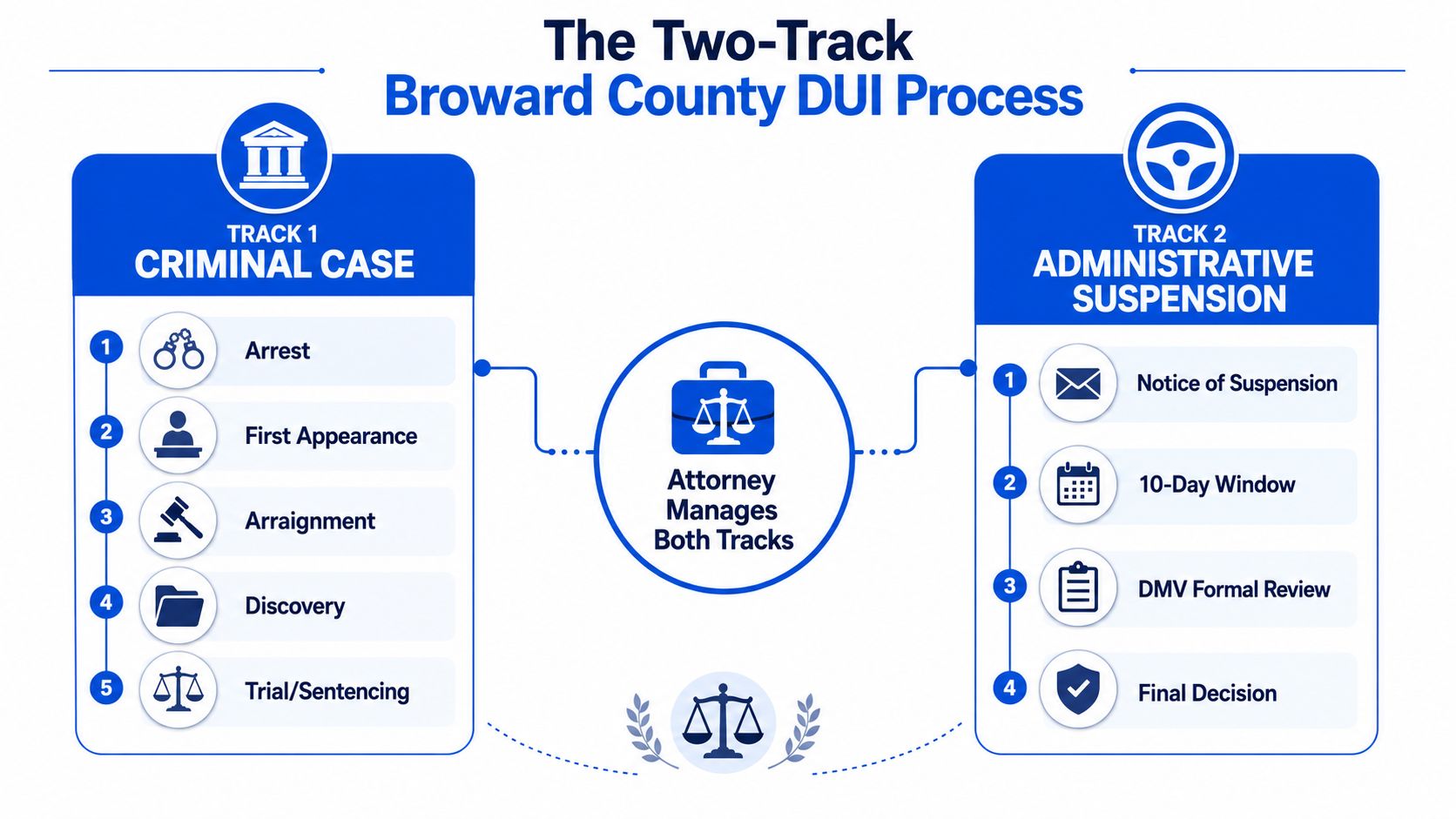
The criminal side and the license side
The criminal side usually moves through arrest, first appearance, arraignment, discovery, motions, and then either resolution or trial. The administrative side starts earlier, because the State can move to suspend driving privileges almost immediately after arrest. Those tracks are connected, but they're not the same proceeding.
The most urgent move is the hearing request. In Florida, a driver arrested for DUI generally has only 10 days to request a hearing to contest suspension of driving privileges, so counsel has to act right away to preserve that parallel civil remedy while the criminal case is still unfolding. Florida 10-day DUI hearing deadline If you wait, the license issue can become much harder to fight.
What the 10-day window really does
The deadline matters because it creates a narrow evidence window. That window is when the lawyer can start testing probable cause for the stop, the legality of the arrest, and whether the State preserved the evidence it needs. Over time, records get harder to pull and memories get less precise, which is exactly why delay helps the prosecution more than it helps you.
If the license issue is ignored at the start, the criminal case doesn't pause to save it.
For people trying to understand what happens after reinstatement problems or suspension steps, the article on license reinstatement after DUI gives useful background. But the practical takeaway is this, the license fight and the criminal fight should be handled together from day one, not one after the other.
Common DUI Defenses and Where They Come From
Good DUI defenses aren't slogans. They come from records, videos, machine logs, medical facts, and the officer's own report. The earlier the defense team gets involved, the better the chance of finding something the State has to explain instead of merely assuming the arrest was solid.
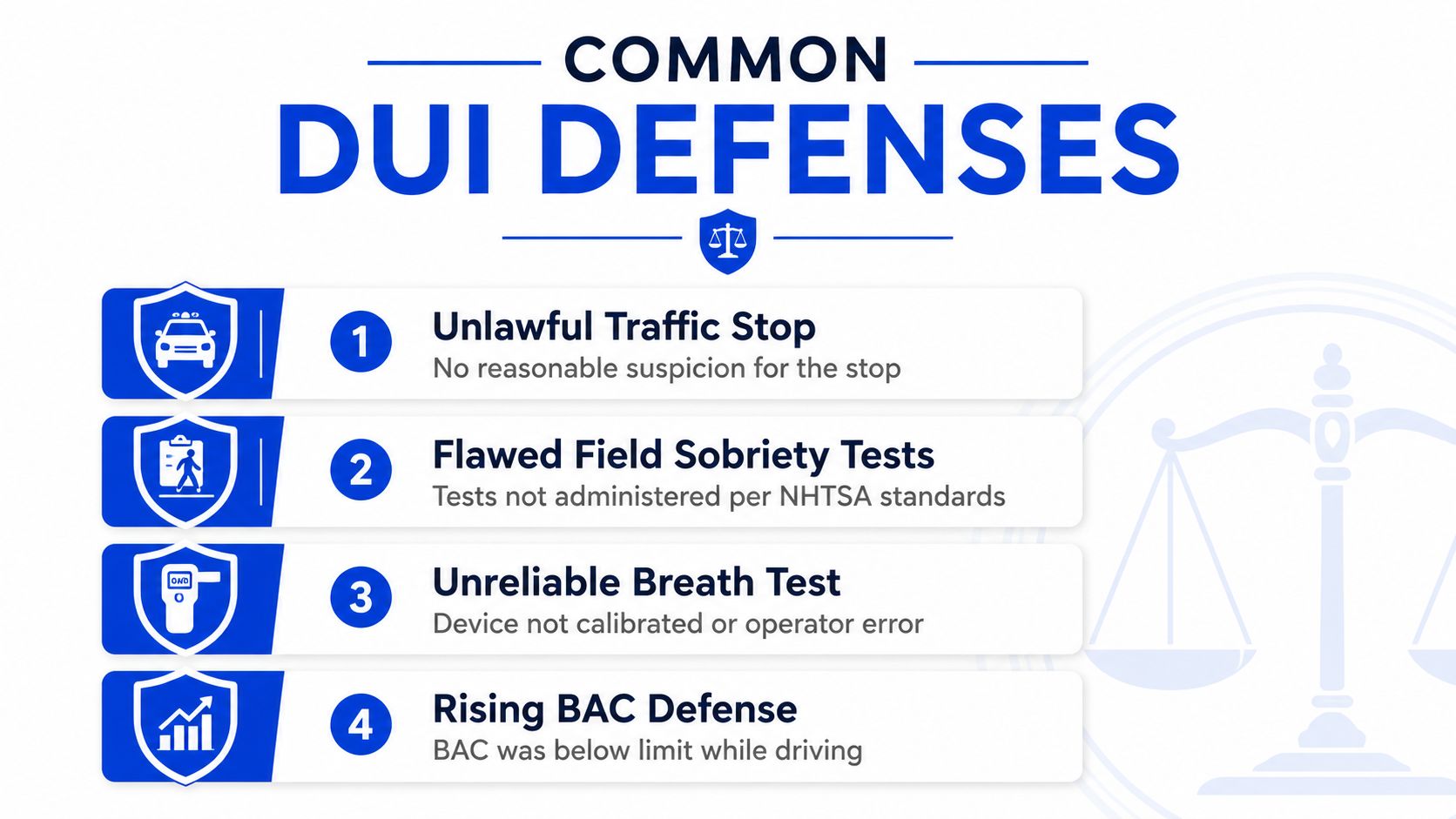
The first things lawyers usually test
An attorney usually starts with the traffic stop. If the deputy lacked reasonable suspicion, the stop itself may be vulnerable. From there, the lawyer looks at field sobriety exercises, because those tests are often affected by nerves, road conditions, footwear, injuries, lighting, or incomplete instructions.
Breath testing is another pressure point. The defense may ask whether the device was calibrated, whether the operator followed proper procedures, and whether the printout really reflects the driver's condition at the relevant time. Blood cases raise different questions, including chain of custody and how the sample was handled after collection.
Timing changes what can be proved
The most useful evidence is often the most fragile. Dashcam footage, body-worn video, breath machine logs, and witness memory can all become harder to pin down as time passes. That's why the short post-arrest period matters so much in Fort Lauderdale DUI cases. The 10-day deadline creates a short evidentiary window in which the lawyer can begin testing probable cause for the stop, the legality of the arrest, and whether the State complied with evidentiary preservation requirements before key records and witness memories degrade.
Why “I felt fine” is not enough
People often want a single explanation that makes the case go away. That usually doesn't work. A subjective feeling of sobriety doesn't erase video, a test result, or an officer's observations, and it doesn't replace a legal challenge to the way the evidence was gathered.
Best defense work starts with records, not arguments. If the records are weak, the argument gets stronger. If the records are strong, the defense has to look for pressure points elsewhere.
That's why a serious Broward County defense focuses on the stop, the test, the timeline, and the physical evidence together. Those are the places where cases are won, reduced, or at least forced into a more realistic negotiation.
What a Fort Lauderdale DUI Attorney Actually Does for You
A DUI lawyer in Fort Lauderdale should do more than show up at court. The work that matters most happens before the hearing, when the attorney is preserving deadlines, requesting evidence, and deciding what the State can prove.

Three traits that matter in Broward County
A former prosecutor's background can help a defense lawyer see how a charging decision was built and where the weak spots are. That matters because DUI cases often turn on how the State frames the stop, the tests, and the arrest report.
Jurisdictional familiarity matters too. Broward County has its own court rhythm, and local practice can affect how quickly motions are filed, how evidence requests are handled, and how realistic a particular resolution might be. A lawyer who works regularly in the area knows the practical pace of the courthouse, not just the black-letter law.
The third trait is responsiveness. DUI arrests happen at night, after weekends, or right before the 10-day deadline becomes a real problem. A lawyer who answers quickly can preserve the hearing request, start the evidence review, and keep a license issue from slipping through the cracks.
What that looks like in real terms
The right attorney should move fast on administrative filings, explain the criminal-court path without sugarcoating it, and identify weak points in the stop or the testing. If you're also dealing with broader criminal charges, traffic issues, or probation exposure, one place people in South Florida use for that kind of defense is Ticket Shield, PLLC, which handles Florida criminal-defense matters from a former prosecutor's perspective.
What doesn't help is waiting for the court date to “see what happens.” By then, the defense has already lost advantage if evidence hasn't been secured or the license hearing deadline has passed. In Broward County, speed is not a marketing claim. It's part of the case.
Cost and Case-Path Scenarios for a Fort Lauderdale DUI
A first-time DUI with no crash, no refusal, and a clean driving record usually follows a simpler path than an aggravated case. Even then, the process is not cheap or painless, because the criminal case, the license issue, and the collateral costs all stack together.
A low-complexity first-offense path
In a straightforward first-offense case, the defense may focus on the stop, the field exercises, the breath or blood result, and whether there's room to negotiate a reduction or challenge. The lawyer's work is often front-loaded into early evidence review and the administrative hearing request, because that's where the advantage starts.
Local defense pages indicate that DUI lawyer fees in Fort Lauderdale can range from $2,000 to $7,500, while some Florida DUI defense matters can run $2,000 to $10,000 depending on case complexity, prior history, injuries, and other aggravating facts. Broward DUI fee range discussion Those ranges aren't promises, they're a reminder that the harder the case, the more work usually goes into it.
An aggravated path is different
A case becomes more difficult when there's a prior DUI, a refusal issue, crash injuries, or facts that raise the stakes beyond a routine misdemeanor. Those cases tend to require more discovery, more motion practice, and more careful review of whether the State can prove each element without gaps.
That's also where timing matters most. The same early steps that help in a simple case, preserving the hearing request, requesting evidence, and testing the stop, become even more important when the State's advantage is stronger. The more serious the exposure, the less room there is to assume the case will "work itself out."
The real cost is bigger than the invoice
The attorney fee is only one part of the total burden. Time off work, court dates, driver's license problems, insurance consequences, and the possibility of probation conditions all carry practical costs that don't show up in the retainer agreement. The better question isn't just what a lawyer charges, it's what delay costs if no one is fighting the case early.
If you're weighing whether to hire counsel, ask how the firm handles the 10-day administrative deadline, how quickly evidence is requested, and how often the lawyer personally handles DUI matters in Fort Lauderdale and the surrounding South Florida courts.
Your Next Steps and How to Reach Ticket Shield PLLC
The first 72 hours after a DUI arrest are about protecting choices, not panicking about labels. The people who make the best decisions in that window are usually the ones who slow down just enough to preserve evidence and deadlines.
Protect the 10-day hearing window. That administrative deadline runs fast, and missing it can make the license fight much harder.
Don't give a detailed statement to police without counsel. Short, necessary communication is one thing. Arguing the facts without a plan is another.
Save medical records, photos, and texts. If fatigue, a medical issue, or a prescription mattered, that paper trail can matter too.
Stay off social media about the arrest. Posts, comments, and jokes can become evidence in ways people don't expect.
Keep every court and release document. Those pages often tell the lawyer what the State is claiming and what deadline comes next.
A calm, fast response usually helps more than an emotional one. If you've been arrested in Fort Lauderdale, Broward County, Miami-Dade, Palm Beach, or anywhere else in South Florida, Ticket Shield, PLLC works on Florida criminal defense matters with 24/7 availability and a former prosecutor's perspective. The firm offers confidential consultations, and calling early gives you a better chance to protect the license issue while the criminal case is still open.
If you were arrested for DUI in Fort Lauderdale, don't wait for the court system to define your options for you. Contact Ticket Shield, PLLC for a confidential consultation, and get a defense plan in motion before the 10-day deadline, the evidence, and the court calendar start narrowing your choices.