
Prison Sentence for Assaulting a Police Officer in Florida
Jason Goldsmith, Esq
One argument. One sudden movement. One officer says you threatened him. By the end of the night, you're in handcuffs, your family is calling in a panic, and you're searching for one answer: what prison sentence for assaulting a police officer are you facing in Florida?
That fear is understandable. In South Florida, these cases often start fast and get charged aggressively. A traffic stop in Fort Lauderdale turns tense. A domestic call in Broward County gets loud. A crowd situation in Miami-Dade becomes chaotic, and an officer's report frames a shove, raised fist, or even a movement during handcuffing as assault, battery, or a related violent offense.
People often assume the case will depend only on what happened in that one second. It usually doesn't. The State builds these charges around officer statements, body camera footage, witness accounts, injury claims, and the story prosecutors think they can tell a judge or jury. That means a strategic defense has to do more than deny the allegation. It has to break the State's narrative where it's weakest.
Table of Contents
Understanding Florida's Laws on Assault and Battery on an Officer
Frequently Asked Questions About Assault on an Officer Charges
Facing an Assault Charge Against a Florida Officer
If you've been arrested for assaulting an officer in Broward County, Palm Beach, Fort Lauderdale, or anywhere in South Florida, you're probably dealing with two problems at once. The first is panic about jail or prison. The second is confusion, because many people charged in these cases don't believe they "attacked" anyone in the ordinary sense of the word.
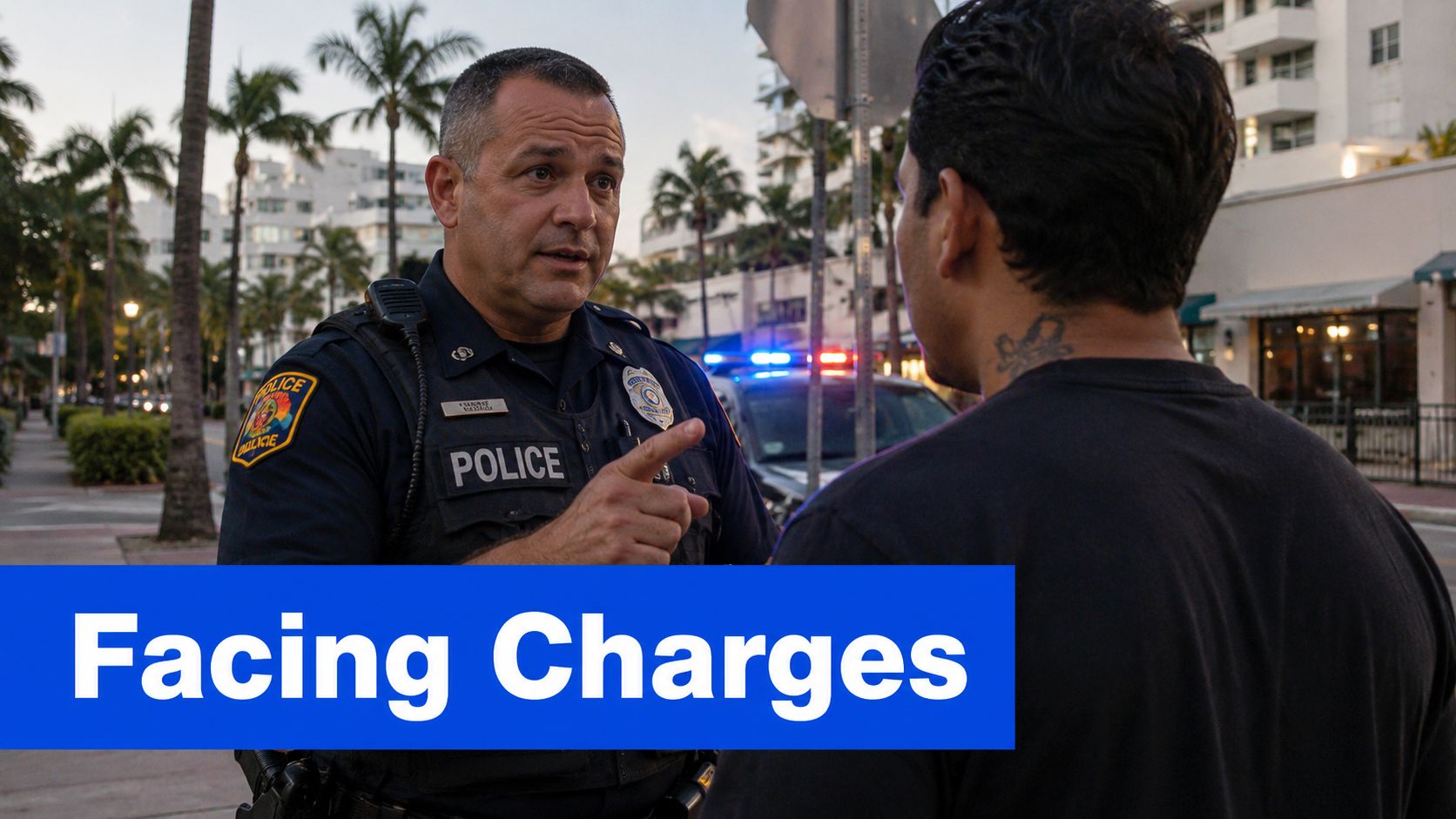
A common pattern looks like this. An officer gives commands during a DUI stop, a street detention, or a heated domestic violence investigation. You pull your arm back, step forward, flinch, yell, or make contact while trying to turn away. The report later describes the event in words that sound much worse than the moment felt to you.
That gap matters. Prosecutors don't file charges based on your intent alone. They file charges based on what they think they can prove from reports, video, photographs, medical records, and the officer's credibility in court.
Why these cases move differently
Cases involving law enforcement alleged victims usually get more attention from the State than an ordinary misdemeanor fight. The charging decision is often more rigid. The paperwork is usually tighter. Officers also know the legal phrases prosecutors look for, so reports may be written with those elements in mind.
Practical rule: The first story in the file often shapes the entire case. If the officer's version is the only detailed version, the defense starts from behind.
That doesn't mean the charge can't be challenged. It means you need to approach it strategically and early. The same office that prosecutes DUI, drug crimes, theft cases, probation violations, gun charges, juvenile offenses, white collar matters, injunctions, and other violent crimes knows how to package an officer case for court. A smart defense has to know how that packaging works.
Why early decisions matter
The hours after arrest can affect the whole case. Calls from jail, texts to friends, social media posts, and attempts to "explain what really happened" often give prosecutors extra evidence to use later.
The stronger move is usually simpler:
Stay silent: Don't try to talk your way out of it after arrest.
Preserve evidence: Save names, videos, photos, and timelines while your memory is fresh.
Get counsel involved early: Early review can expose weak identification, excessive force issues, or report language that doesn't match the footage.
That's how these cases stop being just about fear and start becoming about advantage.
Understanding Florida's Laws on Assault and Battery on an Officer
A common arrest scenario goes like this. An argument gets loud, an officer says you stepped toward him, raised a hand, or pulled away during contact, and a case that might have been treated as a lower-level offense suddenly gets filed as an offense against law enforcement. That shift matters because prosecutors do not view these files as routine. They review them for statutory elements, officer status, and whether the facts support an enhanced charge.
Under Florida law, assault and battery are different offenses. Assault generally involves an intentional, unlawful threat or act that creates a well-founded fear of imminent violence. Battery requires actual unwanted touching or striking. When the alleged victim is a law enforcement officer engaged in lawful duties, Florida can enhance the charge under Florida Statute § 784.07 as summarized here.
The officer's status does not automatically make the State's case valid. It gives the prosecutor an upgraded charging path if the evidence supports it. From the State's side, that usually means proving more than a heated encounter. The file has to support that the person was a qualifying officer, that the officer was performing lawful duties, and that the conduct meets the elements of assault or battery.
That is also why these cases often arrive bundled with related allegations. A file may include resisting, obstruction, or a more serious contact-based charge depending on how the arrest report is written and whether body camera footage helps or hurts the officer's account. If the allegation includes physical resistance during an arrest, the legal analysis often overlaps with Florida resisting with violence charges.
Here is the practical comparison:
Offense | Victim Civilian | Victim Law Enforcement Officer LEO |
|---|---|---|
Assault | Typically charged less severely than assault on an officer | Enhanced to a first-degree misdemeanor when the statutory requirements are met |
Battery | Charging level depends heavily on the facts, injury claims, and prior record | Often filed more aggressively because of the officer's status and the surrounding circumstances |
What prosecutors have to prove
As a former prosecutor, I can tell you these cases are usually built from the report outward. The report frames the event. The body camera, witness statements, dispatch history, and medical records are then used to support that version. If those pieces do not line up cleanly, the case has a pressure point.
Prosecutors usually focus on four issues:
Intentional threat or act: Harsh language alone is often not enough for assault. The State looks for conduct that suggests immediate violence.
Actual contact: If the allegation involves pushing, grabbing, striking, or even slight unwanted contact, prosecutors may pursue a battery theory.
Knowledge of officer status: Uniforms, marked vehicles, badges, verbal commands, and scene conditions all matter.
Lawful performance of duty: If the officer was acting outside lawful duties, the enhancement can become harder for the State to sustain.
A prosecutor also looks for clean wording in the reports. Terms like "aggressive posture," "clenched fists," and "pulled away violently" are common because they track legal elements. Those phrases can sound strong in an affidavit and look much weaker on video.
That is where defense work gets practical. The question is not just what the report says. The question is whether the State can prove the enhancement beyond a reasonable doubt after the footage is slowed down, the timing is examined, and the officer is pinned to specifics under oath. In some cases, the genuine weakness is identity. In others, it is whether there was true imminent-threat conduct at all. In others, the issue is whether the officer was lawfully performing duties when the encounter turned physical.
Those distinctions often decide whether the charge stands, gets reduced, or becomes much harder for the State to try.
Sentencing and Penalties What Prison Time Are You Facing
When people ask about the prison sentence for assaulting a police officer, they're usually asking two different questions. What is the maximum exposure on paper, and what could realistically happen in a Florida courtroom?
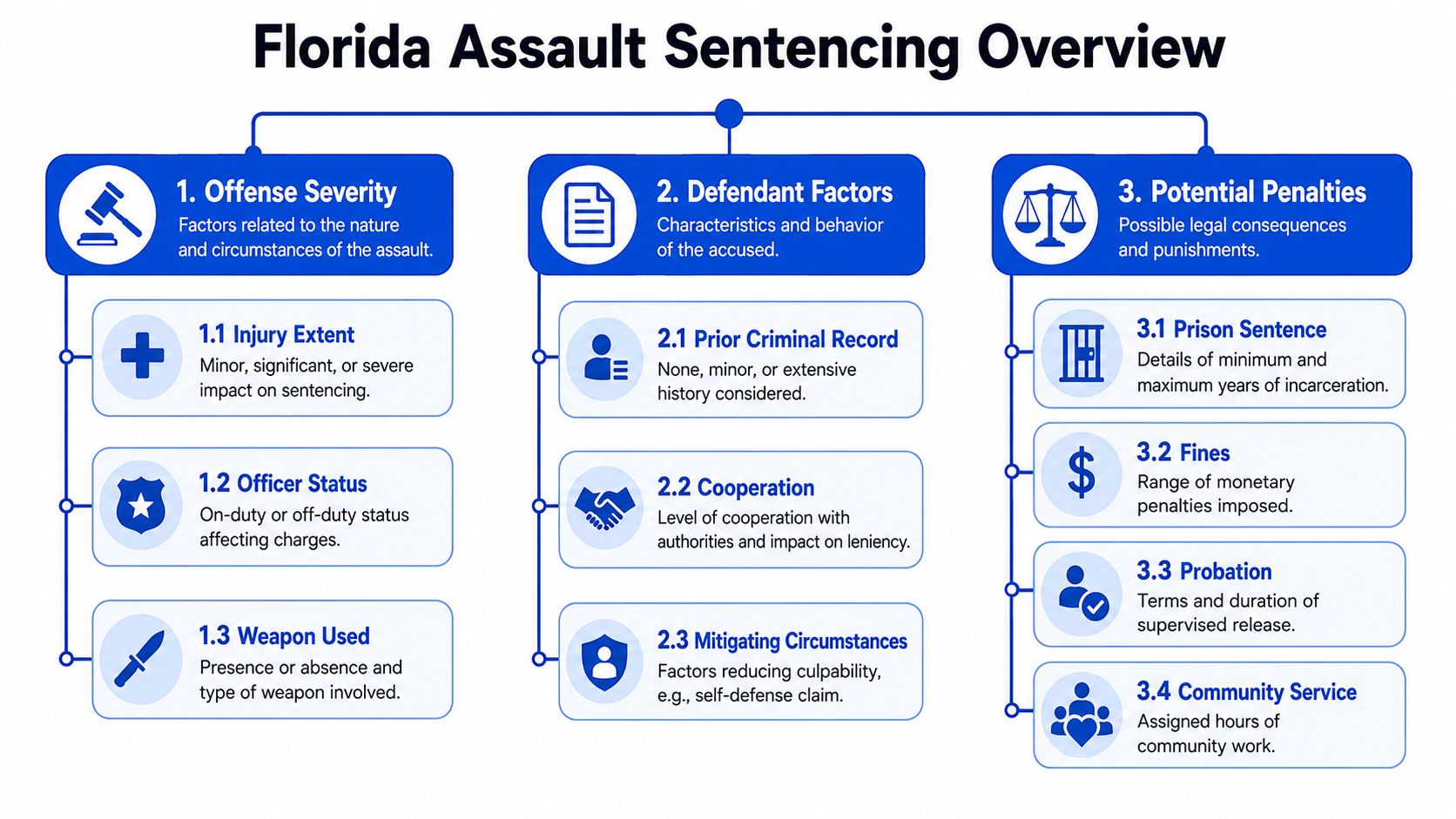
Those aren't always the same thing. The statute sets the charging framework, but sentencing often depends on the exact offense level, the surrounding allegations, your history, and whether the State claims there was injury, a weapon, or additional violent conduct.
How sentencing works in the real world
Florida sentencing isn't just a matter of looking at one line in a statute book. In felony cases, courts use a scoresheet system under the Criminal Punishment Code. The scoresheet takes into account the primary offense, additional offenses, prior record, and other case-specific factors.
You don't need to memorize the mechanics to understand the danger. The practical point is this: a case that starts with one allegation can become much more serious if the State adds related counts, alleges injury, or uses your record to push for a harsher outcome.
In practice, sentencing exposure often turns on questions like:
Is the case charged as a misdemeanor or felony
Did the officer claim pain, visible injury, or medical treatment
Was there an accusation of striking, kicking, or using an object
Are there companion charges such as resisting with violence
Do prior convictions increase the State's sentencing position
If your case involves a more serious touching allegation, it's useful to understand how Florida treats related felony-level conduct in this overview of felony battery in Florida.
What tends to increase exposure
A lot of clients think the case will hinge on whether they meant harm. Prosecutors care about intent, but they also care about provable aggravation. Cases become harder when the State says the officer suffered a visible injury, the incident happened during arrest processing, or the video appears to show repeated movements instead of one reflexive act.
A few recurring patterns tend to raise the stakes:
Issue | Why it matters |
|---|---|
Claimed injury | Injury allegations give prosecutors a stronger emotional and legal narrative |
Multiple officers | More officers often means more reports and more witness testimony aligned against the defendant |
Video from several angles | Video can help the defense, but if it appears unfavorable, the State will lean on it heavily |
Prior record | Prior cases affect both negotiation posture and sentencing risk |
Statements after arrest | Explanations, apologies, or angry remarks may be framed as admissions |
The most dangerous mistake is assuming "minor contact" means a minor case. Officer cases are often prosecuted harder than the facts alone would suggest.
That doesn't mean prison is automatic. It means the analysis has to be honest. Some cases are better positioned for reduction, diversion-style advocacy, or negotiated resolution. Others need immediate litigation because the evidence is being overstated from the start.
Key Factors That Influence Your Sentence
A charging statute tells you the ceiling. It doesn't tell you how the State will argue the case, how a judge will view the incident, or where the defense can lower the temperature. That's where prosecutorial perspective matters.
A former prosecutor doesn't look at these files the same way a frightened defendant does. The question isn't only "did something happen." The question is "what can be proved cleanly, consistently, and credibly in court."
How a prosecutor evaluates the file
In an officer case, the State usually starts by asking whether the officer will present well. Is the report detailed? Does the body camera support the wording? Are there civilian witnesses who help or hurt the government's version? Is there any obvious inconsistency between the first report, later supplement, booking video, or use-of-force paperwork?
Prosecutors also assess whether the defendant gives them a favorable contrast. A person with no recent record, stable employment, and calm post-arrest behavior may be easier to resolve than someone whose jail calls sound angry, threatening, or contradictory.
That review is often more practical than dramatic. The State isn't looking for moral perfection. It is looking for a file that survives attack.
What can help or hurt you
Several factors shape sentencing pressure and negotiation advantage in Broward, Fort Lauderdale, Palm Beach, and surrounding South Florida courts.
Evidence quality: Grainy, partial, or interrupted video leaves room for interpretation. Clear footage can either dismantle the case or strengthen it.
Officer testimony: Some officers are precise and measured. Others overstate. Overstatement creates openings for cross-examination.
Scene dynamics: A cramped hallway, crowded sidewalk, or chaotic arrest scene can support a defense that the movement was reflexive, defensive, or misunderstood.
Your background: Prior violence allegations usually harden the State's position. A limited record may support a more constructive resolution.
Conduct after arrest: Silence helps. Rambling explanations usually don't.
A judge also watches how the event fits into the larger context. Was this a brief flare-up during a stressful encounter? Or does the file suggest escalating aggression? That distinction influences both plea discussions and sentencing arguments.
In many officer cases, the sentence discussion starts long before sentencing. It starts when the prosecutor decides what kind of person the file makes you look like.
That is why early framing matters. Defense work isn't only about trial. It's about forcing the State to confront weak proof, disputed context, and facts that make a harsh punishment harder to justify.
Building a Strategic Defense Against the Charges
An arrest isn't a conviction, and an officer's report isn't the final word. These cases can be defended aggressively, but the defense has to be built on specifics, not general denial.
The first step is to stop treating the report as neutral. Prosecutors often do. Defense counsel shouldn't. Reports summarize events from the officer's point of view, usually after force has already been used and after the legal labels have become obvious.
Where the State's case often cracks
The strongest defenses usually attack one or more required pieces of the State's story.
Mistaken interpretation: A movement described as a threat may have been a recoil, stumble, or attempt to protect yourself during force.
Lack of knowledge: If the officer wasn't clearly identifiable, that can matter.
Lawfulness of the encounter: If the stop, detention, or arrest was unlawful, it may affect how the charge is litigated.
Self-defense or excessive force context: Florida law doesn't give officers unlimited force. If the encounter escalated because of unnecessary force, that can become central.
Inconsistent evidence: Reports, bodycam, dispatch timing, witness statements, and medical claims don't always line up.
A major part of defense work is evidence review. Body camera footage, booking room video, dashcam, civilian phone recordings, dispatch logs, and photographs often tell a more complete story than the probable cause affidavit.
For a closer look at one of the most important tools in that process, see how a motion to suppress evidence can challenge evidence obtained in violation of your rights.
What early defense work actually does
Early strategy is practical. It identifies what to demand, what to preserve, and what to challenge before the State hardens its theory.
That work often includes:
Securing video quickly: Some footage is overwritten or becomes harder to obtain with time.
Comparing every version of events: Dispatch audio, affidavits, supplements, and medical notes may conflict.
Interviewing neutral witnesses: Civilian accounts often disappear if no one reaches them early.
Challenging legal sufficiency: Sometimes the facts support a lesser offense, not the charged one.
This video gives helpful background on why early legal intervention matters in criminal cases:
When the defense acts early, the case becomes less about the accusation and more about proof.
That shift is often where advantage comes from. It can lead to reduction, dismissal arguments, better plea options, or a much stronger position for trial.
Beyond Prison Other Consequences and Plea Options
A client sits across from me after first appearance and asks one question: "Am I going to prison?" That question matters, but from the State's side, prison is only one part of the file. Prosecutors also look at the label of the conviction, whether it involves violence against law enforcement, and whether they can justify holding the line on a felony based on the facts, the video, and the officer's account.
That is why plea decisions in these cases are rarely just about jail. A conviction tied to an officer can affect hiring, housing, professional licenses, firearm rights, and immigration status long after the courtroom case ends.
Why the charge matters beyond jail
From a former prosecutor's perspective, the charging decision creates bargaining power. If the State believes it can prove the officer element cleanly and present the defendant as the aggressor, plea offers usually get tighter. If the record is messy, the officer identification is weak, the body camera is incomplete, or the facts fit a lesser offense better than the booking charge, there is often more room to negotiate an outcome that limits the long-term damage.
Sometimes that means pursuing a reduced misdemeanor. Sometimes it means fighting for a disposition that avoids a formal conviction if the law and facts allow it. If you are weighing that kind of result, it helps to understand how adjudication withheld in Florida can affect your record and future options.
Federal exposure raises a different set of risks. Under 18 U.S.C. § 111(b), assaults on a federal officer involving a deadly weapon or resulting in bodily injury can be prosecuted far more aggressively than the typical state case. That is not the usual Florida county-court scenario, but it shows how quickly the stakes can rise when federal jurisdiction enters the picture.
When plea negotiations become the smart move
Good plea negotiation starts with an honest assessment of what the prosecutor will be able to prove, and what problems they will have explaining away. That analysis is practical. Does the video match the report. Did the officer clearly identify himself or herself. Is there actual evidence of fear, threat, contact, or injury. Are there witness statements the State would rather not highlight at trial.
A sound resolution strategy often focuses on four questions:
Can the State prove every element without stretching the facts
Do the recordings support the officer's version of events
Is the original charge higher than what the evidence supports
Would a negotiated result better protect work, licensing, immigration, or firearm interests than a trial verdict would
Pleading early just to end the stress can be a mistake. Trying a weak case out of pride can be a bigger one. The right move depends on where the prosecution's case is strong, where it is vulnerable, and what outcome protects your life after the criminal case is over.
Frequently Asked Questions About Assault on an Officer Charges
Is assault the same as battery in Florida
No. Assault usually involves a threat or act creating fear of imminent violence. Battery involves actual unwanted touching or striking. That difference can change both the charge and the defense.
Do I have to touch the officer to be charged
No. Physical contact isn't required for an assault allegation. A prosecutor may claim your words, movement, or gestures created fear of immediate violence.
Should I explain my side to police after arrest
Usually no. Invoke your right to remain silent and ask for a lawyer. Explanations made while stressed, angry, or injured often become evidence for the State.
Will my case definitely go to trial
No. Many cases are resolved through negotiation, motion practice, or charge reductions. The right path depends on the evidence, your history, and the weaknesses in the State's proof.
Can this charge affect other parts of my life
Yes. These allegations can affect work, licensing, housing, firearm rights, immigration status, and future criminal cases. That's why early defense strategy matters so much.
If you're facing an assault on an officer charge in Fort Lauderdale, Broward County, Miami-Dade, Palm Beach, or elsewhere in South Florida, don't wait for the State to define the case for you. Ticket Shield, PLLC provides confidential consultations and strategic criminal defense informed by former prosecutor insight. Whether the case involves a violent crime allegation, DUI stop, probation issue, gun charge, theft accusation, domestic violence arrest, or search and seizure problem, early action can protect your rights, your record, and your future.
Charges involving law enforcement carry enhanced penalties in Florida. Learn the potential sentences and defense strategies that work.