Licencia para Portar Armas Ocultas en Florida: Lo que debe saber en 2026
Jason Goldsmith, Abogado
The most popular advice about a concealed carry permit in Florida is now incomplete. People still tell applicants, “You need a permit before you can legally carry concealed.” That was once a useful starting point. It isn't anymore.
Florida's permitless concealed-carry law took effect on July 1, 2023, under House Bill 543. Florida Statutes section 790.01 now allows a person to carry a concealed weapon or firearm without a license if that person satisfies the statutory criteria for receiving and maintaining a concealed weapon license. The rule is broad, but it isn't a blanket authorization to carry anywhere, ignore identification requirements, or carry after a disqualifying event.
The legal question in 2026 is more precise: Do you qualify to carry, where are you carrying, and would a Florida concealed weapon license give you a practical advantage? A mistake on any one of those questions can turn a lawful-carry decision into a weapons investigation or criminal charge.
Table of Contents
Do You Still Need a Concealed Carry Permit in Florida
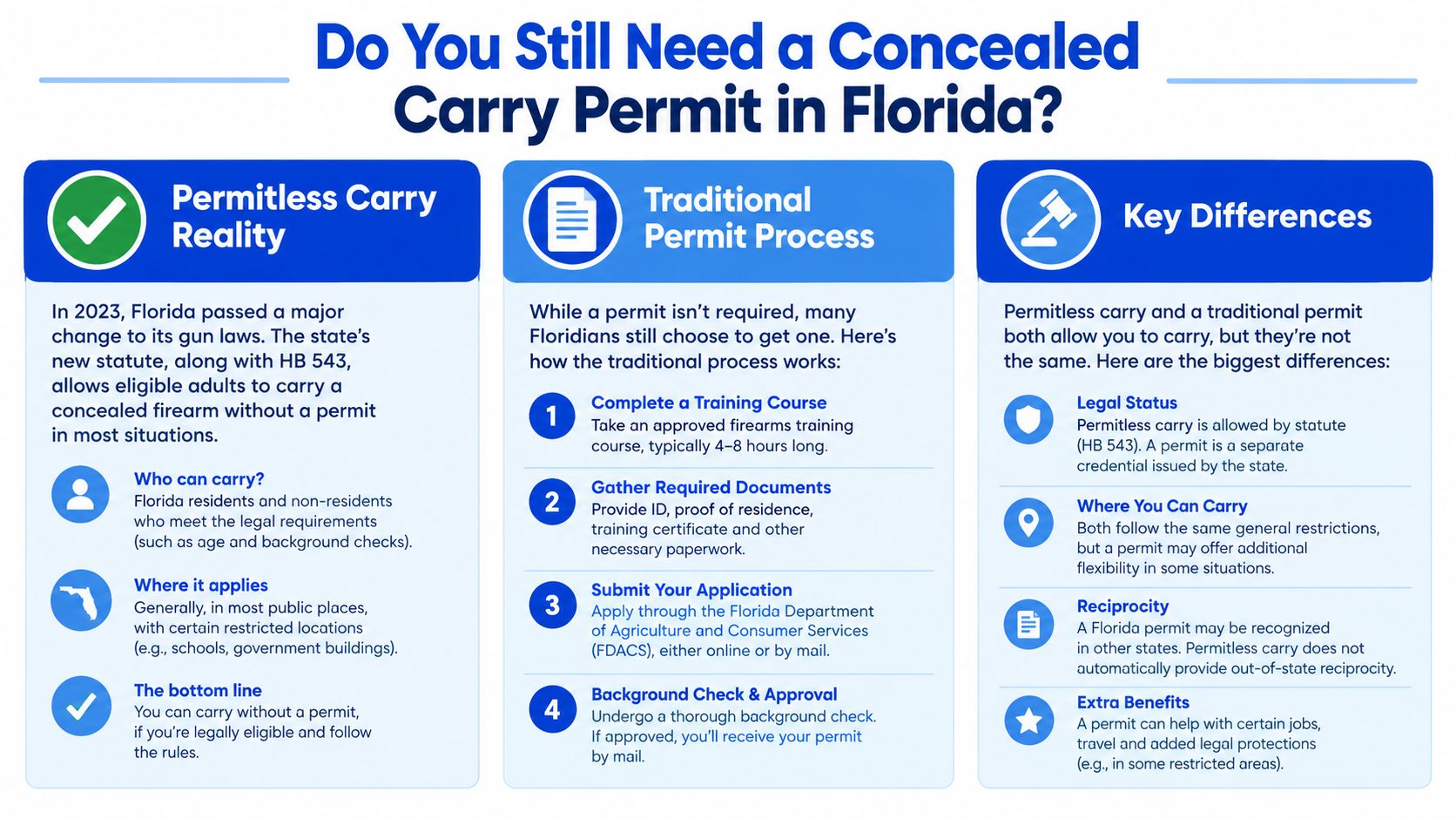
Florida no longer requires every qualifying adult to obtain a license before carrying concealed in the state. Florida Statutes section 790.01 permits concealed carry by a person who is licensed under section 790.06 or who is unlicensed but meets the applicable eligibility criteria. That change matters because many older articles still treat the license as the starting point for every Florida carry analysis.
It isn't. Eligibility comes first. If you can't legally receive and maintain a license because of a disqualifying criminal, mental-health, substance-abuse, residency, or other statutory issue, permitless carry doesn't rescue you. An unlicensed carrier must still satisfy the statutory conditions incorporated into section 790.01.
Why a license still matters
A license remains strategically useful even for an in-state carrier. Other states may recognize a Florida concealed weapon license while refusing to recognize Florida's permitless-carry status. Reciprocity changes by state, and a traveler must follow the destination state's rules rather than assume Florida law travels with the firearm.
A license also creates a clear government-issued record of eligibility and training. It can make roadside interactions more orderly, although Florida law still imposes identification duties on armed carriers. It doesn't give you permission to carry in prohibited places, and it doesn't prevent an officer from investigating suspected criminal conduct.
The age issue is especially important. In 2026, the Fourth District Court of Appeal held Florida's 21-and-older licensing limit unconstitutional as applied to adults aged 18 to 20, and state licensing practice reportedly began accepting applicants aged 18 and older. That ruling doesn't erase the need to examine the current statutory and judicial position before carrying. Younger adults should get individualized advice instead of relying on a social-media summary.
Practical rule: Florida's permitless law answers whether a license is always required. It doesn't answer whether you personally qualify or whether your chosen location is lawful.
A license can also document competency for travel and reduce uncertainty when dealing with jurisdictions that honor licenses but don't recognize permitless carry. For questions about how concealed and open carry rules differ, review this explanation of Florida open-carry law. The distinction matters because the manner of carry, the location, and the facts of an encounter can all affect criminal exposure.
Who Qualifies for a Florida Concealed Weapon License
FDACS doesn't review an application as a casual form submission. The Florida Department of Agriculture and Consumer Services checks whether the applicant meets statutory eligibility requirements, and a tax collector or regional office collects the documents and application information. The application is sworn, so an inaccurate answer can create a separate criminal problem under Florida Statutes section 837.06.
The baseline requirements include age, qualifying citizenship or residency status, firearm competency, and the absence of listed disqualifiers. The published application instructions require valid photo identification, citizenship or residency documentation, proof of competency, and a completed sworn application. An applicant must answer the criminal-history and eligibility questions completely, even when an old matter seems minor.
The checklist a reviewer actually cares about
Requirement | Qualifying Condition | Common Disqualifier |
|---|---|---|
Age | Meets the legally applicable age requirement for licensing | Applying under an age restriction without considering the current 2026 ruling |
Status | U.S. citizenship, qualifying U.S. residency, or permanent-resident status | Missing or inconsistent citizenship, residency, or immigration documents |
Criminal history | No statutory conviction, adjudication, pending-case, warrant, or other listed bar | Pending charges, disqualifying convictions, out-of-state warrants, or incomplete disclosures |
Protective orders | No disqualifying injunction or protective-order condition | An active domestic-violence or similar protective injunction |
Mental health history | No statutory adjudication or commitment that bars eligibility | A qualifying adjudication or voluntary commitment under section 790.06(2)(m) |
Substance-abuse history | No disqualifying history under the statute | A qualifying substance-abuse commitment or documented condition |
Competency | Acceptable proof under section 790.06(2)(h) | Certificate that lacks verification details or doesn't match the applicant |
Documentation | Current, legible, consistent records | Outdated driving records, sealed records appearing in FDLE checks, or military paperwork with unclear discharge information |
A sealed or expunged record may still create a records-matching issue that needs explanation. An out-of-state warrant can stop an application even if the applicant thought the matter was closed. Military applicants should examine the characterization and completeness of discharge paperwork before submitting it.
Screen yourself before applying
Pull your criminal-history information, review pending cases and warrants, confirm your address matches your identity records, and locate the original competency document. If FDACS denies or questions the application, administrative remedies may exist, including correction of records or a formal hearing process. Don't submit a rushed sworn application and hope the agency overlooks a discrepancy.
For the governing licensing framework, review Florida Statute 790.06. If a background issue appears before filing, a criminal defense attorney can help determine whether the problem is a true statutory disqualifier, a records error, or an issue that needs administrative handling.
Applying Through FDACS and Your Tax Collector
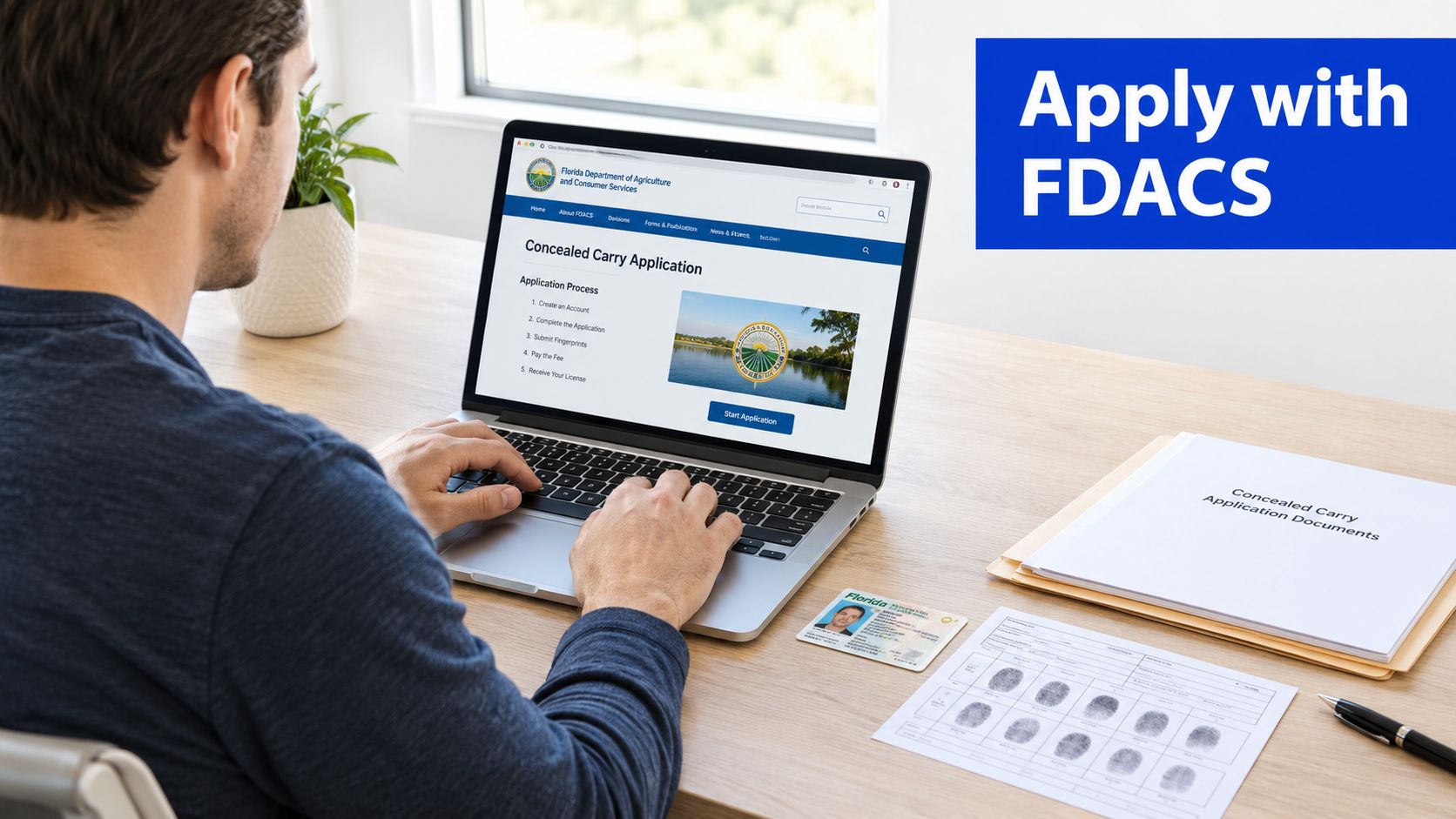
A Florida concealed weapon license application starts with FDACS, an authorized tax collector, or a regional office. A Broward County applicant seeking a license for interstate travel should gather a valid photo ID, citizenship or residency documentation, firearm-competency proof, and the information required for the sworn application.
Online filing is convenient, but a careless submission creates avoidable problems. Create or access the FDACS account, enter identifying information exactly as it appears on official records, submit documents in the format requested, and pay the applicable charges. A tax collector may add a convenience charge. Confirm the current total before paying because agency fees can change.
Fingerprints and background review
Complete electronic fingerprinting through an approved vendor or participating tax collector office. LiveScan usually moves fingerprints to the required background review more efficiently than ink cards, but FDACS still must receive and evaluate the results. A mismatch can delay the application.
Keep copies of every submission, receipt, certificate, and confirmation number. Check the identity image before sending it. An unclear image, an unacceptable training certificate, or an address that conflicts with the driving record can lead to a clarification request or denial. Outstanding civil warrants or unresolved records may keep the application pending while the agency seeks a resolution.
The checklist a reviewer cares about
Submitting the form does not establish eligibility. Your sworn answers carry legal consequences. A false answer or false document can support prosecution under Florida Statutes section 837.06, as explained in the FDACS application instructions.
Processing depends on the submission's completeness, fingerprint quality, and background information returned for review. Do not make nonrefundable travel or employment decisions based on an assumed approval date. If FDACS sends an adverse notice, preserve the notice and identify the response deadline immediately. Missing the administrative window can turn a correctable records problem into a much harder case.
Post-2023 permitless carry does not make this paperwork irrelevant. A license can still matter for reciprocity and travel, while an inaccurate sworn application can create criminal exposure beyond the carry question itself.
Proving Firearm Competency the Right Way
Florida requires an applicant to demonstrate firearm competency, but the state doesn't prescribe a single classroom curriculum or one mandatory live-fire format. The statutory paths under section 790.06(2)(h) include approved firearms training, hunter safety education, law-enforcement firearms training, organized shooting competition, and prior military service. The published competency guidance describes those alternatives and explains that Florida doesn't mandate a minimum number of classroom hours, a specific written test, or a state-prescribed range course of fire.
That flexibility helps qualified applicants, but it also creates documentation problems. FDACS must be able to determine what the document proves and whether the issuing person or organization fits a qualifying category.
Choosing the cleanest proof
For many civilians, a course from a Florida instructor who understands FDACS documentation is the most straightforward route. The certificate should identify the student, the instructor or provider, the date, and the nature of the training. A generic certificate with no verifiable instructor information may trigger manual review.
A law-enforcement or correctional officer qualification can work when the records clearly identify the agency and qualification. Military applicants should submit complete service documentation showing the relevant firearms training or service basis. A hunter-safety certificate can qualify when it comes from a recognized program and contains enough information for verification.
I wouldn't submit a partial DD-214, an unsigned record, or a certificate that merely says “firearms training” without supporting details. The issue isn't whether you handled a firearm at some point. The issue is whether your proof fits the statutory category and allows the reviewer to verify it.
Keep the legal distinction clear
Competency proof doesn't erase a criminal disqualifier. It also doesn't authorize carry in a restricted location. A valid certificate may support a license application, but a person can still face charges for unlawful possession, trespass, threatening display, or another offense based on conduct and circumstances.
If your conduct involved showing, displaying, or handling a firearm during an argument, read about improper exhibition of a firearm. The training certificate won't decide whether the display was legally justified.
Where You Still Cannot Carry and ID Rules That Bite
Permitless carry expanded lawful concealed carry. It didn't turn every public or private place into a lawful carry zone. The restrictions in section 790.06(12) continue to matter, and the Florida concealed-carry location guidance explains why a qualifying carrier still has to separate licensing questions from prohibited-location questions.
Florida restrictions include sensitive locations such as schools, polling places, courthouses, government meetings, bars that primarily serve alcohol, and airport sterile areas. Airport rules deserve particular care because secured terminals and sterile areas involve screening controls that can make an otherwise lawful possession scenario criminal. A private property owner can also tell you to leave or prohibit firearms. Ignoring that direction can create a trespass investigation, including an armed-trespass theory depending on the facts.
The location problem is usually a facts problem
A school-property exception may apply in a narrow circumstance, but you shouldn't assume that dropping a firearm into a vehicle or entering a campus for a routine errand makes the conduct safe. Vehicle carry also requires attention to concealment, accessibility, the destination, and the rules of the property where the vehicle is parked.
A person may lawfully possess a firearm when entering a business, then receive a trespass warning. Remaining after that warning changes the legal posture. The firearm doesn't automatically become illegal, but continued presence can support an armed-trespass charge if the statutory elements are met.
Location or Situation | Legal Status | Common Arrest Trigger |
|---|---|---|
School or school-related property | Restricted, subject to narrow statutory exceptions | Entering with a firearm without fitting the exception |
Courthouse or government meeting | Restricted location | Passing through security or entering a prohibited area |
Polling place | Restricted | Carrying while voting or entering the polling location |
Bar primarily serving alcohol | Restricted under the location rules | Treating a concealed license as permission to enter armed |
Airport sterile or secured area | Restricted and heavily controlled | Reaching a screened area with a firearm |
Private property | Owner may set conditions and demand departure | Refusing a trespass warning while armed |
Traffic stop or law-enforcement demand | Identification duties apply | Failing to carry or produce required identification |
Firearm not concealed as required | May create a separate legal issue | Accidental exposure, waistband carry, or display during a confrontation |
Identification can become the whole encounter
An armed person should carry valid government identification and understand the duty to produce it when law enforcement demands it under the applicable statute. An expired or invalid license doesn't give the same protection as a current credential, and an officer may investigate whether the person is otherwise eligible.
Don't argue the constitutional-carry headline on the roadside. Keep your hands visible, follow lawful commands, and don't make statements about possession or intent without understanding the consequences. If an encounter has already led to a search, seizure, or arrest, the legality of the stop and search may matter as much as the firearm itself. This discussion of illegal firearm possession covers why the precise charge and the facts behind it control the defense.
Reciprocity and Traveling With a Florida License
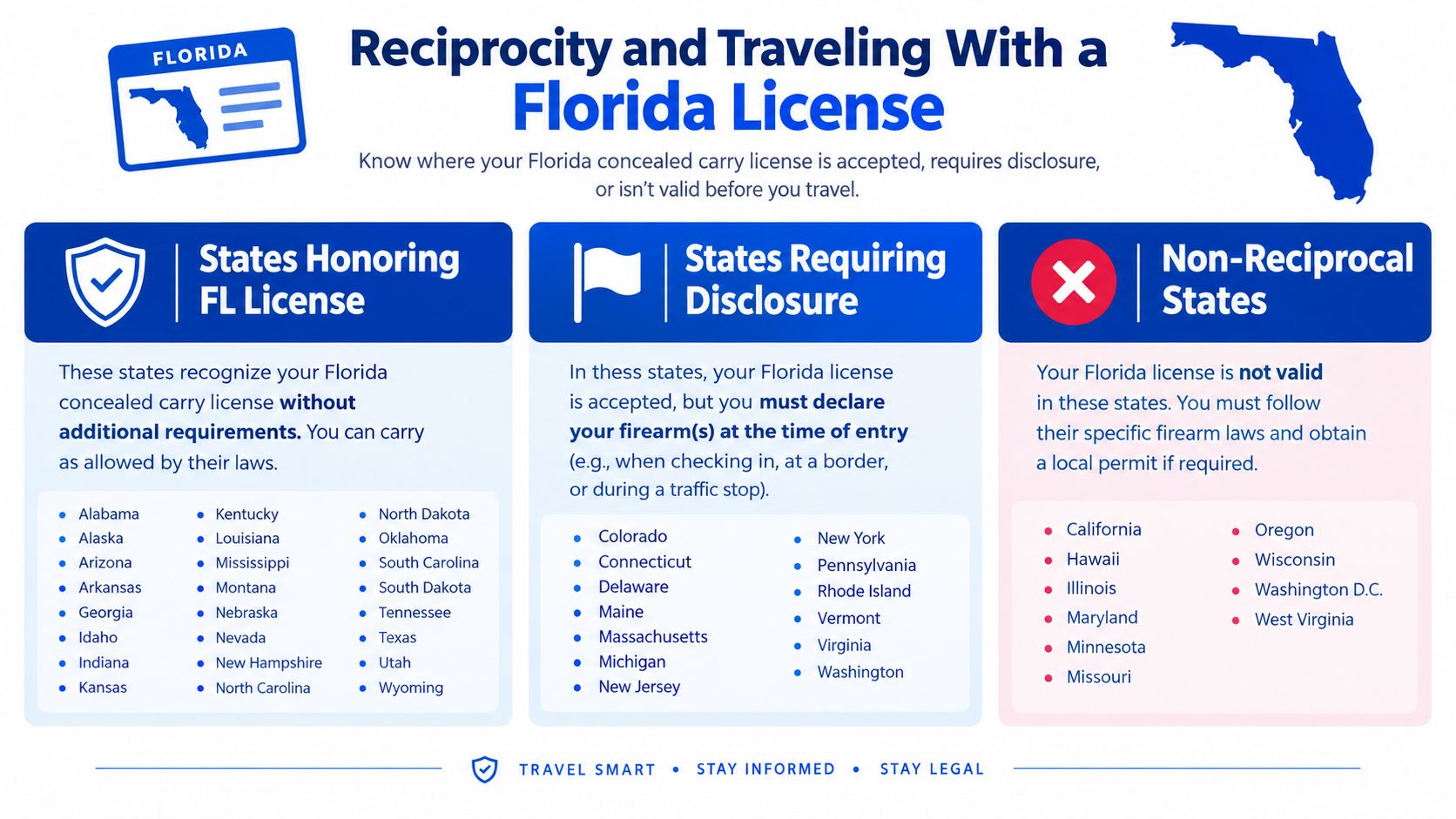
A Florida concealed weapon license is most valuable outside Florida when the destination state recognizes the credential. Reciprocity isn't symmetric. One state may honor the Florida license while imposing disclosure or transport duties, another may allow permitless carry for its own qualifying adults but not recognize Florida's license for every purpose, and another may refuse to honor it altogether.
Don't rely on an old map saved to your phone. Check the current FDACS reciprocity information before leaving, then read the destination state's statutes and official guidance. Recognition can depend on age, license type, location, vehicle transport, and whether the state imposes a duty to inform law enforcement.
The destination controls
A constitutional-carry state may let a qualifying visitor carry without a license, but that doesn't mean the Florida license is irrelevant. The destination's restrictions still govern conduct, prohibited locations, vehicle storage, disclosure, and transportation. A Florida permit also doesn't automatically satisfy another state's duty to inform an officer during a traffic stop.
Travelers commonly make the mistake of checking only the state they enter first. A road trip through Georgia, North Carolina, or another state requires a separate review of each jurisdiction's rules. The route matters, not just the final address.
Air travel creates another layer of risk. Ammunition and firearms must be handled under applicable transportation rules, and a traveler should never assume that lawful possession in Florida answers questions involving airline procedures, secured airport areas, or transit through restrictive jurisdictions. Transportation through major hubs or airspace connected with jurisdictions such as Atlanta or Washington, D.C. deserves advance planning rather than improvisation.
The correct question isn't “Does my Florida permit work everywhere?” It's “What does the next state require from a Florida license holder?”
A Florida arrest or new disqualifying event can also affect the license itself, even when the underlying incident occurs away from the issuing county. Treat any criminal investigation, protective-order proceeding, or eligibility notice as a license issue and a potential criminal-defense issue at the same time.
Renewals, Revocations, and When to Call a Defense Attorney
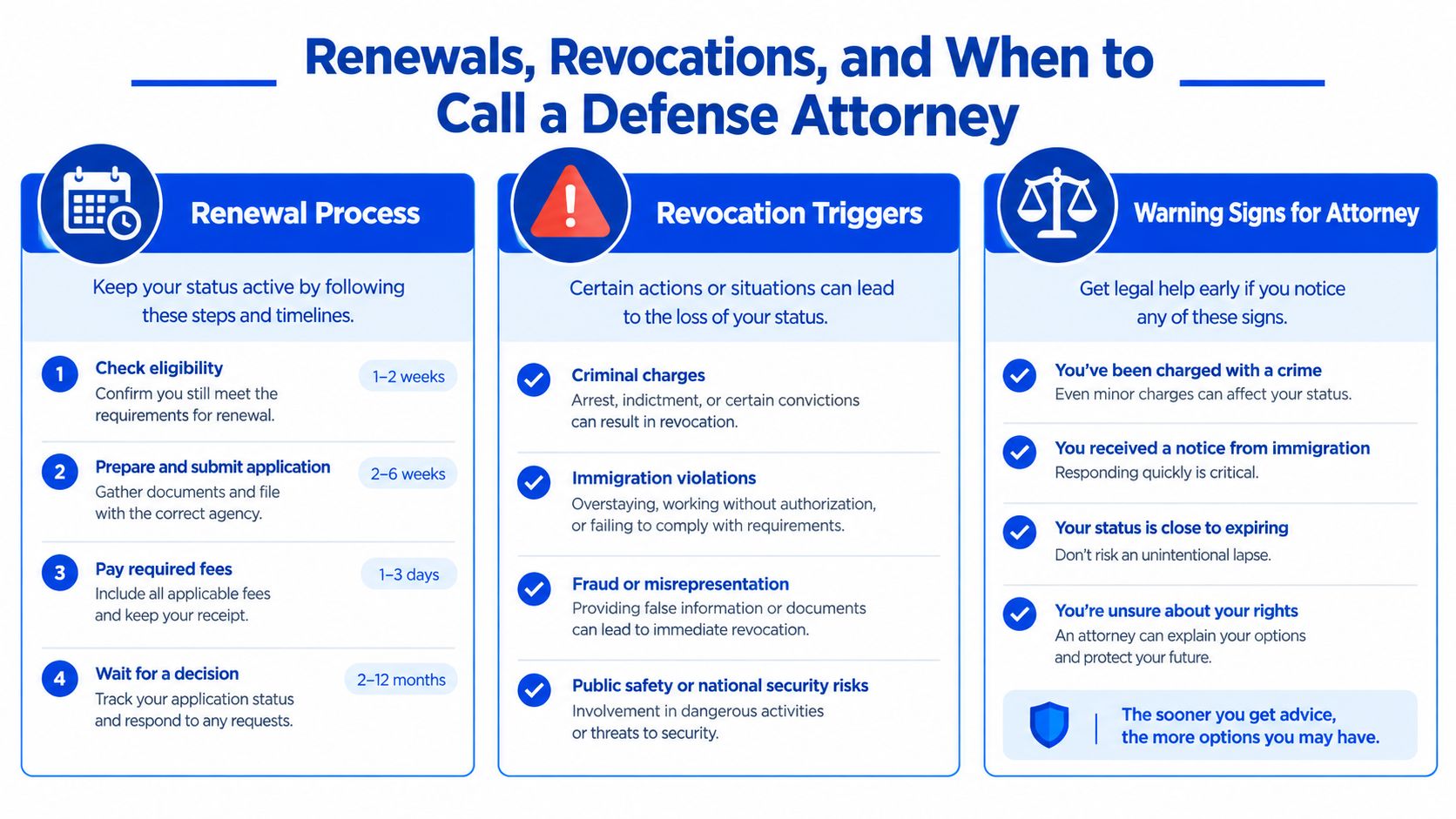
A Florida concealed weapon license runs for seven years from issuance. The renewal process isn't merely a rubber stamp. FDACS conducts a fresh background review under section 790.06(6)(a), so an arrest, protective injunction, mental-health event, or other new record can create a problem that didn't exist when the original license was issued.
FDACS guidance should control the current renewal window and charges. The renewal instructions described in the applicable materials provide for a 90-day renewal window, a $48 processing fee, and a $22 fingerprint-retention fee, subject to confirmation with FDACS because administrative charges can change. If the prior competency record is more than one year stale under the applicable renewal rules, the applicant may need to submit proof of competency again.
Revocation isn't limited to a conviction
Statutory revocation grounds can include a felony conviction, adjudication of guilt, a qualifying drug-abuse commitment, or violation of a protective order. A new arrest may prompt review even before the case reaches a final disposition. FDACS may notify the license holder by certified mail before revoking or taking further action, which makes mail monitoring and prompt response critical.
A sealed or expunged record resurfacing in a background check needs investigation, not guesswork. The agency may be seeing a records mismatch, a legally reportable event, or information that requires correction. The answer depends on the underlying disposition and the applicable licensing rules.
Call before the agency or prosecutor sets the timeline
Get legal advice promptly if any of these events occurs:
New criminal arrest: Especially if the firearm was present, accessible, or mentioned during the encounter.
Protective-order service: A domestic-violence injunction can affect possession, licensing, and the ability to remain in certain places.
Mental-health evaluation or commitment issue: Obtain the records and determine whether the event fits a statutory disqualifier.
Notice of ineligibility: Preserve the envelope, notice, attachments, and response deadline.
Background-check discrepancy: Compare the FDACS result with certified court dispositions and sealing or expungement orders.
Travel-related investigation: A lawful Florida license won't automatically defeat a charge based on another state's rules.
If an officer has seized a firearm or you received a notice connected to a weapons charge, contact a defense attorney before offering a narrative statement. Ticket Shield, PLLC handles Florida weapons-defense matters and can evaluate searches, identification issues, location restrictions, eligibility records, and the prosecution's evidence.
Ticket Shield, PLLC represents Floridians facing weapons investigations and criminal charges across Broward County, Fort Lauderdale, Miami-Dade, Palm Beach, and surrounding South Florida communities. Visit Ticket Shield, PLLC to request a consultation and discuss your concealed-carry, licensing, or firearm-possession problem before a records error or prosecutor's decision determines what happens next.