
Qué es una citación de un gran jurado y cómo proceder
Jason Goldsmith, Abg.
If that envelope showed up at your home or office with a court seal, don't treat it like junk mail. A grand jury subpoena is a real court order, and it usually means prosecutors want documents, testimony, or both in a criminal investigation. In Florida and in federal court, the safe move is the same, read it carefully, stay quiet, and get counsel involved before you hand over a single page or answer a single question.
Table of Contents
How a Florida Grand Jury Subpoena Differs From the Federal Version
Grand Jury Subpoena Compared With Other Subpoenas You May Receive
Your Rights as a Recipient, From Counsel to Motions to Quash
What Is a Grand Jury Subpoena in Plain English
A grand jury subpoena is the government's formal demand that you appear, testify, or produce records in a closed criminal investigation. It is not a polite request. It is enforceable court process, and in the federal system it's governed largely by Federal Rule of Criminal Procedure 17, with noncompliance exposing you to contempt if you don't have an adequate excuse as explained by the U.S. Department of Justice.
The plain meaning matters more than the label
The grand jury itself is not deciding whether you're guilty. It's looking at evidence to decide whether probable cause exists to charge someone with a crime. That distinction matters because people panic and assume the subpoena means charges are already inevitable. It doesn't, but it does mean prosecutors are serious enough to pull formal court power into the investigation.
If the subpoena calls for testimony, you'll usually be sworn and your words are recorded. If it calls for documents, the government expects actual responsive records, not a summary you typed up from memory. Either way, the subpoena carries the authority of the court, which is why ignoring it is a bad idea.
Practical rule: treat the subpoena as an active criminal defense problem, not an administrative errand.
One more point people miss, a grand jury subpoena is often the first sign that you need to think about your status in the case. Witness, subject, or target are very different positions, even if the paper in your hand looks the same. If you're trying to understand how that matters for the charging side of the case, this overview of indicted versus arrested gives helpful context.
How a Florida Grand Jury Subpoena Differs From the Federal Version
Florida and federal grand jury practice overlap, but they're not the same machine. Federal grand juries sit inside the federal criminal system, and they can serve subpoenas anywhere in the United States, which gives federal prosecutors broad reach when the investigation crosses state lines as the federal courts' history page explains. Florida grand juries operate under Chapter 905, Florida Statutes, and statewide grand jury practice is built for crimes that spill across counties, like corruption, complex narcotics activity, or multi-county financial schemes.
Statewide reach versus district-based reach
A federal subpoena usually ties back to a federal district and the grand jury sitting there. A Florida statewide grand jury subpoena can reach conduct across county lines and support statewide charging authority. That's a structural difference, not just a paperwork difference.
Florida also has circuit grand juries, which operate within a single judicial circuit. So when a subpoena lands in Florida, the first question isn't only “who sent it,” it's “which grand jury is this, and what geography does it cover?” That answer tells you a lot about the likely scope of the investigation.
Secrecy rules also differ in practice
Federal grand jury secrecy is governed by Rule 6, and Rule 6(e) binds jurors and government-side participants, not witnesses. Florida's secrecy rules are more explicit and more restrictive for grand jury testimony and materials, especially under section 905.27, which makes disclosure of testimony or evidence far more tightly controlled. That difference matters when a witness wants to know whether they can talk to family, coworkers, or the media.
Feature | Federal Grand Jury Subpoena | Florida Grand Jury Subpoena |
|---|---|---|
Reach | Can be served anywhere in the United States | Can run throughout Florida, including statewide grand jury practice |
Governing framework | Federal Rules of Criminal Procedure, especially Rule 17 and Rule 6 | Chapter 905 and related Florida grand jury rules |
Scope | District-based federal investigation | Statewide or circuit-based Florida investigation |
Secrecy | Rule 6(e) limits government-side disclosure | Florida law imposes strict secrecy on testimony and proceedings |
Challenge route | Motion to quash or modify in federal court | Motion practice under Florida procedure and grand jury rules |
Grand Jury Subpoena Compared With Other Subpoenas You May Receive
Not every subpoena is a grand jury subpoena, and confusing them can lead you to make the wrong move. A grand jury subpoena is part of a criminal investigation. A trial subpoena, by contrast, is for a known case and a specific court date, not a closed investigative proceeding.
The issuer tells you a lot
An administrative subpoena comes from an agency, not a grand jury. Agencies like the IRS or SEC can demand records through their own authority, and those requests usually focus on documents rather than sworn testimony. A civil subpoena comes out of private litigation, where one side is trying to build a case against the other in a lawsuit.
If the paper asks for live testimony in a secret criminal investigation, you're dealing with something more serious than a routine records request.
The rights and risks are not identical
In a grand jury setting, counsel usually doesn't sit inside the room with you. In civil cases, depositions work differently and lawyers are typically present. In administrative matters, the agency can still push hard on document production, but the legal framework and remedies are different from a criminal case.
Criterion | Grand Jury Subpoena | Trial Subpoena | Administrative Subpoena | Civil Subpoena |
|---|---|---|---|---|
Purpose | Investigate possible crimes | Compel testimony or documents for a case already in court | Obtain records for agency enforcement | Obtain evidence for private litigation |
Issuer | Grand jury process through prosecutors | Court in an active case | Government agency | Party to a lawsuit |
Typical demand | Testimony, documents, or both | Testimony, documents, or both | Usually records, sometimes testimony | Documents or testimony |
Counsel presence | Lawyer usually outside the room, not inside | Lawyer may attend depending on setting | Depends on forum and procedure | Lawyer usually present in deposition or hearing |
Refusal risk | Contempt or other court enforcement | Contempt or sanctions | Enforcement action, contempt, or penalties depending on statute | Court sanctions, contempt, or evidence limits |
What Compliance Actually Looks Like Day by Day
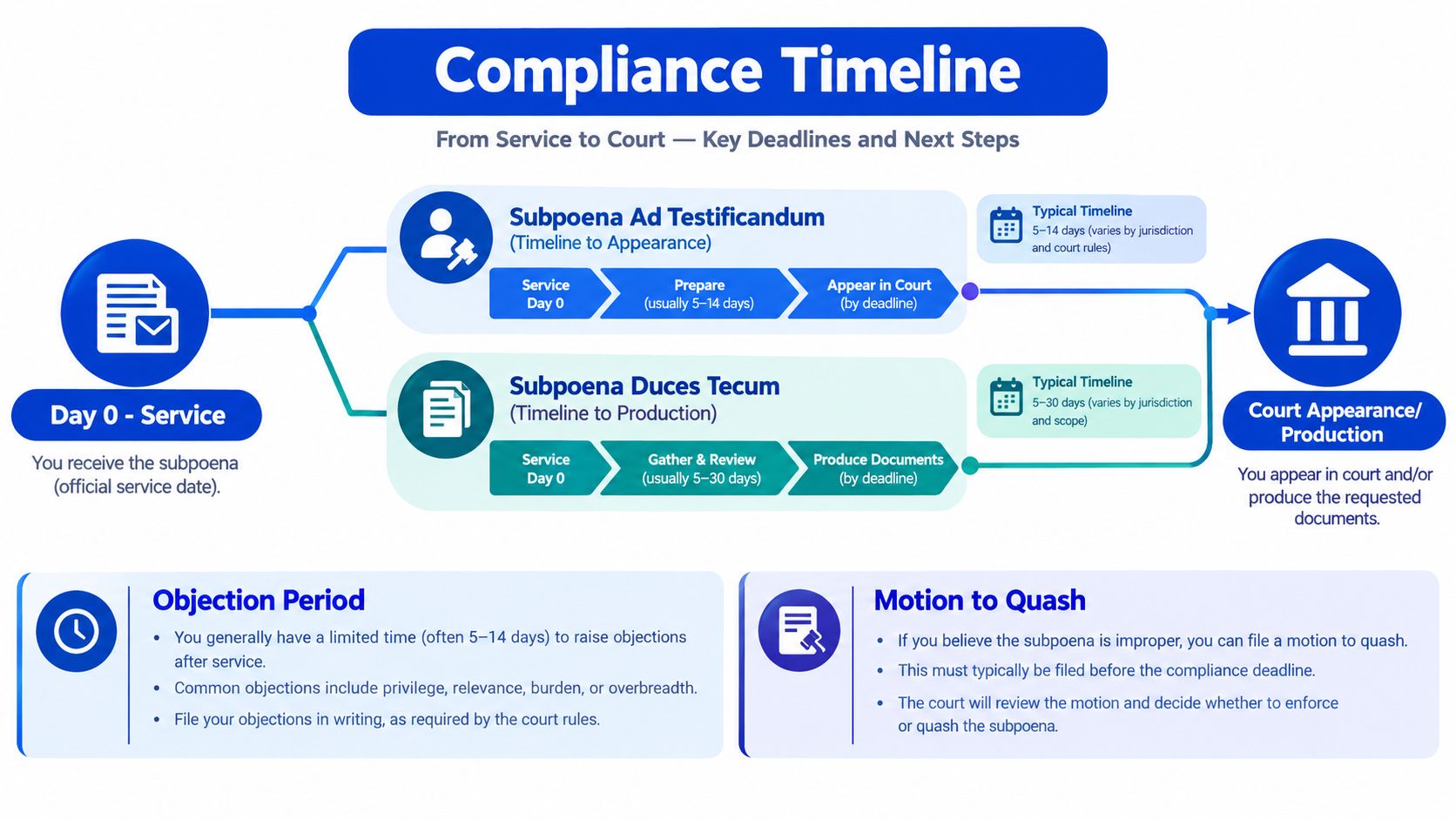
A subpoena is not something you put on the desk and “deal with later.” The return date is a real deadline. If the subpoena is for testimony, that's a subpoena ad testificandum. If it asks for documents, that's a subpoena duces tecum. The wrong assumption is that you can show up casually and sort it out there. You can't.
Service is the starting gun
In federal practice, subpoenas can be served anywhere in the United States, and Florida grand jury subpoenas also have statewide reach under section 914.001, which says they run throughout the state Florida statutes set that out plainly. Once service happens, the clock starts. If the subpoena is for records, you need to preserve everything potentially responsive without changing it.
Production usually means producing the actual records requested, organized the way the subpoena requires. If the request is broad, sloppy responses create problems. If the subpoena wants originals, summaries won't cut it unless the prosecutor agrees.
Noncompliance is a court problem, not a negotiation tactic
Courts can treat noncompliance as contempt, and they will look at whether your refusal was willful or grounded in a real legal dispute. That's why the literal terms of the subpoena matter so much before a judge changes them. If there's a dispute, your lawyer raises it quickly and formally.
Bottom line: comply with the subpoena's text unless a court orders something different.
Your Rights as a Recipient, From Counsel to Motions to Quash
You do have rights, and they matter more than most frightened people realize. You can talk to a lawyer before testifying, and you should. You can usually have counsel waiting outside the grand jury room, ready to advise you between questions. Once testimony starts, your lawyer generally does not sit there coaching you question by question.
The motion to quash is real, but it has limits
Courts can quash or modify a subpoena when compliance would be unreasonable or oppressive that standard is reflected in congressional research on grand jury practice. In plain English, that means the subpoena's purpose, burden, and scope all matter. Privilege, harassment, overbreadth, improper service, and requests that stray into the wrong kind of discovery can all support a challenge.
A subtle but important point, a grand jury subpoena doesn't automatically gag the recipient. Under federal Rule 6, witnesses generally aren't barred from saying they got a subpoena or from discussing it with counsel. That is different from the secrecy surrounding the grand jury room itself Rule 6 is laid out in the federal criminal rules.
Practical rule: you can usually speak with your lawyer freely about the subpoena and your concerns, but don't guess at what you can tell others without legal advice.
Fifth Amendment issues can change the whole strategy
If answering a question would incriminate you, the Fifth Amendment may come into play. In some cases, prosecutors respond with immunity, and the type of immunity matters. Use immunity and transactional immunity are not the same thing, and you should never assume the government has protected you just because it wants your testimony.
These questions to ask a criminal defense lawyer are the right ones to raise before you produce anything or step into the grand jury process.
Ground | Legal Test | Typical Outcome |
|---|---|---|
Privilege | Does the request reach attorney-client, work-product, or another protected category? | Protected material is withheld or narrowly redacted |
Overbreadth | Is the subpoena broader than the legitimate investigative need? | Scope may be narrowed or modified |
Burden | Is compliance unreasonable or oppressive? | Court may quash or limit production |
Improper purpose | Was it used mainly for trial prep or civil discovery? | Challenge may succeed if misuse is shown |
Improper service | Was service defective or outside the rules? | Re-service or quash is possible |
Two Real-World Scenarios People Walk Into
A business owner gets a call from a former employee who says the company is under federal investigation. Two days later, a subpoena duces tecum arrives asking for five years of bank records. The worst move is to empty every file cabinet and send a giant dump to the prosecutor. The smarter move is to bring counsel in first, narrow the scope, review privilege issues, and decide what has to go out the door.
Scenario one, the business records subpoena
That owner's lawyer may be able to ask what the government is really investigating, negotiate a production protocol, and decide whether to push back on overbreadth. If the records are partially privileged or contain unrelated private information, blind production can create new problems that didn't exist before. That's not theory, it's basic defensive lawyering.
A former associate gets a Florida grand jury subpoena in a public corruption case and doesn't know whether they're a witness or a target. That person wants certainty the government won't give. The right move is a proffer meeting only after counsel evaluates the risk, and if the answers could expose the witness, invoking the Fifth can be safer than trying to “explain everything.”
Scenario two, the witness who may be a target
Counsel reads the prosecutor's questions for tells. Are they asking about your own conduct, your communications with others, or your knowledge of someone else's actions? Prosecutorial discretion is broad, and the government often says less than people want, which is why this explanation of prosecutorial discretion matters before anyone starts talking.
Common Mistakes That Can Worsen a Grand Jury Subpoena Case
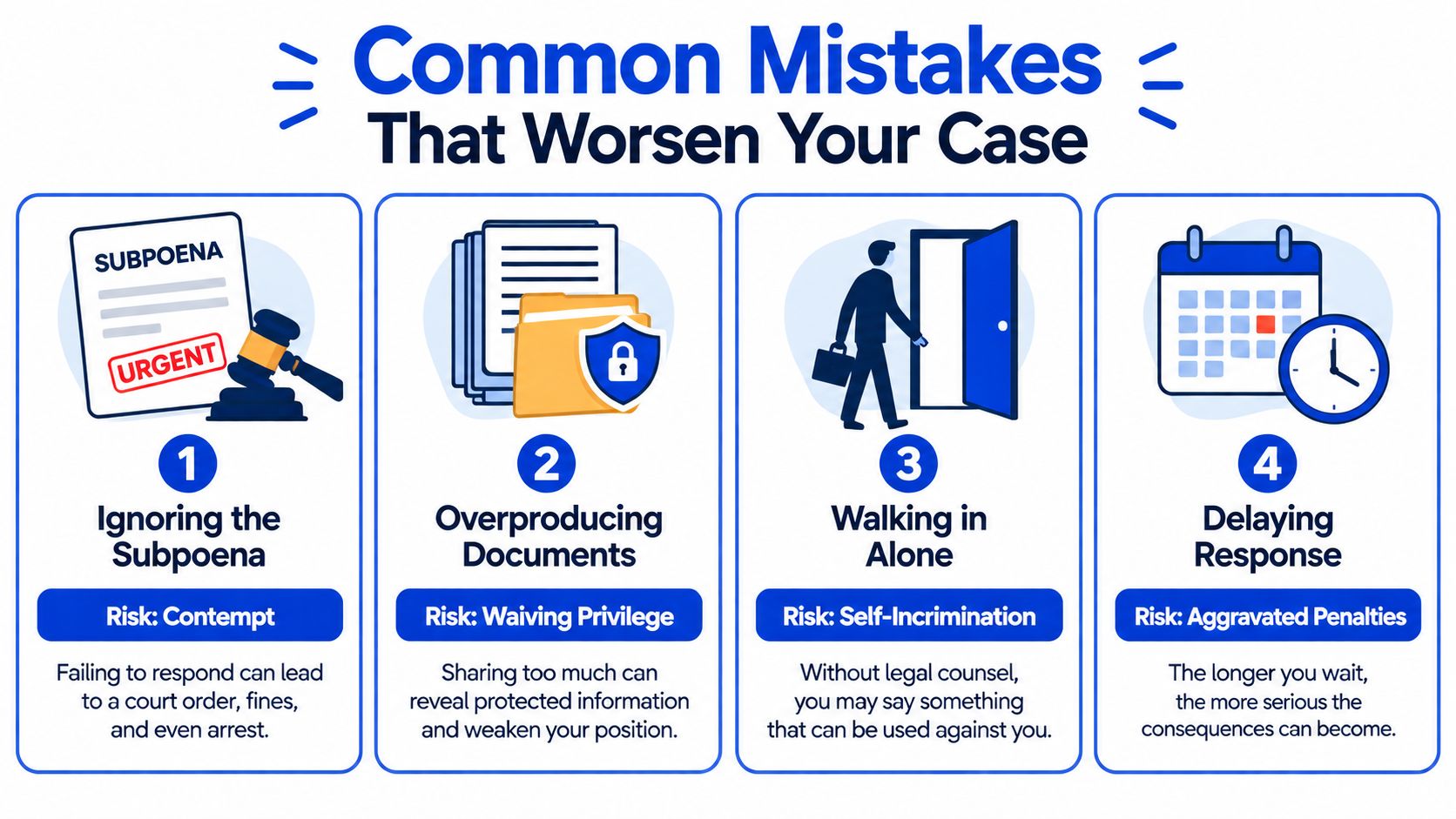
People usually make four mistakes. They ignore the subpoena, overproduce documents, walk in alone, or assume secrecy means silence. Each one can make a bad situation worse.
The first mistake is delay
Ignoring the paper doesn't make it disappear. It can turn a manageable compliance issue into contempt exposure. If you need more time, the lawyer asks for it the right way instead of pretending the deadline isn't real.
The second mistake is overproduction
People often hand over every email, text, and folder because they're nervous. That's a mistake, especially if responsive material is mixed with privileged material or irrelevant records. Pre-appearance review protects you from accidental production that can't be undone.
The third mistake is showing up alone
A witness without preparation can answer more than the question asked, volunteer harmful details, or misunderstand what the prosecutor really wants. Counsel usually can't sit inside the grand jury room, but that doesn't mean you should face it cold.
The fourth mistake is misunderstanding secrecy
A Florida grand jury setting is tightly secret, but that doesn't mean every conversation about the subpoena is forbidden. The safer move is to ask a lawyer what you can say, to whom, and when. Don't guess.
This motion hearing overview helps explain how a challenge gets heard once the subpoena is in dispute.
Your First 48 Hours and When to Call a Defense Lawyer
Start with the paper itself. Read every line, including the issuing court, the return date, and exactly what is being requested. Then preserve everything potentially responsive without deleting, editing, or “cleaning up” anything.
The first two days should look like this
Open it carefully. Identify whether it demands testimony, documents, or both.
Calendar the deadline. The return date is real, and missing it creates avoidable risk.
Preserve records. Keep emails, texts, files, logs, and paper documents intact.
Stop talking about it casually. Friends, coworkers, and family are not protected by privilege.
Call defense counsel before you produce or appear. That call changes the case immediately.
A lawyer can often narrow the request, talk to the prosecutor, and move to quash or modify the subpoena where the rules allow it. In some Florida cases, that early intervention keeps the problem from growing into a bigger one. If you want to understand the kind of representation that should be in your corner from the start, this Florida criminal defense lawyer overview is a useful place to begin.
Practical rule: the first 24 hours are the highest-leverage window you have.
Ticket Shield, PLLC handles Florida criminal defense matters with the kind of steady, prosecutorial perspective that matters when a subpoena lands in your hands. If you're facing a grand jury subpoena in Broward, Miami-Dade, Palm Beach, or anywhere else in South Florida, visit Ticket Shield, PLLC and get a direct, confidential review before you produce documents or answer questions.