Weapons Charge Lawyer in Florida What to Expect
Jason Goldsmith, Esq
You're sitting in a Broward County booking area after a traffic stop, trying to understand how a firearm found in a vehicle became your problem. Maybe the gun wasn't yours. Maybe officers searched a home, car, bag, or room without showing a warrant. Your family is calling from Fort Lauderdale, Miami-Dade, or Palm Beach and asking the same frightened questions: What happens next, and can this charge be stopped before it becomes a conviction?
Florida weapons cases can escalate quickly because the charge depends on details that may seem small at the scene. The alleged weapon, where it was found, whether it was concealed, your prior record, the reason for the stop, and the way officers conducted the search can all change the legal exposure. A weapons allegation may involve a misdemeanor, a felony, or a mandatory minimum sentence.
A Florida weapons crimes defense resource should do more than list offenses. You need a clear explanation of what a weapons charge lawyer examines, how possession works in shared spaces, why the Fourth Amendment may provide decisive protection, and how the case moves from arrest toward dismissal, reduction, plea negotiations, or trial. The information below is educational, not a prediction of what will happen in any individual case.
Table of Contents
Introduction When a Weapons Allegation Turns Your Life Upside Down
When to Hire a Weapons Charge Lawyer and What Help Looks Like
Introduction When a Weapons Allegation Turns Your Life Upside Down
A former prosecutor knows why the first police report can look more conclusive than the underlying evidence. Reports often describe the location of a weapon, but the location alone doesn't answer the legal question. The State still must connect the accused person to the item through admissible evidence and prove the elements of the specific offense.
That distinction matters when officers find a firearm under a seat, in a shared bedroom, inside a bag, or near several people. Being close to a weapon isn't automatically the same as possessing it. The prosecution may try to rely on constructive possession, but that theory requires careful examination of knowledge, access, and control.
The search itself may be even more important. A brief investigative stop generally requires reasonable articulable suspicion under Fourth Amendment doctrine. If officers lacked a constitutional basis to stop, detain, or search, a suppression motion may exclude the firearm and weaken the physical-evidence portion of the prosecution's case, as explained in this discussion of weapons-charge defense and suppression.
Florida law also creates sharp differences between allegations. Carrying a concealed weapon or electric weapon without meeting statutory requirements is a first-degree misdemeanor, while carrying a concealed firearm without meeting those requirements is a third-degree felony under Florida Statutes section 790.01. A prior felony record or an allegation that a firearm was used during another crime can raise the stakes further.
You don't need to decide your entire defense from a jail phone. You do need to protect your right to remain silent, preserve paperwork and recordings, and obtain case-specific advice before making statements or accepting a plea.
Understanding What a Weapons Charge Lawyer Actually Does
A weapons charge lawyer acts as both a shield and a case strategist. The shield protects constitutional rights and prevents the State from using evidence obtained unlawfully. The strategy identifies the facts the prosecution must prove, tests whether its evidence satisfies those requirements, and seeks the safest available resolution.
The work begins before a courtroom argument
Early review usually starts with the arrest affidavit, charging document, body-camera footage, dispatch records, photographs, search paperwork, and witness accounts. Counsel asks practical questions:
Why did the stop begin? The reason officers approached the person may determine whether the detention was lawful.
What happened before the search? Consent, a warrant, probable cause, and recognized exceptions can affect admissibility.
Where was the weapon? A weapon on a person raises different proof questions from one found in a shared vehicle or residence.
What did the accused say? Statements may support or undermine knowledge and control, but their context matters.
What does the statute require? The State must prove the charged offense, not show that a weapon existed.
A lawyer also communicates with prosecutors, evaluates discovery, files motions when appropriate, and prepares for hearings. Negotiation is not a substitute for preparation. A credible defense position comes from identifying a real weakness, such as an unsupported search, unreliable identification, or insufficient proof of possession.
The charge label doesn't tell the whole story
Florida weapons cases can involve concealed weapons, concealed firearms, prohibited possession, ammunition, electric weapons or devices, firearm use during another offense, or allegations prosecuted under federal law. The classification depends on the statute and the facts alleged.
Practical rule: Don't judge the case by the arresting officer's summary. Judge it by the elements of the charged offense and the evidence the State can legally present.
A defense lawyer's role isn't to promise a result. It is to make sure the State has to prove its case through lawful, reliable evidence while protecting the accused from avoidable damage.
Florida Weapons Laws Penalties and How Charges Are Graded
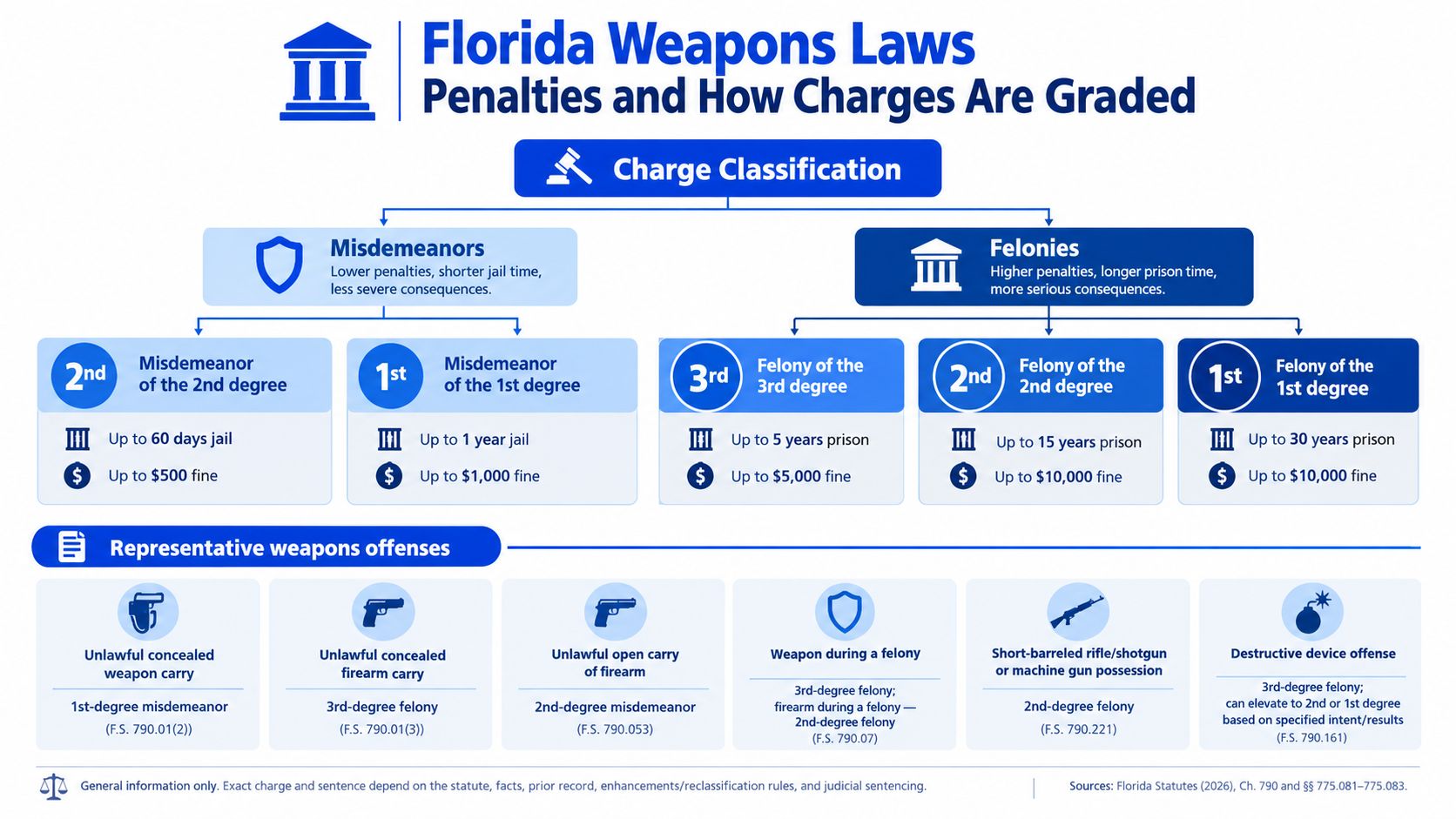
Florida grading begins with the alleged conduct, but the surrounding facts often determine the exposure. Two people may be found near similar objects and face different allegations because the State claims different concealment, possession, prior-record, or use facts.
Concealed and openly carried weapons
Section 790.01 distinguishes between a concealed weapon or electric weapon and a concealed firearm. A concealed weapon allegation that doesn't meet the statutory criteria is a first-degree misdemeanor. A concealed firearm allegation under the same general statute is a third-degree felony. That difference can affect the initial charge, bond, court process, record consequences, and future opportunities.
Florida generally treats open carry as unlawful under section 790.053, subject to listed exceptions. The statute also recognizes a limited situation in which a person legally carrying a concealed firearm briefly and openly displays it to ordinary sight, unless the display is intentional, angry, or threatening and not in self-defense. Whether the item was concealed, openly carried, or briefly exposed can become a central factual dispute.
Prohibited possession and prior records
Florida's felon-in-possession law reaches more than firearms. Under section 790.23, a person with a qualifying felony history may face prosecution for owning or having a firearm, ammunition, or an electric weapon or device in their care, custody, possession, or control. Most violations are second-degree felonies under the statute, with a higher-level enhancement path for repeat qualifying offenders.
The State's theory must still connect the person to the item. A prior felony doesn't automatically prove that the accused knowingly possessed something found in a shared space.
Mandatory minimum exposure
Florida's 10-20-Life law can impose mandatory prison terms when a firearm is used during certain crimes. The statute provides 10 years for possession, 20 years for discharge, and 25 years to life when serious injury or death results, as described in this Florida firearm-charge explanation. It also includes a separate three-year minimum mandatory for certain cases involving felon firearm possession or burglary of a conveyance when a firearm or destructive device is possessed.
Allegation Type | Florida Law Basis | Classification and Exposure |
|---|---|---|
Concealed weapon or electric weapon without statutory qualification | Section 790.01 | First-degree misdemeanor |
Concealed firearm without statutory qualification | Section 790.01 | Third-degree felony |
Open carry of a firearm or electric weapon, outside an exception | Section 790.053 | Criminal exposure depends on the alleged conduct and applicable law |
Prohibited possession involving a qualifying felony record | Section 790.23 | Generally a second-degree felony, with possible enhancement for repeat qualifying offenders |
Firearm used during a qualifying crime | 10-20-Life provisions | Mandatory minimum exposure may apply based on possession, discharge, or resulting serious injury or death |
For questions about licensing and statutory requirements, review Florida Statute section 790.06, then obtain advice based on the exact allegation. The charge's degree is only one part of the analysis. The alleged facts may create sentencing consequences that are more serious than the basic classification suggests.
The broader federal system also illustrates why statutory details matter. The Bureau of Justice Statistics reported that in 1992 U.S. attorneys investigated 7,971 suspects and prosecuted 5,613 suspects whose most serious offense was a federal weapons violation. Those totals had increased roughly four-fold and five-fold, respectively, since 1980, and the report stated that weapons prosecutions rose from 3% of all investigations to 7% and from 3% of all prosecutions to 8% during that period. In 1992, almost 86% of convicted federal weapons violators received prison terms averaging more than six years, while the average federal sentence for a weapons conviction in 1990 was 47 months, according to the Bureau of Justice Statistics report.
What to Expect After a Weapons Arrest in Florida
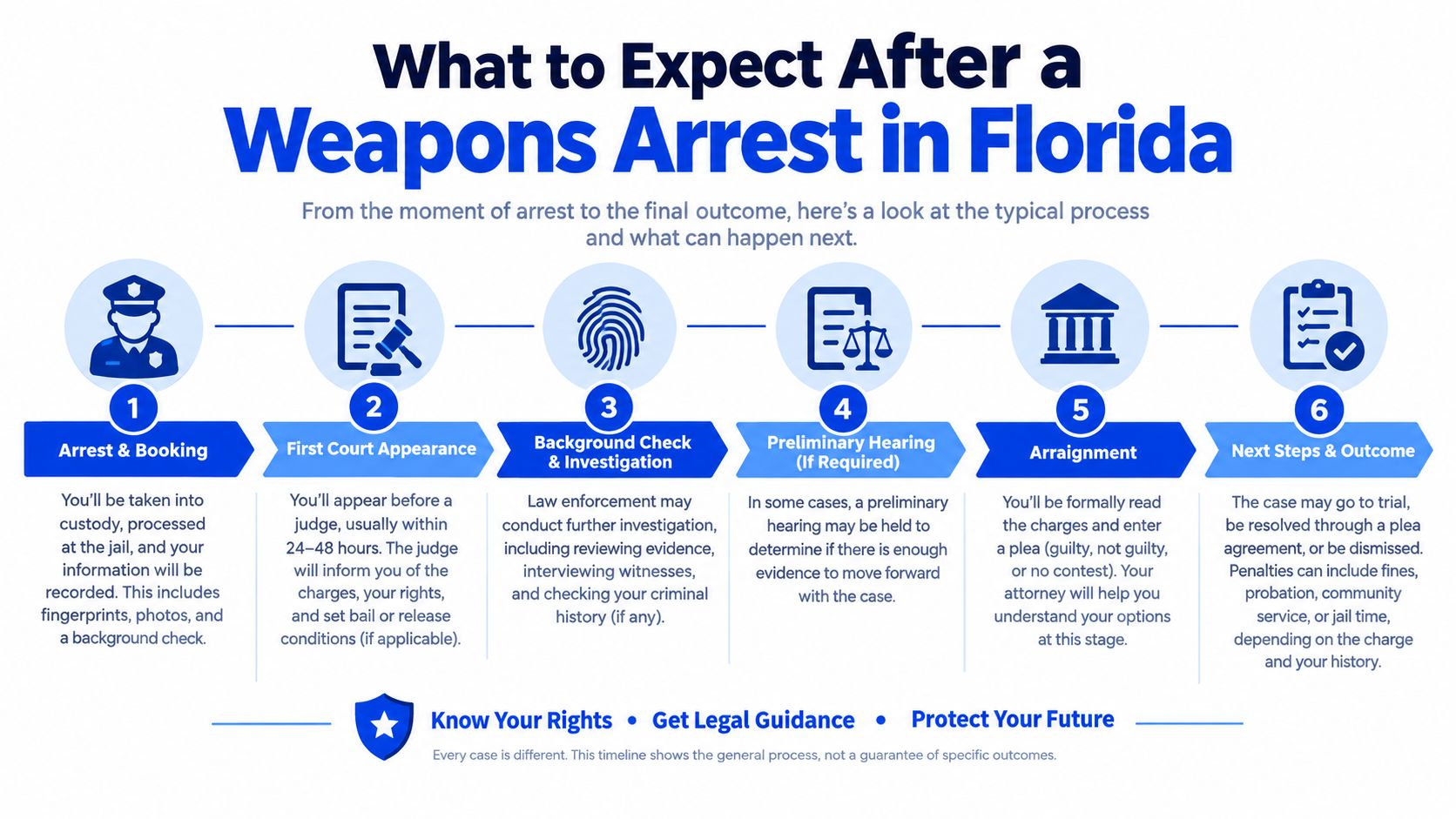
The criminal process usually develops in stages. Each stage gives the defense a different opportunity to protect the client and test the State's evidence.
Arrest, booking, and first appearance
After arrest, law enforcement completes booking and prepares paperwork describing the alleged offense. The first appearance addresses release, bond, and conditions. The court may consider the charge, criminal history, community ties, and other legally relevant circumstances.
Don't use the first hours to explain the case to officers or other people in custody. A simple request for counsel and a decision to remain silent can prevent an emotional statement from becoming evidence.
Discovery and investigation
Once counsel receives discovery, the review should go beyond the police narrative. The defense examines body-camera video, dispatch communications, photographs, property records, laboratory information, witness accounts, and the precise location where officers claim they found the weapon.
The lawyer may also investigate whether the item was handled, moved, photographed, or tested in a way that affects the State's proof. In a shared home or car, floor plans, ownership records, text messages, receipts, and witness statements may help show who had access or control.
Motions and negotiation
A suppression motion asks the court to exclude evidence obtained through an unconstitutional stop or search. If the weapon is the State's central physical evidence, exclusion can change the entire negotiation. As guidance on seized-weapon evidence explains, removing the item may leave the prosecution relying on weaker secondary evidence, such as statements or a constructive-possession theory.
A lawyer may also challenge the charging decision, seek dismissal where the evidence cannot establish an element, or negotiate a reduction that avoids more damaging consequences. No attorney can guarantee that a motion or negotiation will succeed.
Resolution in court
Some cases end through dismissal or reduction. Others proceed through hearings, depositions where permitted, and trial preparation. South Florida cases may involve different courthouses and procedures across Broward, Fort Lauderdale, Miami-Dade, Palm Beach, and surrounding jurisdictions.
Ticket Shield can handle court appearances in many jurisdictions, which may reduce unnecessary disruption for clients, but attendance requirements depend on the court and the conditions of release. The safest approach is to follow written instructions and confirm every appearance with counsel.
A plain-language guide to what happens after an arrest can help families understand the sequence, but it can't replace review of the actual arrest documents and evidence.
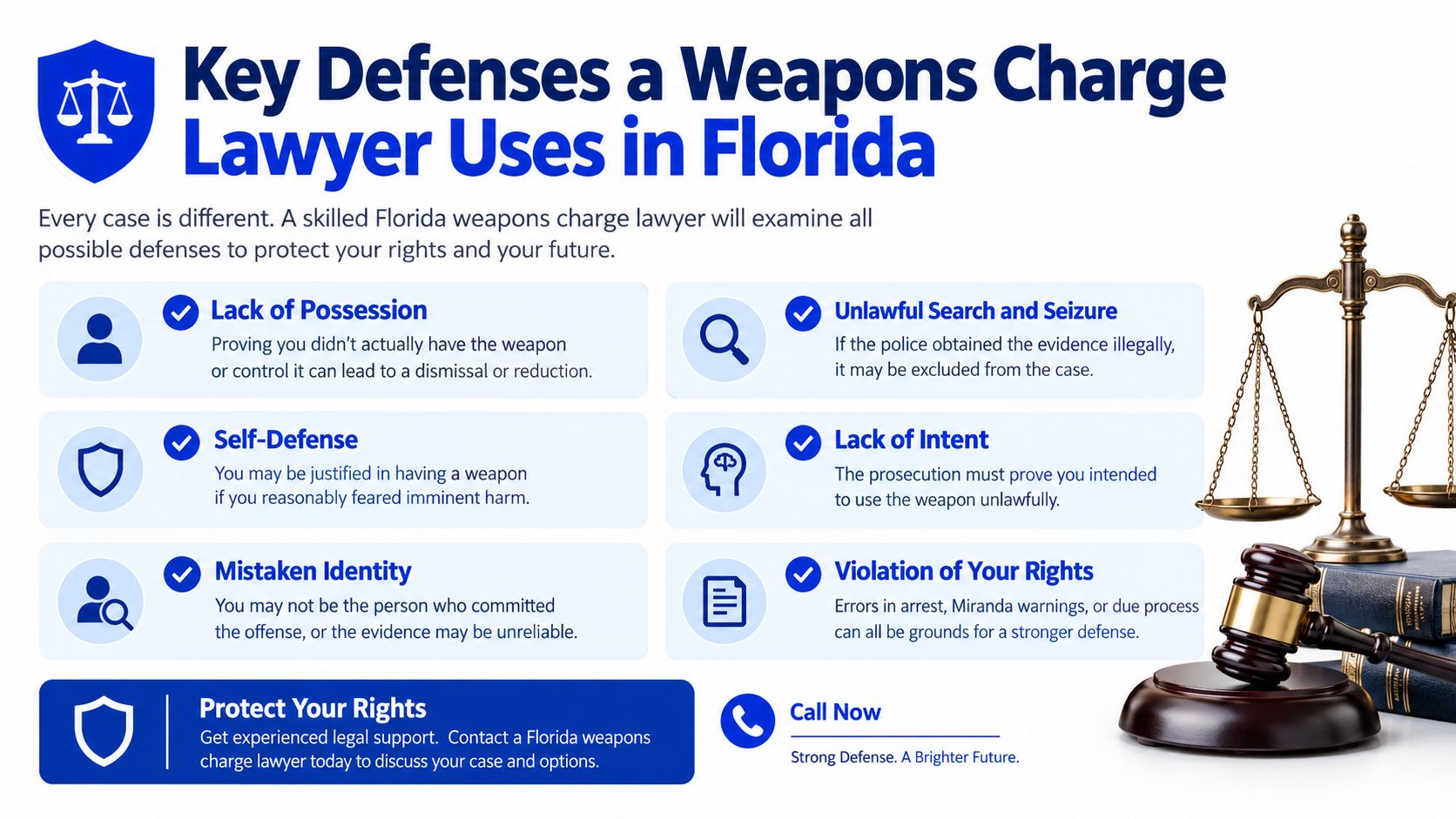
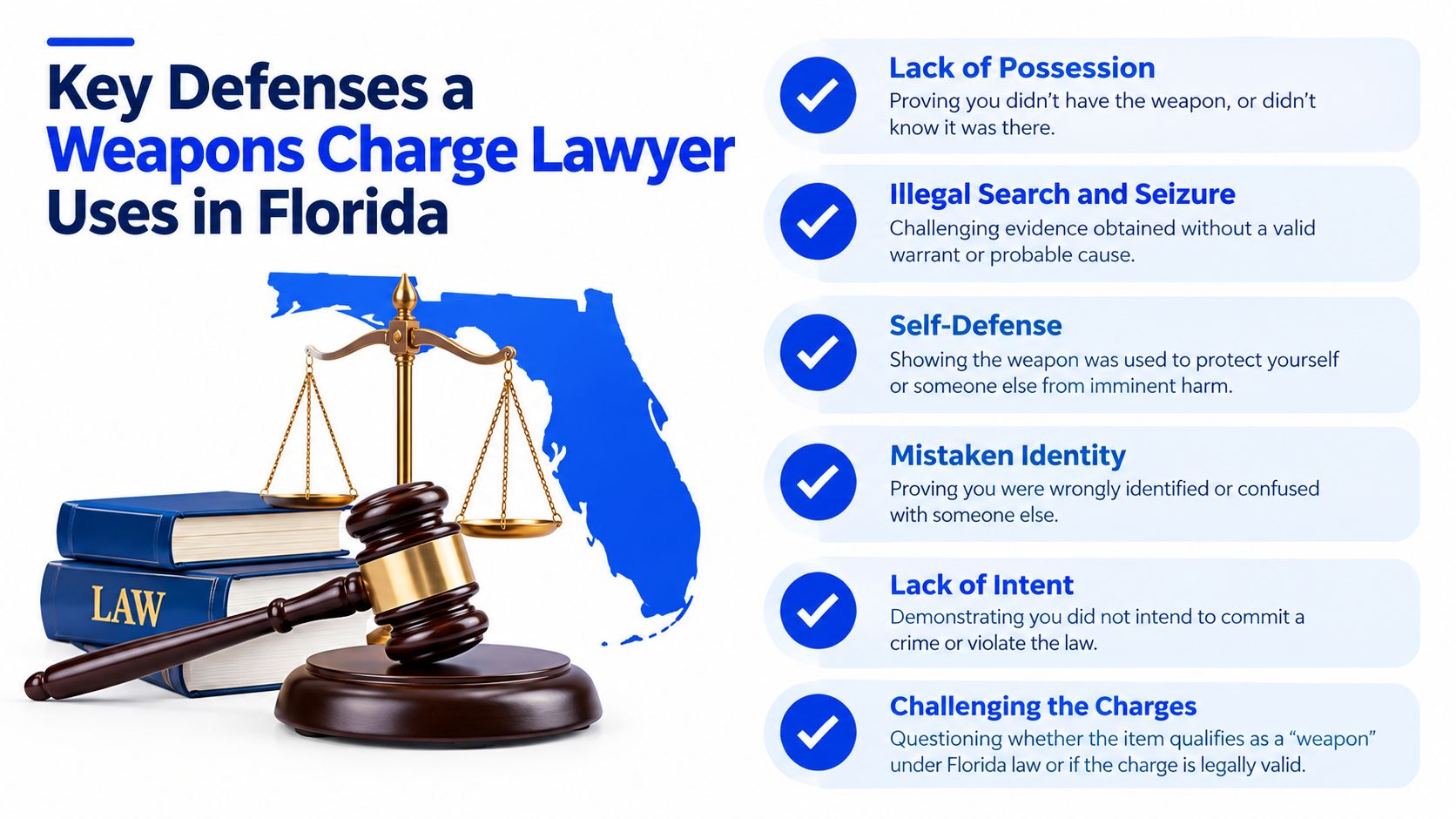
Key Defenses a Weapons Charge Lawyer Uses in Florida
The strongest defense depends on how the weapon was found and what the State must prove. A lawyer usually begins with the evidence that could disappear from the case entirely, then examines the alternative theories the prosecution may use.
The stop and search
The first question is often simple: Why did the officer stop the person, and what justified the search? A brief investigative detention requires reasonable articulable suspicion. A more intrusive search may require a warrant, probable cause, consent, or a recognized exception.
The timeline matters. Counsel examines the officer's stated reason, what the officer knew at each moment, whether the detention expanded, what was said about consent, and whether the search exceeded its lawful scope. If the court suppresses the firearm, the State may lose the evidence it needs to prove possession or use.
Knowledge and control
Possession doesn't necessarily mean ownership. In a shared home, vehicle, hotel room, or bag, the prosecution may argue constructive possession. That theory becomes vulnerable when the evidence shows only proximity without proof that the accused knew the item was present and exercised control over it.
Consider a firearm found under a passenger seat with several occupants in the vehicle. The location may be accessible to more than one person, but accessibility alone doesn't identify the person who knew about or controlled the weapon. Seating position, fingerprints or other forensic evidence, statements, ownership, and the visibility of the item can all affect the analysis.
The central question is not simply who was nearby. It is whether the State can prove knowing possession beyond a reasonable doubt.
Concealment, display, and lawful possession
A case under section 790.01 may turn on whether the item was concealed on or about the person and what type of weapon the State alleges. A case under section 790.053 may turn on whether the object was openly carried or briefly exposed in a circumstance recognized by the statute.
Other defenses may focus on lawful possession, an exception, mistaken identification, lack of knowledge, or the State's failure to prove an essential element. The facts must be tested against the exact statutory language, not a general assumption that every firearm found near someone creates criminal liability.
For a broader explanation of defense approaches, see types of criminal defenses. The practical value of each defense comes from matching it to the reports, video, physical evidence, and testimony in the individual case.
Federal matters require separate attention. TRAC reported that the federal government initiated 667 new weapons prosecutions during October 2025, down 24.4% from 2020 levels, and identified Title 18 U.S.C. section 922, “Firearms; Unlawful acts,” as the most frequently cited lead charge in magistrate court. TRAC also reported 202.8 weapons prosecutions for every ten million people in the United States in June 2025, showing that weapons allegations remain a recurring part of the federal docket. The Department of Justice's historical overview identifies the Gun Control Act of 1968 as a major milestone in the federal firearms framework.
When to Hire a Weapons Charge Lawyer and What Help Looks Like
The safest time to contact a weapons charge lawyer is before answering investigative questions or entering a plea. Waiting until trial can make it harder to investigate the search, preserve video, locate witnesses, or identify a charge resolution that avoids serious collateral consequences.
Immediate legal review is especially important when:
The weapon was found after a warrantless search: Counsel can assess consent, probable cause, reasonable suspicion, and exceptions to the warrant requirement.
The allegation involves a prior felony: The case may involve firearm, ammunition, or electric-device possession, and the exact record can matter.
The State alleges firearm use: Mandatory minimum exposure may affect every negotiation and hearing.
The case could move into federal court: Federal statutes and sentencing rules may create a different level of risk.
Trying to manage the case alone often means relying on the arrest report, guessing about deadlines, and making statements without knowing what evidence the State has. Representation provides a structured review of the evidence, communication with the prosecutor, motion practice when appropriate, and preparation for the outcome that follows if negotiation fails.
Families also need practical support. A lawyer can explain release conditions, identify documents to preserve, and clarify which court appearances require the client's presence. Ticket Shield, PLLC offers confidential consultations, direct attorney communication by phone, text, or email, and defense for Florida firearm and weapons offenses across South Florida. Its Florida weapons and firearm offenses service describes the firm's approach to weapons charges and enhancements.
No lawyer can promise dismissal, acquittal, or a particular sentence. A meaningful consultation should instead identify the legal questions that control the case and the steps available to protect the accused.
Taking the Next Step to Protect Your Rights and Future
Three principles deserve attention. The weapon's classification and the alleged conduct matter. A concealed weapon allegation isn't treated the same as a concealed firearm allegation, and prior records or firearm-use claims can change the exposure.
The search may decide the case before trial. If officers lacked a lawful basis to find the weapon, suppression may remove the State's most important evidence. If the weapon remains admissible, the defense should still test whether the prosecution can prove knowledge and control rather than mere proximity.
Early action protects options. Don't discuss the facts with investigators or post about them online. Keep the charging papers, bond documents, property receipts, and court notices. Tell counsel where and how the weapon was found, who had access to the location, and what officers said or did, even if a detail seems embarrassing or unimportant.
Families in Broward County, Fort Lauderdale, Miami-Dade, Palm Beach, and nearby South Florida communities can seek a confidential consultation to understand the charge and the immediate decisions ahead. The right defense plan depends on the evidence, the statute, the search, and the accused person's history.
Ticket Shield, PLLC provides Florida weapons charge defense, including challenges to firearm searches, possession theories, and weapons enhancements. Visit Ticket Shield, PLLC to request a confidential consultation and discuss the next step with a Florida criminal defense attorney.