
Significado de Nolle Prosequi en casos penales de Florida explicado
Jason Goldsmith, Abg.
You leave a Florida courtroom after the prosecutor says “nolle prosequi.” The charge appears closed, yet no one declared you not guilty. That uncertainty is understandable.
Nolle prosequi is the State's formal decision to stop prosecuting a charge. In Florida, it generally takes effect without a separate finding that you were innocent. It can end the current prosecution while leaving open the possibility of refiling, depending on the statute of limitations, procedure, and whether jeopardy has attached. Most misdemeanors have a 2-year limitations period, while many felonies have a 3-year period, so timing matters. Florida criminal defense guidance explains why a lawyer should examine those details.
The immediate case may be over, but the paperwork can still affect you. A docket may show “nol prossed,” while background checks, professional licensing reviews, or immigration applications raise separate questions. Confirm which counts ended, whether refiling remains possible, and whether record sealing or expungement should be considered.
Table of Contents
What Nolle Prosequi Means When the Judge Says It
You are in a Florida county courtroom when the prosecutor announces, “The State enters a nolle prosequi.” The judge records it, and the case appears to stop. No one says “not guilty,” so you may wonder whether the charge is finished or whether another court date could appear.
In plain English, nolle prosequi means the State is no longer pursuing the charge at that time. The Latin phrase is often shortened to “nolle pros” or “nol pros.” Through the State Attorney's Office, the prosecutor places a formal entry on the record instead of asking the judge to decide whether the evidence proves your innocence. Cornell Law School's legal reference defines it as the State's formal decision to stop pursuing a pending criminal charge.
A nolle prosequi generally ends the current prosecution without prejudice. The State may still be able to refile if the statute of limitations has not expired and Florida procedure allows it. The result also differs from an acquittal, which follows a trial or other determination that the prosecution failed to prove guilt.
What the docket entry tells you
Read the docket carefully. It should show which charge or counts the State ended. If the case includes several counts, the prosecutor can nolle prosequi one while continuing with another, so “nol prossed” does not always describe the entire case.
The judge may acknowledge or record the announcement, but the prosecutor's act is self-executing upon announcement. The prosecution ends when the State announces the nolle prosequi, without separate trial-court approval at that stage. Florida procedural guidance on nolle prosequi explains why the filing is a prosecutorial act rather than a judicial finding. Because the prosecutor controls the entry, a defendant cannot compel the judge to enter it over the State's objection.
Florida timing can change what happens next. If jeopardy has attached, refiling may raise different constitutional issues. If it has not, the State may have more room to bring the charge again, subject to the limitations period and procedural rules.
Practical meaning: Your immediate court exposure may be gone, but “case closed” does not automatically mean “record erased” or “charge permanently barred.”
You can explain the result to your family this way: “The prosecutor stopped the case, but a lawyer still needs to check whether the State can refile and whether I can seal or expunge the record.” That wording separates the end of this prosecution from a finding that you were innocent.
Why Prosecutors File a Nolle Prosequi in Florida
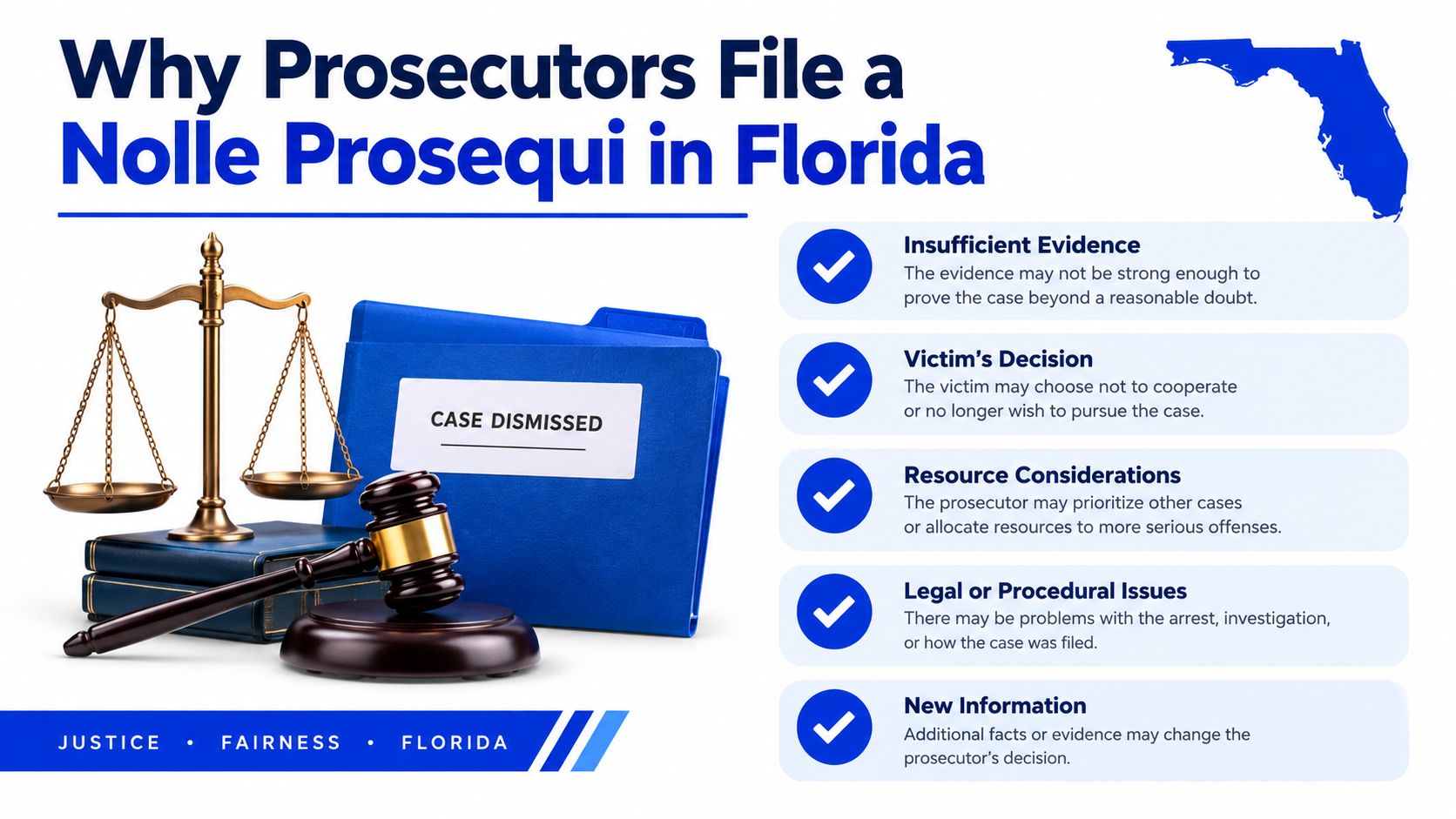
A charge can look active when it is filed, then change after the prosecutor reviews discovery, interviews witnesses, litigates motions, or discusses a resolution. In Florida, the State may enter a nolle prosequi when continuing the prosecution no longer makes practical or legal sense. That decision does not mean a judge found the accusation false or declared the defendant innocent.
The State Attorney controls this decision. A judge does not ordinarily order a nolle prosequi, and an alleged victim cannot require one. The victim's wishes may affect the prosecutor's evaluation, but the formal choice belongs to the State. This exercise of prosecutorial discretion in criminal cases includes weighing proof, witnesses, legal barriers, public safety, and available resources.
Common reasons the State steps away
The evidence is insufficient. After reviewing the file, the prosecutor may decide the evidence is unlikely to prove guilt beyond a reasonable doubt. That assessment can change as weaknesses become clearer.
A key witness becomes unavailable. A witness may move, refuse to cooperate, become medically unavailable, or lose credibility. If the State needs that testimony, the case may no longer be workable.
Forensic evidence is inconclusive. Laboratory testing or other technical evidence may fail to connect the defendant to the alleged offense as expected.
A diversion or negotiated resolution changes the case. For example, the prosecutor may nol pros a charge after the defendant completes Florida pretrial intervention or a veteran's treatment program, if the agreement allows the State to refile after a breach. A resolution involving another count can also make continued prosecution unnecessary.
New information changes the charging decision. Investigators may find facts pointing to the wrong person, a stronger defense, or a constitutional problem affecting the evidence.
A prosecutor may also end the current charge while considering a different legally permitted charging approach. The practical result depends on the docket, the applicable statute of limitations, and whether jeopardy has attached. A nolle prosequi can end the present prosecution without permanently preventing another one.
Prosecutorial discretion is not a finding of innocence
As a former prosecutor, I would explain it this way: the entry shows what the State chose to do, not the single reason behind that choice. A nolle prosequi may reflect a serious weakness in the case, but it can also result from witness problems, changed priorities, negotiations, or legal concerns.
The careful interpretation is simple: the State stopped pursuing the identified charge. That removes the immediate risk of trial or conviction on that count. It does not automatically erase the record or guarantee that the State can never act again.
Nolle Prosequi vs Dismissal vs Acquittal vs Plea
Legal dispositions can sound similar while protecting you in very different ways. The easiest way to understand the difference is to ask two questions: Who ended the case, and did jeopardy attach?
A nolle prosequi is the prosecutor's voluntary decision to stop pursuing a charge. A court-ordered dismissal is entered by a judge, often after a defense motion raises a legal defect such as lack of probable cause or a speedy-trial violation. Depending on the wording and circumstances, a dismissal may be with or without prejudice.
An acquittal follows a trial or another legally recognized adjudication in which the fact finder determines that the State failed to prove guilt. An acquittal generally carries the strongest protection against refiling because double jeopardy bars the State from trying the defendant again for the same offense.
A plea is different from all three. In a plea, the defendant accepts responsibility, usually in exchange for an agreed outcome such as a reduced charge, a sentencing recommendation, or dismissal of other counts. Before entering a plea, you should understand the immigration, licensing, firearm, employment, and record consequences. Florida plea bargain guidance can help explain the basic negotiation concept.
Comparing common Florida case dispositions
Disposition | Who Decides | Jeopardy Attached | Can State Refile |
|---|---|---|---|
Nolle prosequi | Prosecutor | Depends on timing and circumstances | Sometimes, if permitted and the limitations period remains open |
Court-ordered dismissal | Judge | Depends on the legal basis and timing | Depends on whether it is with or without prejudice |
Acquittal | Judge or jury after adjudication | Yes | Generally no for the same offense |
Plea | Defendant and prosecutor, accepted by the court | The plea creates its own final consequences | The resolved charge generally isn't retried, but any reserved or dismissed counts require review |
The table is a practical map, not a substitute for reading your docket. One Florida legal reference notes that after jeopardy attaches in some states, a nolle prosequi can operate like an acquittal bar, while in other circumstances it remains a dismissal without prejudice. This discussion of nolle prosequi and reindictment illustrates why timing and jurisdiction-specific procedure matter.
A nolle prosequi is often good news, but don't describe it as an acquittal on an employment, licensing, or immigration form unless the form specifically asks for that category and your lawyer confirms the answer. Accurate disclosure depends on the wording of the question and the official disposition.
How Florida Procedure Affects a Nolle Prosequi
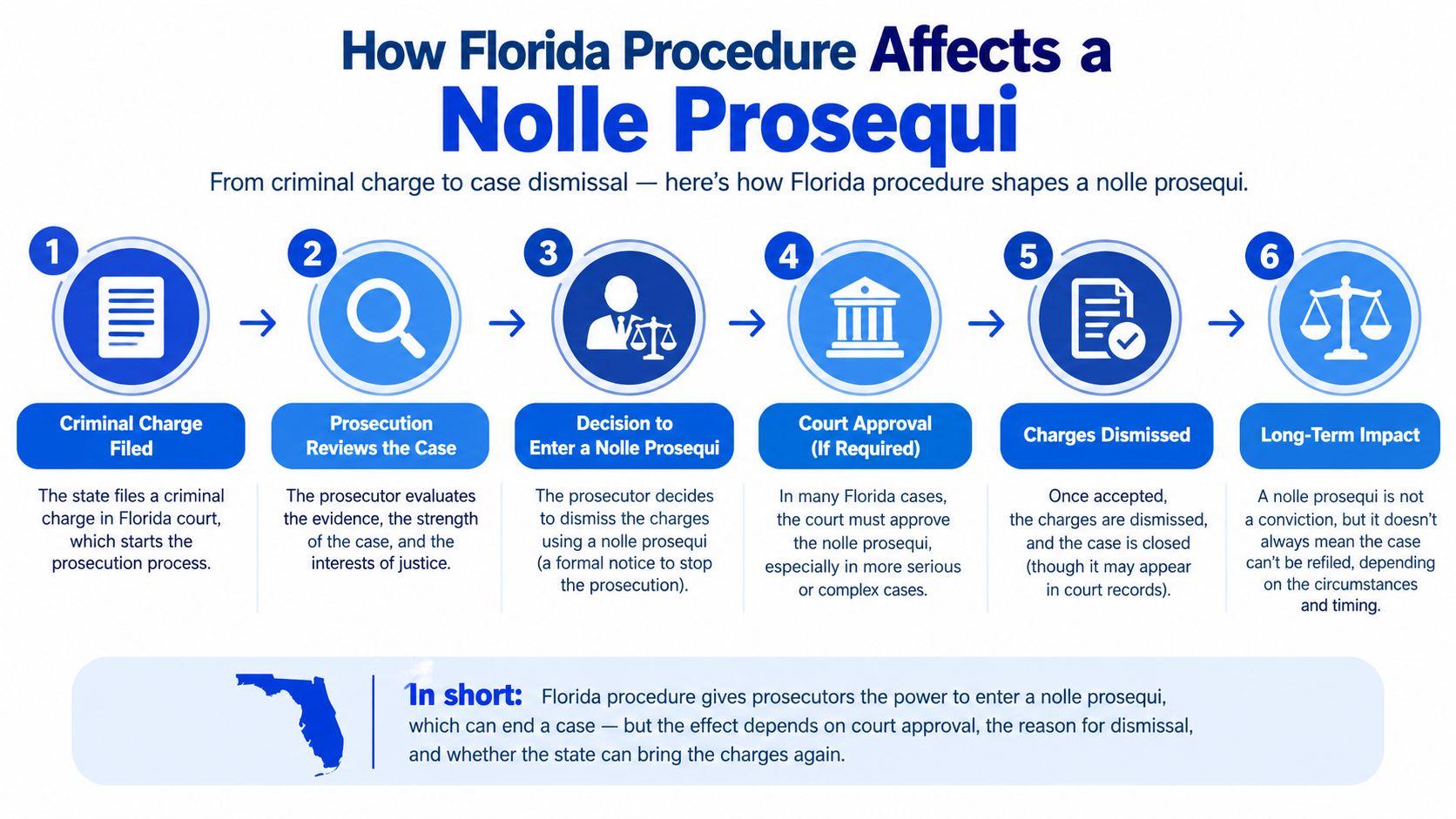
Your case can appear finished on the docket and still raise a timing question: may the State file the charge again? In Florida, the answer often begins with when jeopardy attaches. Before that point, prosecutors generally have more room to withdraw a charge and potentially refile it, subject to the statute of limitations and other legal barriers. After jeopardy attaches, withdrawal can create double-jeopardy problems or require court approval.
Florida procedure also treats a nolle prosequi as self-executing upon announcement. Before jeopardy attaches, the State may generally enter it without the judge's approval. After jeopardy attaches, the prosecutor must ask the court to approve ending the charge and explain the reason. The jury-sworn stage and the start of a bench trial can mark important points in that analysis.
The timing line can change the outcome
Suppose the State announces a nolle prosequi during an early court appearance, before trial proceedings begin. The charge ends at that point, yet the State may retain a refiling option if the limitations period remains open.
Now consider a case in which the prosecutor waits until after a jury has been sworn, or until the first witness testifies in a bench trial. Jeopardy may have attached. The State's ability to withdraw the charge and later refile it can then be restricted. The result depends on the type of proceeding, the offense, the reason for withdrawal, and how Florida law applies to those facts.
The statute of limitations creates another boundary. Under Florida Statutes section 775.15, many misdemeanor charges have a 2-year limit, while many felony charges have a 3-year limit. The correct deadline may change because of the offense, tolling rules, exceptions, or the case's procedural history. A lawyer must compare those details with the date of the alleged conduct and the docket.
What remains in the court file
The charging document does not disappear when the State enters a nolle prosequi. The docket generally preserves the arrest, charging document, hearings, motions, and final disposition. The record may therefore show both the accusation and the State's decision to stop prosecution.
A deferred-prosecution arrangement follows a different path. It may require you to complete conditions before the State resolves the charge. If that option is part of your case, review deferred prosecution in Florida with counsel instead of assuming every program ends with the same disposition.
Florida counties and court divisions may handle docket entries and administrative steps differently. Treat the general rules as a starting point, then have a lawyer examine the actual docket, announcement date, trial status, and charging statute.
Record, Background Checks, and Collateral Consequences
A nolle prosequi can end the prosecution without cleaning every database that received information about your arrest. The court may show the charge as nol prossed or dismissed, while a background-check company still reports the arrest and the underlying charge. That creates the gap many defendants discover after they thought the matter was completely behind them.
The disposition generally isn't a conviction. But employers, licensing agencies, landlords, immigration authorities, and security-screening organizations may ask about arrests, charges, or dispositions rather than convictions alone. The exact question controls what you must disclose.
The practical effects vary by audience
Area of Life | How a Nolle Prosequi Is Usually Treated | Action to Consider |
|---|---|---|
Employment screening | Often reported as an arrest and a closed charge, not a conviction | Obtain the official disposition and review the employer's exact wording |
Professional licensing | The board may examine the conduct, arrest, and final outcome | Ask counsel about disclosure rules for your profession |
Immigration | A dropped prosecution may still require careful analysis of the arrest, allegations, and disposition | Consult an immigration lawyer before submitting forms or accepting any resolution |
Firearm rights | The disposition may not answer every federal or state rights question | Get individualized legal advice before possessing or transferring a firearm |
Public court records | The case history may remain visible with a nol pros entry | Explore whether sealing or expungement is available |
Security clearances | Forms may ask about arrests or investigations regardless of conviction | Disclose accurately and preserve certified records |
Immigration deserves special caution. A nolle prosequi isn't automatically equivalent to a clean factual record, and immigration authorities may evaluate the charging documents, arrest circumstances, admissions, and final disposition. A criminal defense lawyer should coordinate with qualified immigration counsel before you make a statement that could affect admissibility or other immigration rights.
Professional boards can also apply standards that reach beyond conviction records. A board may ask about an arrest, alleged conduct, or discipline even when the criminal charge ended without a conviction. The answer should be accurate, limited to what the form asks, and supported by official paperwork.
Sealing and expungement are separate steps
A closed case and a clean public record aren't the same result. Eligibility for sealing or expungement depends on Florida statutes, the offense, your prior record, the disposition, and whether you've used an earlier certificate or received another qualifying outcome. Florida record sealing guidance explains why a separate application may be necessary.
Don't promise yourself that a nolle prosequi guarantees expungement. Have counsel check eligibility before you disclose the disposition to an agency, file a petition, or assume that every background-check database will update automatically.
What to Ask Your Attorney and How to Protect Your Record
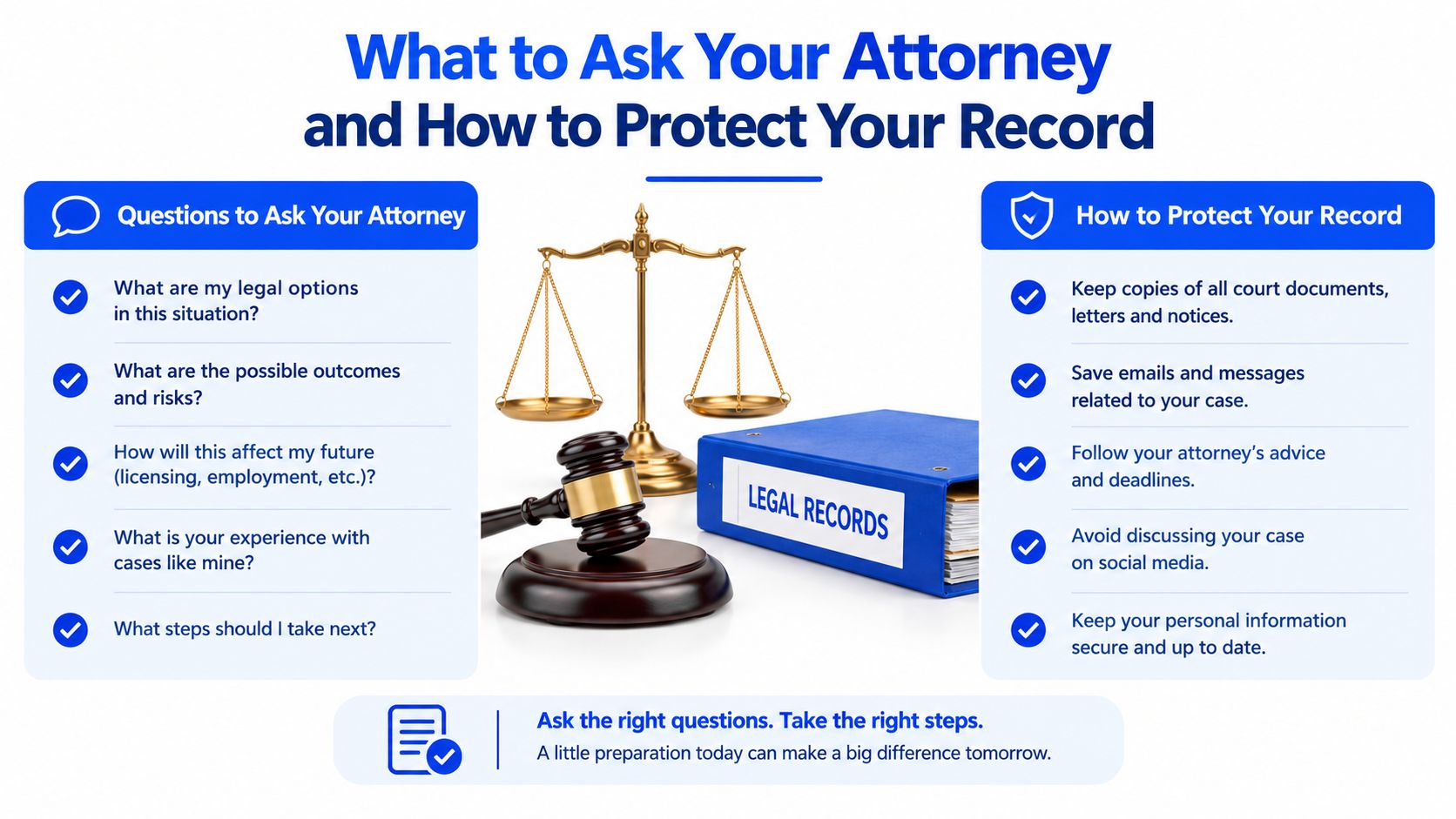
The most useful attorney meeting after a nolle prosequi is specific. Bring the docket, arrest paperwork, charging document, release conditions, and every notice you received. Ask the lawyer to identify what ended, what remains, and what action protects you next.
Start with these questions:
Which counts were nol prossed? Confirm whether the State ended every charge or only selected counts.
Was the entry with or without prejudice? The wording may affect the State's ability to refile, but the timing and governing law still require analysis.
Had jeopardy attached? Ask the lawyer to identify the relevant event in your case and explain its effect.
What limitations period applies? Have counsel calculate the legally relevant dates rather than relying on a general rule.
Can the record be sealed or expunged? Eligibility requires reviewing the offense, disposition, prior history, and Florida requirements.
Are any release conditions or holds still active? A closed count doesn't necessarily resolve unrelated charges, warrants, detainers, or obligations.
Build a certified record packet
Ask the clerk of court how to obtain a Certificate of Disposition and an official court disposition sheet. Request certified copies when an agency, immigration lawyer, licensing board, or another court may rely on the documents. A screenshot of an online docket can help you monitor the case, but it may not satisfy an official filing requirement.
Keep the following together:
Certified disposition documents: Preserve the formal proof of the nolle prosequi.
Charging paperwork: Keep the information, indictment, or other document showing the original count.
Arrest records: Retain the booking and arrest documents so you can answer record questions accurately.
Discovery and attorney notes: Preserve materials that may become important if the State attempts to reactivate the matter.
A date log: Record the announcement date, docket-entry date, and any limitations date your lawyer identifies.
Correct inaccurate background reports
If a background check reports a nolle prosequi as a conviction, save the report and compare it with your certified disposition. Give the reporting company and requesting agency the documentation they require. Don't make a casual statement that the arrest never happened if the form asks about arrests rather than convictions.
For a focused consultation, prepare a short timeline and bring your questions in writing. Questions to ask a criminal defense lawyer can help you organize the meeting around the docket, refiling risk, and record protection.
Next Steps and How a Defense Lawyer Can Help
Treat the nolle prosequi as an outcome that needs verification, not as paperwork you can ignore. This week, confirm that the entry appears on the docket, check whether every count was resolved, and obtain a certified disposition for your records. If you were released on conditions or posted bond, ask whether any obligation remains for another case or charge.
Create a short calendar with the announcement date, the docket date, and the limitations information your lawyer provides. If an employer, licensing board, immigration lawyer, or security-clearance form asks about the matter, read the question carefully and answer it accurately. Don't use “acquitted” when the official record says “nolle prosequi.”
A defense lawyer can review the State Attorney's file for unresolved counts, holds, warrants, or language suggesting a possible refiling. Counsel can monitor the case status, assess collateral consequences, coordinate with immigration counsel when necessary, and prepare sealing or expungement paperwork when Florida law allows it.
Ticket Shield, PLLC can review a Florida nolle prosequi disposition, check whether counts remain open, and discuss possible record-sealing or expungement steps. A confidential consultation can give you a clear review of the docket and a practical record-protection plan without promising a particular result.
If your Florida charge was nolle prossed, contact Ticket Shield, PLLC to review the official docket, certified disposition, refiling concerns, and possible record-protection options. The firm serves clients in Broward County, Fort Lauderdale, Miami-Dade, Palm Beach, and surrounding South Florida communities, with consultations available to discuss your specific case.