
Notarized Letter for Guardianship: A Quick Guide
Jason Goldsmith, Esq
You're in Tampa, facing an unexpected surgery, and suddenly the practical questions become urgent. Who can collect your child from school? Who can sign a medical form? Who can care for your child while you're unavailable? A notarized letter for guardianship may help with those immediate needs, but it won't automatically make another adult your child's legal guardian under Florida law.
That distinction matters. A notarized letter can document your voluntary consent and define temporary authority, while formal guardianship generally depends on a court proceeding and judicial order. If you're dealing with a family emergency, incarceration, rehabilitation, deployment, hospitalization, or a disputed custody situation, the right document depends on how long the arrangement will last and whether anyone challenges it.
Table of Contents
When You Need a Notarized Letter for Guardianship
A parent often reaches for a temporary guardianship letter when an ordinary caregiving favor is no longer enough. A grandparent may be willing to watch a child, but the school, doctor, pharmacy, airline, or emergency room may ask for written proof that the caregiver can act on the parent's behalf.
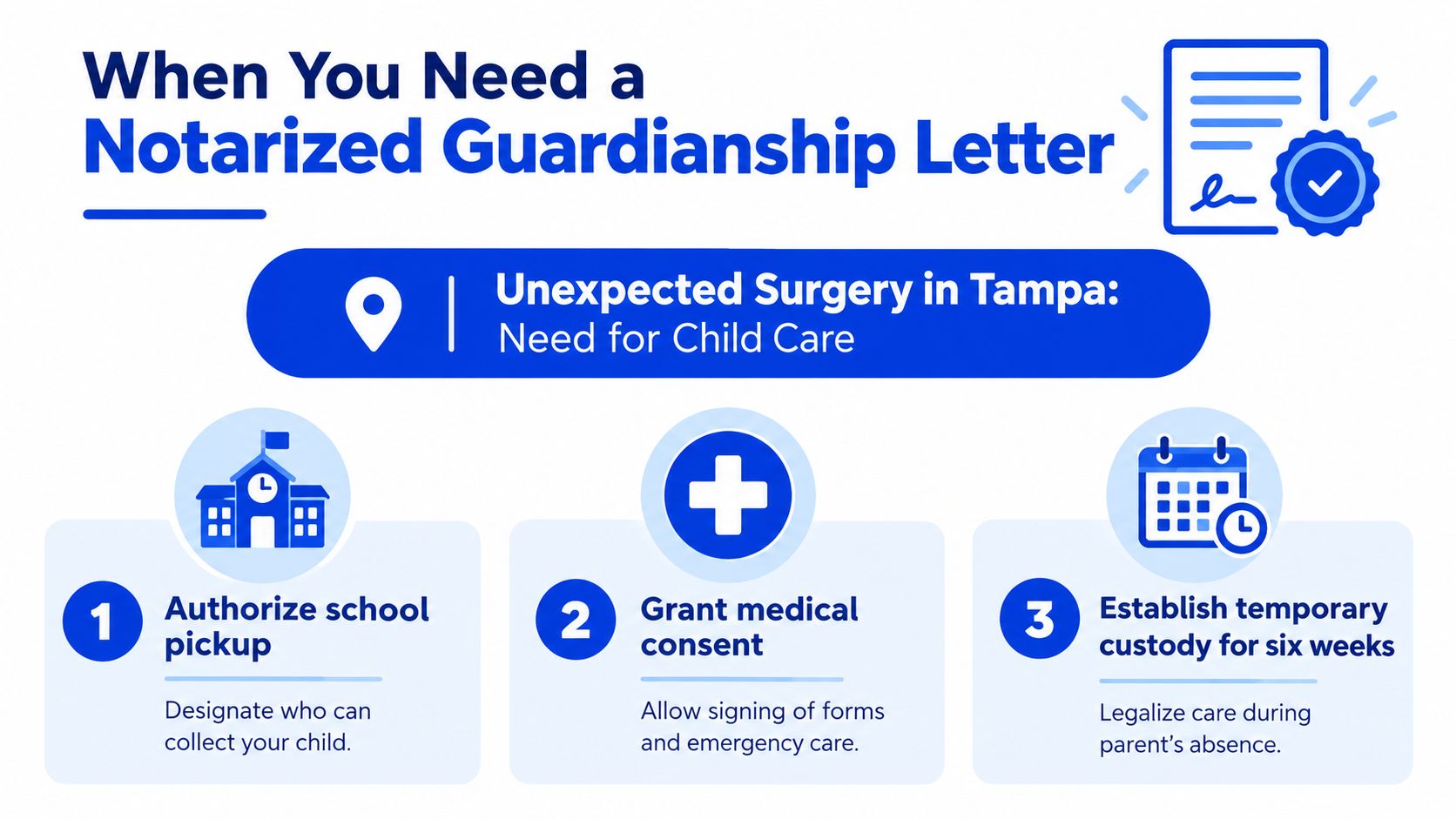
The document is most useful for a defined, temporary period. Common situations include:
Unexpected hospitalization: A parent needs someone to handle school pickup, routine medical decisions, and daily care.
Military deployment: A service member wants a trusted adult to manage ordinary responsibilities while the parent is away.
Incarceration: A parent needs to document who can care for a minor during a period of unavailability.
Rehabilitation: A parent entering treatment may authorize a relative or another trusted caregiver to manage the child's routine needs.
Extended travel: A parent leaving Florida for medical care or another serious obligation may need a written authorization for travel and care.
Family crisis: A grandparent may step in while the parent addresses an emergency, illness, or temporary legal problem.
The letter should identify the child, the parent or legal guardian, the temporary caregiver, the effective dates, and the exact powers being granted. Those powers might include school pickup, enrollment paperwork, routine medical consent, or permission to travel with the child.
A notary's role is narrower than many families realize. The notary verifies the signer's identity and confirms the signer's acknowledgment or execution of the document. The notary does not create guardianship rights, issue a court order, or decide whether the arrangement serves the child's best interests. The reference form for temporary guardianship reflects this limited, practical use of a written authorization, rather than a judicial transfer of custody. Review the temporary guardianship authorization form before relying on a letter alone.
Practical rule: Use the letter to make a short-term arrangement clear to third parties. Don't treat the notarial seal as a substitute for a Florida guardianship proceeding.
If the child's situation intersects with a juvenile criminal matter, the family should also understand how Florida juvenile proceedings can affect decision-making and court involvement. Learn about criminal defense representation for juveniles.
What a Notarized Letter Can and Cannot Do in Florida
A notarized letter is evidence of a parent's written consent. Under Florida's notarial framework, notarization generally confirms the identity of the signer and the voluntary acknowledgment of the signature. It doesn't transform a private document into a court-sanctioned guardianship.
The parent can grant authority for carefully described tasks, and the parent generally retains parental rights unless a court orders otherwise. The document may authorize school pickup, routine medical care, travel with a minor, or specified property and financial tasks. The wording matters because an institution may reject a broad statement that fails to explain what the caregiver is allowed to do.
The letter cannot permanently transfer custody, eliminate another parent's rights, or override a conflicting court order. It also isn't a reliable replacement for formal guardianship when the parent's incapacity is indefinite, the child's property requires management, or another person disputes the arrangement. Florida's formal guardianship system is governed by Chapter 744 of the Florida Statutes, and court-issued authority follows statutory and procedural requirements.
Feature | Notarized Letter | Court-Ordered Guardianship |
|---|---|---|
Source of authority | Parent's written, voluntary authorization | Judge's order under Florida guardianship law |
Typical purpose | Temporary care and specific decisions | Formal, court-supervised authority |
Parental rights | Generally remain with the parent | May be limited according to the court's order |
Scope | Should be narrow and expressly written | Defined by the court, including possible limited authority |
Duration | Effective dates or revocation terms control | Continues according to the court's order and applicable law |
Disputes | Can be challenged or rejected by an institution | Resolved through the court process |
Notary's role | Verifies identity and execution | Does not appoint the guardian |
That gap becomes especially important when the parent is incapacitated, the child needs long-term protection, or family members disagree. A mental-health crisis may involve separate Florida procedures, so families should understand that a Florida mental health court case isn't converted into a guardianship merely because someone has a notarized letter.
Preparing the Letter Before You Visit the Notary
The notary appointment should be the final execution step, not the time when you start deciding what authority to grant. Prepare the document first, review it carefully, and ask the receiving school, physician, or airline whether it has its own form.
Gather the identifying information
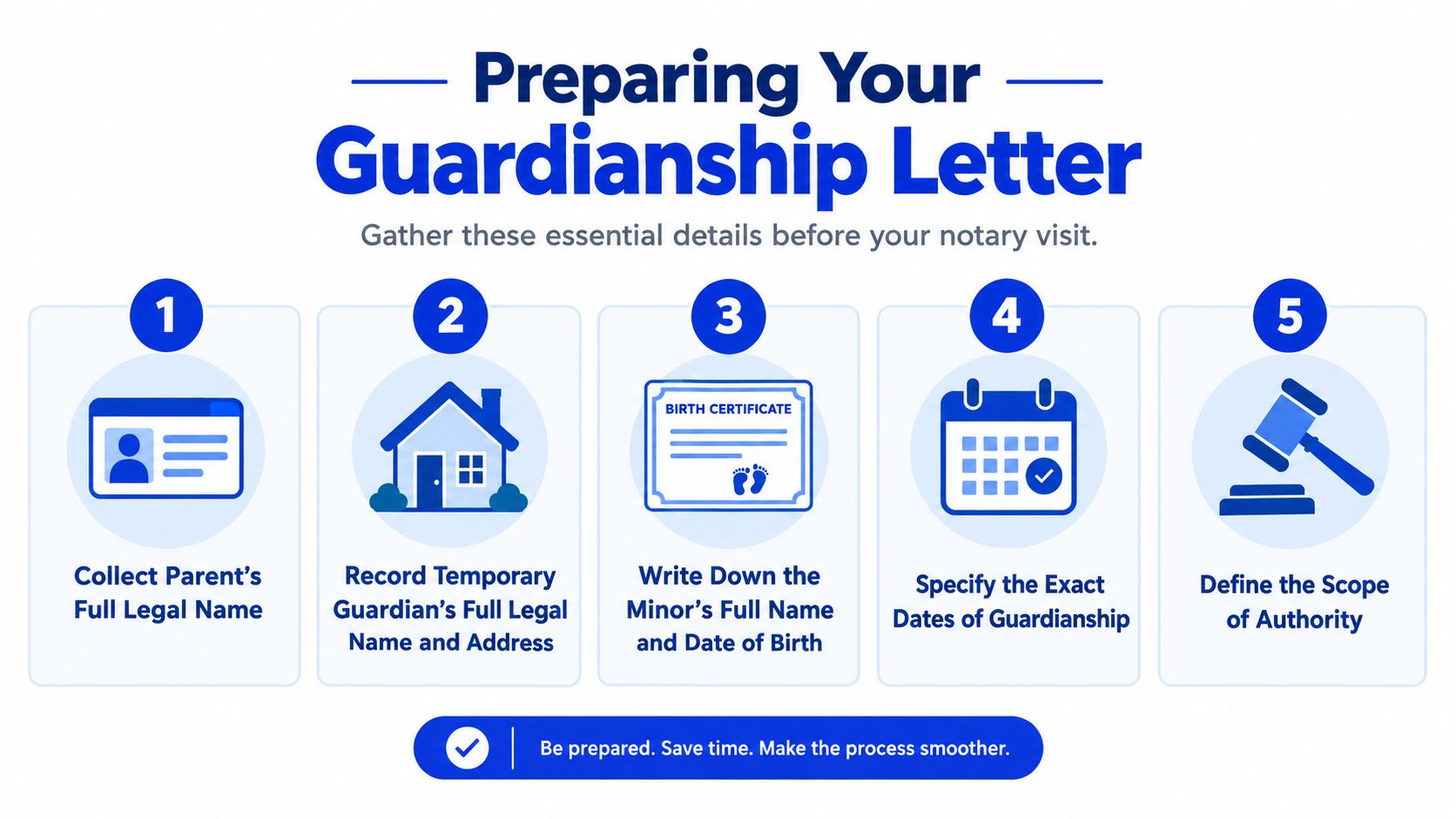
Use complete legal names. The letter should identify:
The parent or legal guardian: Include the full legal name and relationship to the child.
The temporary caregiver: List the caregiver's full legal name, address, telephone number, and email address.
The minor: State the child's full legal name and date of birth.
Other relevant contacts: Add the parent's contact information, emergency contacts, and any second parent or legal guardian whose consent may be necessary.
Avoid nicknames, unexplained initials, and inconsistent spellings. A school or hospital employee comparing the letter with its records may pause if the names don't match.
Define the authority narrowly
Write the powers as specific permissions. For example, the caregiver may be authorized to collect the child from school, complete enrollment documents, consent to routine medical treatment, communicate with healthcare providers, and travel with the child within a stated period.
Don't use sweeping language such as “all legal authority” unless a Florida attorney has reviewed the document and confirmed that the language fits the situation. A broad grant may create confusion rather than solve it, particularly if the parent is trying to preserve control over major decisions.
Set the dates and revocation terms
State the effective date and expiration date. The period should correspond to the actual event, such as the parent's expected hospital discharge or deployment end date. Include a written revocation provision and explain how notice must be delivered.
The practical guidance on these documents emphasizes defined dates, express expiration language, government identification, and notarization at signing. Review practical drafting guidance for a notarized guardianship letter before finalizing the text.
Before the appointment, check the draft, make copies, gather identification, and decide how the original will be stored. A sealed envelope or secure file can protect the original while copies go to the caregiver, school, physician, and parent.
Getting the Document Notarized Step by Step
Bring acceptable government identification to the appointment. A Florida driver license, Florida identification card, or U.S. passport is commonly used to establish identity, although the notary must follow the requirements applicable to the transaction.
Most temporary guardianship letters use an acknowledgment. With an acknowledgment, the signer confirms to the notary that the signature is theirs and that they signed voluntarily. A jurat is different because the signer swears or affirms that the document's contents are truthful. The notary should tell you which certificate applies to the document, but don't sign before the notary instructs you to do so.
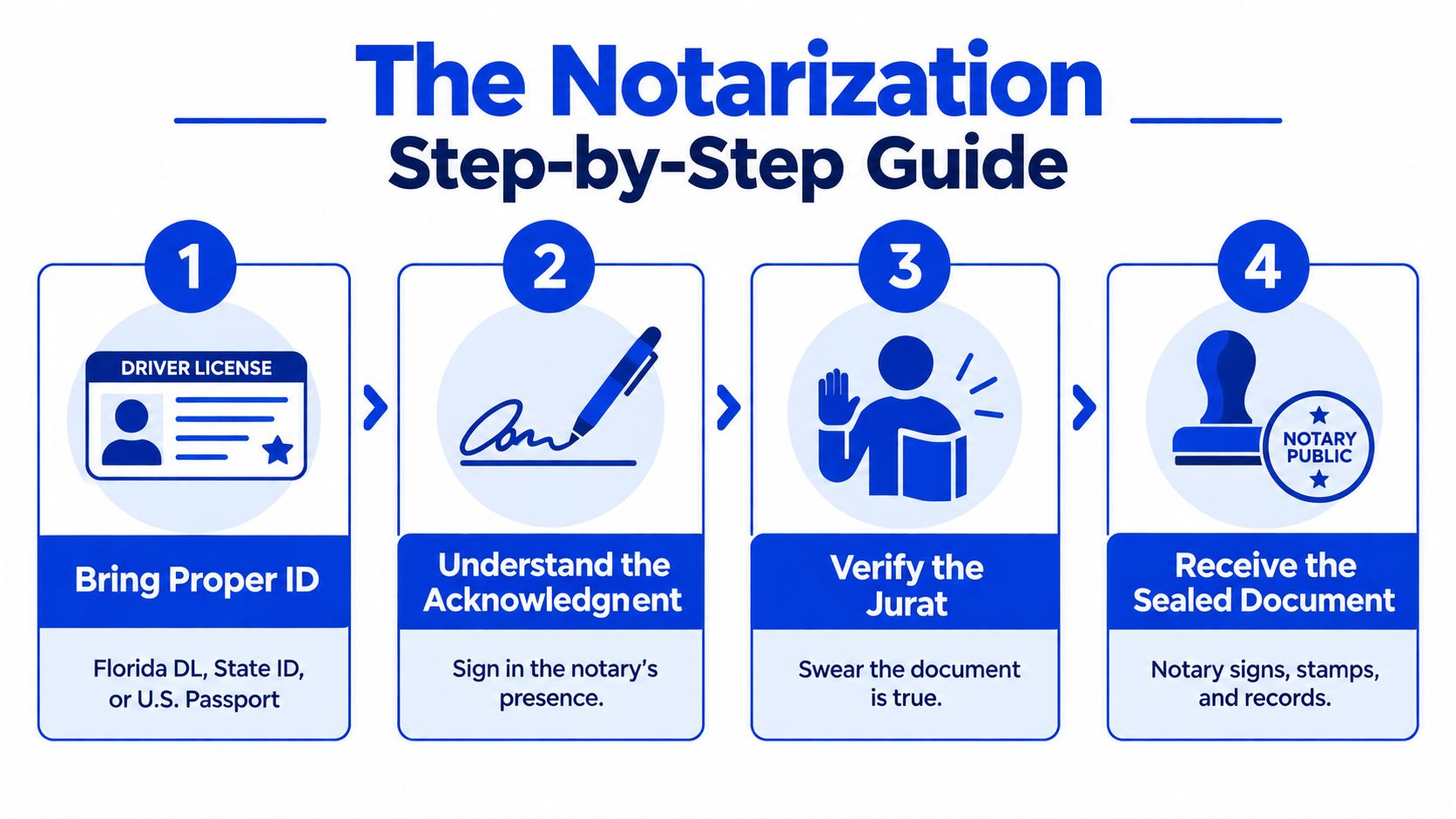
At the desk, present your identification, confirm that you understand the document, and sign in the notary's presence if the certificate calls for that sequence. The notary completes the acknowledgment, signs the certificate, applies the seal, and records the required commission information. Ask whether witnesses are required for your particular document or transaction. A private temporary authorization and a formal guardianship declaration may have different execution requirements.
Before leaving, inspect the completed document:
Names: Check every spelling against the child's records and identification.
Dates: Confirm the start date, expiration date, and any date written in the notarial certificate.
Venue: Make sure the state and county information is correct.
Blank spaces: Don't leave authority provisions or signature lines incomplete.
Presence: The signer must be physically present unless a valid remote-notarization process applies.
Florida permits remote online notarization through qualified remote online notaries under its statutory framework, but not every notary can perform that service, and the receiving institution may have its own acceptance policy. If you're considering remote execution, confirm both the notary's authority and the school, healthcare provider, airline, or court's willingness to accept the electronically notarized document.
Small defects create practical problems. A missing expiration date, mismatched name, absent seal, incomplete acknowledgment, or unsigned parental consent can cause a hospital or school to set the document aside while staff seek additional approval.
How Schools, Hospitals, and Courts Treat the Letter
A notarized guardianship letter helps third parties understand the parent's intent, but acceptance is institution-specific. The school may use it for pickup authorization, emergency contacts, enrollment paperwork, or certain medical forms, while still requiring its own district documents and proof of the child's address.
Hospitals and pediatric practices are more cautious when treatment is significant or non-emergency. A letter may support consent for routine care, but it may not satisfy every internal policy, and it doesn't automatically replace a healthcare authorization or resolve questions about protected medical information. Ask the provider what it needs before an appointment, especially if the caregiver must access records or approve treatment.
Travel creates another layer. Airlines may request their own minor-travel consent documentation, and border authorities can ask questions or refer a traveler for additional screening. A notarized letter can explain the parent's permission and the caregiver's relationship to the child, but it can't guarantee that a carrier or border official will accept it as the only document.
Florida courts view the letter as evidence of parental intent, not as a judicial appointment. For a minor, Florida Statute section 744.3021 provides a court procedure for appointing a guardian in qualifying circumstances. The court controls that appointment.
Situation | Notarized Letter Usually Accepted | Court Order Typically Required |
|---|---|---|
School pickup | A dated letter naming the caregiver and permission to collect the child may help | A disputed custody arrangement or school refusal to rely on private authorization |
Routine medical care | Specific consent language may support ordinary treatment | Ongoing, contested, or legally significant medical decision-making |
Emergency treatment | The caregiver can present the letter as evidence of parental intent | The provider requires formal authority or the parent's incapacity is ongoing |
Short-term travel | Written parental permission may assist with airline or border questions | A custody dispute, travel objection, or formal restriction |
Long-term caregiving | The letter may document the initial arrangement | Formal guardianship, relocation, or court-supervised authority |
Child's property | Only specifically stated powers may be considered | Management requiring fiduciary or court-supervised authority |
When a parent's substance use or mental-health condition raises immediate safety concerns, a notarized letter shouldn't be used to avoid the appropriate legal process. Families may need to discuss court-based options, including the Marchman Act process in Florida, with a qualified attorney.
A Sample Template and a Real-World Scenario
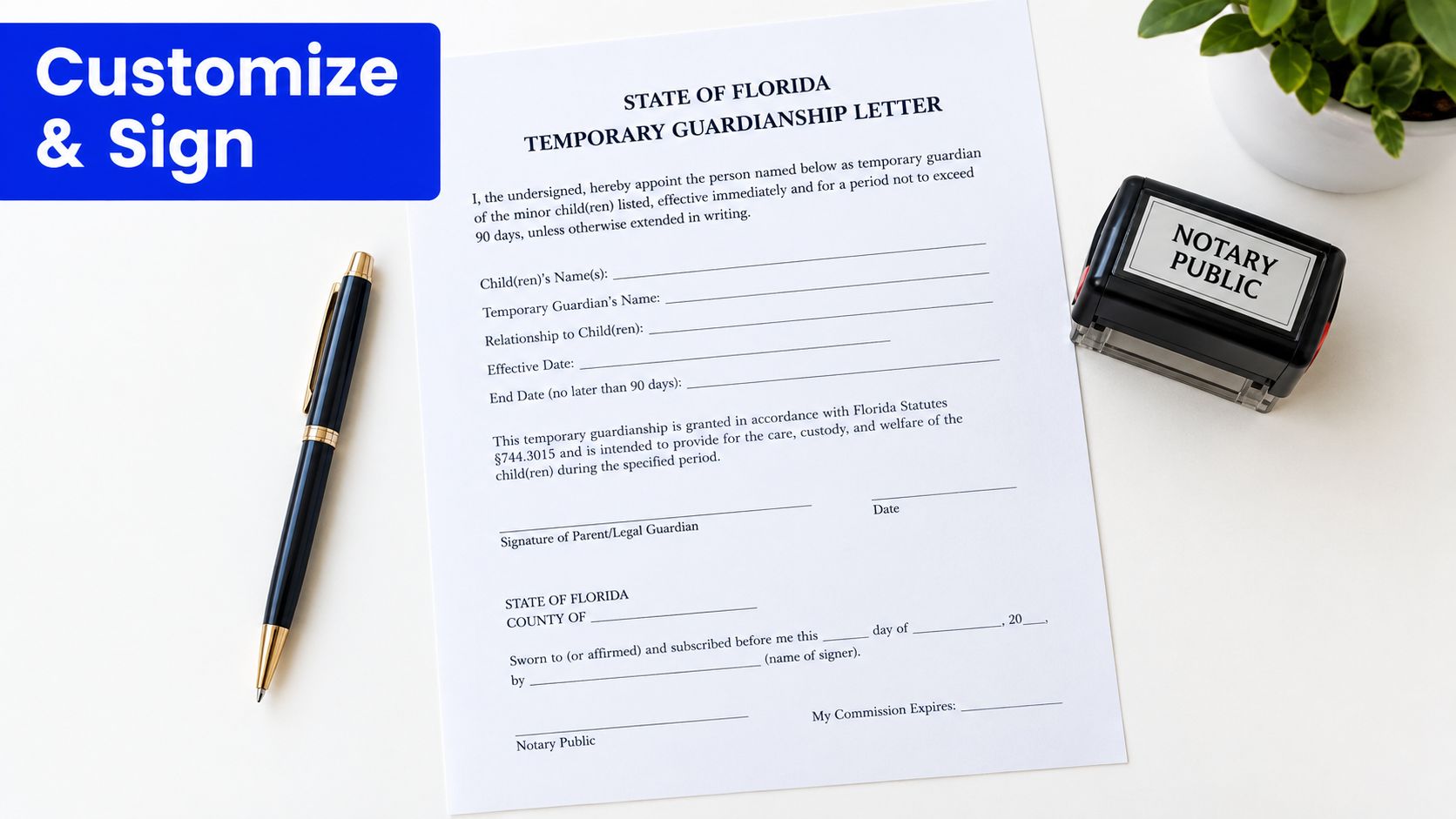
The following sample is designed as a drafting starting point, not a replacement for reviewing the facts with a Florida attorney or the receiving institution. Keep the authority limited and make every placeholder accurate.
Sample temporary authorization
Temporary Authorization for Care of Minor
Parent or legal guardian:
I, [Parent's full legal name], residing at [address], am the parent or legal guardian of [Child's full legal name], born [date of birth].
This identifies the person granting authority and the child covered by the document.
Temporary caregiver:
I authorize [Temporary caregiver's full legal name], residing at [address], to provide temporary care for my child beginning [effective date] and ending [expiration date].
The dates prevent the letter from appearing open-ended.
Specific authority:
During that period, I authorize the temporary caregiver to collect the child from school, communicate with school personnel, complete routine school enrollment or attendance paperwork, consent to routine medical and dental care, obtain necessary prescriptions, and travel with the child [describe permitted destination or travel limits].
This section defines what the caregiver may do. Remove powers that aren't needed.
Limits:
This authorization doesn't transfer permanent custody or create court-appointed guardianship. The temporary caregiver may not make decisions outside the powers stated above unless I provide further written consent or a court issues an order.
The limitation helps third parties understand that the parent retains broader rights.
Revocation:
I may revoke this authorization in writing. Revocation becomes effective when delivered to the temporary caregiver and, where practical, to each school, healthcare provider, or other institution relying on this document.
The clause explains how the parent can end the arrangement.
Signature:
Parent or legal guardian signature: [signature]
Printed name: [name]
Date signed: [date]
Notarial acknowledgment:
Complete the Florida acknowledgment block with the notary's signature, seal, date, and required commission information.
Consider a deployed service member who leaves two children with grandparents in Tampa. The parent signs a notarized letter covering school enrollment and routine medical care for the deployment period, with the family using the letter as evidence of consent while the grandparents handle daily responsibilities.
The school may still require its own enrollment forms, proof of residence, emergency contacts, and health records. That doesn't mean the letter failed. It performed its proper function by documenting the parent's intent and identifying the caregiver, while the institution applied its separate administrative requirements.
When the family later decides to relocate permanently, the temporary letter no longer solves the larger problem. The family seeks a separate court order, and the clear written authorization helps show how caregiving began before formal proceedings. Families looking for broader Florida legal information can review the firm's criminal defense resource library, but guardianship disputes should be directed to counsel handling that area of law.
Key Takeaways and When to Seek Legal Help
A notarized guardianship letter works best for a short-term, voluntary arrangement between a parent and a willing caregiver. It should contain accurate identifying details, a specific scope of authority, clear effective and expiration dates, and a properly completed notarial acknowledgment based on valid identification.
The recurring mistakes are practical but consequential:
Vague authority: “Full authority” may not answer whether the caregiver can enroll the child, consent to treatment, or travel.
Missing signatures: A parent's unsigned draft has no execution to authenticate.
Expired dates: A school or hospital may refuse an authorization that no longer covers the current event.
Wrong execution details: A document notarized in another state or completed with the wrong acknowledgment may not satisfy the receiving institution.
Overreliance: A private letter becomes inadequate when the absence stretches into a long-term arrangement, custody becomes contested, or the child needs complex special-needs care.
Florida law treats formal guardianship differently. A competent adult naming a preneed guardian must reasonably identify the declarant and named guardian, and the declaration must be signed in the presence of at least two attesting witnesses who are present at the same time, as provided by Florida Statute section 744.3045. If a guardianship is later confirmed, the guardian must file the required oath and any required bond before letters of guardianship issue.
The letters aren't automatic. Florida's framework ties formal authorization to the court-appointed guardian's oath and other statutory and procedural prerequisites, as explained in Florida's guardianship provisions concerning issuance of letters. In one Eleventh Judicial Circuit checklist, the guardian's authority may be categorized as authority over the person and property, the person only, or limited guardianship, showing why formal authority must be matched to the actual need. The same checklist identifies an initial plan due within 60 days of the date of letters of guardianship. Review the Eleventh Judicial Circuit guardianship checklist.
Seek advice from a licensed Florida family-law attorney when the arrangement will extend beyond a brief absence, the parent is incapacitated rather than merely away, a non-parent needs authority over the child's finances, or anyone disputes the plan. You can also contact the local clerk of court about filing procedures and review Florida Statutes Chapters 744 and 765 for formal guardianship and healthcare-planning options. For situation-specific guidance, contact a Florida attorney before signing a document that may be used in a contested proceeding.
Ticket Shield, PLLC helps Florida families understand how an unexpected criminal case, incarceration, probation issue, or related legal emergency may affect caregiving arrangements and parental rights. Visit Ticket Shield, PLLC to request a consultation and discuss the immediate steps needed to protect your rights and your family's interests.