
DUI Process Florida: A Step-by-Step Defense Guide
Jason Goldsmith, Esq
You're probably reading this on a phone, still replaying the stop in your head. You're worried about your license, your job, and what happens next in Broward County or anywhere else in South Florida. That reaction is normal, but panic costs people cases. The dui process Florida uses is not one case, it's two tracks running at once, and the first move matters more than many realize.
Florida treats a DUI arrest as both a criminal prosecution and an administrative driver-license fight. That means the roadside choices, the breath or blood decision, and the next 10 calendar days can shape everything that follows. If you handle the first part badly, you can hand the State evidence it doesn't have to work for.
Table of Contents
Implied Consent, Chemical Testing, and the 10-Day License Deadline
Booking, First Appearance, Arraignment, and Pretrial Motions
What Happens at the Traffic Stop and Arrest
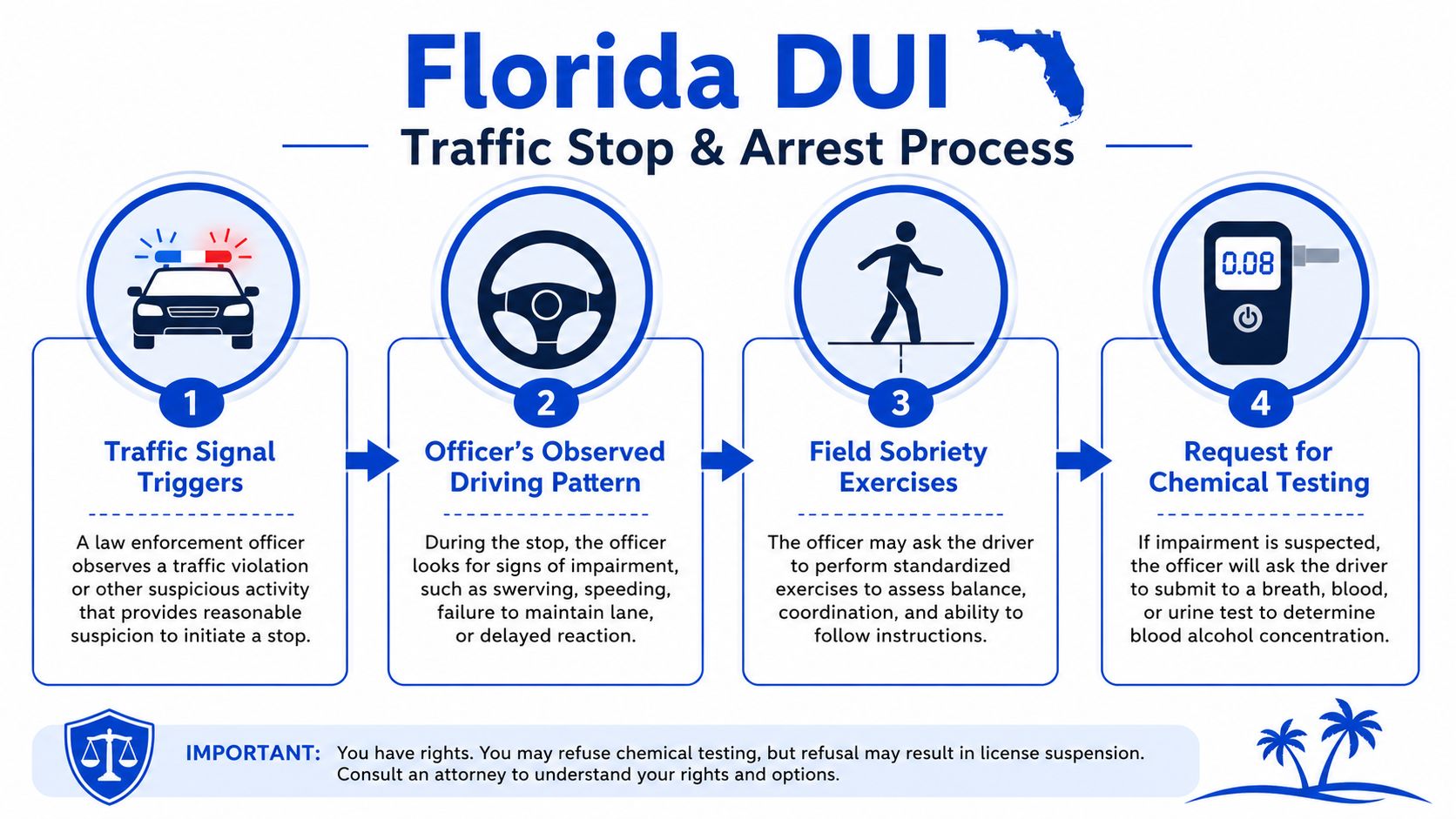
The arrest usually starts long before the cuffs. An officer notices a lane drift, a rolling stop, a turn that looks sloppy, or some other driving pattern that raises suspicion. From that moment on, every word you say and every movement you make can end up in a police report, a bodycam file, and a courtroom exhibit.
The roadside part is evidence, not small talk
Be polite. Give your license, registration, and insurance when asked. Don't volunteer that you had “just a couple drinks,” don't explain where you've been, and don't try to talk your way out of the stop with a long story.
Practical rule: The less you say at the roadside, the less material the State has to quote back at you later.
Field sobriety exercises are where many people hurt themselves. Officers often use those tests to build probable cause, but they're also subjective and easy to misread in real life. Fatigue, anxiety, shoes, weather, injuries, and simple confusion can all make a sober person look unsteady.
If an officer asks about a breath, blood, or urine test, the decision matters. You are not helping yourself by guessing, arguing, or volunteering extra information. Ask to speak with an attorney as soon as you can, and keep your answers short.
The first day after arrest is about containment. Don't text friends about what happened. Don't post on social media. Don't start explaining yourself to every family member who asks what you blew. That roadside conversation can travel straight into the criminal case and the driver-license case, and it usually doesn't help you. For a deeper look at roadside balance tests, see the firm's guide on Florida field sobriety testing.
Implied Consent, Chemical Testing, and the 10-Day License Deadline
Florida's implied-consent rule is blunt. If you drive here, the State treats you as having consented to lawful breath, blood, or urine testing after a DUI arrest. Refusing is not a harmless choice. It can cost you your license even if the criminal case later weakens. The State also treats refusal and test results as separate pieces of the DUI case, and the driver-license fight starts right away. For the administrative suspension rules, see the Florida Highway Safety and Motor Vehicles system's Florida DHSMV DUI administrative suspension laws, which also addresses first-offense penalties and enhanced fines when the BAC is 0.15 or higher or a minor is in the vehicle.
The license case starts fast
The deadline people miss is the one that hurts the most. You generally have only 10 calendar days after arrest to request a DHSMV Formal Review Hearing and contest the suspension. Miss that window, and the suspension can start automatically while the criminal case is still pending, as explained in the Florida DUI legal process and penalties overview.
The first battle is administrative. The State can still prosecute the DUI charge later, but the license issue moves now. A smart defense lawyer treats that hearing as a live fight, not paperwork.
Refusal and test results both have consequences
If you refuse lawful testing, Florida's administrative process can impose a 1-year suspension for a first refusal and 18 months for later refusals. If you submit to testing and the result is at or above 0.08, the State can also move on your license immediately under the same framework Florida DHSMV DUI administrative suspension laws. Those consequences are separate from whatever the judge later does in court.
The criminal case and the DMV case are not the same fight. Lose sight of that, and you can lose your driving privileges before the prosecutor even gets to trial.
The refusal issue deserves its own close look, and the firm's article on refusing a breathalyzer in Florida is worth reading right away.
A Florida DUI defense lawyer should start preserving the hearing issue, force the State to justify the stop and the test request, and check whether the officer followed the right procedure. That work matters because the license case moves fast and does not wait for the criminal docket.
Booking, First Appearance, Arraignment, and Pretrial Motions
After arrest, the case does not pause. You are booked, photographed, fingerprinted, and processed. Depending on the bond decision and the facts, you may get out quickly or sit in jail until a judge reviews the case. In Florida DUI cases, the first appearance usually comes fast if you are still in custody, and that hearing addresses probable cause, release conditions, and whether the court will appoint counsel Florida DUI court process overview.
The administrative license fight is already running while that happens. The DHSMV case does not wait for the criminal court calendar, and early action matters because your driving privileges can be affected before the main case is even set for trial.
First appearance is not arraignment
People mix these up because both happen early. First appearance is the judge's first look at the arrest. Arraignment comes later, when the charge is formally read and the defendant enters a plea of guilty, not guilty, or no contest. The difference matters because the lawyer's job changes at each stage, and the parallel DHSMV track keeps moving the whole time what happens at a DUI arraignment.
Discovery is where defense work starts
Once the case is filed, the defense pushes hard for discovery. That usually means bodycam video, dashcam video, dispatch logs, breath-machine records, witness statements, and the police reports. Weak cases start to show their seams fast. Officers write one version of events, video often shows something messier, and machine records sometimes reveal gaps the State does not highlight.
That is also where motions to suppress or dismiss can create meaningful pressure. If the stop lacked legal justification, if the testing process was flawed, or if the search and seizure crossed constitutional lines, the defense can force the issue before trial. A Fort Lauderdale DUI lawyer who moves early can often shape what evidence ever reaches the courtroom, and that matters in both the criminal case and the license case.
The mistake is waiting for the first court date and hoping the problem sorts itself out. By then, the State has already started building its file, and the DHSMV deadline pressure has not gone away. For a separate discussion of the arraignment stage, the firm's guide on what happens at a DUI arraignment explains why that hearing is only one stop in a much longer process.
How Florida Prosecutes the DUI Case
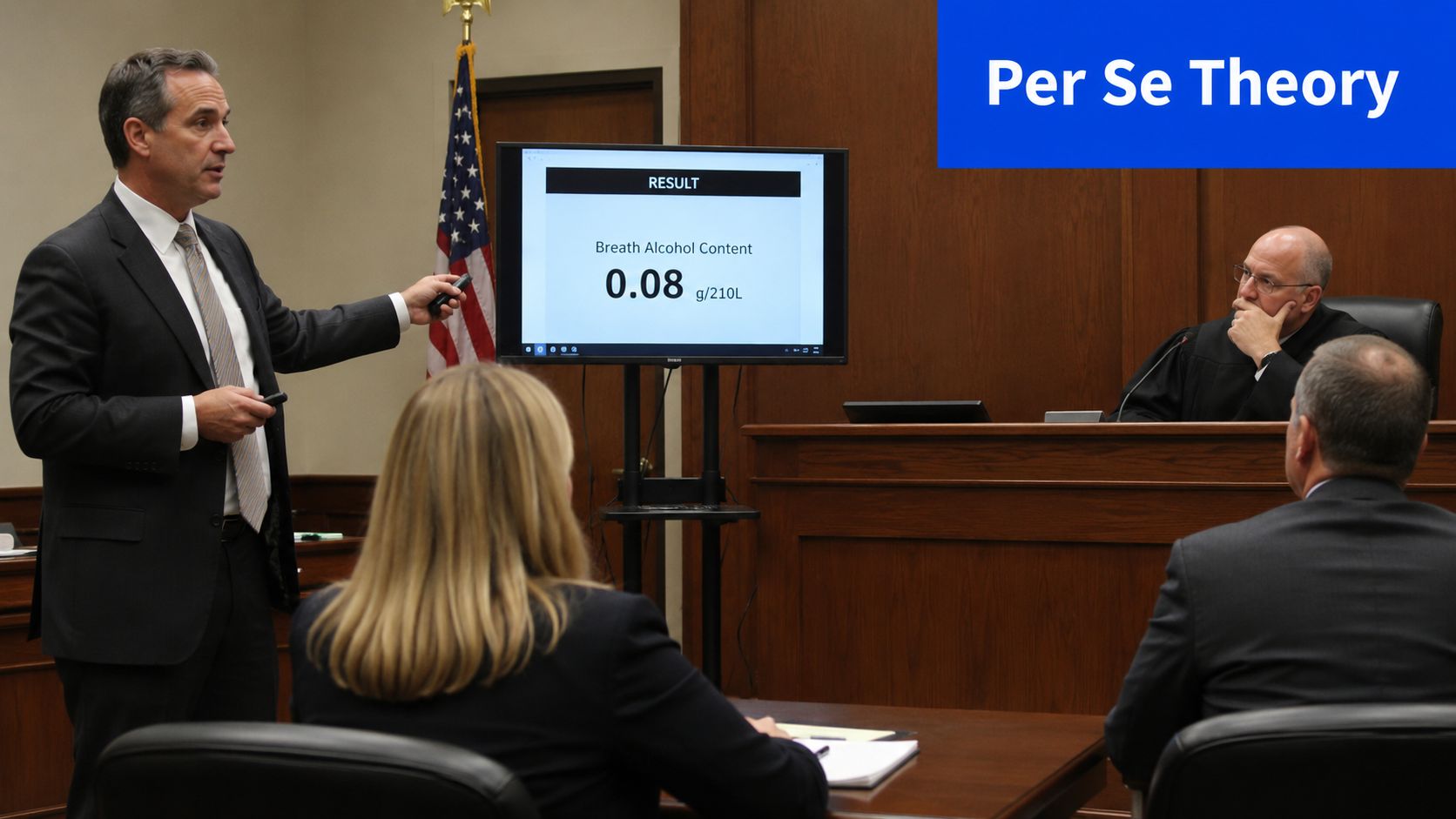
Florida prosecutors do not have to win the case one way. They have two paths, and they often argue both at the same time. The per se theory says a BAC of 0.08 or higher is enough for a conviction even if the officer did not see dramatic impairment. The impairment theory says the driver's normal faculties were impaired by alcohol or drugs. Florida also recognizes a 0.05 or lower presumption of no impairment, though the State can still try to overcome it with other evidence Florida court DUI lab chemical materials.
What the prosecutor brings to court
The State usually shows up with officer observations, field sobriety exercises, breath-test or blood-test results, dashcam and bodycam video, and witness statements. That stack of evidence can look heavy, but each piece has a weak point. Officers write reports after the fact, video often captures more uncertainty than the narrative suggests, and machine records can expose gaps the prosecutor would rather skip over.
The criminal case is only half the fight. The license case keeps moving on its own track, and that pressure starts immediately after arrest. A lawyer who treats the DHSMV side like an afterthought gives up an advantage before the first hearing even starts.
Where the defense pressure points are
Timing matters, and Florida's own DUI lab materials recognize that chemical testing is generally expected within about 2 to 3 hours of arrest to remain reliable. A late sample can weaken the result and create credibility problems. A sloppy chain of custody can do the same thing. So can a machine record that does not line up with the State's story Florida court DUI lab chemical materials.
Defense reality: A breath result is not magic. It still has to be collected, preserved, and interpreted correctly.
The prosecutor also has to prove more than a bad night and a poor roadside performance. Proof can be challenged, and penalties can be severe if the case is mishandled, as explained in Florida DUI penalties. The lawyer's job is to attack the proof itself, not just argue for sympathy after the fact.
Common Defenses and How They Play Out
A Broward County driver comes home from dinner in Fort Lauderdale, gets stopped, does the field exercises, and later blows over the limit. That's the kind of case people assume is hopeless. It usually isn't. The defense starts by asking one question, what exactly did the officer have, and what did the officer do wrong?
The stop, the tests, and the machine all get tested
If the stop was weak, the whole case can wobble. If the officer exaggerated what happened on the roadside, the report loses force. If the breath device wasn't properly maintained or calibrated, the number on the page may not carry the weight the State wants it to have. Search and seizure problems can also open the door to suppression when officers crossed constitutional lines.
A lawyer will also look at the gap between arrest and testing. Rising BAC can matter if alcohol absorption was still happening when the test occurred. Medical issues can mimic impairment, and being in actual physical control is not the same as driving. Those distinctions are not academic, they're often the difference between a charge that sticks and one that gets reduced or thrown out.
In real cases, the defense doesn't need to win every argument. One strong issue can change the whole posture of the case. That's why experienced counsel pushes discovery, files motions early, and uses the State's own records against it.
Ticket Shield, PLLC can evaluate those issues in a DUI case, but the main point is timing. The earlier the defense gets involved, the more likely it is that the stop, the tests, and the paperwork can be challenged while the record is still fresh.
Plea Negotiations, Trial, and Sentencing Outcomes
Once the evidence is fully reviewed, the case reaches a decision point fast. Some Florida DUI cases should be negotiated because the State has strong proof, the client needs to limit exposure, or the license fight has already been handled as the first battle. Other cases should go to trial because the stop was weak, the test can be attacked, or the officer's account will not survive cross-examination.
What trial looks like
A DUI trial is a sequence, not a single hearing. It usually starts with jury selection or a bench trial, then opening statements, then the State's case, followed by the defense case, closing arguments, deliberation, and verdict Florida DUI arrest process guide. That structure matters because the defense gets repeated chances to challenge the officer, the testing, and the State's timeline.
Sentencing for a first conviction
For a first conviction, Florida law sets a fine of not less than $500 and not more than $1,000. If the BAC is 0.15 or higher or a minor is in the vehicle, the fine rises to $1,000 to $2,000. The law also requires at least 50 hours of community service and allows up to 6 months in jail, increasing to up to 9 months in aggravated first-offense cases Florida DHSMV DUI administrative suspension laws.
Florida DUI penalties also escalate quickly for repeat cases. A second or third DUI can mean harsher jail exposure, longer license consequences, and more collateral punishment than people expect. You do not want to treat a first arrest like a short-term headache when it can become the anchor for the next case.
Florida DUI Penalties by Offense Level | Fine Range | Maximum Jail | License Revocation |
|---|---|---|---|
First offense | $500 to $1,000 | 6 months | Suspension or revocation can follow criminal and administrative action |
First offense with BAC 0.15 or higher or a minor in the vehicle | $1,000 to $2,000 | 9 months in aggravated first-offense cases | Suspension or revocation can follow criminal and administrative action |
Second offense | Higher than first-offense exposure | Harsher than first-offense exposure | Longer revocation consequences |
Third offense | Higher than second-offense exposure | Harsher than second-offense exposure | Even more severe revocation consequences |
The Long Tail of a Florida DUI
A DUI doesn't end when the judge says so. Florida does not let people expunge DUI charges, and prior DUI convictions stay in the picture no matter how much time passes. That means a later arrest can bring the old case back to life in a very real way, because the State treats it as a prior regardless of elapsed time Florida DUI procedures.
The aftereffects keep showing up
The practical fallout keeps spreading. Insurance can get more expensive. Employers can ask about the record. Professional licensing boards can take notice. Non-citizens can face immigration problems. And if the court orders ignition interlock or other conditions, the inconvenience doesn't stop at sentencing.
A quick plea can feel easier on day one. Years later, it can still be costing you.
This is why the first case deserves aggressive defense. If you resolve it too quickly, you may be locking in consequences that don't fade with time. A serious defense lawyer looks at the arrest as the start of a long-term record problem, not just a short-term courtroom nuisance.
The license issue matters here too. Future stops and future testing decisions are often shaped by the history already in the system. Once there's a DUI on the record, every later interaction with law enforcement gets harder.
Practical Next Steps and When to Call an Attorney
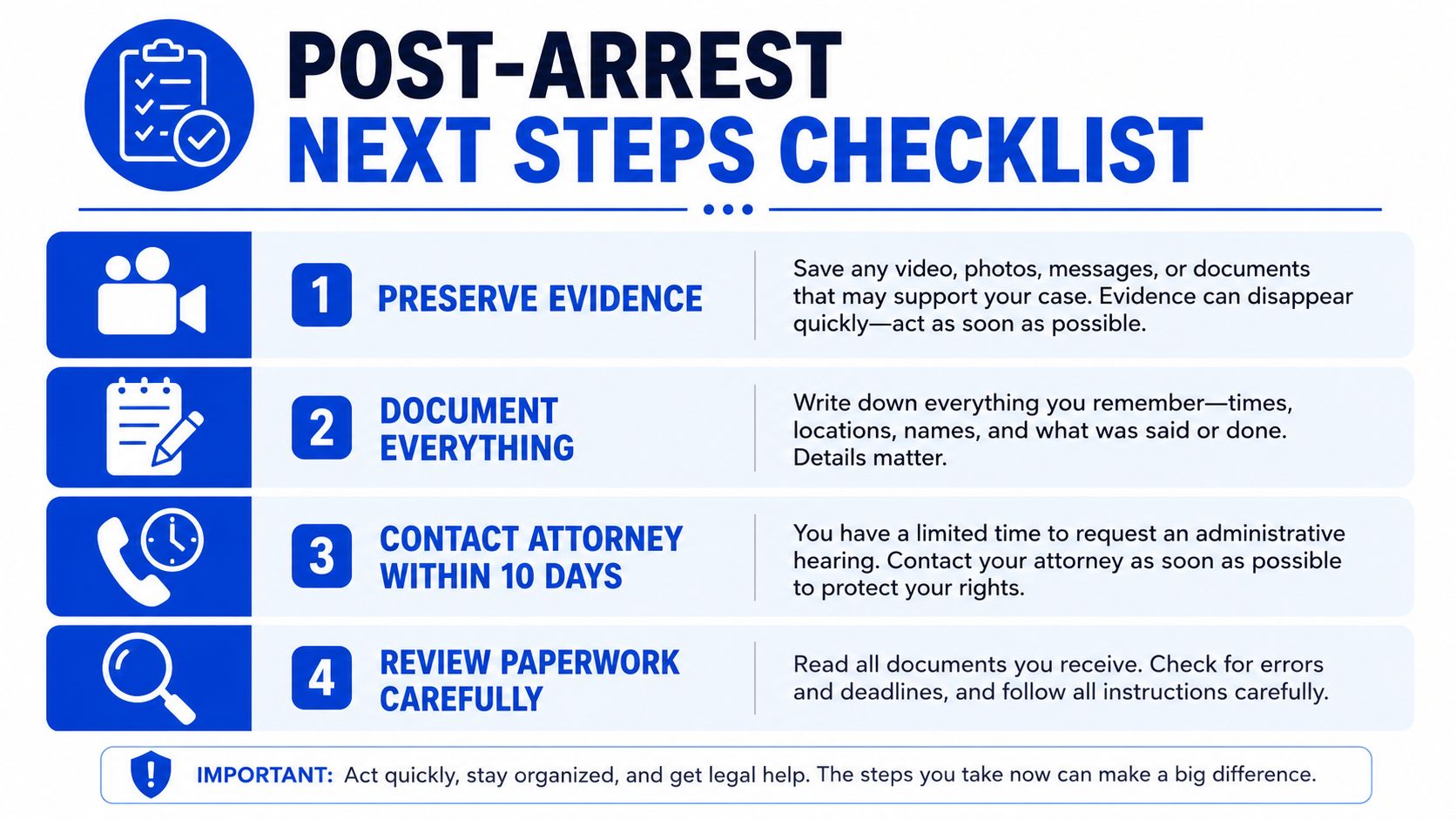
Do three things immediately. First, preserve evidence. Save dashcam footage if you have it, keep receipts, and save time-stamped texts that show where you were and when. Second, write down everything you remember while it's still fresh, including the timeline, the names of anyone with you, and what the officer said. Third, stop talking about the case online or to people who don't need to know.
Your next move should be legal, not emotional
If you're on bond, follow the conditions exactly. If you got paperwork about the suspension, read it carefully and move fast. The 10-day DHSMV deadline is real, and waiting to “see what happens” can cost you the chance to challenge the administrative suspension.
An early consultation can uncover suppression issues, discovery gaps, and problems in the chemical-test chain before those mistakes harden into the State's version of events. A defense lawyer can request records, push the hearing, and challenge what the prosecutor is relying on. You can't do that effectively while trying to guess your way through a criminal case.
If you were arrested in Fort Lauderdale, Broward County, Miami-Dade, Palm Beach, or anywhere in South Florida, schedule a confidential consultation with Ticket Shield, PLLC. Get the license issue handled, get the evidence reviewed, and get a defense plan in motion before the deadline closes on you.