
Attempted Murder Sentence in Florida: A Practical Guide
Jason Goldsmith, Esq
You get a call from a Broward detective. Your spouse has been arrested in Fort Lauderdale. A family member in Palm Beach is being investigated after a shooting. Or someone in Miami-Dade has learned that prosecutors may file an attempted murder charge. The word itself sounds conclusive, but it isn't. Florida law treats “attempted murder” as a label covering different legal theories, elements, and sentencing consequences.
The attempted murder sentence in Florida depends first on the statute and subsection charged. It can also turn on premeditation, the alleged act, the underlying felony, injury, firearm allegations, prior record, age, and whether the case ends in a conviction, dismissal, or negotiated resolution. Don't assume an online summary gives you the answer. Read the charging document and identify the exact theory.
Table of Contents
When the Headlines Meet the Courtroom
A representative South Florida case might begin with a chaotic confrontation outside a Broward County business. A witness tells police that one person pointed a weapon, another person was injured, and the suspect left before officers arrived. By the next morning, social media calls it attempted murder. The prosecutor may see something much more specific, such as premeditated attempted first-degree murder, attempted second-degree murder, or attempted felony murder.
Those labels matter because the statute drives the sentencing exposure. A surviving victim doesn't make the case minor, but neither does a headline establish intent, identity, premeditation, or an attempt. The State still has to prove every required element beyond a reasonable doubt.
The charge controls the analysis
Florida's statutes distinguish murder degrees and define attempt separately. Under Florida's murder statute, section 782.04, first-degree murder is a capital felony in qualifying circumstances, while second-degree murder is a first-degree felony. Under Florida's attempt statute, section 777.04, an attempted capital felony becomes a first-degree felony.
That framework creates a sharp difference between a failed plan and a punishable attempt. A person may have discussed violence, searched for someone online, or possessed a weapon, but prosecutors still must connect the evidence to the required intent and an act beyond preparation.
Practical rule: Don't discuss the facts with police, the alleged victim, or potential witnesses before a defense lawyer reviews the situation.
Early decisions shape later options
Evidence disappears quickly. Surveillance footage can be overwritten, phone data can change, witnesses can revise accounts, and inflammatory messages can be misunderstood without context. A lawyer should begin preserving communications, medical records, photographs, location information, and video before the State's version becomes the only version in the file.
People in Broward, Fort Lauderdale, Miami-Dade, and Palm Beach also need to account for investigations that cross municipal and county lines. One agency may handle the shooting, another may execute a warrant, and a third may possess digital or forensic evidence. The defense has to examine the entire investigation, not just the arrest report.
The practical point is simple. “Attempted murder” is a public description. The sentence depends on the legal theory the State files and proves.
How Florida Defines Attempted Murder
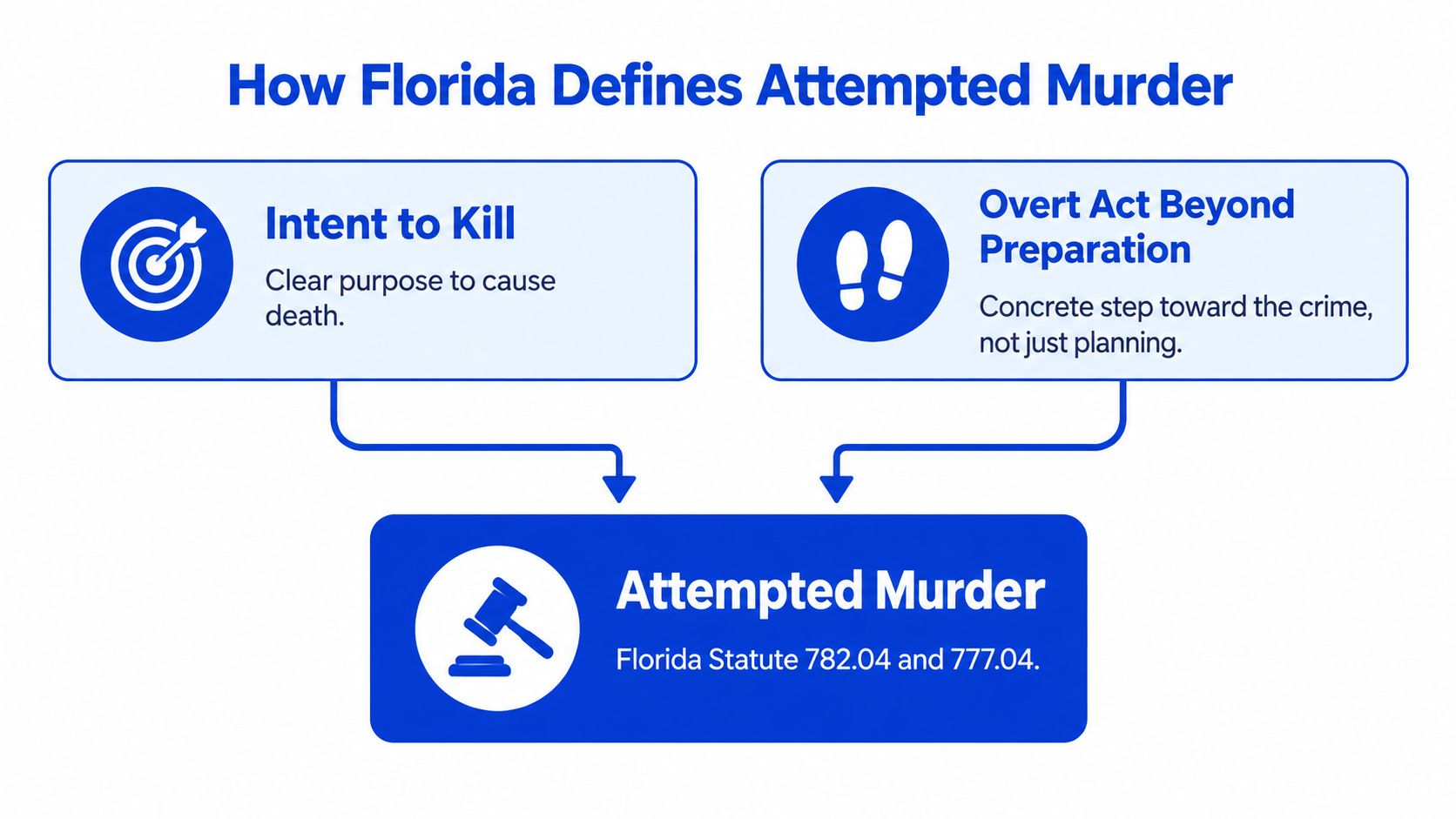
Florida attempted murder cases turn on two building blocks: intent and an overt act. The State must prove the criminal intent required for the particular murder theory and conduct that moved beyond planning or preparation. A threatening thought or angry statement, standing alone, does not establish an attempt.
Intent is not the same as anger
Attempted first-degree murder generally requires proof of a deliberate intent to kill and the premeditation required for the underlying first-degree theory. Premeditation can form quickly. The prosecution still must prove a conscious decision to kill, not merely a sudden outburst, generalized hostility, or reckless conduct.
Attempted second-degree murder rests on a different theory. The State may claim that the defendant acted with a depraved mind and engaged in conduct showing a high likelihood of death, without relying on the same premeditation allegation. The charging language and jury instructions control the analysis. Anyone evaluating exposure should read those documents, not rely on the label “attempted murder.” Florida's violent crimes resource offers general background, but it cannot replace a review of the actual charge and discovery.
The overt act draws the legal line
Florida requires proof of criminal intent plus an overt act beyond mere preparation. The line matters because prosecutors must show movement toward carrying out the alleged crime, rather than only discussion, research, or possession of materials. Florida's attempt and homicide framework provides the governing structure.
The overt act marks the point at which planning crosses into execution. A person may have selected a target or obtained a weapon, yet the State still must identify conduct sufficiently close to the alleged killing and prove the required intent.
Identity and causation present separate questions. Prosecutors must establish who committed the act and connect it to the alleged victim and claimed injuries. Witness accounts, video quality, forensic testing, medical testimony, and digital records can strengthen or weaken that proof. A defense lawyer should test each link instead of treating the accusation as a single conclusion.
Three Charging Theories That Change Everything
Florida doesn't have one universal attempted-murder penalty. The State's theory determines the elements, felony classification, Criminal Punishment Code treatment, and possible sentence.
Theory | Governing statute | Felony degree | Sentencing ceiling |
|---|---|---|---|
Attempted first-degree premeditated murder | Section 782.04(1), with section 775.0823 applying to a qualifying conviction | First-degree felony under the attempt framework | The general first-degree felony framework can allow a term of years not exceeding life, with a 25-year mandatory minimum under section 775.0823 |
Attempted second-degree murder | Section 782.04(2), together with section 777.04 | First-degree felony under the attempt framework | The applicable statutory and Criminal Punishment Code framework controls the sentence |
Attempted felony murder | Section 782.051 | First-degree felony in the general provision | Imprisonment for a term of years not exceeding life, with Level 8 or Level 9 treatment depending on the connected felony |
The first theory focuses on premeditated intent to kill. The second focuses on the alleged depraved-mind conduct and the circumstances showing a high likelihood of death. The third connects an underlying felony to an intentional act that could have caused death but didn't.
Why attempted felony murder is different
Under section 782.051, attempted felony murder generally constitutes a first-degree felony when a person attempts or commits a qualifying felony and performs an intentional act that could have caused another person's death, without causing death. The statute identifies Level 8 or Level 9 treatment depending on the felony involved. A related provision involving injury can be a second-degree felony ranked at Level 7.
The predicate felony and the separate dangerous act both deserve close examination. The defense should ask whether the State has identified the correct underlying felony, whether the alleged life-threatening act was intentional, and whether it was legally independent of the predicate offense.
Two people can be described publicly as facing “attempted murder” while their charging documents create materially different sentencing exposure.
Ask for the exact subsection. Don't accept a general answer that the charge is a first-degree felony. The difference between a mandatory minimum, a statutory maximum, and a scoresheet-driven sentence can determine the entire defense strategy.
The 25-Year Mandatory Minimum Explained
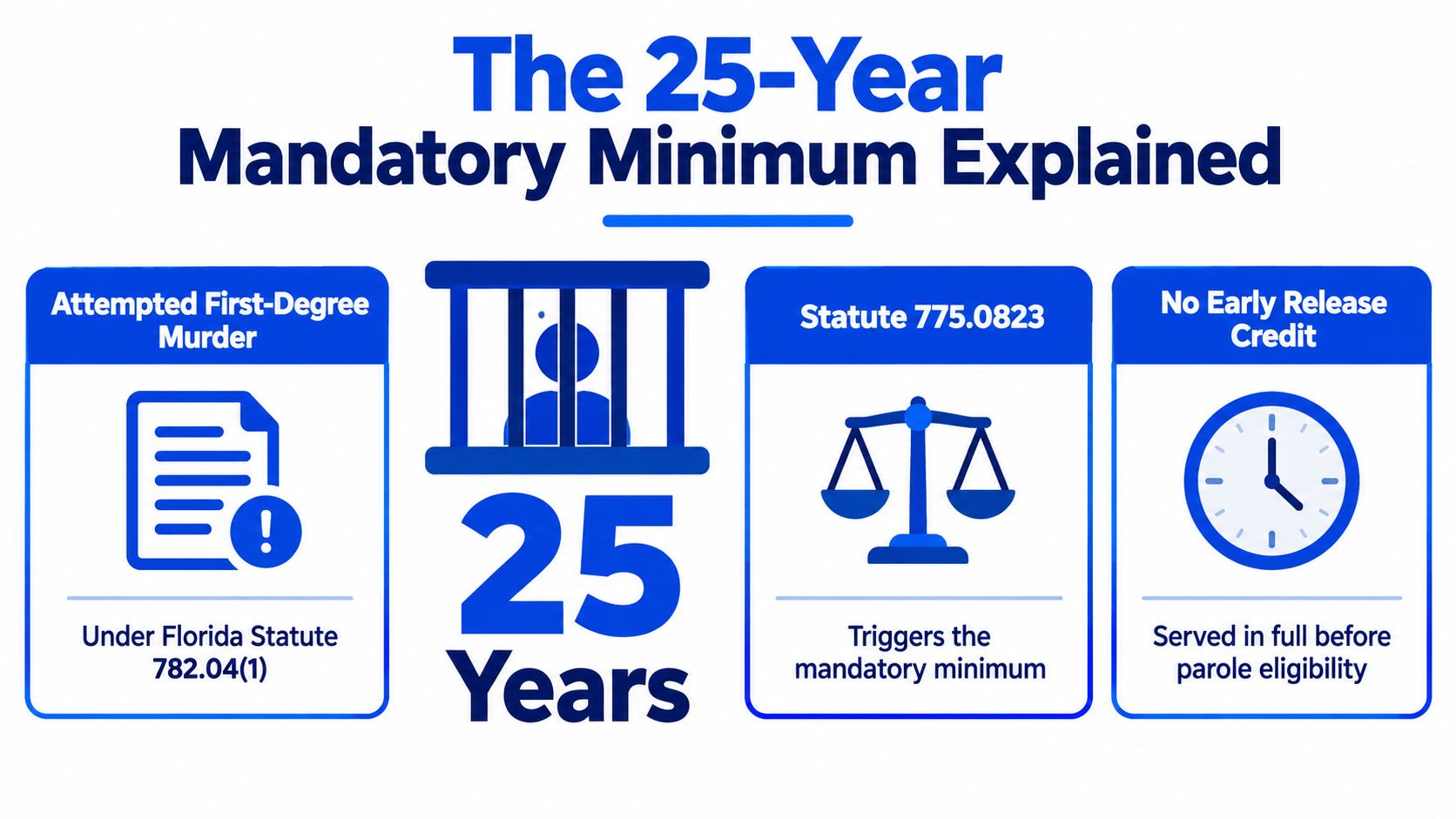
The most important number in a qualifying Florida attempted murder case is 25 years. Under Florida Statute section 775.0823, a person convicted of attempted first-degree murder under section 782.04(1) must receive a mandatory minimum prison term of 25 years.
That is a floor, not a recommendation. Ordinary judicial discretion generally can't reduce a mandatory minimum. The statute also directs the court to apply the broader sentencing provisions in sections 775.082, 775.083, and 775.084, so the 25-year requirement operates within Florida's felony sentencing framework rather than replacing every other sentencing rule.
Why online summaries mislead people
Many summaries stop at “attempted murder is a first-degree felony.” That description omits the critical distinction between classification and mandatory sentencing. Florida's attempt law makes an attempted capital felony a first-degree felony, but section 775.0823 separately attaches the quarter-century minimum to the qualifying attempted first-degree murder conviction.
The 25-year floor applies only when the conviction fits the specified statutory pathway. Charge selection, proof of premeditation, statutory exceptions, and a lawful negotiated resolution can materially affect exposure. A defense lawyer should therefore investigate whether the State can prove the charged theory before treating the minimum as inevitable.
The scoresheet still matters
Prior record, victim injury, firearm allegations, the exact conviction, and other case-specific factors can affect the ultimate sentence within Florida's framework. The sentence isn't calculated from the public label alone.
A lawyer also needs to distinguish an adult case from a juvenile case and a conviction after trial from a negotiated disposition. Those distinctions can change which sentencing rules apply. Information about Florida's 10-20-Life framework may be relevant when firearm allegations appear, but it doesn't replace a review of the actual charging language and facts.
The sentence question should be handled precisely. First identify the theory, then test the elements, then calculate the sentencing consequences of the conviction the State is pursuing.
Factors That Move the Sentence Up or Down
The charge sets the legal frame, but case-specific facts influence the practical outcome. Florida sentencing analysis should account for age, prior record, victim injury, firearm allegations, scoresheet calculations, and the way the case resolves.
A defendant's age at the time of the alleged conduct is especially important. Florida provides special rules for a person who killed, intended to kill, or attempted to kill a victim and was convicted under section 782.04 of a capital felony, or an offense reclassified as a capital felony, when the offense occurred before the person turned 18. After a hearing under section 921.1401, the court may impose life imprisonment if it finds life appropriate. If it doesn't impose life, the statute requires at least 40 years' imprisonment. Section 775.082 governs that rule.
The facts that increase pressure
A prior record can affect the Criminal Punishment Code scoresheet and the State's position at negotiations. Victim injury can add sentencing weight, while firearm or weapon allegations can create separate exposure or statutory consequences. The defense must verify how each allegation is charged and whether the evidence supports it.
The prosecution's evidence also matters at sentencing. Medical records, photographs, witness testimony, and forensic conclusions may affect how the court views injury and the alleged conduct. But injury alone doesn't prove premeditated intent or identity. Those elements still require proof.
Mitigation is evidence, not a speech
Mitigation can include age, mental-health history, family circumstances, employment, education, treatment, and conduct after the incident. Cooperation or acceptance of responsibility may influence negotiations or sentencing positions, but no factor guarantees a lower sentence.
The resolution matters just as much. A plea can change the conviction, eliminate disputed allegations, or narrow the sentencing range. A trial can produce an acquittal or conviction on a different offense, but it also leaves the State responsible for proving every element. Your lawyer should compare those paths using the actual evidence, not pressure you with a generic prediction.

For a prior-record analysis, review how habitual felony offender treatment in Florida might intersect with the specific conviction and statutory authority. Don't assume an enhancement applies without checking the record and the State's filing.
Defense Strategies That Move the Needle
A strong defense attacks the State's proof instead of reacting to the charge's headline. An arrest affidavit may sound decisive, yet the case can weaken once counsel tests the evidence, the statutory theory, and the witnesses behind it.
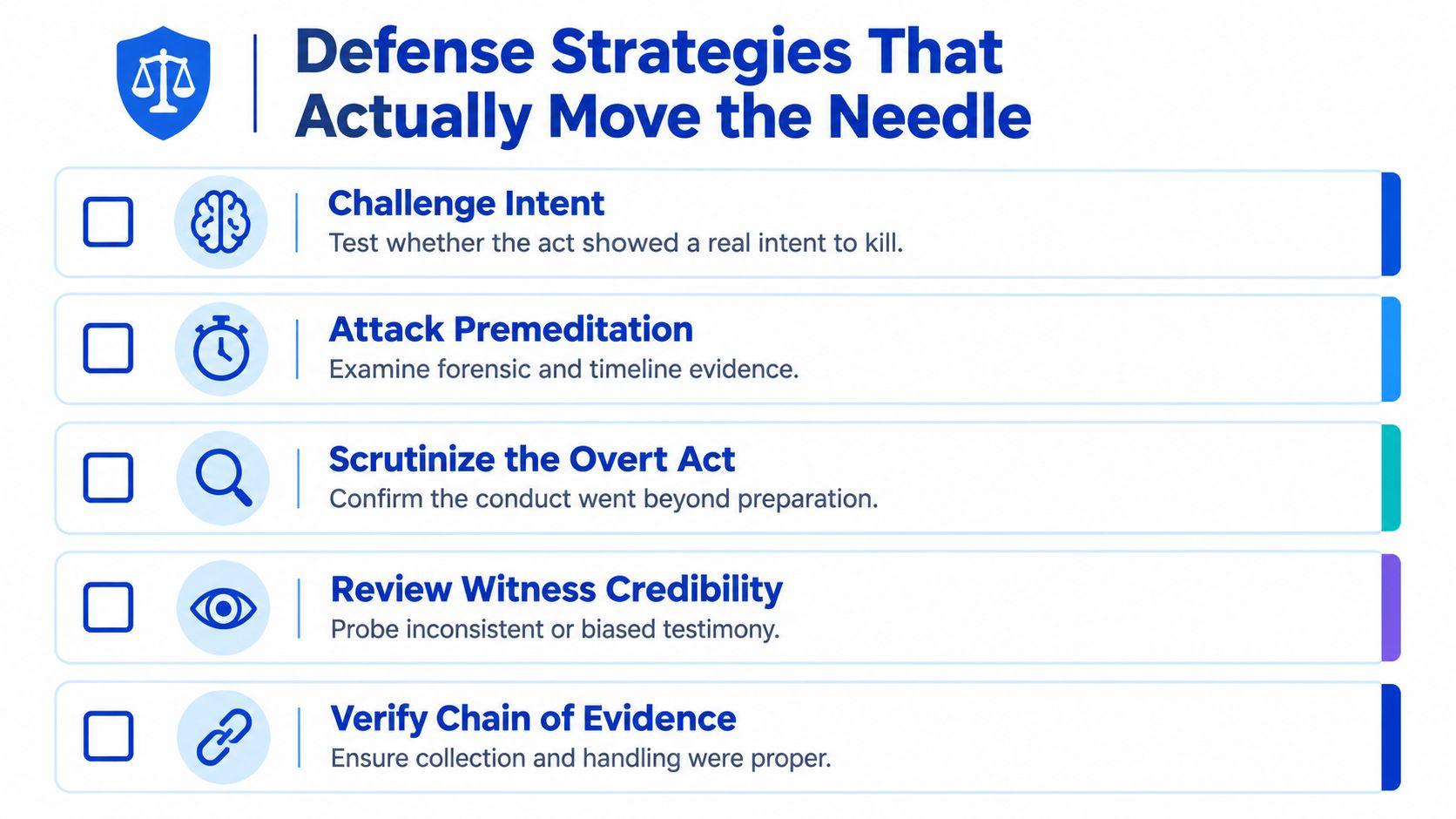
Challenge intent and premeditation
Start with the timeline. Did the conduct follow a sudden confrontation? Do messages show a purpose to kill, or anger without that specific intent? Do medical findings, ballistics, video, and witness accounts support the State's interpretation?
Anger or possession of a weapon does not establish premeditation by itself. The State must prove the mental state required by the charged theory. If the evidence supports an assaultive act but does not prove an intent to kill, the defense should force the prosecution to confront that distinction.
Attack the overt act
Florida's attempt framework requires criminal intent and an overt act beyond mere preparation. Counsel should identify the exact conduct the State says crossed that line. Planning, travel, messages, or possession may show preparation, but they do not automatically prove a concrete movement toward execution. The defense should challenge the attempt element directly.
Test the investigation
Witness identification deserves close examination. A witness may have observed events in poor conditions, received suggestive information, or changed an account over time. Digital evidence may lack context, while forensic evidence may have been mishandled or overstated.
A disciplined defense review asks five specific questions, each targeting a different part of the State's case:
Check the timeline: Compare dispatch records, video, phone data, medical records, and witness statements.
Challenge the search: Determine whether police obtained statements, devices, or physical evidence lawfully.
Separate the allegations: Test the predicate felony, dangerous act, firearm allegation, injury claim, and identity evidence independently.
Preserve favorable proof: Secure surveillance, messages, photographs, location records, and witnesses before they disappear.
Demand element-by-element proof: Require proof of intent, identity, causation, and the overt act beyond a reasonable doubt.
Suppression motions can remove unlawfully obtained evidence. A charge review can expose a mismatch between the facts and the statute. Early negotiation may change the available outcomes, but counsel should first understand the evidence and the consequences of every proposed plea. Review Florida plea bargaining considerations alongside the proof, not apart from it.
No lawyer can promise a result. A serious defense can force the State to prove the case it filed, element by element, rather than rely on the story presented in public.
What to Do in the First 72 Hours After a Charge
First, stop discussing the facts. Don't give a field interview, don't explain the incident by text, and don't contact the alleged victim or witnesses. Tell investigators that you want a lawyer and use your right to remain silent.
Second, preserve evidence without altering it. Keep phones, messages, photographs, clothing, location records, medical documents, and social-media content. Don't delete, edit, forward, or post about anything connected to the allegation.
Third, secure counsel quickly. A lawyer can request discovery, preserve surveillance, examine arrest and search procedures, assess bond and release conditions, and communicate with prosecutors. What happens after an arrest in Florida can involve several urgent decisions, so waiting for the case to “settle down” is a mistake.
If you're in Broward County, Fort Lauderdale, Miami-Dade, Palm Beach, or elsewhere in Florida, treat an attempted murder investigation as an evidence problem and a legal-elements problem. The accusation is serious, but it isn't the verdict. A lawyer can test the theory, challenge unlawful evidence, negotiate from facts, and prepare to fight every unsupported element.
Ticket Shield, PLLC provides 24/7 Florida criminal defense for attempted murder and other serious felony investigations, with former-prosecutor insight focused on protecting your rights and exposing weaknesses in the State's case. Contact Ticket Shield, PLLC for a free consultation and a clear assessment of the statute charged, evidence available, and immediate steps to protect your future.
See how Florida sentences attempted murder, which factors change the penalty, and what defense options may be available in your case.