Guía sobre la violación de la libertad condicional por pruebas de detección de drogas en Florida
Jason Goldsmith, Abogado
You just got the call from probation. Or you left the office with a slip in your hand and a knot in your stomach. They say you failed a drug test, missed a test, or gave a diluted sample. Now you're wondering if the judge is going to revoke probation and send you to jail.
Slow down. A failed probation violation drug test in Florida is serious, but it is not the same thing as an automatic revocation. I've seen too many people hurt themselves by panicking, talking too much, skipping appointments, or assuming there's no defense. That's wrong. In Florida, a positive test is usually treated as a technical violation, and the State still has to prove that violation in court.
If you're in Broward County, Fort Lauderdale, Miami-Dade, Palm Beach, or anywhere in South Florida, the next few days matter. Your job is to protect your rights, preserve evidence, and stop a bad allegation from turning into a worse result.
Table of Contents
What a Probation Violation Drug Test Means in Florida
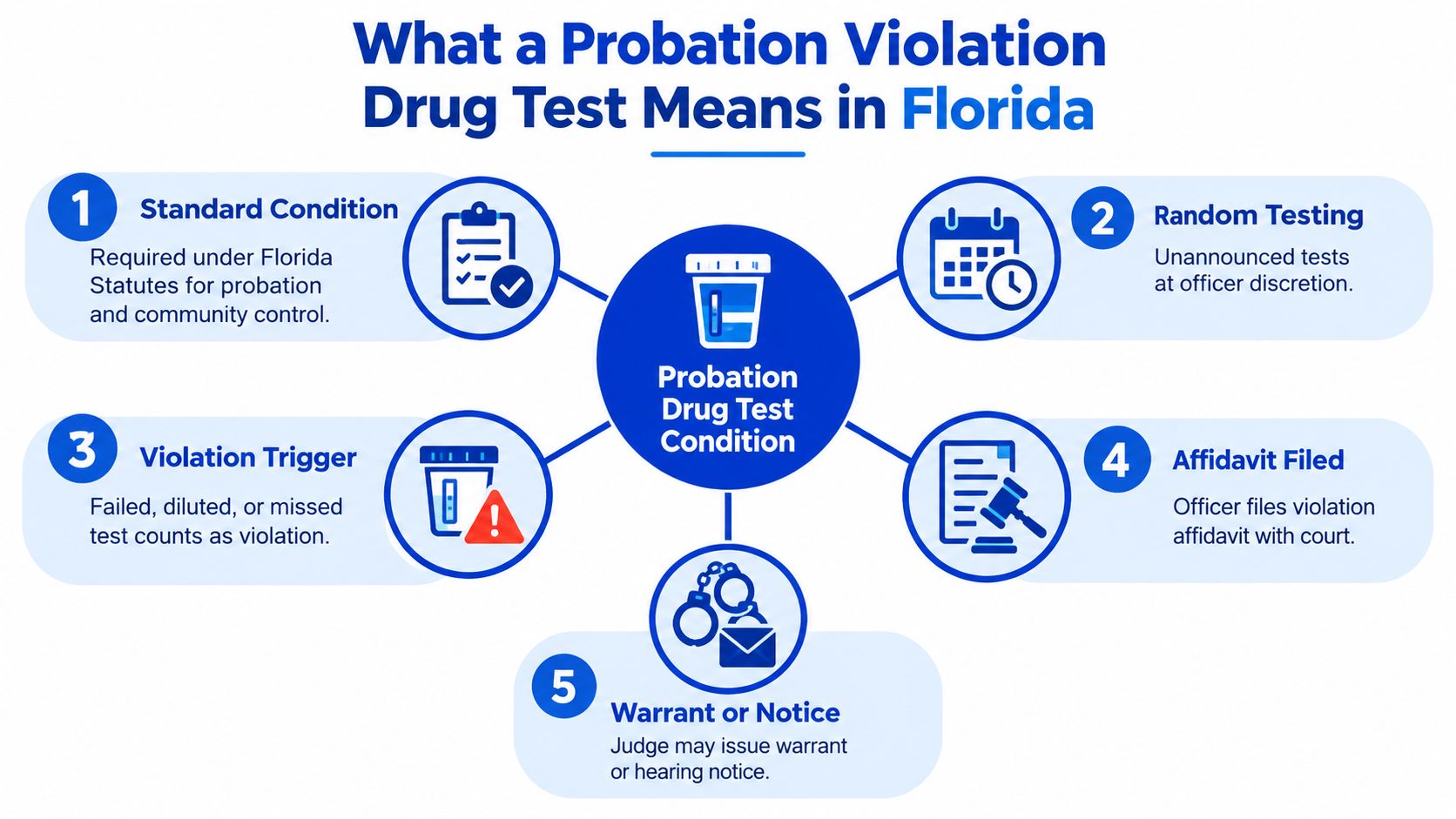
A lot of people think drug testing is some special punishment added only in extreme cases. It isn't. In Florida, courts can require people on probation or community control to submit to urinalysis testing, and the statute also allows supervision to include random drug testing, including for drug offender probation under Florida Statute 948.20 on probationary testing conditions. If you want a broader overview of supervision rules, review these terms of probation in Florida.
Nationally, drug testing is built into probation practice on a large scale. The Bureau of Justice Statistics reported that 32.5% of all probationers were subject to mandatory drug testing, including 43.0% of felons and 17.1% of misdemeanants, and a historical survey found 49% of probationers reported being tested during their current probation sentence. Federal supervision data also showed 186,509 post-conviction cases in fiscal year 2018, with 120,217 carrying substance-abuse treatment conditions, and the judiciary spent $45,681,745 on substance-use testing and treatment that year, according to the Bureau of Justice Statistics drug-treatment data.
Why one failed test is not the same as automatic revocation
In Florida, a failed drug test is commonly treated as a technical probation violation, not a new criminal charge by itself. That matters. The judge still has to hold a violation process, and the State has to prove the violation by a preponderance of the evidence, which is a lower standard than beyond a reasonable doubt, as explained in this discussion of how probation drug testing in Florida works.
That lower standard helps the State, but it doesn't erase your defenses. A test result can be challenged. The collection process can be challenged. The officer's interpretation can be challenged. Whether the violation was willful and substantial can become a fight.
What usually happens after the test
Many who test positive aren't marched straight from the testing room to prison. More often, the probation officer documents the issue, decides whether to file an affidavit of violation, and the court may issue a warrant or notice for hearing.
A failed test creates risk. It does not end the case.
What judges care about is the full picture. Was this a one-time allegation? Was the sample diluted because of actual tampering or because of hydration or a medical issue? Are you otherwise compliant with reporting, treatment, work, and payment obligations? Those details can change the outcome.
Immediate Actions to Take After a Failed Drug Test
Start with discipline. The worst move is to spiral.
What to do in the first day
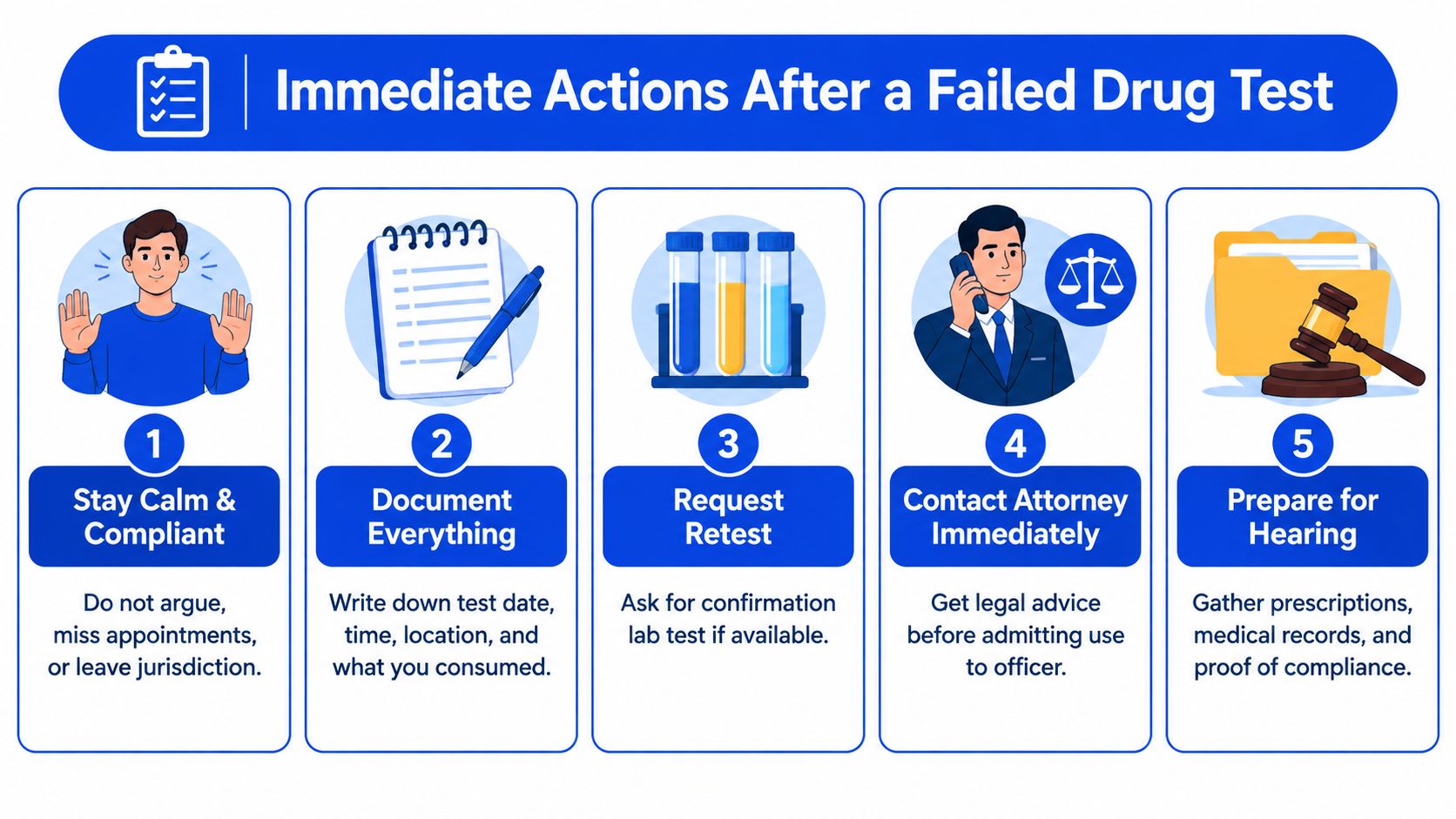
If you've just been told you failed, act in this order:
Stay compliant. Keep every appointment. Answer lawful instructions. Don't leave the county or state if your supervision terms restrict travel.
Stop talking about facts you haven't reviewed. Don't guess. Don't “explain” yourself into a violation. Don't admit drug use if you don't know exactly what the test showed.
Write everything down. Record the date, time, location, who collected the sample, what you ate, drank, or took, and whether the test was instant or sent out.
Preserve medications. Keep prescription bottles, pharmacy printouts, over-the-counter products, supplements, and discharge paperwork.
Call a lawyer fast. If you're searching for help, speak with a probation violation lawyer near you in Florida before you make statements that box you in.
Here's a practical visual overview of the early response:
What not to do
People often damage their own defense in the first 48 hours. Avoid these mistakes:
Don't miss probation. A bad test plus a missed appointment makes you look like you're running.
Don't try home remedies or gimmicks. They can create a second allegation of tampering or avoidance.
Don't contact the lab on your own and freelance the science. Your lawyer should decide what records to request and how.
Don't delete texts or medical messages. Preserve them.
Don't assume marijuana will be treated the same as every other substance, or that it won't matter at all. The facts and the judge matter.
Practical rule: Your job is to look steady, organized, and credible from this moment forward.
Documents to gather now
Build your file before the hearing gets scheduled. That means collecting anything that can explain the result or show you're otherwise doing what the court ordered.
Document | Why it matters |
|---|---|
Prescription records | May explain a result or support a lawful-use argument |
Treatment attendance | Shows effort, compliance, and mitigation |
Work schedule and pay records | Helps explain timing, transportation issues, or stability |
Medical records | Can support hydration issues, medication use, or health conditions |
Probation paperwork | Confirms exact testing terms and special conditions |
If the officer says you failed a field test, write down the exact words used. “Failed.” “Preliminary positive.” “Dilute.” “Refused.” Those terms are not identical, and the language matters later.
Common Defenses for a Failed Probation Drug Test
A probation drug test case is usually won or lost in the details. Not broad speeches. Not excuses. Details.
Florida gives the State room to prove violations with a lower burden, but that doesn't mean every positive result is reliable. It means your defense has to be focused and evidence-based. If you want to understand how these allegations fit within the larger category of supervision issues, this overview of technical probation violations is a useful starting point.
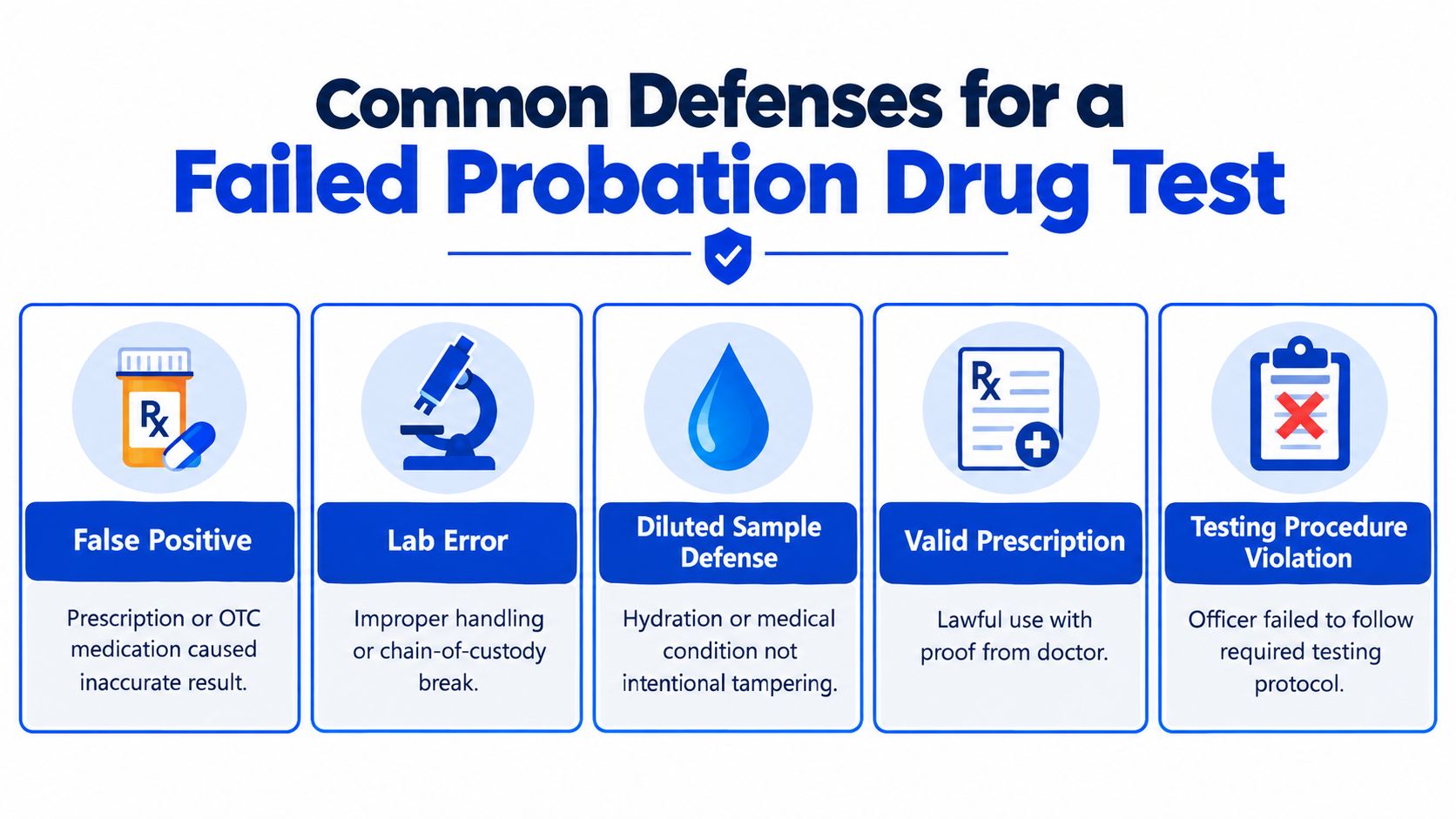
False positives and cross-reactivity
Some results need a second look because screening tests are not perfect. Medications, lawful prescriptions, and even common products can create confusion, especially when the first result is a preliminary screen rather than a confirmatory lab analysis.
That's why you need the exact product names, dosage, prescribing doctor, and pharmacy record. “I take meds” is weak. A bottle, prescription history, and treatment notes are useful.
Chain of custody and handling problems
Drug tests don't prove themselves. Someone has to collect the sample, label it, store it, transfer it, and document each step. If the paperwork is sloppy or the sample handling is unclear, that can weaken the allegation.
This defense is especially important when the probation officer's account is stronger than the paper trail. If the timeline is messy, labels don't match, or the sample sat where it shouldn't have, your attorney should press that point.
Field test limits in Florida
Florida law gives probation officers more evidentiary power than many people realize. The Florida Supreme Court held that when a probation officer personally administered a field drug test and testifies that it was failed, that testimony is competent, nonhearsay evidence that can support revocation when combined with hearsay evidence, according to the court's opinion in State v. Queior.
That does not mean field tests are unbeatable. It means you have to attack them the right way. You challenge training, administration, documentation, contamination risk, and whether the officer followed the testing procedure.
If the officer's testimony is the center of the case, credibility and procedure become the battlefield.
Detection windows and why timing matters
Not every matrix tells the same story. A probation-focused review states that urine immunoassay is used in about 90% of probation tests, urine is the cheapest and easiest routine method, cannabis detection can range from roughly 3 to 5 days for a single use at a 50 ng/mL cutoff to 60 to 90+ days for heavy use, oral fluid is better for very recent use at about 24 to 72 hours, and hair testing can extend to about 90 days for scalp hair, according to this probation testing overview.
That matters because a positive result does not always answer the question the judge cares about. When did the use happen? Before probation started, during probation, recently, or long ago? Different test types tell different stories.
Prescription and mitigation defenses
Some defenses don't erase the result but still help avoid the worst penalty. If you were in treatment, if your doctor changed medication, if you promptly disclosed lawful prescriptions, or if you can show you were trying to comply, those facts can shape the judge's response.
A law firm like Ticket Shield, PLLC can help organize the paper trail, request records, and frame those facts in a way a judge can use. That's not magic. It's preparation.
How Florida Probation Violation Hearings Work
A probation violation hearing is not a jury trial. It moves faster, the rules are looser, and that catches families off guard. If the alleged violation involves felony supervision, this guide to felony probation violation proceedings in Florida can help you understand the stakes.
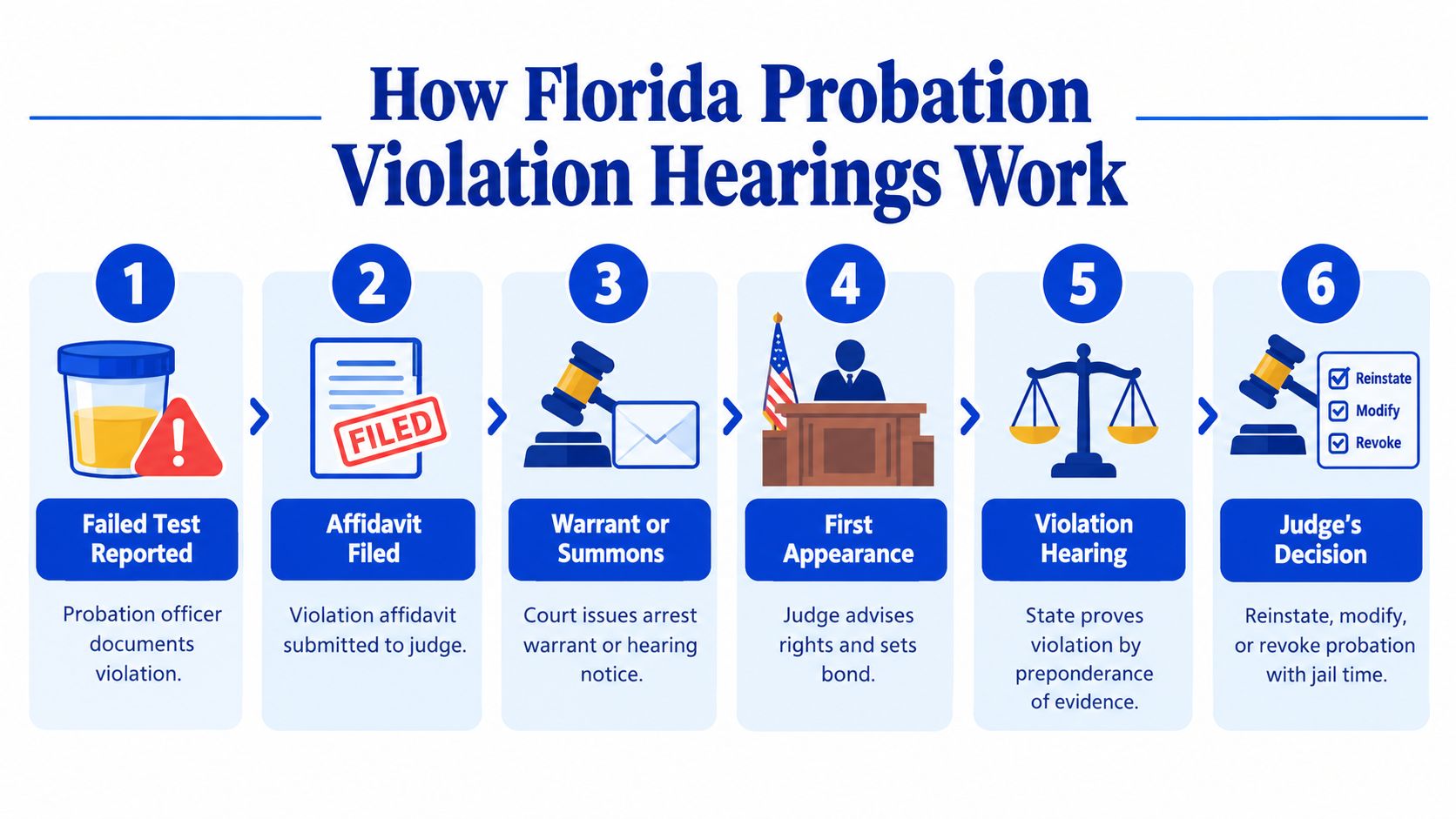
The usual sequence
The process often looks like this:
The probation officer claims you failed, missed, refused, or diluted a test.
The officer files an affidavit of violation with the court.
The judge may issue a warrant or send notice for court.
You appear before a judge. Sometimes that starts with an arrest and first appearance.
The court sets the violation hearing.
The judge decides whether the violation was proven and what happens next.
What the State must prove
The State doesn't need to prove the violation beyond a reasonable doubt. It needs to prove it by the greater weight of the evidence. That lower standard matters, but so does the quality of the evidence.
Testing frequency research also shows why probation departments lean so heavily on random or frequent testing. A review in the Journal of Ethics summarized California data showing that once-a-week urine testing creates only about a 35% chance of detecting a drug-use incident, twice-a-week testing raises detection to more than 80%, and monthly testing has less than a 10% chance of catching an incident. The same review discussed a New Mexico probation and parole dataset covering 689,767 tests given to 67,565 individuals from 2004 to 2016, averaging 4.28 tests per person per year, with just over 34% of individuals testing positive at least once per year, as summarized in the American Medical Association Journal of Ethics article on probation drug testing.
Those numbers explain why courts see these cases often. They do not mean every allegation is solid.
What your lawyer does at the hearing
Your attorney's job is to make the judge slow down and look at proof instead of assumptions. That can include cross-examining the officer, forcing clarity about collection and testing, presenting pharmacy records, calling treatment providers, and arguing that the alleged violation was not willful and substantial.
Judges often decide these hearings by asking one question they may never say out loud: Who is more believable, and whose paperwork makes sense?
You also have the right to present mitigation even when the test result is difficult to dispute. Sometimes the smartest defense is a two-track approach. Challenge reliability where you can, and build a strong record for reinstatement or modification if the judge finds a violation.
Possible Outcomes and Penalties After a Violation
Florida judges have options. That's the good news and the hard truth. A judge can give you another chance, tighten supervision, or revoke probation and impose a sentence up to the lawful maximum on the underlying case.
The range of outcomes
Here's the practical spectrum:
Possible result | What it can mean |
|---|---|
Reinstatement | Probation continues under the same terms |
Modification | More testing, counseling, treatment, classes, or stricter reporting |
Extension | More time under supervision |
Community control or tighter supervision | Increased restrictions on movement and daily life |
Revocation | Jail or prison exposure based on the original offense |
The underlying case matters. A misdemeanor probation violation usually carries a different sentencing risk than a felony probation violation because the original charge sets the ceiling.
What judges tend to weigh
Judges usually look at patterns, not just a single lab sheet. They want to know whether this is a one-off issue, part of repeated noncompliance, or tied to larger problems like absconding or new arrests.
Independent research also shows why a positive drug test should not be treated as an automatic revocation trigger. A Robina Institute review found no research showing drug testing alone reduces recidivism or drug use, and it warned that more intensive testing can increase detection of technical violations and revocations. The same review noted that in one intensive supervision program, participants were almost twice as likely to be revoked, and positive drug tests were cited as the revocation reason at 10 times the rate of standard probation. A Colorado analysis discussed in that review also found substance-use violations were common, with nearly half of both successful and revoked cases showing at least one missed drug test and around a third showing at least one positive drug test, according to the Robina Institute review on drug testing and revocation.
Another point matters in real cases. A community supervision study found that cannabis-only positives were not associated with supervision revocation for new crimes or non-drug technical violations, while positives for hard drugs were associated with revocation risk. That same discussion noted federal supervision rules require testing and that some jurisdictions charge supervisees for tests, with costs averaging about $15 to $20 per test, as described in this community supervision drug-testing analysis.
Technical violation versus new-law violation
This distinction matters. A dirty test alone is usually argued as a technical violation. If the State also claims possession, paraphernalia, fraud, tampering, or another fresh offense, the risk rises fast because the court is no longer looking only at compliance. It's looking at new criminal conduct.
That's why you should never treat a probation drug test allegation like a simple paperwork issue. The facts can expand quickly if you handle it badly.
How an Attorney Helps and What to Bring to Your Consultation
A good defense lawyer doesn't just “go to court.” The lawyer should test the allegation from every angle. Was the test properly administered? Was it a field test or confirmatory lab result? Is there a prescription issue? Did the officer overstate what happened? Is the best strategy to contest the result, present mitigation, or both?
A former prosecutor sees the weak spots quickly because these hearings often turn on routine habits. Officers use standard forms. Labs produce standard records. Courts hear the same explanations every week. The defense has to break that pattern with facts that are specific, documented, and credible. If you're meeting counsel soon, bring a written list of concerns and review these questions to ask a criminal defense lawyer.
Bring these items with you
Bring as many of these as you can:
Probation order and sentencing paperwork
Any notice of violation, warrant information, or court date
Drug test paperwork, including collection slips or lab notices
Prescription bottles and pharmacy printouts
Medical records tied to treatment, hydration, or medication changes
Proof of counseling, rehab, meetings, or treatment attendance
Work records and family support letters
A timeline of what happened before, during, and after the test
Questions worth asking
Ask direct questions. Don't worry about sounding less smart.
Can the test itself be challenged?
Was this enough for a willful and substantial violation?
Do I need an independent retest or records request?
Am I at risk of a warrant?
What mitigation should I start collecting now?
Can counsel appear for me at any stage, depending on the court and posture of the case?
Bring paper, not just a story. Judges hear stories all day. Documents change outcomes.
If you're scared, that's normal. But fear is not a strategy. Fast, organized action is.
Ticket Shield, PLLC represents people accused of technical probation violations across Broward County, Fort Lauderdale, Miami-Dade, Palm Beach, and throughout Florida, including cases involving failed, missed, or disputed drug tests. If you need a clear plan, a review of the evidence, and a defense built around protecting your freedom and record, visit Ticket Shield, PLLC.