Robo de armas de fuego en Florida: leyes, sanciones y defensa
Jason Goldsmith, Abg.
You're sitting at home when an officer calls about a firearm reported missing from a vehicle, or you're stopped and asked questions about a gun someone says you took. Maybe the firearm belonged to a relative, a roommate, a former partner, or a business. You may believe the dispute is personal or that the gun has little financial value. In Florida, those assumptions can create serious problems.
A theft of firearm allegation is treated differently from ordinary value-based theft. Florida law identifies a firearm as a specific item that can make the offense grand theft in the third degree, even when the firearm's market value is low. Florida's statute expressly lists theft of a firearm under section 812.014(2)(c)5, and the state's offense-ranking chart separately classifies it as a third-degree felony. See the Florida theft statute and the Florida offense-ranking chart.
The accusation still has to be proven. The State must establish the required theft elements, connect you to the alleged taking, and prove that the item qualifies as a firearm. Evidence may include statements, surveillance video, ownership records, serial-number information, fingerprints, digital messages, and the circumstances surrounding the firearm's disappearance. A defense attorney must examine how that evidence was obtained and whether it proves each element beyond a reasonable doubt.
This guide explains the law in plain English, the felony consequences, related charges, the path from arrest to resolution, and practical ways to protect your rights. If you're in Broward County, Fort Lauderdale, Miami-Dade, Palm Beach, or another Florida community, getting informed early can help you avoid statements and decisions that make the case harder to defend.
Table of Contents
Introduction What Theft of Firearm Means for You in Florida
A missing firearm can produce panic before anyone knows what happened. A family member may report a gun stolen after a disagreement. A vehicle owner may discover that a firearm disappeared and provide police with a name. An investigator may contact you at work, arrive at your home, or ask you to explain why the gun was in your possession. Even if you believe you had permission, the situation can quickly become a criminal investigation.
The most important point is that a firearm theft allegation is not merely a property dispute. Florida treats the firearm itself as legally significant. Ordinary theft classifications often depend on the property's value, but the firearm-specific provision changes that analysis. The charge can be a felony even where the State can't show a high purchase price or substantial resale value.
Practical rule: Don't try to “clear things up” with police before speaking with a criminal defense attorney. A well-intended explanation can create admissions about possession, access, timing, or intent.
The process usually begins with an investigation, arrest, or notice to appear. It can then involve a first appearance, release conditions, arraignment, discovery, motions, plea discussions, and possibly trial. The case may resolve through dismissal, a negotiated outcome, or a contested hearing, depending on the evidence and the legal issues involved.
For families, the uncertainty can be exhausting. You may worry about jail, employment, immigration, professional licensing, family relationships, or future firearm rights. Those concerns deserve direct answers, but no attorney can responsibly promise a particular result without reviewing the facts. The first useful steps are more concrete: preserve messages and receipts, avoid contacting an accuser about the firearm, and write down what happened while your memory is fresh.
The rest of this guide separates the accusation into manageable questions. What must the State prove? Why does value not control the charge? What related offenses might appear? What happens after arrest? Which evidence can be challenged? Those answers provide a clearer basis for protecting your constitutional rights in South Florida and throughout Florida.
Understanding Theft of Firearm Under Florida Law
Florida theft law generally focuses on conduct and intent, not on whether property changed hands. Prosecutors typically must prove that a person knowingly obtained or used another person's property, intended to deprive the owner of the property or its benefit, and acted without authorization. The precise jury instructions and facts matter, but the basic idea is clear: an unauthorized taking isn't automatically enough unless the required intent is also proven.
A borrowed firearm illustrates the difference. If the owner gave you permission to possess it and you were expected to return it, the State may need evidence that you exceeded that permission or formed an intent to keep the firearm from the owner. A found firearm presents a different question. Possession alone doesn't automatically establish who took it, when it was taken, or what you intended when you encountered it.
The general theft questions
A defense review often asks:
What property was involved? The State must identify the item and connect it to an alleged owner or lawful possessor.
How did you obtain or use it? Access, possession, transfer, and the alleged taking must fit the evidence.
What permission existed? Messages, household arrangements, loan agreements, and witness accounts may matter.
What was your intent? The State must prove the required intent to deprive, rather than relying only on suspicion or later disagreement.
The Florida theft-crimes resource explains the broader framework for theft allegations, but a firearm allegation adds a critical statutory rule.
Why the firearm changes the classification
Florida section 812.014(2)(c)5 specifically identifies a firearm as an item whose theft constitutes grand theft in the third degree. That means the nature of the property, not its market value, controls the charge. A low-value handgun and a high-value firearm can fall under the same firearm-specific classification if the State proves the necessary theft elements.
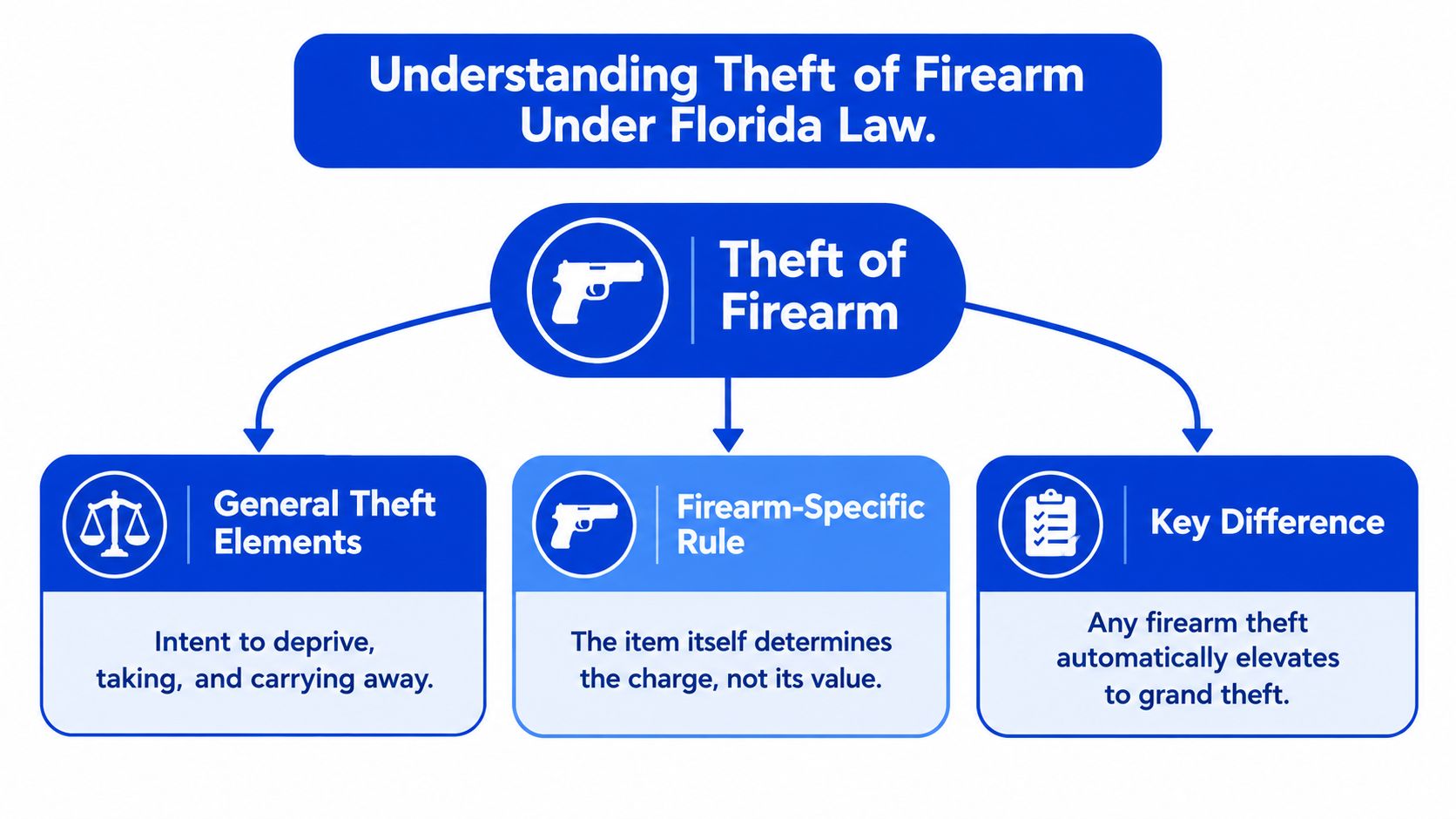
That rule doesn't eliminate the State's burden. Prosecutors still must prove the alleged taking, the absence of authorization, the required intent, and the firearm's identity or status when that issue is disputed. A defense may focus on any missing link, including mistaken identity, lawful possession, a misunderstanding about permission, or unreliable evidence concerning the item.
Florida Statutes Penalties and Why Value Does Not Matter
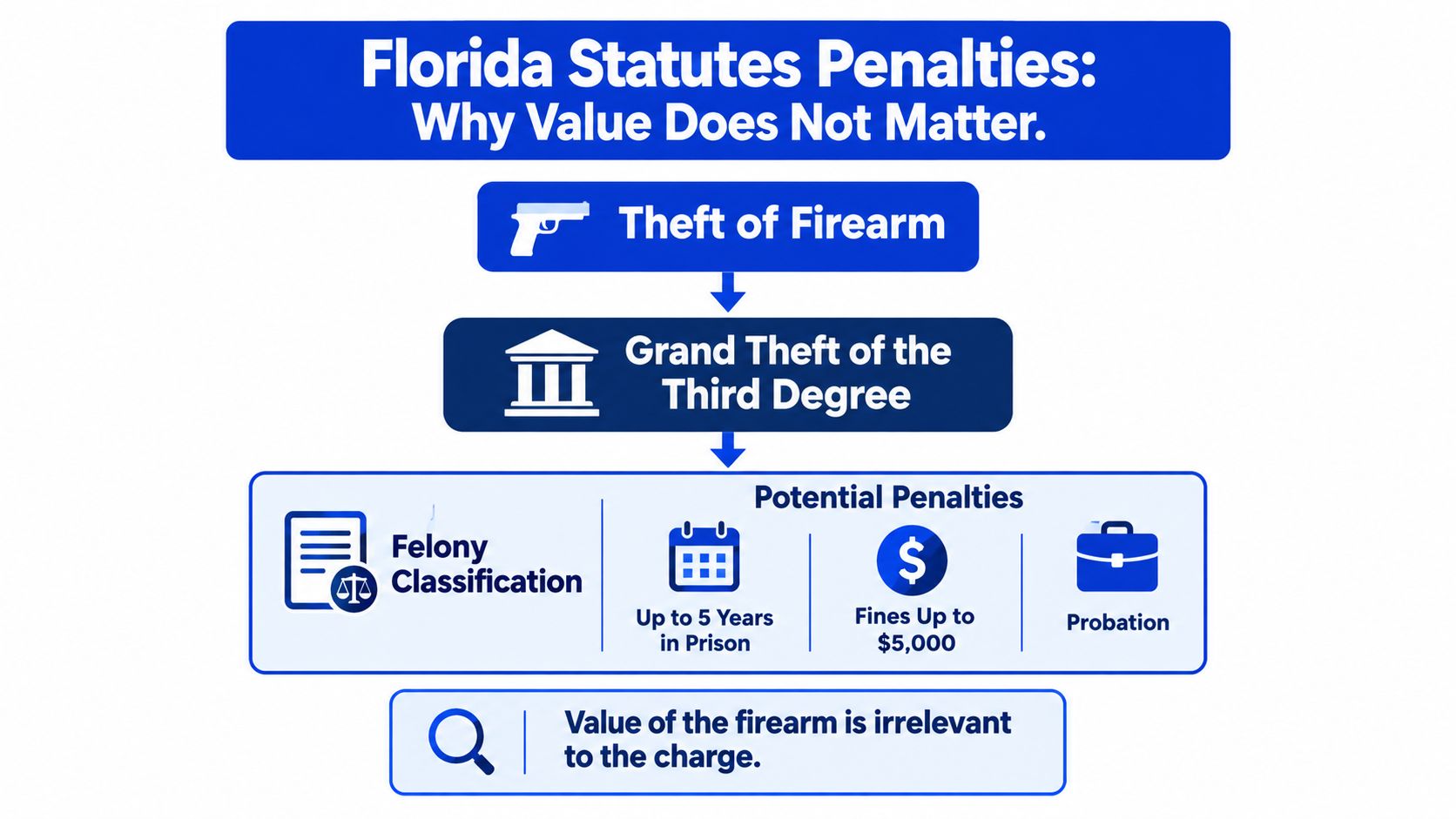
Florida categorizes theft of a firearm as grand theft in the third degree, a felony of the third degree. The statute does this because a firearm is an enumerated item, not because prosecutors first need to establish that the gun exceeded a particular value. The offense-ranking chart confirms that section 812.014(2)(c)5 is separately listed as a third-degree felony.
This distinction matters because people often apply the wrong mental model. With many theft allegations, the value of the property helps determine whether the charge is petit theft or grand theft and may affect the degree. For a firearm, the item itself moves the allegation into the firearm-specific grand-theft provision. The question isn't whether the gun was expensive enough. The question is whether the State can prove the theft of a firearm as defined by Florida law.
Felony exposure and practical consequences
A third-degree felony can expose a person to significant consequences, including incarceration, probation, fines, court supervision, and a permanent criminal record if there's a conviction. The potential statutory maximum associated with a third-degree felony is up to five years in prison and a fine of up to $5,000, although the actual sentence depends on the charge, criminal history, scoresheet issues, facts, judicial rulings, and negotiated resolution. Those penalty figures are described in Florida's felony classification framework and should be reviewed with counsel in the context of the specific case.
A conviction can also affect employment, housing, education, travel, professional licenses, and firearm possession rights. Those consequences may extend beyond the sentence imposed in court. A person who has been accused, however, hasn't been convicted, and the defense process is designed to test the State's proof rather than assume guilt.
The firearm's price may be disputed, but that dispute usually doesn't answer the central charging question under section 812.014(2)(c)5.
Potential outcomes vary. Some cases are dismissed when evidence fails, witnesses change their accounts, ownership or permission is established, or a search is found unlawful. Other cases resolve through negotiations, sentencing, or trial. A person may also need to evaluate eligibility for record sealing or expungement later, but those options depend on the final disposition and statutory requirements.
For a broader review of Florida theft and property-crime representation, see the Florida theft and property crimes hub. The key point is simple: do not build a defense around the gun's purchase price alone. The legal analysis must address every element and every piece of evidence.
Related Charges That Often Accompany Firearm Theft
A firearm investigation may produce more than one theory of criminal liability. The State might allege that a person took the gun, transferred it, possessed it while legally prohibited from doing so, carried it unlawfully, or entered a location to obtain it. Whether those charges apply depends on the evidence, the person's status, and the circumstances of the alleged conduct.
The charges aren't interchangeable. Each has its own elements, and the defense must test them separately.
Common related charges alongside theft of firearm
Charge | Key Element | Classification |
|---|---|---|
Grand theft of a firearm | Unauthorized taking or use of a firearm with the required theft intent | Third-degree felony under section 812.014(2)(c)5 |
Dealing in stolen property | Trafficking, selling, transferring, or otherwise dealing with property known to be stolen | Classification depends on the alleged conduct and governing statute |
Unlawful possession by a prohibited person | Possessing a firearm while subject to a legal prohibition | Classification depends on the specific prohibition and statute |
Carrying a concealed firearm | Carrying a firearm concealed in circumstances prohibited by Florida law | Classification depends on the facts and applicable statute |
Burglary or trespass | Entering or remaining in a structure, conveyance, or property without authorization, with the required intent | Classification depends on the location, intent, and statutory circumstances |
A person accused of stealing a firearm isn't automatically guilty of dealing in stolen property. That additional allegation may require proof of a later transfer or other qualifying transaction, along with knowledge or the required mental state. The Florida dealing-in-stolen-property defense resource provides context for why prosecutors must prove more than possession.
Why charge overlap matters
Suppose police say a firearm disappeared from a vehicle, then later claim that someone carried a similar weapon, gave it to another person, or entered a locked area. Each fact may lead investigators toward a different charge. But a report's narrative isn't proof by itself. The defense must compare the timeline, witness accounts, physical evidence, video, messages, and forensic results.
Possession charges also raise separate legal questions. The State may need to prove actual or constructive possession, knowledge, and the person's prohibited status. A gun found in a shared home or vehicle may create an inference dispute, but shared access doesn't automatically establish exclusive control.
Where prosecutors file multiple counts, counsel must examine whether the charges are supported, whether evidence overlaps, and whether motions or negotiations can narrow the case. A careful defense doesn't treat the most serious-sounding allegation as the only issue. It identifies what each count requires and where the State's proof falls short.
What Happens After an Arrest From Bail to Discovery
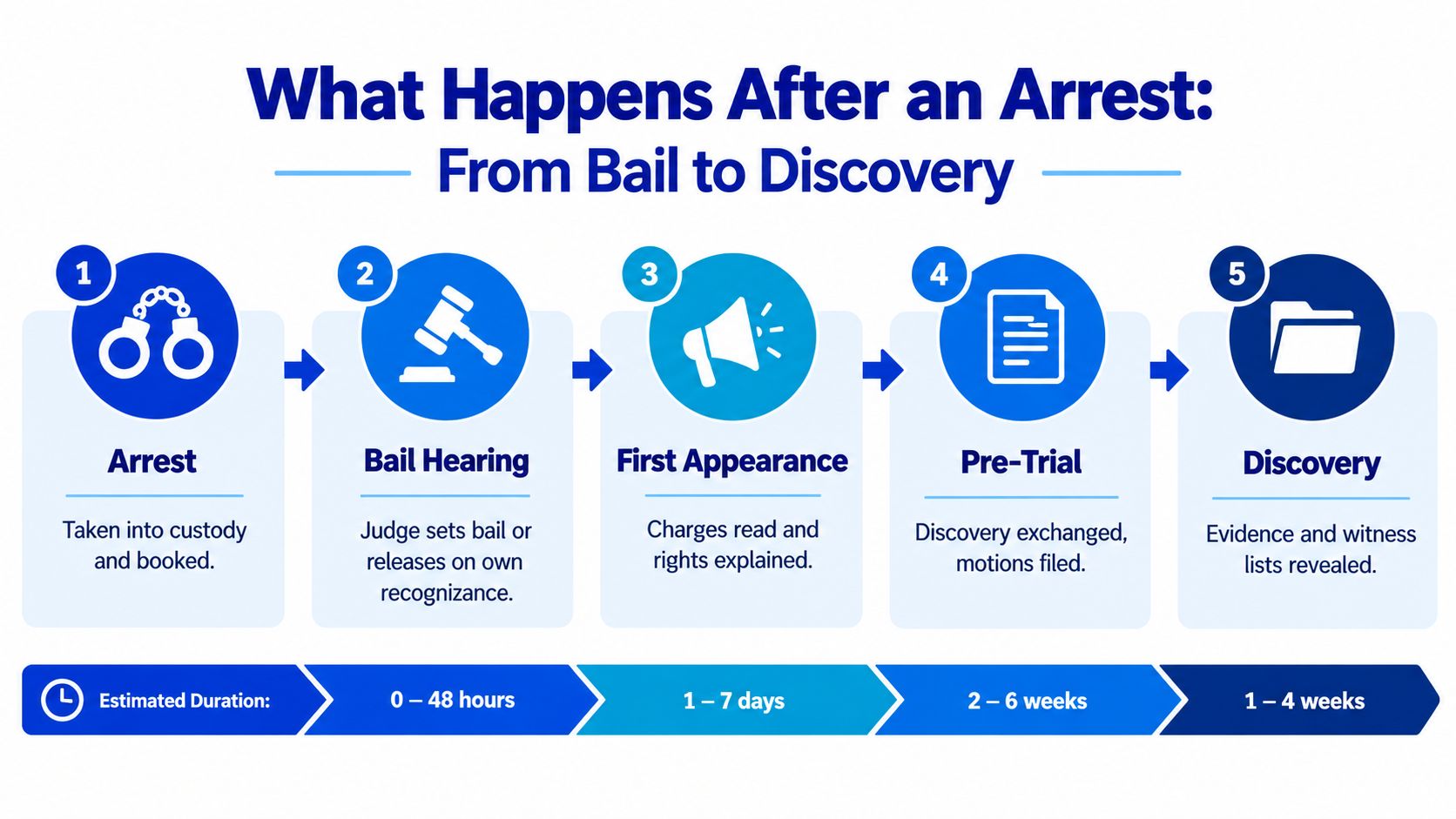
An arrest starts a legal process, not a final result. The first hours can be confusing because police, jail staff, prosecutors, and judges each handle different parts of the case. Your choices during that period can affect what evidence exists and how your attorney approaches the defense.
The initial custody period
After booking, officers may seek information about the firearm, the alleged owner, other people involved, and where the gun may be located. You have constitutional rights, including the right to remain silent and the right to counsel. Give identifying information required by the process, but don't provide an investigative interview without legal advice.
The court then addresses release and custody issues. Depending on the circumstances, a judge may set bail, impose conditions, or release a person on their own recognizance. Conditions can include no-contact requirements, travel restrictions, supervision, or restrictions related to weapons. Violating a release condition can create a separate problem, so read every condition carefully.
First appearance and arraignment
At first appearance, the judge addresses the arrest, rights, release, and immediate conditions. Arraignment is the stage at which the formal charge is addressed and a plea is entered. The details vary by courtroom and case posture, but you generally shouldn't use either hearing to tell your side of the story.
The Florida guide to what happens after arrest offers additional procedural context. Your attorney can also determine whether a written plea, a waiver, or another filing is appropriate.
Discovery and pretrial litigation
Discovery is the evidence-exchange phase. Your lawyer may obtain police reports, witness statements, photographs, video, dispatch information, property records, firearm documentation, search-warrant materials, and other items the prosecution must disclose. The defense may also investigate independently, identify witnesses, preserve surveillance, and compare statements against the timeline.
Pretrial motions can challenge evidence before trial. A suppression motion may address an unlawful stop, search, seizure, or statement. Other motions may concern identification, authentication, admissibility, or the State's ability to prove an element.
Don't contact the accuser: Messages can be misunderstood, preserved, or presented out of context.
Preserve original evidence: Keep phones, receipts, messages, access records, and photographs in their original form.
Follow release conditions: Ask counsel before possessing, carrying, or handling firearms if an order restricts that conduct.
Record your memory: Write down dates, locations, people present, and what officers said before details fade.
The case may proceed toward negotiation or trial. A responsible decision requires reviewing discovery, assessing legal motions, and understanding the consequences of each available resolution.
Defenses Evidentiary Issues and How Cases Are Challenged
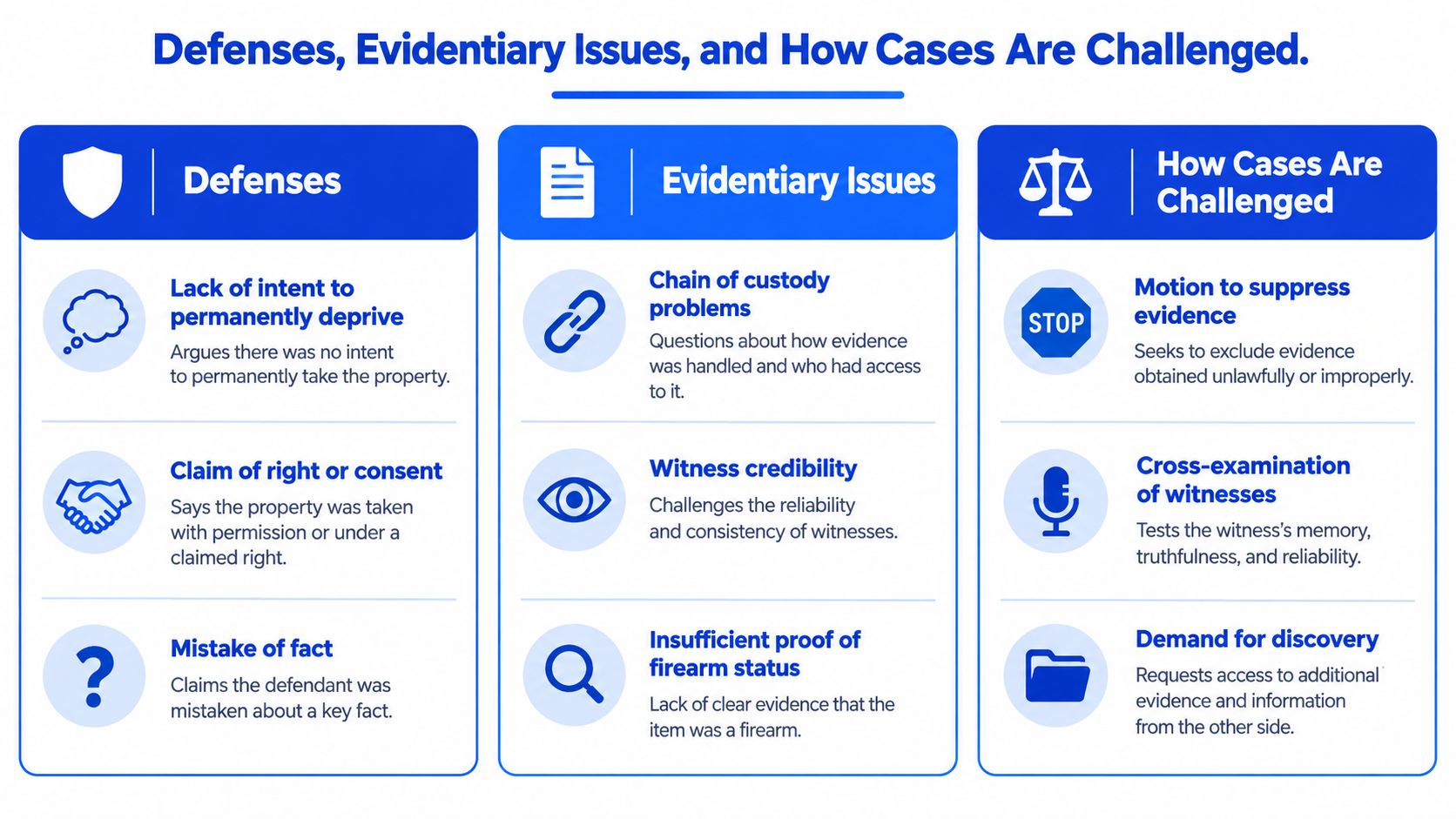
A strong defense begins by separating suspicion from proof. The fact that a firearm is missing, or that you were connected to the owner, doesn't automatically establish that you took it with criminal intent. The State's evidence must be tested element by element.
Defenses based on intent and authorization
Lack of intent can matter when the evidence supports borrowing, temporary possession, an honest mistake, or an agreement to return the firearm. A disagreement after lawful possession doesn't automatically prove that the original possession was theft.
Claim of right or consent may arise when the owner authorized access, allowed use, or gave mixed instructions. Text messages, household practices, purchase documents, and testimony can help clarify whether the alleged taking was unauthorized.
Mistake of fact can apply when a person reasonably misunderstood ownership, permission, or the identity of the item. The defense must evaluate whether the mistake fits the surrounding evidence, not merely whether someone later describes it that way.
Evidence problems that can change the case
The firearm's identity may be disputed. Police must connect the recovered item to the alleged theft, and serial-number records, photographs, purchase records, and chain-of-custody documentation can become important. A gap in handling or documentation may affect whether the evidence is reliable or admissible.
Witness credibility also requires careful review. People may remember events differently, repeat assumptions as facts, or have personal reasons to accuse someone. Prior statements, inconsistent timelines, surveillance footage, and communications can expose those weaknesses.
Reporting and recovery gaps
National theft data also show why timing and documentation matter. ATF reported that 1,074,022 firearms were reported stolen from 2017 through 2021, including 1,026,538 taken from private citizens, 34,339 stolen from federally licensed dealers, and 13,145 stolen in interstate shipments. ATF's National Firearms Commerce and Trafficking Assessment also described about 215,000 guns documented as stolen and reported each year during that period.
Recovery may become more difficult with time. ATF reported that 45% of recovered firearms tied to originating FFL theft incidents were recovered within 90 days and 62% within one year, with recovery dates recorded for nearly 99% of recovered firearms between 2017 and 2021. The ATF firearm-theft recovery analysis supports the practical lesson: preserve serial numbers, report a loss promptly, and document lawful possession before memories and records disappear.
Defense challenges may include a motion to suppress, cross-examination, a demand for complete discovery, and an independent investigation. None guarantees dismissal, but each can reveal whether the accusation rests on admissible, dependable proof.
Protecting Your Rights Outcomes and How a Defense Attorney Helps
The case's outcome may range from dismissal to a negotiated plea, diversion where legally available, a reduction, trial acquittal, or sentencing after a conviction. Later sealing or expungement may be possible in some circumstances, but eligibility depends on the disposition, prior record, statutory rules, and agency or court requirements. No attorney can promise which path applies before reviewing the case.
Your immediate conduct matters. Don't discuss the facts with police, the alleged victim, friends who may become witnesses, or anyone online. Preserve evidence, comply with release conditions, avoid deleting messages, and tell your attorney about prior firearm possession, household access, searches, and statements. If another charge involves prohibited firearm possession, the Florida felon-in-possession defense resource addresses a separate legal theory that must be evaluated independently.
Ticket Shield, PLLC, led by former prosecutor Jason S. Goldsmith, represents clients facing theft and weapons allegations in Broward County, Fort Lauderdale, Miami-Dade, Palm Beach, and surrounding Florida communities. The firm reviews searches, statements, ownership records, witness accounts, and charging decisions, and it handles negotiations, motions, court appearances, and trial preparation based on the evidence rather than promises.
If you're facing a theft of firearm investigation or charge, contact a Florida criminal defense attorney before answering questions or making decisions about the case. Early legal advice can help preserve evidence, protect constitutional rights, and identify whether the State can prove every required element.
If you're accused of theft of firearm in South Florida, Ticket Shield, PLLC offers direct criminal defense guidance, evidence review, and representation during the investigation and court process. Visit the firm to request a free consultation and discuss your arrest, accusation, release conditions, and next steps with an attorney.