Explicación del plazo de prescripción en Florida para demandados
Jason Goldsmith, Abg.
You get a call, a text, or a message from someone you haven't heard from in years. Then comes the part that makes your stomach drop: they say police are asking questions about something that allegedly happened a long time ago.
In that moment, many ask the same thing. Can they still charge me now?
In Florida, that question often turns on the statute of limitations. That phrase sounds technical, but it's really about time. The State doesn't get forever to bring every criminal case. In many situations, if prosecutors miss the deadline, the case can be barred.
That's why the statute of limitations Florida rules matter long before a courtroom date. If you live in Broward County, Fort Lauderdale, Miami-Dade, Palm Beach, or anywhere else in South Florida, understanding that deadline can change how you respond to investigators, what records you keep, and when you need a defense lawyer involved.
Table of Contents
What the Statute of Limitations Means in Florida Criminal Law
Florida Criminal Time Limits by Offense Level and Charge Type
Tolling Exceptions and Extended Deadlines That Change the Clock
How Time Limits Affect Charges Dismissals and Defense Strategy
How to Verify Your Deadline and Protect Your Case in Florida
How Florida Statute of Limitations Protects Your Rights
A delayed criminal accusation creates a real problem for the defense. Memories fade. Phones get replaced. Messages disappear. Witnesses move. Surveillance footage is overwritten. That's exactly why limitations periods exist.
Think about a person who learns today that detectives are reviewing an accusation tied to an old falling-out, a past business dispute, or an incident from years ago. The first instinct is panic. The second is often confusion. People assume that if police are investigating, the State must still have time to file. That isn't always true.
The statute of limitations works as a safeguard against stale prosecutions. It forces the government to act within the time the law allows. When the deadline has passed, that timing issue can become a defense weapon, not just a procedural footnote.
Why this matters before an arrest
A lot of people think deadlines only matter after charges are filed. In practice, timing can shape the whole case much earlier.
If officers contact you early enough, your lawyer can start checking dates, records, and the exact offense being investigated.
If the filing window is close, even a small mistake in the State's timeline may matter.
If the deadline has already expired, the defense may be able to challenge the case before it gains momentum.
Florida uses a tiered limitations system, and different charges can have very different deadlines. Some charges have standard filing periods. Others have longer periods, and some have no time limit at all. If you want a broader overview of how these rules fit into Florida criminal laws, it helps to see the statute of limitations as part of the larger framework that protects the accused.
Practical rule: Never assume an old allegation is either safely expired or automatically valid. The date, the charge, and the statute all have to match.
That's the part many people miss. In a criminal case, one calendar mistake can change everything.
What the Statute of Limitations Means in Florida Criminal Law
A detective calls about something that supposedly happened years ago. You have not been arrested. You may not even know whether charges are coming. In that moment, the statute of limitations stops being an abstract rule. It becomes a question with teeth: did the State run out of time?

Start with the date the legal clock began
In Florida criminal law, the statute of limitations sets the filing window for a case. Under Florida's general limitations statute, the clock usually starts the day after the crime is complete, as stated in section 775.15. If prosecutors start the case before that deadline, the prosecution can go forward. If they start too late, the missed deadline can become a defense tool to block the charge.
That sounds simple until you ask one hard question. When was the offense complete?
For a one-night incident, the answer may be obvious. For conduct alleged to have happened over weeks or months, the answer can shift the deadline in a meaningful way. Florida Senate analysis explains that a continuing offense accrues when the conduct ends, not necessarily when it first began, according to this Florida Senate bill analysis.
Filing a case is what matters
A police investigation does not stop the clock. Suspicion does not stop it either. What matters is whether the State legally commenced the prosecution within the allowed time.
That point causes a lot of confusion because people often mix up being arrested, being charged, and being indicted. Those events are related, but they are not the same. If you need a clear timeline, this explanation of the difference between being indicted and being arrested helps sort out what starts a criminal case.
Use a defense-lawyer checklist
If I were reviewing this issue for a client, I would check three things in order:
The exact charge being considered. The deadline depends on the offense level and sometimes on a special statute for that specific crime.
The true completion date of the alleged conduct. The first date in a police report is not always the date that controls.
The date the State officially began the prosecution. That is the point that decides whether the filing was timely.
A statute of limitations argument works a lot like checking whether a train left the station before the gate closed. The accusation may be serious. The evidence may be strong. But if the State missed the legal cutoff, timing itself can defeat the case.
That is why this issue deserves attention before charges are filed, not only after an arrest.
Florida Criminal Time Limits by Offense Level and Charge Type
A lot of people hear "statute of limitations" and picture an abstract rule buried in a law book. In practice, it works more like a gate. If the State tries to file after the gate closes, that deadline can become a powerful defense tool.
Florida uses a tiered system. The first question is the offense level. The second is whether the charge falls under a special rule that changes the usual deadline.
Florida Criminal Statute of Limitations by Offense Classification
Offense Classification | Filing Deadline | Legal Basis |
|---|---|---|
First-degree felony | Within 4 years | |
Any other felony | Within 3 years | Same statute |
First-degree misdemeanor | Within 2 years | Same statute |
Second-degree misdemeanor or noncriminal violation | Within 1 year | Same statute |
Those are the starting points, not the end of the analysis.
The classification matters because two cases that sound similar in everyday conversation may sit in different legal boxes. One box gives prosecutors more time. Another gives them less. If you are sorting out the lower-level side of the system, this guide to Florida misdemeanor charges helps explain how those offenses are categorized.
Here is the practical defense point. You do not verify the deadline by saying, "It was a felony, so the State had three years." You verify it by matching the alleged conduct to the exact statute, then checking whether that statute follows the general tier or a special deadline.
Some charges do have special time limits. Florida law lists examples such as certain felony violations in chapters 517 and 403 with 5-year limits, some offenses under section 825.102 with 4-year limits, and felony violations of sections 440.105 and 817.234 with 5-year limits.
That is why defense lawyers read the charge line carefully. A single word in the accusation can change the filing window.
Timing disputes also get more complicated when the State adjusts the charge. A prosecutor may start with one offense description, then file a different count or amend the wording later. If the later version depends on a different statute or offense level, the limitations analysis can change with it.
A good way to view this section is by risk level. General categories give you a rough estimate. The exact statute gives you the answer. If the filing came after the correct deadline, the clock may bar the prosecution even before the case gets traction.
Tolling Exceptions and Extended Deadlines That Change the Clock
A statute of limitations is a clock. Tolling is what happens when the law pauses that clock, delays its start, or removes it entirely for certain charges.
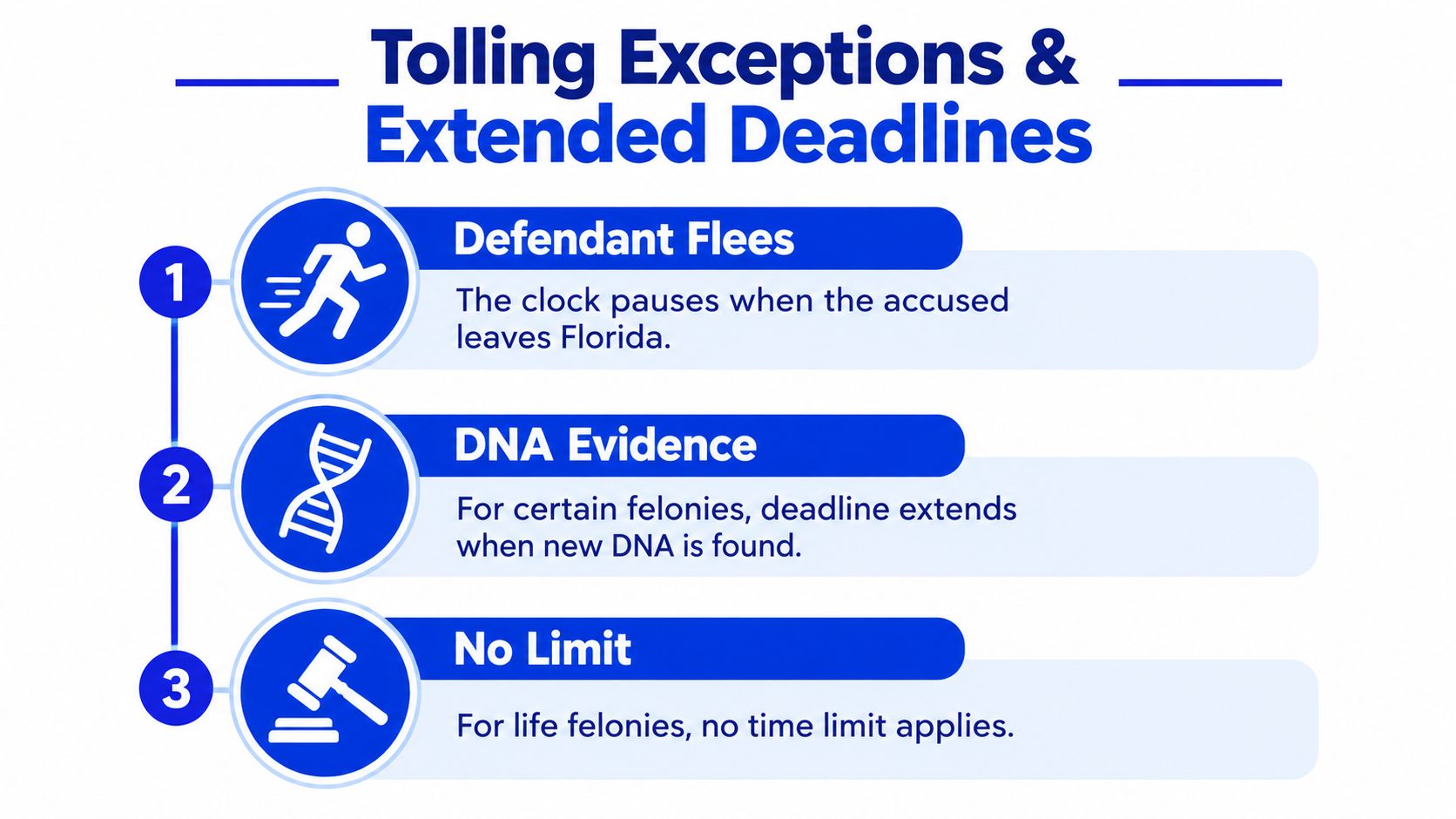
For the defense, this is the part that decides whether an old allegation is beatable on timing grounds. A case can look stale at first glance and still be timely if a special rule changed the clock. The reverse is also true. The State may rely on a broad date range or a serious-sounding accusation, but the deadline still has to fit the exact rule that applies.
Crimes that can be prosecuted at any time
Some Florida charges do not expire. Under Florida law, prosecutions for a capital felony, a life felony, or a felony that resulted in death may be filed at any time.
That matters because people often check a general felony chart and stop there. In these categories, the ordinary filing window does not help. If investigators are looking at one of these offenses, a limitations defense may be off the table, and the defense has to focus on other pressure points instead.
Sexual battery cases can use different starting points and no-limit rules
Sexual battery cases often create the most confusion because the deadline rules can change based on the victim's age, the degree of the offense, and when the matter was reported.
Florida legislative analysis has described several situations with no statute of limitations, including sexual battery involving a victim under 16, certain first-degree felony sexual battery charges involving a victim under 18, and some first- or second-degree felony sexual battery charges involving a victim age 16 or older when the offense is reported within the required time frame. The same analysis explains that when the victim is under 18, the clock may not begin until the victim turns 18 or the offense is reported to law enforcement or another governmental agency, whichever happens first, as summarized in this Florida policy summary on sexual battery limitations rules.
That is why defense lawyers do not just ask, "How old is this case?" They ask, "When did the legal clock start, if it started at all?"
What tolling means in practice before charges are filed
If you are worried charges might be coming, do not assume the incident date gives you the answer. Start with four facts:
The exact statute investigators appear to be considering
The alleged date, or date range, of the conduct
Whether the accusation involves a category with no deadline
Whether a special rule delayed the start of the clock
If the State missed the statute of limitations deadline, that can block prosecution before the case gets real momentum. But you only get that benefit if you verify the right date, the right offense, and the right exception.
If your case is already past trial or plea and you are sorting out later-stage deadlines instead, this guide to Florida post-conviction relief options and filing rules covers a different part of the process.
How Time Limits Affect Charges Dismissals and Defense Strategy
Once a case is filed, the statute of limitations stops being an abstract deadline and becomes a litigation issue. The defense has to test whether the charging document was timely, whether the offense date is accurate, and whether the State is relying on a valid exception.
How a limitations defense is used in practice
In real cases, the defense usually starts by comparing a few basic documents and facts:
The charging document. What exact offense did the State file?
The alleged date or date range. Is it specific, vague, or internally inconsistent?
The statute behind the count. Does it use the general deadline or a special one?
The State's likely tolling argument. Is the prosecution claiming the conduct continued longer than the defense believes?
A former prosecutor looks at this differently than someone seeing the system for the first time. Prosecutors often draft around timing problems if they think they can support a later end date or a different charge classification. Defense counsel has to pressure-test that decision.
What dismissal fights often turn on
Sometimes the issue is simple. The alleged conduct happened on one date, the charge was filed after the legal deadline, and no exception fits.
More often, the fight centers on details such as whether the alleged conduct was continuous, whether the offense was charged under the correct statute, or whether the State is trying to stretch the timeline. A careful date review can expose weaknesses that aren't obvious from the arrest paperwork alone.
A statute of limitations defense is often won in the paperwork before it's argued in open court.
This is also why people shouldn't wait for arraignment to get answers. Early legal review gives the defense time to preserve messages, travel records, employment records, call logs, and anything else that fixes the timeline in place.
A short video can help put the courtroom side of criminal defense in perspective:
What you should do if you think the deadline passed
Don't explain the timeline to police on your own. Even truthful statements can accidentally supply facts the State didn't have.
Pull records while they still exist. Old calendars, emails, texts, bank statements, and employer records can matter.
Get the actual charge reviewed. The defense analysis depends on the statute, not the rumor about the statute.
When timing is favorable, the defense can use it to seek dismissal, limit exposure, and protect your constitutional rights before the case becomes harder to contain.
How to Verify Your Deadline and Protect Your Case in Florida
The hardest part isn't learning that a deadline exists. It's figuring out which deadline applies to their own case.
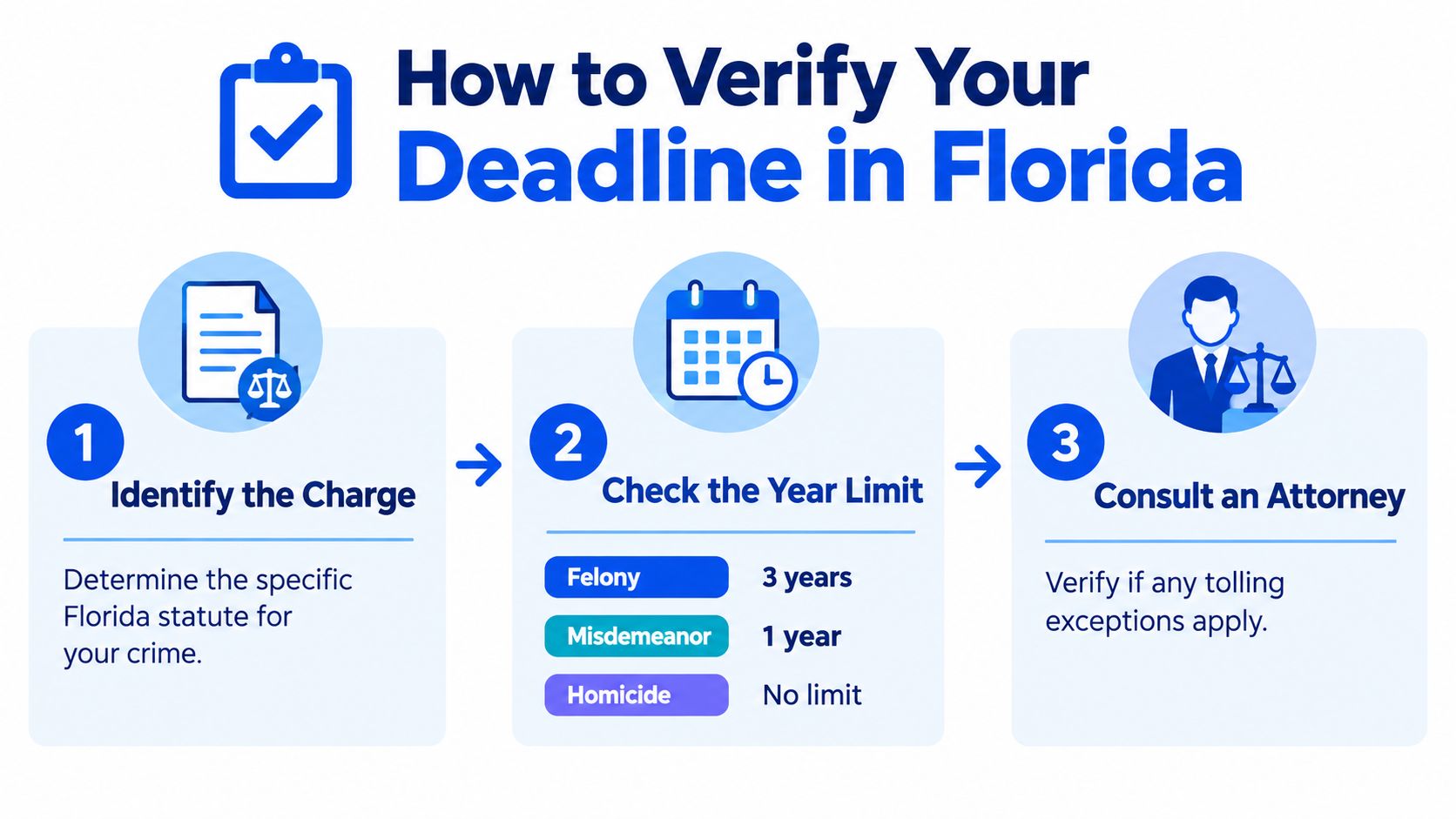
A workable way to check the timeline
Start with the documents, not assumptions. An arrest affidavit, notice to appear, capias, information, indictment, or even a detective's reference to a statute number can help identify the charge being considered.
Then build the timeline in this order:
Pin down the statute first. “Theft,” “battery,” or “fraud” may be too broad to calculate anything accurately.
Mark the alleged offense date carefully. If the accusation spans a range of dates, note the first and last date the State may rely on.
Check whether the offense is alleged as a continuing course of conduct. That can affect when the clock began to run.
Look for special categories. Some charges don't use the ordinary framework people expect.
Records that often matter
People under stress usually focus only on the accusation itself. The better move is to collect anything that helps anchor dates.
Useful items may include:
Phone records that show contact or lack of contact
Work schedules and payroll records
Travel confirmations and location history
Court paperwork from related family, civil, or injunction matters
Digital messages with timestamps
Medical or school records if they help establish where people were and when
Legal review should happen early
The sooner a Florida defense lawyer reviews the timeline, the more options you usually have. In a pre-charge investigation, counsel can sometimes identify a limitations issue before formal filing. In a pending case, counsel can evaluate whether dismissal arguments are available and whether the State's dates hold up.
One option for that kind of review is Ticket Shield, PLLC, which evaluates criminal cases across Broward, Miami-Dade, Palm Beach, and statewide with attention to charging documents, offense dates, and potential defenses. The goal isn't guesswork. It's matching the facts to the right Florida statute and testing whether the prosecution acted in time.
Bring every document you have, even if it seems minor. In limitations questions, small date details often decide big legal issues.
Taking the Next Step When Time Is on Your Side
If you're worried about an old allegation, don't treat the statute of limitations as a side issue. In many cases, it's one of the first things a defense lawyer should examine.
The right analysis is practical. Identify the exact offense. Confirm when the conduct legally ended. Check whether the charge falls under the standard deadline or a special rule. Then test whether the State filed on time. That process can reveal defenses that aren't obvious from the police version of events.
It also helps to think beyond the immediate panic. A criminal charge can affect work, family, reputation, firearm rights, immigration consequences, and future background checks. If time is on your side, you want to protect that advantage early, not after the State has shaped the record.
For some people, the next concern is what happens if the case doesn't go away and how it may affect a future record. If that becomes relevant later, this guide to record sealing in Florida is a useful starting point.
The bottom line is simple. Statute of limitations Florida issues are highly specific, and they can be powerful. But they only help if someone checks the dates, the charge, and the exceptions before valuable evidence disappears.
Ticket Shield, PLLC helps people in Broward County, Fort Lauderdale, Miami-Dade, Palm Beach, and throughout Florida evaluate whether criminal charges were filed on time and how timing affects defense strategy. If you need a careful review of dates, charging documents, and possible statute of limitations defenses, visit Ticket Shield, PLLC to learn more and request a consultation.