
Hurto en un vehículo motorizado: Guía de la ley de Florida
Jason Goldsmith, Abogado
If police just showed up at your home, called your phone, or handed you paperwork about a vehicle break-in, your mind is probably racing. Some hear words like "car burglary" and assume the case is simple. It usually isn't.
In Florida, burglary of a motor vehicle is not just about whether something was missing from a car. The State has to prove a specific burglary charge under Florida law, and that opens real room to fight. I handled these cases as a prosecutor, and I defend them now. The difference between a bad police report and a provable felony matters more than many realize.
Table of Contents
A Knock at the Door and a Charge You Did Not Expect
It's 6 a.m. Officers are outside a Sarasota apartment. They say a nearby vehicle was entered overnight, someone identified you, and they want you to step outside and answer a few questions. That moment feels like the case is already over.
It's not.
Under Florida law, this charge usually falls under burglary of a conveyance. A conveyance includes more than a car. Florida defines a conveyance to include a motor vehicle, ship, vessel, railroad vehicle or car, trailer, aircraft, or sleeping car under Florida's burglary statute definitions. The legal issue is not just whether someone says you were near a vehicle. The State must prove an entry or unlawful remaining in that vehicle with intent to commit an offense inside.
What the charge really means
A lot of people confuse this charge with auto theft. That's a mistake. The FBI treats burglary and motor vehicle theft as different categories. Burglary involves unlawful entry into a structure to commit a felony or theft, while motor vehicle theft involves theft or attempted theft of a self-propelled vehicle under the FBI Uniform Crime Reporting framework. In plain English, taking a wallet from a parked car and stealing the whole car are not the same crime.
That distinction helps the defense because prosecutors still have to prove intent at the time of entry, not just suspicious circumstances after the fact.
Practical rule: If police contact you before arrest, your first job is to stop helping them build the case.
What you should do immediately
Three decisions matter right away:
Stay silent: Give your name and basic identifying information if required, then say you want a lawyer.
Refuse consent searches: If officers ask to search your phone, apartment, vehicle, or bag, say no.
Do not explain: People talk themselves into charges by trying to sound cooperative.
An arrest notice is not a conviction. A witness can be wrong. Video can be unclear. Police often jump from "you had property" to "you intended burglary." Those are not the same thing, and a careful defense starts by treating them as separate issues.
The Four Legal Elements Florida Must Prove
Florida burglary cases are won and lost on elements. If the State misses even one, the charge should fail. That's why I focus less on the label in the arrest report and more on what the prosecutor can prove.
Here's the visual version first.
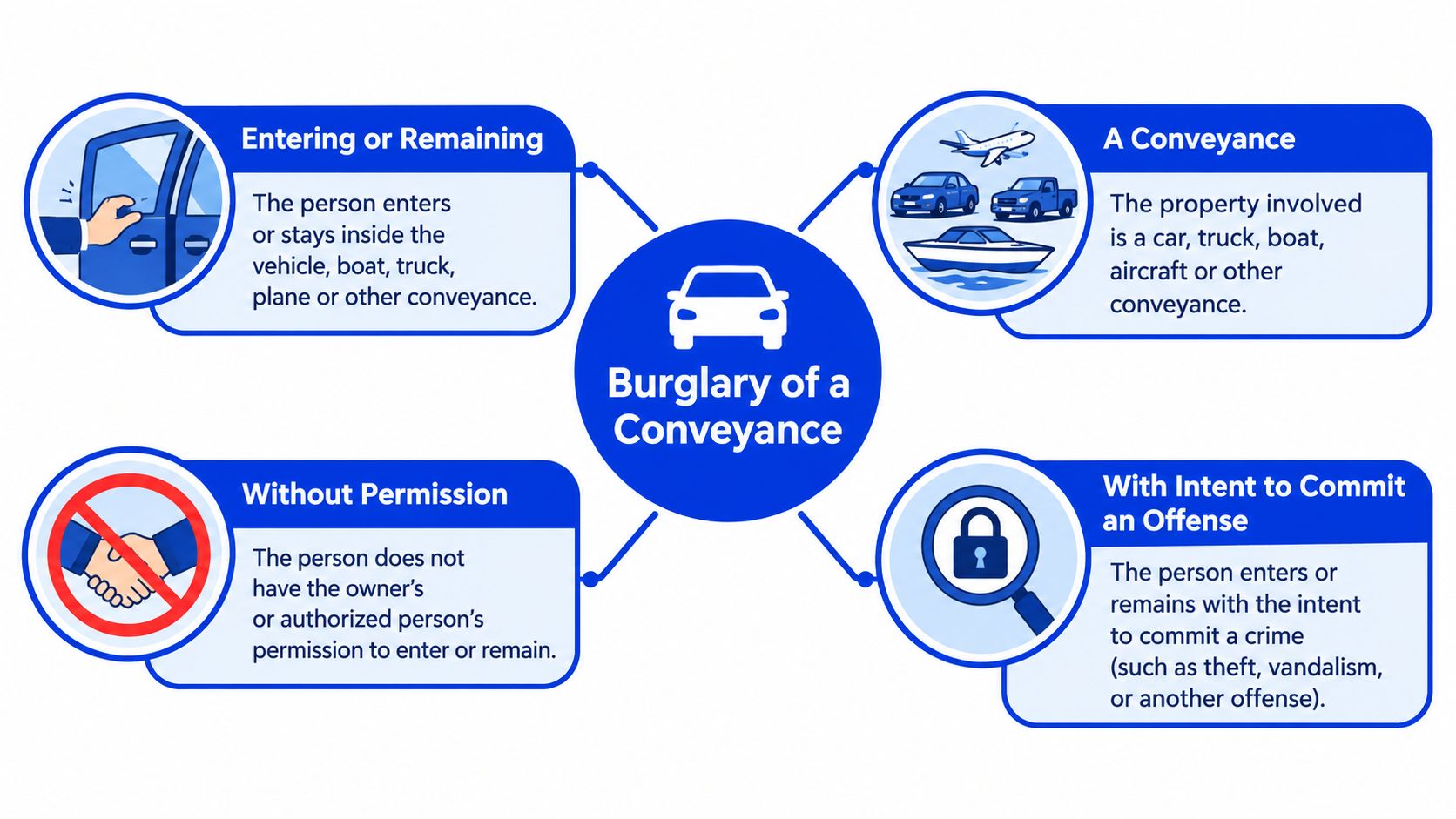
Entry or remaining
The first question is simple. Did the person enter the vehicle, or stay inside when they had no right to remain?
Entry does not require climbing fully into the car. Even partial entry can become the issue. Florida's burglary jury instruction also recognizes that entry into a conveyance includes taking apart any portion of the conveyance, which matters in close cases involving door panels, windows, trunks, or vehicle parts under Florida burglary law and jury instruction language.
A plain example helps. Reaching an arm through a broken window to grab property creates a different legal problem than standing next to the car holding property someone else already removed.
A conveyance under Florida law
Not every case involves a standard sedan. Florida's definition of conveyance is broad. It can include:
Passenger vehicles such as cars and SUVs
Work vehicles such as vans or trucks
Water and air transport such as vessels or aircraft
Trailers and rail vehicles in the right fact pattern
That matters because the charge doesn't disappear just because the object wasn't a traditional car.
Without permission or after permission ends
Many weak cases get overcharged. The prosecutor may claim the entry was secretive, unauthorized, or that permission ended and the person stayed anyway. Think about a person who was allowed near the vehicle but then started digging through a console or glove box without permission. The State will argue that the lawful contact ended and the criminal conduct began.
Secretive conduct matters because juries often use behavior to infer what a person intended, especially when there is no direct confession.
Intent to commit an offense inside
This is the hardest part for the State and the most important part for the defense. Florida's standard burglary instruction says jurors may infer intent if the entry was stealthy and without consent, but they still must find that the person intended to commit an offense other than burglary or trespass inside the conveyance under the Florida burglary intent instruction discussed here.
Intent is rarely captured on video. Prosecutors usually try to build it from surrounding facts:
Time of night
Possession of tools
Movement inside the vehicle
Statements to police
What property was disturbed or missing
That's where real defense starts. Suspicion is not proof beyond a reasonable doubt.
Felony Levels and the Penalties You Are Facing
This charge is serious the moment it's filed. In Florida, burglary of an unoccupied conveyance is generally a third-degree felony, punishable by up to 5 years in prison, up to 5 years of probation, and a $5,000 fine under Florida Statute 810.02.
If another person is inside the vehicle when the entry or remaining happens, the charge can be filed as a second-degree felony, carrying up to 15 years in prison and a $10,000 fine under the same Florida burglary penalty statute. Early facts matter because prosecutors often decide the degree of the charge before the defense has had a real chance to challenge the narrative.
Why early intervention matters
People make a mistake when they look only at the maximum penalty. The actual risk in court depends on things like prior record, whether the alleged victim was present, whether there is related theft or battery conduct, and whether the facts support probation instead of prison.
A lawyer can often affect the case early by attacking the filing theory itself. If the evidence is weak on intent or occupancy, the difference between a felony burglary count and a lesser offense can be significant.
Felony tiers for burglary of a conveyance in Florida
Statutory Trigger | Felony Degree | Maximum Prison | Maximum Fine |
|---|---|---|---|
Unoccupied conveyance | Third-degree felony | 5 years | $5,000 |
Occupied conveyance | Second-degree felony | 15 years | $10,000 |
Two practical points. First, prosecutors sometimes file the highest count they think they can support and negotiate later. Second, sentencing exposure changes quickly when the case is paired with theft, criminal mischief, resisting, or probation issues.
The charge level is not just paperwork. It affects bond, plea leverage, diversion options, and how seriously the court treats your case from day one.
How Burglary of a Conveyance Differs From Theft and Trespass
A lot of clients say the same thing. "But I didn't steal the car." That may be true and still not answer the burglary allegation.
Burglary of a conveyance focuses on entry or remaining with criminal intent. Theft offenses focus on taking property or controlling property that belongs to someone else. Trespass strips away the intent element and usually centers on unauthorized presence.
Why prosecutors stack charges
One set of facts can lead to multiple counts. A person allegedly opens a truck door, reaches into the cab, and takes a wallet. The State may file burglary of a conveyance, petit theft or grand theft depending on the property, and criminal mischief if there was damage. That doesn't mean every count is strong. It means the prosecutor is preserving options.
When I review these cases, I separate each charge and ask a different question for each one. What proves entry. What proves intent. What proves taking. What proves value. That's how overcharging gets exposed.
Burglary of a conveyance vs. related Florida vehicle offenses
Offense | Key Element | Intent Required | Typical Charge Level |
|---|---|---|---|
Burglary of a conveyance | Entering or remaining in a vehicle without authority | Intent to commit an offense inside | Felony |
Grand theft auto | Taking or using the vehicle itself | Intent to deprive or appropriate | Felony |
Petit theft | Taking property from the vehicle | Intent to deprive owner of property | Usually misdemeanor |
Trespass in a conveyance | Unauthorized presence in the vehicle | No separate offense-inside intent required | Often less serious than burglary |
For a broader look at Florida theft law, see this Florida theft statute overview.
Why the distinction helps the defense
A burglary charge can be vulnerable even when a theft count survives. If the State can show someone possessed a stolen item but cannot prove when or how that person entered the vehicle, the burglary case may weaken fast. The reverse can also happen. There may be evidence of unlawful entry but weak proof that anything was taken.
That's why a defense lawyer should never negotiate this kind of case as if all vehicle-related charges are interchangeable. They aren't.
Common Fact Patterns and How They Play Out
These cases are fact-driven. The same charge can look strong on paper and collapse once you examine timing, permission, identification, and what the person did inside the vehicle.
The center console case
The owner steps away from a parked car at a gas station. A passenger or bystander is later accused of reaching into the center console. The State argues there was unauthorized entry and intent to steal.
The defense question is narrower. Was there actual entry, and at what point did any permission end? If the accused had been invited near the car or into the car moments earlier, that detail can matter more than the prosecutor wants to admit.
The unlocked SUV after a night out
A teenager is found asleep in an SUV in a residential neighborhood. Nothing is missing. No damage is found. Police still arrest for burglary of a conveyance.
This is the kind of case where intent becomes the battleground. One locality reported that 58% of completed larcenies from autos came from unlocked vehicles in 2025 according to Henrico County crime statistics. That doesn't decide a Florida case, but it does highlight a real-world problem. Opportunistic entry into a vehicle that is not secured is not the same thing as proof of planned burglary intent.
A bad fact pattern for the State often starts with an unlocked car, no forced entry, no clear statement, and no reliable evidence about why the person entered.
The contractor, repo, or access dispute
Someone with some connection to the vehicle, such as a contractor, driver, tow worker, or repo agent, enters through a window or manipulates a part of the vehicle. Prosecutors may treat it as obvious burglary. It often isn't obvious.
These cases turn on authority, scope of permission, and whether the person intended a separate offense when the entry happened. Civil disputes and criminal allegations can overlap, and police often flatten the difference.
The grainy doorbell video case
Two people appear on a Ring-style video near a pickup truck at night. One seems to pull on a door handle. Property is later found missing. Police identify suspects from clothing, a vague witness description, or social media photos.
Defense work gets technical fast:
Identification problems: dark footage, poor angles, masks, similar clothing
Timing gaps: no clear proof of when the property disappeared
Co-defendant spillover: one person's conduct gets attributed to another
Assumption stacking: police infer intent from presence alone
These are the files where reduced charges and dismissals often become realistic once the evidence gets tested instead of accepted at face value.
Defenses That Actually Weaken the State's Case
Good defenses are not slogans. They are evidence-based attacks on a specific weak point in the prosecution.
Lack of intent at the time of entry
This is often the strongest defense. The State has to prove the person intended to commit an offense inside the vehicle when they entered or remained. If the facts support confusion, mistake, intoxication, shelter-seeking, or some non-criminal reason for entry, the burglary theory may crack.
What helps:
body camera statements showing confusion rather than theft planning
no disturbed property inside the vehicle
no burglary tools
no flight, concealment, or effort to search compartments
Permission, implied consent, or mixed access
If the accused had permission to be in or near the vehicle, even in a limited way, the case may shift sharply. Shared relationships, prior use, work access, ride-share misunderstandings, and family disputes create factual gray areas prosecutors don't like trying in front of a jury.
A defense lawyer should gather texts, call logs, location data, and witness statements early. Delay hurts this defense because people delete things.
Illegal stop, search, or seizure
If officers stopped you without lawful grounds, searched your belongings without valid consent or a recognized exception, or pulled evidence from your phone or vehicle unlawfully, suppression can change the entire case. That includes property allegedly found after a bad detention.
If search issues are part of your case, review how illegal search and seizure challenges work in Florida.
Police don't get a free pass because the accusation sounds serious. Constitutional violations still matter in burglary of a motor vehicle cases.
Weak identification
Vehicle burglary cases often rely on shaky proof. A witness sees someone at night. A camera catches clothing but not a face. Officers backfill the rest.
That's not enough unless the details hold up. I look for inconsistencies between dispatch logs, police reports, body cam, and the witness's later testimony. Those cracks matter.
Mitigation that changes the outcome
Not every useful defense ends in trial. Some cases need mitigation packaged correctly. Mental health history, youth, addiction treatment, restitution ability, clean record, school enrollment, and work history can push a case toward diversion, reduced charges, or a withhold.
One Florida option among others for reviewing those issues in a burglary case is Ticket Shield, PLLC, which handles burglary defense consultations focused on charging degree, search issues, and intent evidence.
What Happens From Arrest Through Resolution
After arrest, the pace feels fast. The legal process usually isn't. That gap creates both stress and opportunity.
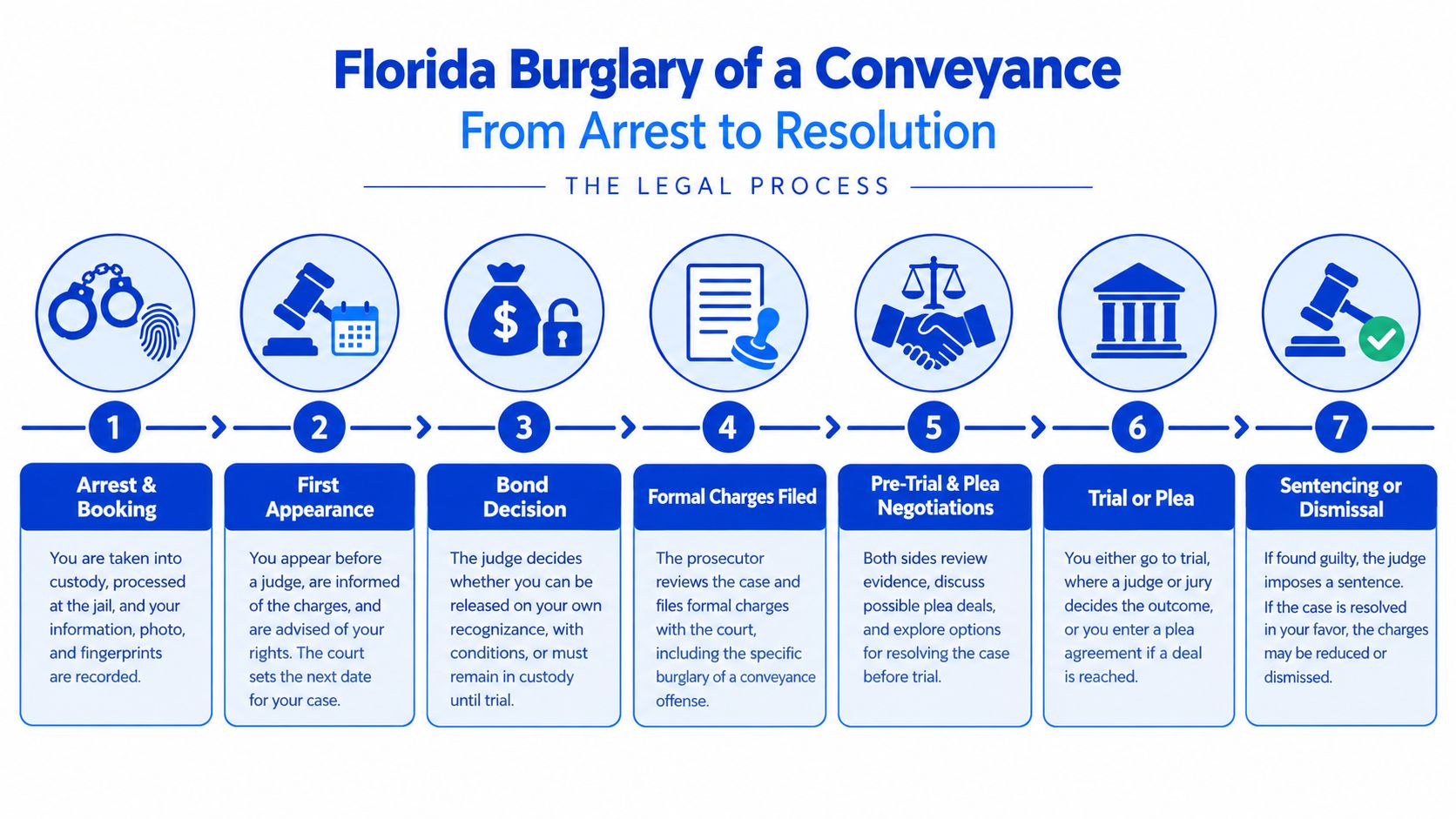
The early court stages
The first steps usually include booking, first appearance, and a bond decision. The judge looks at the charge, your history, and any public-safety concerns. Then comes arraignment, where the formal charge is addressed and the case starts moving on a court schedule.
If you need a practical overview, this guide on what happens after arrest in Florida is a useful starting point.
Where cases turn
In a burglary of a motor vehicle case, the work happens in discovery and pretrial litigation. That can include:
Body camera footage
Civilian surveillance or store video
Fingerprint or forensic submissions
Victim statements
Dispatch timelines
Photos of the vehicle and alleged damage
The Bureau of Justice Statistics found that the share of motor-vehicle thefts reported to police fell from 81% in 2022 to 72% in 2023 in Criminal Victimization 2023. That matters because delayed or incomplete reporting often creates holes in timeline proof, witness memory, and probable cause.
Possible resolutions
Many cases resolve before trial, but not all should. The key decision points include motions to suppress, motions attacking identification, requests for diversion where available, plea negotiations, and trial preparation if the State won't back off a weak theory.
Juries usually care about common-sense facts. Was there clear entry. Was there a believable reason for being there. Did the police investigation connect the right person to the right conduct. Those questions decide a lot more cases than dramatic accusations do.
Questions Families and Defendants Ask First
The first questions are usually practical. Good. That's where your focus should be.
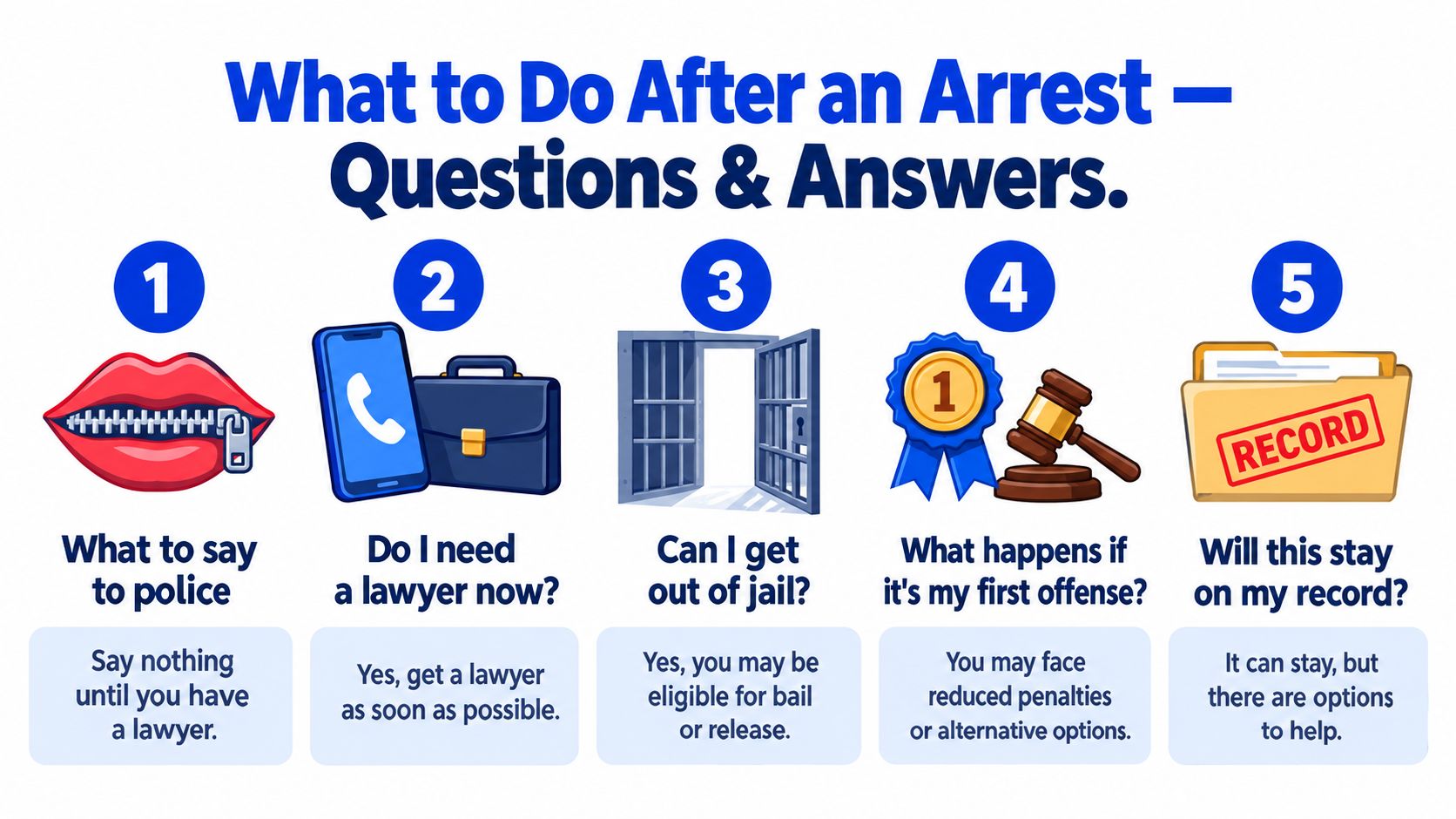
What should I say to police
Almost nothing. Be respectful. Identify yourself if required. Then say you want a lawyer and won't answer questions. That advice protects innocent people as much as anyone else.
Police may act casual. They may say they just want your side. Don't fall for that. In these cases, intent is often built from your own words.
Will this stay on my record
If you are convicted of a felony burglary offense, the consequences can follow you into jobs, housing applications, professional licensing, and background checks. A non-conviction result may create better options, but record relief depends on how the case ends and your prior history.
A lot of people wait too long to fight the charge and then ask about sealing or expungement later. The smarter move is to aim for an outcome from the start that protects your record if possible.
What if it's my first offense
A first arrest helps, but it doesn't erase the charge. It may improve the conversation around diversion, reduced charges, probation, or a withhold. It does not mean you should plead quickly just because someone says the offer is standard.
Can this affect immigration or other rights
Yes. Any non-citizen should talk to a defense lawyer who understands immigration consequences before making decisions. Collateral consequences can be more damaging than the immediate sentence. Firearm rights, school discipline, public employment, and probation status can also be affected depending on the case.
What should my family do right now
Use a checklist:
Get the case number: The clerk, jail, or arrest paperwork usually has it.
Preserve evidence: Save texts, receipts, GPS data, photos, social media, and names of witnesses.
Stop discussing facts by phone or text: Those messages can surface later.
Act quickly on counsel: Early intervention can affect bond, evidence preservation, and charging decisions.
The FBI reported that motor vehicle theft rose from 199.4 per 100,000 people in 2019 to 283.5 per 100,000 in 2023, and automobiles made up 78.1% of the top stolen vehicle types in that period according to the FBI motor vehicle theft release for 2019 to 2023. That broader environment can make police and prosecutors treat every vehicle-related case like a major theft case. Your lawyer's job is to force the court back to the actual charge, the actual evidence, and the actual weaknesses.
If you're facing a burglary of a motor vehicle charge in Broward County, Fort Lauderdale, Miami-Dade, Palm Beach, or nearby South Florida courts, Ticket Shield, PLLC can review the arrest, the charging theory, and the evidence for weak points in intent, identification, and search procedure. If you want direct, Florida-specific guidance from a former prosecutor turned defense attorney, visit Ticket Shield, PLLC.