
Cargo por agresión a un oficial de policía en Florida: lo que debe saber
Jason Goldsmith, Abg.
You were driving home. Lights hit your mirror. You pull over, answer a few questions, step out, and the stop gets physical fast. You tense up during a pat-down, pull your arm back, or say something stupid because you're angry and scared. Ten minutes later, what felt like a confused roadside mess turns into a police officer assault charge.
I've seen this from both sides. As a former prosecutor, I know how quickly these cases get stacked. As a defense attorney, I know how often the charging decision says more about strategy than guilt. In South Florida, especially in Broward, Fort Lauderdale, Miami-Dade, and Palm Beach, the label on the case matters because Florida law increases exposure when the alleged victim is a protected officer.
If you're reading this right after an arrest, focus on one thing. Don't try to talk your way out of it now. The report is already being written. Your job is to stop making the State's case stronger and start protecting yours.
Table of Contents
What Counts as a Police Officer Assault Charge
A lot of people think assault means you had to hurt someone. That's wrong, and it's one of the first traps in these cases.
Under Florida law, assault is an intentional, unlawful threat by word or act to do violence to another person, coupled with an apparent ability to do it, creating a well-founded fear that violence is imminent. Battery is different. Battery involves actual intentional touching or striking against someone's will, or intentionally causing bodily harm. When the alleged victim is a law enforcement officer or another protected official performing official duties, Florida Statute § 784.07 reclassifies the offense.
How a routine stop becomes a criminal case
A very common fact pattern looks like this. The officer says you squared up, clenched a fist, jerked away, lunged, or made a movement that caused fear. If the State claims there was actual contact, even slight contact, prosecutors may add battery on a law enforcement officer too.
That means one ugly roadside encounter can produce multiple charges from the same few seconds. If you need the basic distinction between Florida assault and battery offenses, this overview of assault and battery charges gives the foundation.
Practical rule: If the report says the officer feared immediate violence, prosecutors can pursue assault even without an injury.
The label changes the stakes
Here's the part many miss. The same conduct can carry very different consequences depending on who the alleged victim was. The protected-officer label is what drives the enhanced charge. That's why these cases aren't just about whether there was an argument, movement, or brief contact. They're about whether the State can prove the officer falls within the protected class and was acting within official duties at the time.
Florida also separates assault on an officer from battery on a law enforcement officer. Assault is the threat. Battery is the contact. Prosecutors often file both when the facts are muddy because they want options. If a jury doesn't buy the threat theory, the State still pushes the contact theory. If the contact was questionable, the State leans on the alleged fear.
That charging style is common for a reason. It increases pressure on you early, especially during bond, plea talks, and pretrial hearings.
The Criminal Elements Florida Prosecutors Must Prove
A prosecutor doesn't win this case by saying the officer felt disrespected. The State must prove each legal element beyond a reasonable doubt. If one element fails, the enhanced charge should fail with it.
The four building blocks
Think of the case as four blocks stacked on top of each other:
Protected status
The alleged victim must be one of the officials covered by Florida Statute § 784.07, such as a law enforcement officer or another listed protected officer.Lawful performance of duty
The officer must have been engaged in the lawful performance of a legal duty. Bad stops, unlawful detentions, and off-script conduct matter.Intentional act
For assault, the State must prove an intentional unlawful threat. For battery, the State must prove intentional touching or striking.Fear of imminent violence for assault
Assault requires more than harsh words. The officer must have experienced a well-founded fear that violence was about to happen.
Assault versus battery in plain English
Element | Assault on Officer (§784.07 + §784.011) | Battery on Law Enforcement Officer (§784.07 + §784.03) |
|---|---|---|
Core conduct | Intentional unlawful threat by word or act | Intentional touching or striking against will, or causing bodily harm |
Physical contact required | No | Yes |
Fear element | Yes, well-founded fear of imminent violence | No separate fear element required |
Protected victim issue | State must prove officer was covered under §784.07 | State must prove officer was covered under §784.07 |
Duty issue | Officer must be lawfully performing duty | Officer must be lawfully performing duty |
Defense pressure points | No real threat, no imminent fear, no apparent ability | Accidental contact, no intentional touching, disputed contact |
Where the State's proof often breaks down
Florida prosecutors like these charges because juries tend to give officers the benefit of the doubt at first. But these cases aren't bulletproof. The weak spots are usually obvious once you stop reading only the arrest report.
Unlawful stop: If the detention itself was unlawful, the State can have a serious lawful-duty problem.
Off-duty confusion: If the officer wasn't clearly acting in an official capacity, protected status may be contested.
Fake intent: People flinch, pull away, brace themselves, and lose balance. Not every movement is an intentional threat.
Consensual encounter drift: A conversation becomes a detention without legal justification, then the officer claims resistance.
If the allegation is aggravated or the State is trying to stretch ordinary conduct into a more serious violent offense, review Florida's treatment of aggravated assault charges because prosecutors often use that threat to gain an advantage in negotiations.
Under federal law, 18 U.S.C. § 111 also shows how much charging can turn on physical contact. It creates separate exposure tiers, from up to 1 year for simple assault to up to 8 years when there is physical contact or intent to commit another felony under 18 U.S.C. § 111. Florida cases aren't charged under that federal statute in ordinary state court, but the lesson is the same. Contact changes everything.
Felony Degrees, Mandatory Minimums, and Real Penalties
You get arrested after a tense street encounter, hear the word "assault," and assume you are looking at a minor case. Then the charging document lands. The officer's status changes the level of the offense, and a case that sounded manageable can suddenly carry felony exposure and mandatory prison time.
That is the trap in Florida officer cases. The label does not tell you the risk. The reclassification statute does.
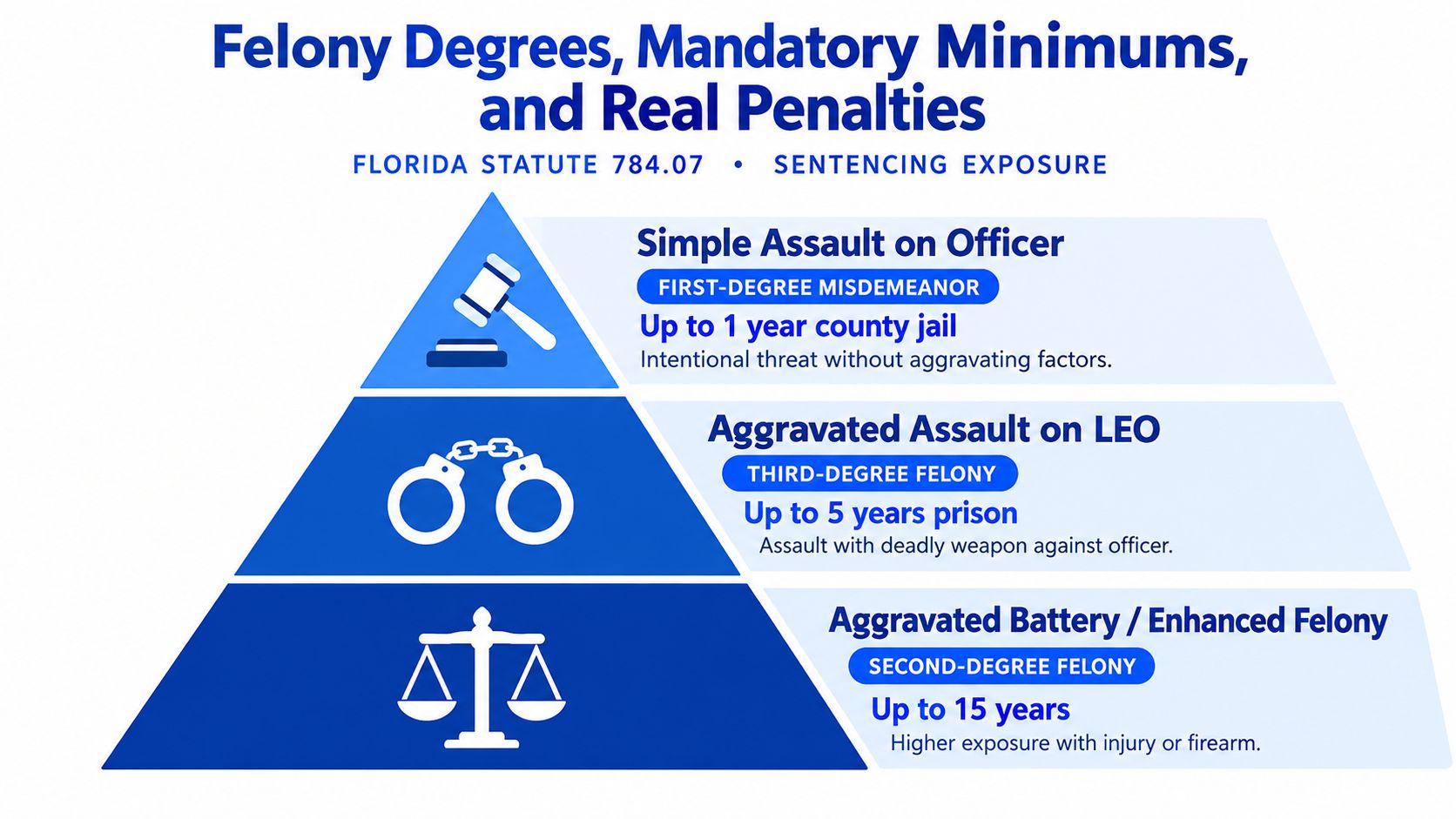
Florida Statute § 784.07 raises a simple assault on a law enforcement officer from a second-degree misdemeanor to a first-degree misdemeanor, punishable by up to 1 year in jail under Florida Statute § 784.07. A simple battery against a law enforcement officer is reclassified from a first-degree misdemeanor to a third-degree felony, carrying up to 5 years in prison, up to 5 years of probation, and a $5,000 fine under that same Florida reclassification statute.
The enhancement people miss
Danger starts when the State upgrades the allegation and treats ordinary movement, contact, or a disputed threat as an aggravated officer case. Then exposure climbs fast.
Florida law makes aggravated assault on a law enforcement officer a second-degree felony and imposes a 3-year mandatory minimum prison sentence under Chapter 784 of the Florida Statutes. Once that mandatory minimum is attached, the pressure on the defense changes immediately. Prosecutors know it. Judges know it. A weak early plea can lock you into consequences that would have been avoidable if the evidence had been tested first.
That is why I tell clients to stop obsessing over the officer's wording in the report and focus on the pressure points that decide these cases in real courtrooms. Was the officer engaged in lawful duty. Does the body camera support an intentional threat or only confusion and movement. Was the officer clearly identifiable as protected law enforcement at the moment of the alleged assault. If the State cannot prove those facts cleanly, the enhancement becomes vulnerable.
A related charge that often appears in the same file
Prosecutors also add resisting an officer with violence under Florida Statute § 843.01 when they want a separate felony path to conviction. It is a third-degree felony punishable by up to 5 years in prison, up to 5 years of probation, and a $5,000 fine.
That matters for a simple reason. The State may charge both counts, even when the underlying facts are messy, inconsistent, or captured badly on video. One theory says you threatened or touched an officer. The other says you violently resisted. If one count weakens, the prosecutor tries to keep the other alive.
What the courtroom consequences really look like
The sentence on paper is only part of the problem.
Bond terms: Judges often set tighter no-contact rules, travel limits, or reporting conditions when an officer is the alleged victim.
Diversion access: Programs shrink fast once the State labels the case as violence against law enforcement.
Record damage: A felony conviction can block a withhold and leave you with a permanent adjudication.
Plea pressure: The State uses the upgraded charge to push quick deals before body cam footage, dispatch logs, and witness inconsistencies are fully examined.
My advice is blunt. Treat an officer-assault filing like a case with prison exposure from day one. In Florida, reclassification and mandatory minimums do the damage. The defense usually turns on whether the State can prove lawful duty, protected status, and intent once the video is reviewed.
Your First 48 Hours After an Arrest in Florida
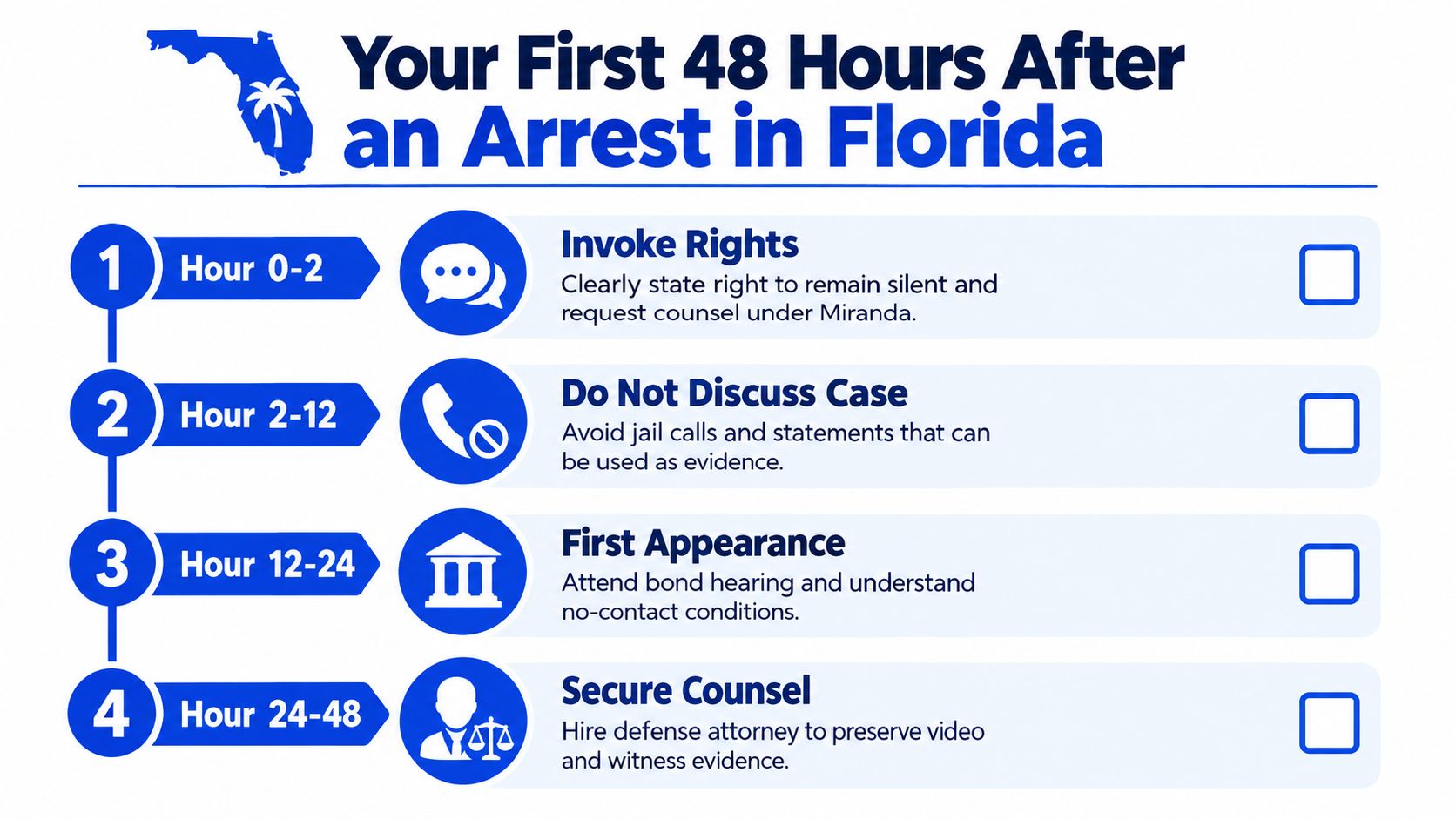
The first two days matter more than most realize. You can either preserve your defense or wreck it before your lawyer sees a single report.
Start with this checklist.
Hour 0 to 12
Invoke your rights clearly: Say, "I want a lawyer. I'm remaining silent." Then stop talking.
Refuse written statements: Don't sign an apology, clarification, or "my side of the story" without counsel.
Say nothing on jail calls: Recorded calls destroy defenses every week.
Document injuries mentally: Notice bruises, pain, torn clothing, or missing property so you can report it to counsel later.
What to say: "I want my attorney. I am invoking my right to remain silent."
If you need a plain-English breakdown of the immediate post-arrest process, review what happens after arrest in Florida.
Hour 12 to 24
Florida Rule of Criminal Procedure 3.130 generally requires a first appearance within 24 hours of arrest. That's when the judge addresses probable cause, release conditions, and bond.
Before that hearing, avoid these mistakes:
Don't explain the incident to deputies at booking
Don't message witnesses to coordinate stories
Don't post online
Don't contact the officer directly or indirectly
This video gives a useful overview of the immediate next steps after an arrest:
Hour 24 to 48
Once you're out, the work starts.
Write a private timeline: Times, locations, words used, who touched whom first, who saw it.
Preserve phone evidence: Save videos, texts, ride logs, maps, and photos.
Identify witnesses: Passengers, bystanders, store employees, family on speakerphone.
Get counsel involved fast: A lawyer can begin preservation demands for body-cam, dashcam, dispatch audio, and nearby surveillance.
If you wait a week because you think the charge will get dropped on its own, you may lose the best evidence in the case.
How the Court Process Unfolds and What Outcomes Are Possible
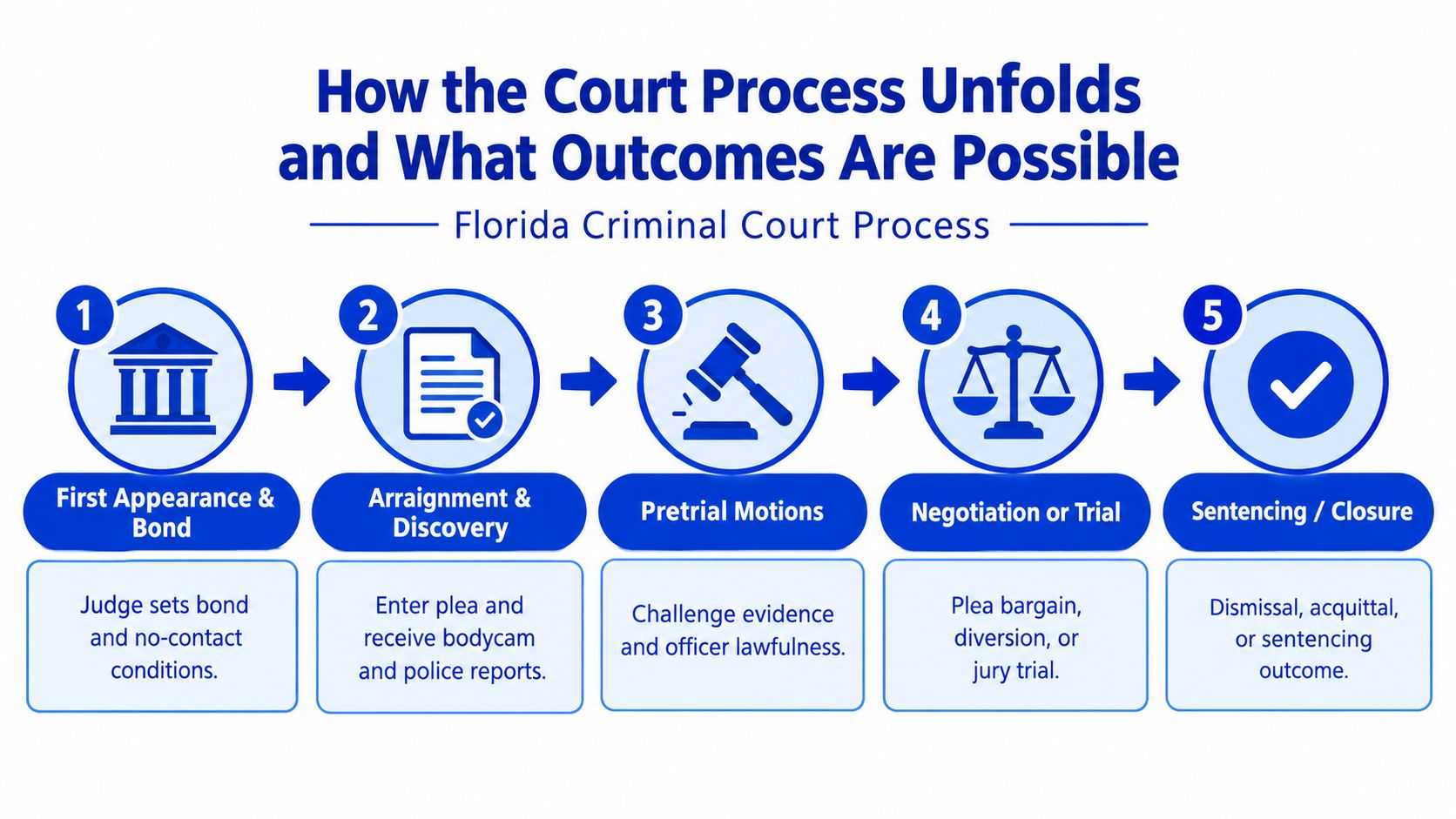
Officer-assault cases in Florida don't move in a straight line. They move in pressure stages. Bond pressure. Discovery pressure. Plea pressure. Trial pressure. If you understand the rhythm, you make better decisions.
First appearance and bond conditions
The first hearing usually happens fast. The judge decides whether probable cause exists and what conditions apply if you're released. In these cases, judges often focus on community safety and respect-for-law concerns, so bond conditions can be stricter than defendants expect.
Common issues include:
No-contact orders
Orders to appear at every hearing
Travel limits
Firearm surrender issues in some cases
Special conditions if alcohol, weapons, or alleged injury were involved
Arraignment and discovery
At arraignment, a plea is entered under Florida Rule of Criminal Procedure 3.160. In many felony cases, the action starts afterward, when the State turns over discovery.
Your defense gets concrete. Your lawyer should be reviewing:
Body-worn camera footage
Dash camera footage
Dispatch and CAD records
Use-of-force paperwork
Officer narratives and supplements
Civilian witness statements
Medical records, if injuries are claimed
Florida courtrooms don't decide these cases based on the arrest affidavit alone. They decide them on whether the extra evidence confirms it or tears it apart.
Motions, negotiations, and trial
A strong defense usually attacks the case before trial. Suppression motions, motions to dismiss where legally appropriate, and targeted impeachment work can reshape plea negotiations.
The outcomes usually fall into a few categories:
Stage | What can happen |
|---|---|
Early review | Case stays as filed, gets reduced, or the State drops weak counts |
Pretrial litigation | Evidence gets limited, statements get suppressed, or leverage shifts |
Negotiation | Plea to lesser offense, diversion request where available, or non-jail resolution efforts |
Trial | Acquittal, conviction on charged offense, or conviction on lesser included offense |
Sentencing | Jail, prison, probation, adjudication, fines, classes, treatment, community service |
A police officer assault charge often looks strongest on paper at filing and weakest after full video review.
How long this can take
Misdemeanor versions can move faster. Felony versions usually stay pending longer because discovery is broader, motion practice matters more, and the State is slower to give ground.
That delay frustrates clients, but speed isn't always your friend. Fast resolutions usually benefit the prosecution when the defense hasn't had time to pull body-cam, compare reports, and test whether the officer was lawfully performing a duty.
Defense Strategies That Actually Work in These Cases
You get arrested after a traffic stop that should have been a warning. By the time the report is written, a split-second movement becomes "assault on a law enforcement officer," and a charge that looked minor on the street now carries enhanced exposure in court. That is how these cases get inflated in Florida. The defense has to cut into the enhancement itself, then force the State to prove each fact with actual evidence.
Attack the enhancement first
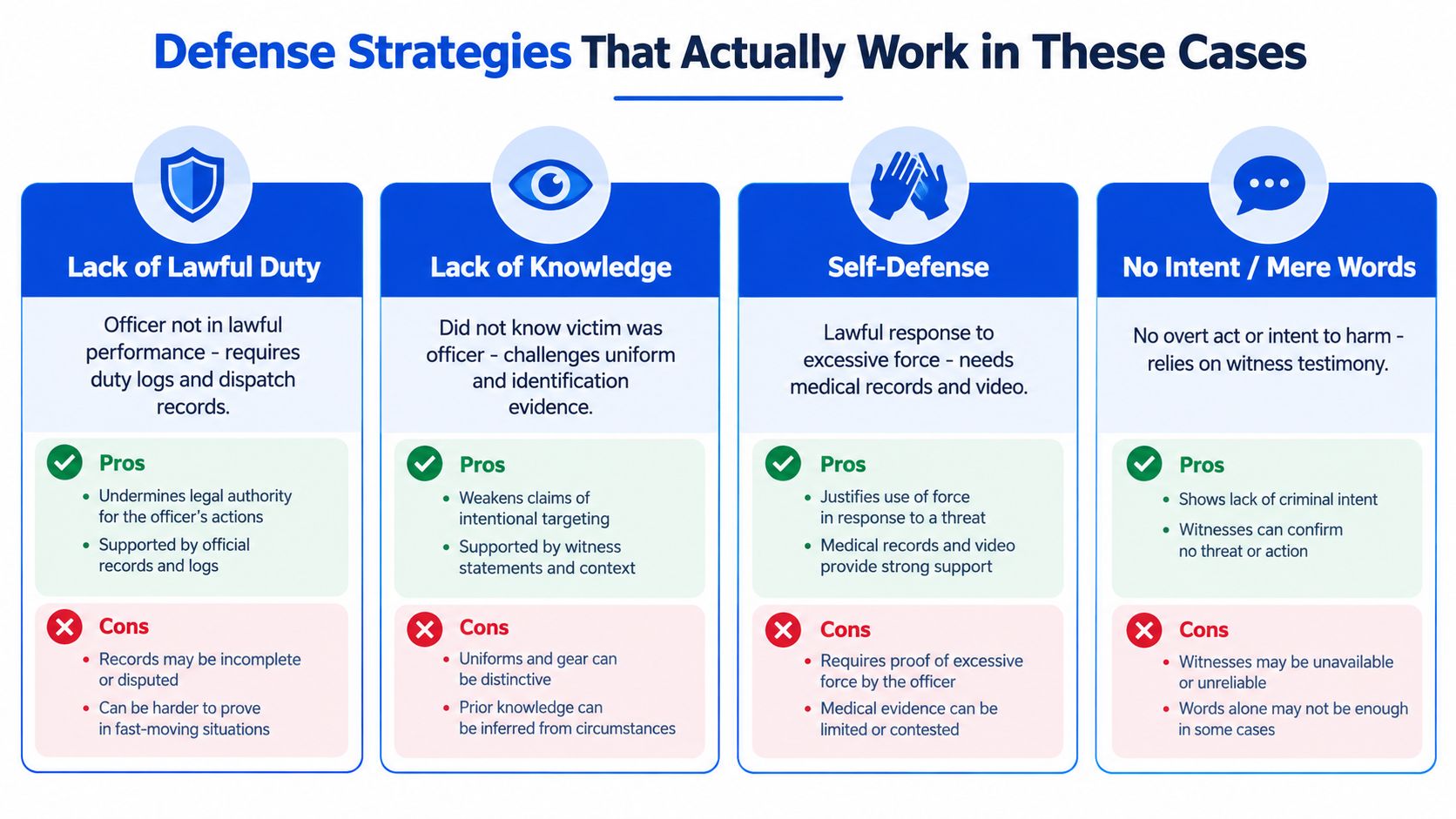
In Florida, the label matters, but the reclassification is often what creates the danger. Prosecutors use the officer's status and the claim that the officer was lawfully performing a legal duty to push exposure higher. If either point fails, the enhanced charge can weaken fast.
Start there. Demand proof of:
Lawful performance of a legal duty at the exact moment of the alleged assault
Clear notice that the person was an officer, if identification is disputed
Facts showing the officer qualifies for the protected-status enhancement charged by the State
A timeline that matches the body cam, dispatch record, and witness accounts
Bad stops, extended detentions, unlawful arrests, and confused street encounters often break the State's theory. If the officer stepped outside lawful authority, the enhancement is vulnerable.
Lawful duty cases are won on timestamps, not speeches
I would rather have ten minutes of unedited body cam than ten pages of righteous argument. These cases turn on sequence. What was said first. When the command was given. Whether it was audible. Whether the officer had legal grounds to detain or arrest before force started.
The pressure points are usually concrete:
Dispatch logs and CAD entries
Body-cam and dash-cam timestamps
Radio traffic
Bystander video
Witness statements about the officer's words and actions before contact
A report can make an encounter sound clean. Video often shows confusion, overlap in commands, rough handling, or a detention that had already gone too far.
Intent is where weak cases hide
Florida prosecutors often file these charges as if every flinch was a threat and every reflexive movement was an intentional act. That is lazy charging. Assault still requires an intentional, unlawful threat by word or act, coupled with an apparent ability to carry it out. Battery still requires an intentional touching or strike.
That means a defense may center on facts like these:
No intentional threat
No intentional touching or striking
A pain response, loss of balance, or startled reaction
Movement inconsistent with an attack
Officer contact that began before any alleged threatening act
For practical examples of how these intent issues get challenged, review this guide on assault and battery defense.
Use video to test the officer's version, frame by frame
Do not treat body cam as a formality. Treat it like the case file that matters most.
A close review can expose whether the officer moved into your space first, whether commands were contradictory, whether your hands were visible, and whether the claimed injury lines up with what the camera shows. Audio matters too. Tone matters. Overlapping commands matter. So does the gap between the report and the recording.
Good defense work here often includes:
Frame-by-frame video review
Audio review for audibility and overlapping commands
Comparison of injury claims to the mechanics shown on video
Civilian witness interviews before memories harden around the police report
That work needs to start early. Preservation requests for surveillance footage, business cameras, and third-party recordings should go out before the files are overwritten. Ticket Shield, PLLC, often begins there because officer assault cases are usually evidence fights long before they become trial speeches.
Self-defense exists, but facts decide whether it survives
Clients love the phrase. Courts care about proof.
If an officer used unlawful force, self-defense can matter. But it only helps when the facts support it with discipline and detail. Medical records, photographs, timing evidence, and neutral witnesses carry far more weight than anger after the arrest.
One more blunt point. Stop building your defense around "the officer lied." Sometimes the officer did shade the facts. Fine. You still win by proving what the video shows, what the stop legally allowed, and what the State cannot establish about lawful duty, protected status, and intent. That is how these charges come down in Florida courtrooms.
Collateral Consequences and How to Move Forward
The courtroom sentence isn't the whole punishment. A conviction for an officer-related violent offense can keep hurting you long after probation ends.
What follows you after the case
A felony conviction can affect your life in obvious and less obvious ways:
Consequence Area | Convicted Felony | Adjudication Withheld |
|---|---|---|
Criminal record | Permanent public felony record | Still appears in many background checks unless later sealed if eligible |
Firearm rights | Serious restrictions and possible federal consequences | May still create practical barriers depending on charge and outcome |
Employment | Major barriers in licensing, government, security, education, and healthcare | Better than a conviction, but still a problem until record relief is pursued |
Voting and civic rights | Rights issues may require restoration steps | Generally less severe than a felony conviction |
Travel and supervision | Probation conditions can limit movement and associations | Same during supervision, though long-term effect may be lighter |
Federal law is part of the danger here too. A conviction can trigger firearm consequences under federal law. If your work, military service, or family life depends on lawful firearm possession, you can't afford to treat that as a side issue.
The smart move is to plan record strategy early
Most people wait until the case ends to ask about sealing or expungement. That's backward. Record strategy should begin during plea negotiations.
Focus on these questions early:
Can the charge be reduced to an offense that preserves record-clearing options
Is a withhold legally available and strategically wise
Will the plea language create avoidable licensing or firearm problems
Can probation terms be structured to support early termination
If you're trying to understand post-case cleanup, start with this guide to record sealing in Florida.
The best time to protect your future record is before you enter the plea, not after the judge accepts it.
Moving forward without making it worse
If your case is pending, keep your life boring. Follow bond conditions exactly. Don't miss court. Don't post. Don't contact witnesses unless your lawyer approves it. Don't assume a lesser plea is harmless because it avoids jail.
The blunt truth is this. A bad plea can outlast a short sentence. In officer cases, the paper result matters almost as much as the immediate punishment.
If you're facing a police officer assault charge in Broward, Fort Lauderdale, Miami-Dade, Palm Beach, or elsewhere in South Florida, Ticket Shield, PLLC can review the stop, the body-cam, the lawful-duty issue, and the charging enhancements that may be inflating your exposure. Visit Ticket Shield, PLLC to get a direct case review and a defense plan focused on protecting your record, your rights, and your freedom.