Qué son las pruebas de fiabilidad y por qué son determinantes en los tribunales
Lic. Jason Goldsmith
You're facing a serious Florida charge, and the State's case may depend on a machine reading, a laboratory result, or a measurement you've never seen before. The number can look decisive in a police report, but a number is only as trustworthy as the method, equipment, and conditions behind it.
In court, reliability isn't a vague impression that a test “usually works.” It's a question about whether the evidence was produced by a dependable method and applied appropriately in your case. Understanding that distinction can help you ask better questions and recognize where a defense may exist.
Table of Contents
A Question Most Defendants Never Think to Ask
Suppose prosecutors charge someone with a drug offense after a field test identifies a substance as illegal. The officer's report records a positive result, and the charge moves forward. But the test kit may have been stored improperly, the sample may have been contaminated, or the result may not be specific enough to identify the substance. A result alone doesn't answer those questions.
Reliability testing means evaluating whether a tool or method produces dependable results under defined conditions. In a criminal case, that practical inquiry often comes down to three questions:
Does the tool work consistently? A method that produces different results when the same material is tested under similar conditions deserves scrutiny.
Has it been validated for this use? A device may work for one purpose or sample type but not another.
Could it have been wrong here? The specific sample, operator, environment, and handling procedures can affect the result.
These questions matter because the State must present evidence that can be trusted, not merely evidence that appears scientific. Reliability is a legal and evidentiary issue, not just an argument over whether a machine displayed a particular result.
A defense lawyer can examine how a test was developed, what conditions it requires, whether the operator followed them, and whether the result has independent support. The answers may affect whether evidence comes in, how much weight a jury gives it, and whether the prosecution can prove the charge. The aim is to understand how reliability is established, tested, and challenged in Florida cases, so you can see why a technical issue may have direct consequences for your defense.
Where Reliability Testing Came From
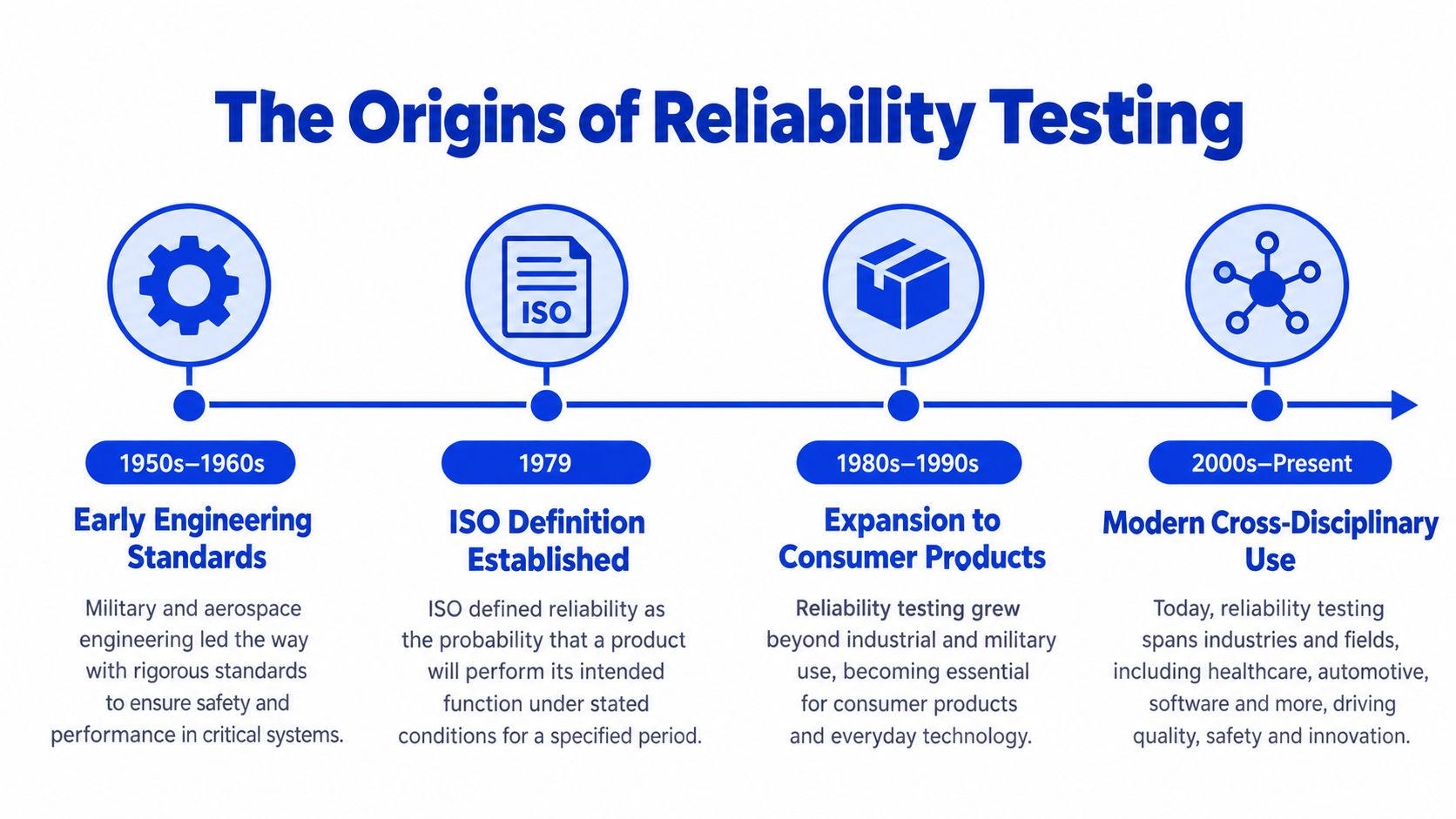
Reliability testing began as an engineering question: can a product keep doing its intended job under specified conditions? In engineering, ISO 19973 defines reliability as the probability that a component avoids a relevant failure during a specified interval of time, number of cycles, or distance while operating under stated conditions (ISO 19973 reliability definition).
A useful mental model is the bathtub curve, a statistical model developed from observations across many years and numerous mechanical and electronic populations. It describes three broad phases. Early in a product's life, defects can cause a high failure rate that falls as problems are discovered and corrected. During the useful-life period, failures occur at a relatively steady rate. Later, wear and aging can cause failures to rise again.
That pattern helps explain why one test can't answer every reliability question. An early test might reveal a manufacturing defect, while longer-term testing may be needed to evaluate wear. A new phone, a car under warranty, and an aging appliance can each present different failure risks at different stages.
Practical rule: A clean result under laboratory conditions doesn't automatically establish dependable performance in the field.
For forensic evidence, the same principle invites questions about the instrument's condition, maintenance, calibration, and operating environment. A tool may produce a number, but the legal significance depends on whether the system was designed, tested, and used in a way that supports a trustworthy result. Defense counsel cares about how the tool can fail, not only whether it produced an answer in a particular case.
Reliability Beyond Machines and Electronics
Reliability also applies to measurements made by psychological, educational, medical, or survey instruments. In those settings, the question isn't whether a component breaks. It's whether the instrument produces consistent results.
Consider a screening tool that uses several questions to assess a person's understanding or a psychological characteristic. If the questions are intended to measure the same underlying idea, internal consistency asks whether the answers fit together in a coherent way. A courtroom expert might rely on such an assessment, but consistency alone doesn't establish that the assessment is appropriate for the legal question at hand.
Lee Cronbach introduced coefficient alpha in a 1951 publication as a reliability coefficient for evaluating internal consistency. The measure, now widely called Cronbach's alpha, is generally higher when items are more consistent with one another. But it doesn't automatically prove that an instrument is valid or measures only one concept. Later work by Melvin Novick and Charles Lewis established conditions under which alpha equals reliability when true scores across compared measures differ by a constant independent of the people measured (history and limits of Cronbach's alpha).
The courtroom lesson is direct: a tool can be consistent and still be wrong for the purpose it's being used for. It may measure a different trait than the expert claims, or its design may not support the inference prosecutors want the jury to draw. For example, the questions used in a psychological assessment may produce similar answers without establishing that the instrument can support a conclusion about a specific legal issue.
This distinction appears in disputes over field evaluations too. A defense lawyer examining a claimed physical sign may ask whether the method is standardized and whether the officer applied it properly. For related questions about how one such evaluation is used, see this explanation of horizontal gaze nystagmus evidence.
How Courts Decide If a Tool or Test Is Reliable
Florida judges act as gatekeepers for expert testimony. Under the Daubert framework, the court evaluates whether expert opinions rest on reliable methods and whether those methods have been reliably applied to the case. A confident expert conclusion doesn't make an unreliable method admissible.
The inquiry isn't limited to whether other people accept a technique. Courts can examine whether it can be tested, whether it has been subjected to peer review, what is known about its error rate, and whether standards control its operation. Florida's shift from the older Frye general-acceptance approach to the Daubert framework puts greater attention on the method and its application.
Factor | What It Asks | Why It Matters |
|---|---|---|
Testability | Can the method be checked or challenged? | A method that can't be meaningfully tested may offer little basis for evaluating its reliability. |
Peer review | Has the method been examined by other qualified professionals? | Independent scrutiny can reveal weaknesses or limits. |
Error rate | What kinds of mistakes can occur, and how are they measured? | A result can't be evaluated fairly without considering the possibility of error. |
Standards and controls | Are there procedures governing the method and its use? | Standards help show whether the operator followed a disciplined process. |
Case-specific application | Did the expert use the method appropriately on this evidence? | A sound technique can still be misapplied. |
These questions often overlap. If police collected a sample, a defense may examine the procedures used to track and preserve it alongside the testing method itself. Chain of custody evidence can help show whether the material tested was the material collected, but proper handling alone doesn't prove the analytical method is sound.
In practice, a challenge may focus on a forensic instrument's validation records, operator training, maintenance history, or the way an expert interpreted the output. The court must assess the method and its fit to the evidence, and not merely accept a scientific label. That scrutiny is especially important when the result supplies a central link in the State's case.
Why Passing a Test Is Not the Same as Being Reliable
A passed test is evidence about the conditions tested. It isn't a guarantee that the tool will behave reliably in every real-world situation. A system may perform well under ordinary loads and still fail during a dependency outage, an unexpected surge, or a recovery event. Microsoft's reliability guidance calls for testing faults, scaling, recovery, and security-related availability risks rather than relying only on extended observation of normal operation (Microsoft reliability testing guidance).
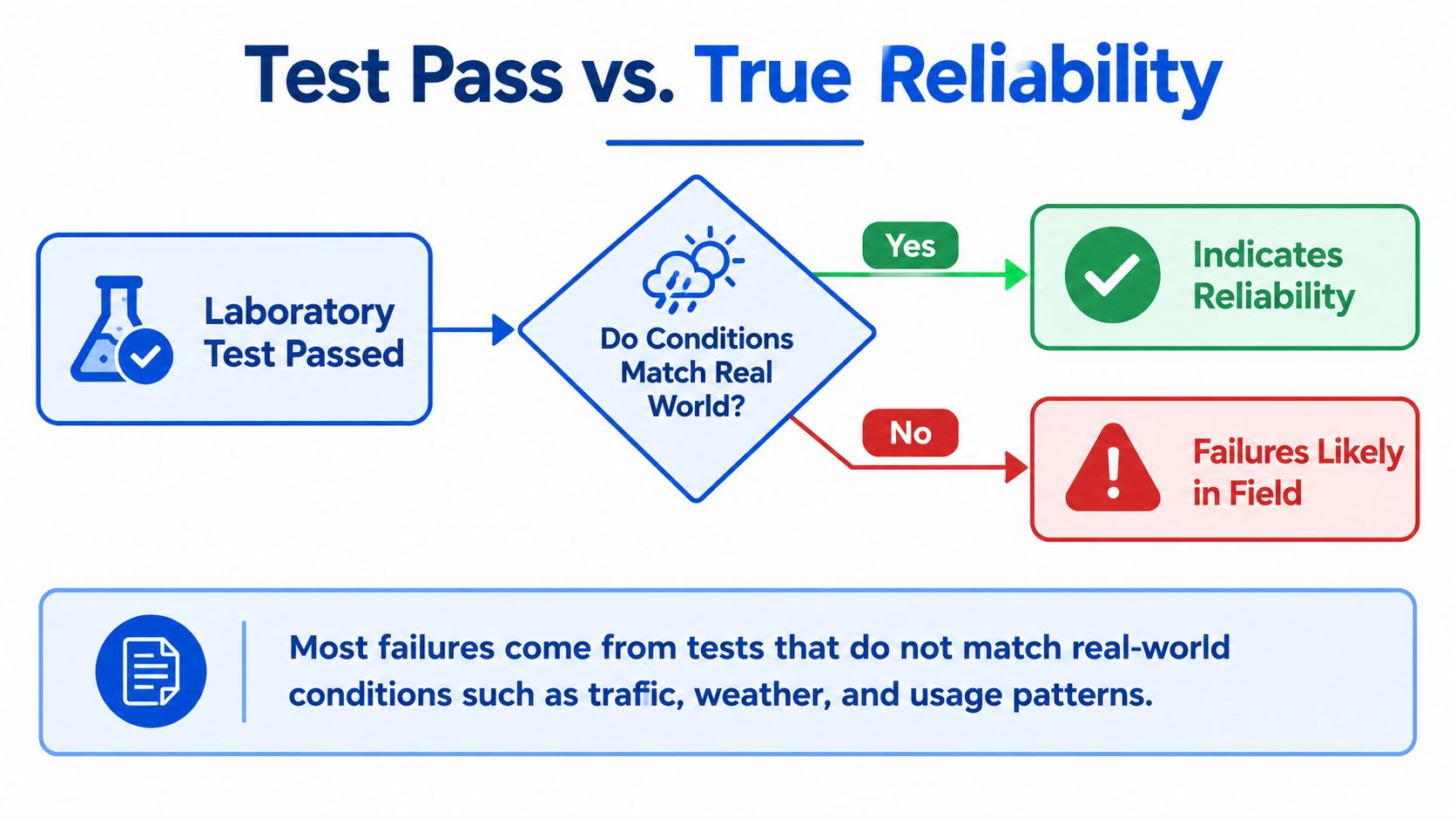
The same limitation applies in court. A forensic method may have been tested in a laboratory, but that doesn't resolve whether the test conditions matched the case. The sample may have been degraded, the operator may have deviated from the protocol, or the defendant may fall outside the population used to validate the method. A defense lawyer can ask what the method was validated to do, what its limits are, and whether those limits matter here.
The useful question isn't just whether the method passed a test. It's whether the test represents the conditions that produced the evidence in your case.
Controlled failure testing can reveal problems, but it does not replace representative conditions. Forensic testing likewise calls for more than a general claim that a tool works. The defense may seek underlying records, question the analyst, and ask the court to exclude an opinion if the method or its application cannot support it. For drug allegations involving a preliminary kit, the limitations of drug field test kits may be central to evaluating what the result establishes.
Reliability should be treated as a continuing question. New records, expert testimony, and case-specific testing may expose weaknesses that a general validation statement doesn't address. Those gaps can shape motions and trial strategy.
What Reliability Challenges Look Like in a Florida Case
A Florida drug case may begin with an officer reporting that a sample tested positive. That preliminary result can influence the initial charge, but it doesn't necessarily settle what the substance is or prove every element of the offense. The defense can investigate the complete path from collection to analysis.
The lawyer may request the kit's instructions and validation materials, records showing how it was stored, the officer's training documentation, and any reports identifying the result's limitations. If a laboratory later tested the sample, the defense can examine the analyst's notes and the methods used. In a blood-evidence case, questions about collection and handling may matter alongside the testing method; legal blood draw procedures can raise issues separate from whether an instrument's analysis is dependable.
A reliability challenge can support a motion to exclude evidence or limit an expert's testimony. If the judge excludes a result that the prosecution needs, the State may reassess the charge or negotiate a different resolution. If the evidence remains admissible, a lawyer can still use its limitations to test the State's claims before the jury. None of these possibilities guarantees a particular outcome; the result depends on the evidence, governing law, and case-specific facts.
The consequences reach beyond the courtroom
A conviction can affect work, family responsibilities, professional opportunities, and, for some people, immigration status. That's why the defense must examine the evidence early and make informed decisions about motions, negotiation, and trial. The objective is to protect the client's rights and pursue the strongest available outcome, not to treat a technical issue as a substitute for a complete defense.
If the case ends without a conviction, record relief may still require separate steps. In Florida, sealing or expungement isn't automatic after a dismissal or other favorable resolution. The practical takeaway is to preserve the details of how evidence was gathered and tested, then have counsel evaluate whether those details support a legal challenge.
Steps You Can Take When Reliability Is Central to the Charge
If a forensic tool or measurement is part of the State's evidence, don't try to recreate the test or contact the officer or analyst yourself. Preserve what you know and give it to your attorney. Early documentation can help counsel identify what evidence and records to seek.
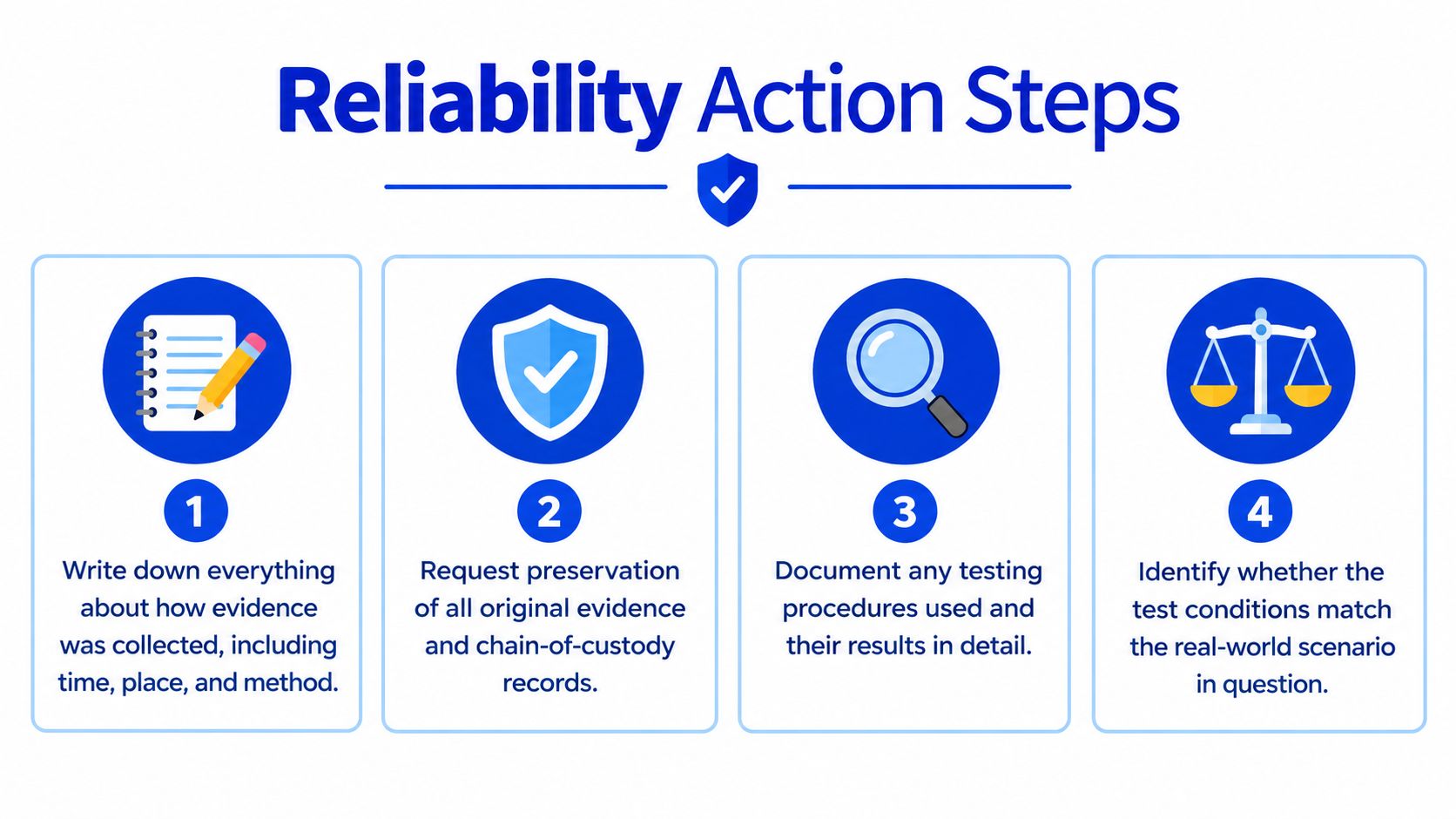
Write down what happened. Record where and when the evidence was collected, who handled it, and what you personally observed. Keep your notes factual and separate what you saw from what someone told you.
Ask counsel about preservation. Your lawyer can request original evidence and relevant records, including chain-of-custody documents, calibration and maintenance logs, and testing materials. Those records may be lost or overwritten if no one acts.
Ask what the test can establish. Find out whether the tool has a known error rate, whether it was validated for the specific use, and whether an independent test is available.
Compare the test with the actual conditions. Consider whether the sample, operator, environment, and procedure matched the assumptions behind the method.
Reliability challenges can connect to constitutional protections, including due process and, where the circumstances support it, protections against unreasonable searches and seizures. A technical flaw doesn't automatically establish a constitutional violation, but counsel can assess whether the way evidence was obtained or used supports a motion. Learn more about motions to suppress evidence.
The questions can be highly specific, and a free consultation can give you an opportunity to discuss them with a defense lawyer. Share the charging documents and any reports you have, and ask how the evidence will be investigated, what records may be requested, and how the results could affect motions or negotiations.
Reliability Testing Questions Florida Clients Ask Most
Can a breath test result be challenged if the machine wasn't calibrated?
Yes. A breath test result can be challenged if maintenance or calibration records raise questions about whether the instrument was working properly when the test was given. Calibration alone does not establish that every part of the test was reliable. The defense can also examine the operator's training, the testing procedure, and whether the State can produce records supporting the result.
Does the State have to show a field test kit worked before trial?
The State must present evidence that meets the rules for admission and supports the test result. A defense lawyer can question whether a field test kit was stored, handled, and used according to its instructions, and whether the test was suitable for identifying the substance at issue. A positive result may be relevant, but the kit's limitations and the conditions of use matter when a court assesses its weight.
Does a sealed record stay hidden from everyone?
No. Florida law allows people with sealed records to deny or fail to acknowledge covered arrests in many situations, but exceptions apply. Certain agencies can access sealed-record information, including some criminal justice employers and employers or licensing bodies responsible for work involving children or vulnerable adults (Florida FDLE guidance on agencies entitled to sealed records). This is a separate record-relief question, not a test of whether evidence in a criminal case is reliable.
What should I do after an arrest if a forensic test may be involved?
Avoid discussing the case publicly or contacting witnesses about what they should say. Keep any paperwork you receive, and write down what you remember about the collection and testing process while the details are fresh. Speak with defense counsel promptly. Ask your lawyer to request the instrument's maintenance and calibration records early, since access to records can become harder as a case progresses.
A test result is evidence, not a conclusion. A focused challenge can expose weaknesses the State must address before a jury relies on that result.
Ticket Shield, PLLC offers free consultations to evaluate forensic evidence and develop a defense strategy focused on protecting your rights. If you're facing a Florida criminal charge, contact Ticket Shield, PLLC to discuss the reliability issues in your case and your next steps.