
Presentar una queja formal ante la policía
Jason Goldsmith, Abogado
You may be here because a police encounter went badly and you want accountability. Or you may be the person officers now say committed a crime, based on someone else's complaint. Those are different situations, and treating them the same can create serious problems.
A complaint can start an investigation, support an arrest, trigger an internal affairs review, or become evidence in a criminal case. If you're reporting misconduct, preserve proof before you file. If you're accused, don't give police a detailed explanation before you understand your rights. A plain-language guide to Miranda rights can help explain why silence and a lawyer matter during custodial questioning.
Table of Contents
Why People File Complaints Against Police in Florida
A Miami-Dade driver believes an officer stopped the vehicle without lawful cause. The driver wants to challenge the conduct, identify the officer, and create a record. In Jacksonville, a convenience-store clerk is shoved during a shoplifting call, and the clerk worries that the officer's report will portray the encounter differently. One person wants to report possible police misconduct. The other may become the subject of a criminal investigation.
Those two situations require different decisions. A victim or witness should focus on prompt reporting, accurate details, and preserving evidence. A person accused of assault, theft, obstruction, or another offense should avoid trying to “clear things up” directly with officers or the complaining witness. Police complaints can become evidence, and an angry or improvised statement can be difficult to undo.
This guide is for Florida residents, visitors, and family members helping someone in custody. It covers when and how to file a complaint, what to expect from internal affairs, how Florida agencies handle possible misconduct, and when federal civil-rights remedies may be relevant. It also explains the risks faced by someone accused after another person contacts police.
Practical rule: If you're reporting misconduct, build the evidence record first. If you're accused, protect your right to remain silent before you tell your side.
This article doesn't replace advice from a lawyer who knows the facts. It also doesn't address ordinary civil traffic disputes handled through clerk-of-court proceedings. The next sections follow the two paths separately, so you can focus on the one that fits your situation.
How to File the Complaint and What to Include
Start by identifying what kind of complaint you're making. A victim or witness reporting burglary, assault, harassment, or another crime generally contacts the law-enforcement agency with jurisdiction where the conduct occurred. Depending on the agency, that may mean a non-emergency phone line, a station visit, or an online reporting portal, such as the Orlando Police online reporting system.
A misconduct complaint against an officer follows a different channel. It usually goes to the employing agency's Office of Professional Standards or internal affairs unit, not the patrol officer who handled the incident. Ask the agency how it accepts complaints and whether it requires a written statement, supporting documents, or an appointment. Florida complaint systems vary, so follow the agency's stated process rather than relying on assumptions.
Build a usable factual record
Write the account in chronological order. Avoid conclusions such as “the officer was corrupt” unless you can explain the specific conduct supporting that belief. Include:
Identifying details: The officer's name, badge number, vehicle tag, agency, and any identifying uniform or unit information.
Time and place: The date, approximate time, exact location, direction of travel, and where each person stood or moved.
Witness information: Names, phone numbers, email addresses, and a short description of what each witness personally observed.
The sequence: What happened first, what was said, what actions followed, and how the encounter ended.
Supporting records: Photographs, videos, medical records, texts, emails, receipts, dispatch information, and property-damage documentation.
People often omit the evidence that can later prove or disprove the account. If you were injured, request and preserve medical records. If cameras may exist, identify nearby homes, businesses, vehicles, or traffic systems before recordings are overwritten. Ask about body-worn-camera footage and the agency's public-records process. If there were earlier related complaints, tell your lawyer or the reviewing agency, but don't exaggerate or repeat unverified allegations.
For help organizing facts before contacting counsel, you can use the firm's case submission page. Keep a copy of everything you submit, including attachments and confirmation screens.
What happens after filing
A reporting agency may provide an incident number or complaint number. An acknowledgment letter may identify the assigned unit, summarize the allegation, explain the next contact, and state whether more documents or an interview are needed. It isn't a finding that misconduct occurred, and it doesn't guarantee criminal charges or discipline.
Expect the process to involve follow-up questions. Be accurate, correct genuine mistakes promptly, and don't guess when you don't know. If police ask you to give a statement while you may also be accused of an offense, speak with a Florida criminal defense lawyer first.
Preserving Evidence Before and After You File
At two in the morning, a Tampa resident hears a door break. Officers enter during what the resident believes was a mistaken no-knock warrant. The resident is shaken, the doorframe is damaged, and the first instinct is to argue with the officers. That instinct can waste the most valuable evidence.
Evidence preservation begins before any complaint form is signed. If the scene is safe, document it immediately. Take wide photographs showing the room and surrounding area, then closer images of injuries, broken locks, damaged walls, debris, and blood. Record video without narrating guesses or confronting officers. Capture visible badge numbers, vehicle numbers, agency markings, and relevant helicopter activity if those details may help identify who was present.
Preserve the first version of events
Ask nearby neighbors whether doorbell, security, or dash-camera footage may exist. Don't pressure anyone to alter or share material improperly. Get contact information and note the location of each camera so a lawyer or investigator can make an appropriate request.
Within the first 24 to 72 hours, take practical steps:
Obtain medical care: Tell the provider how the injury occurred and keep discharge papers, photographs, prescriptions, bills, and follow-up records.
Write a timeline: Type the sequence while memory is fresh, including exact words you remember and facts you're uncertain about.
Save communications: Keep voicemails, texts, emails, call logs, photographs, and social-media messages in their original form.
Request official records: Use the agency's public-records process to request body-worn-camera footage and submit a Florida Public Records Act request for the incident report.
Identify witnesses: Record what each person saw without coaching anyone or asking them to adopt your version.
Don't edit, crop, filter, or overwrite original files. Make working copies for sharing and keep the originals untouched. Preserve the file name, creation information, device, and storage location when possible. If you're moving digital material between devices, keep a simple record of who had it and when.
Do not manufacture a cleaner story. A credible account includes uncertainty, inconvenient facts, and corrections. Editing evidence or deleting material can damage your credibility and create separate legal problems.
The basic idea behind chain of custody for evidence is simple. A later reviewer should be able to understand where an item came from, who handled it, and whether it changed. A lawyer can help preserve evidence formally when an agency, officer, or third party controls the records.
Internal Affairs, State Attorneys, and How Florida Handles Misconduct
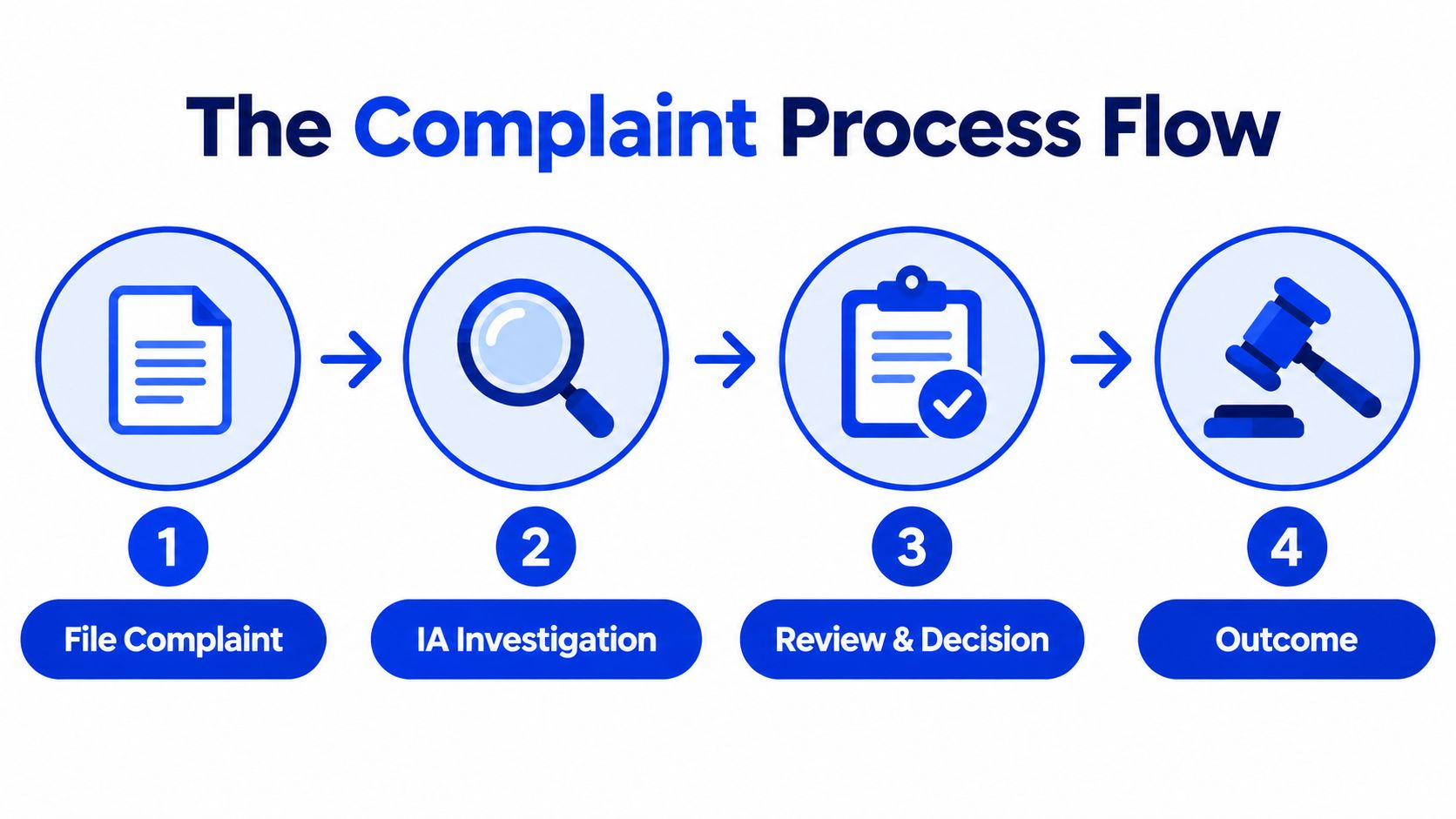
A Florida police-misconduct complaint can travel on two related but distinct tracks. The employing agency's internal affairs unit handles the administrative investigation, meaning it examines whether the officer violated department policy, training rules, or employment standards. The Office of the State Attorney handles potential criminal charges. One office can discipline an officer, while the other decides whether the evidence supports prosecution.
Internal affairs receives and triages the complaint, gathers reports and recordings, interviews witnesses, and obtains the officer's account. It may recommend discipline, including termination. It can't itself bring a criminal charge. If the facts suggest perjury, official misconduct, simple battery, or another offense, the matter may be referred to the appropriate State Attorney's Office or another investigative authority.
Consider a complaint involving a Hillsborough County Sheriff's deputy. The sheriff's internal affairs unit may review policy violations, while prosecutors independently assess whether the same conduct meets the elements of a crime. A Tampa Police Department internal affairs matter may similarly be reviewed alongside a criminal referral to the State Attorney's Office, including the office associated with Andrew Warren during his tenure. The handoff doesn't mean charges will follow. Prosecutors still need admissible evidence and a legally sufficient basis to proceed.
The danger of an inaccurate report
Florida Statute 837.05 makes knowingly giving false information to a law-enforcement officer about an alleged crime a first-degree misdemeanor, punishable under sections 775.082 or 775.083. If the false report concerns a capital felony, the statute provides an enhanced penalty that can raise the offense to a third-degree felony. Read the Florida false-report statute before making accusations you can't support.
Internal affairs interviews also require care. An officer may face compelled administrative questioning under employment rules, while a civilian complainant may face criminal exposure if investigators believe the person knowingly lied. “I was upset” doesn't excuse a deliberate false statement. If the complaint could expose you or someone close to you to charges, get legal advice before the interview.
A complaint doesn't automatically produce an arrest warrant. Under Florida Statute 901.02, a judge issues an arrest warrant when the complaint and supporting proof satisfy the judge that probable cause exists for a crime within the judge's jurisdiction, and the warrant must be signed by the judge. Florida's evidence-driven process expects law enforcement to investigate whether a Florida statute was violated and whether the subject committed it before forwarding the matter to the State Attorney's Office by arrest, notice to appear, or sworn complaint. The Florida warrant statute and guidance on how Florida criminal complaints are investigated explain those procedural limits.
Most complaints take months rather than days because investigators must collect records, locate witnesses, review video, and allow responses. A delay doesn't prove that the agency is ignoring you, but you should keep your complaint number, update contact information, and document every follow-up.
The separate question of prosecutorial conduct can require its own analysis. This overview of prosecutorial misconduct explains why a prosecutor's role differs from internal affairs.
Alternative Routes When Direct Filing Is Not the Right Step
Going directly to the employing agency isn't always the safest or most practical first move. A victim may fear retaliation. A witness may want to remain outside the spotlight. A person seeking money damages may care more about a civil claim than an internal discipline finding. Choose the route based on the evidence, the risk, and the result you want.
Third-party options include Crime Stoppers programs and silent-witness systems. They can let a caller pass information without dealing directly with the agency's front desk, but confidentiality rules differ. Anonymous reporting may limit follow-up, reduce the investigator's ability to test details, and make it harder to obtain records or explain the full context. Ask exactly whether the program records caller information, whether it promises anonymity, and what happens to the tip after submission.
Civilian review boards are another possibility, but Florida has no uniform statewide model that guarantees one in every community. Some municipalities, including Miami-Dade and Orlando, have formal civilian review structures, while many counties do not. Confirm whether the relevant body has authority over the agency, accepts individual complaints, conducts independent investigations, or only reviews completed agency work.
Federal civil-rights complaints may involve the FBI Civil Rights Unit or the Department of Justice. A civil claim under 42 U.S.C. Section 1983 can seek a remedy for certain constitutional-rights violations committed under color of state law. The legal theory is more demanding than showing that an encounter felt unfair. A claimant generally must connect the conduct to a protected right and prove the required level of responsibility. Federal review and a private civil case are also separate processes.
Route | Confidentiality | Who investigates | Likely outcome |
|---|---|---|---|
Direct agency complaint | Usually limited, subject to public-records rules | Internal affairs or professional standards | Policy review, discipline recommendation, referral, or closure |
Crime Stoppers or silent witness | May offer anonymity, but terms vary | Receiving agency or designated program | Lead, referral, or limited follow-up |
Civilian review board | Depends on local rules and records law | Civilian panel or oversight staff | Review, recommendation, mediation, or referral |
Federal civil-rights route | Not a promise of anonymity | FBI, DOJ, or federal court process | Investigation, referral, civil litigation, or no action |
If money damages matter more than discipline, consult a civil-rights or personal-injury attorney promptly. Civil claims have their own deadlines, proof requirements, and strategic concerns. Don't assume an internal complaint preserves every civil remedy.
When to Bring in a Florida Criminal Defense Lawyer
Contact a Florida criminal defense lawyer early when the complaint could lead to criminal charges against anyone involved. Don't wait for the investigation to become an arrest if you can see the risk developing. Early advice can prevent a frightened witness, accused civilian, or officer from making a statement that creates avoidable problems.
Get counsel promptly if:
You were arrested: Stop discussing the facts with police, friends on recorded jail lines, or the complaining witness.
The officer's report sharply conflicts with reality: Preserve your evidence and avoid posting accusations online.
Internal affairs wants an interview: Determine whether the interview is voluntary, compelled, administrative, or potentially criminal.
A State Attorney's target letter arrives: Treat it as a warning that prosecutors may be evaluating you as a suspect.
A counter-charge appears: A complaint about police conduct can sometimes be followed by allegations against the complainant, and those allegations need independent review.
A defense lawyer protects the Fifth Amendment right against compelled self-incrimination. That doesn't mean every person should refuse every interview. It means the decision should account for the type of interview, employment rules, possible criminal exposure, and the evidence already in the agency's hands.
Counsel can also communicate with prosecutors, preserve records, challenge an unlawful search or seizure, examine inconsistent reports, and test whether the evidence actually establishes probable cause. If you're a civilian complainant facing retaliation or a counter-charge, the lawyer can help separate your original report from later accusations and prevent the dispute from becoming a contest of unsupported statements.
Before the first call, gather the complaint or incident number, arrest paperwork, warrants, citations, police reports, photographs, videos, medical records, witness contacts, messages, and every letter or email from an agency or prosecutor. Don't delete anything, contact the opposing witness, or send a new explanatory message.
For a broader overview of representation in Florida criminal cases, review this guide to a Florida criminal defense lawyer. Bring the documents, state only what you know, and let counsel identify the legal issues that need immediate attention.
Ticket Shield, PLLC helps Florida clients assess police complaints, counter-charges, investigations, and criminal accusations before a preventable statement makes the situation worse. Visit Ticket Shield, PLLC to request a confidential consultation and discuss the next practical step with a Florida defense team.