Sanciones por el robo de correspondencia en Florida: Una guía práctica
Jason Goldsmith, Abg.
You're home, the mail has already been checked, and something feels off. A postal carrier in Hialeah reports a missing bundle, a Broward homeowner finds bank statements opened, and then a Miami resident gets a call asking for a voluntary interview with a Postal Inspector. That sequence is common enough that people often don't realize they're under investigation until the government has already started building the case.
Punishment for stealing mail depends on where the case is charged, what was allegedly taken, and whether the conduct looks like a one-time mistake or part of a broader fraud. In Florida, the charge can fall under state law, federal law, or both, and the same facts can produce very different exposure depending on who files first and what evidence exists. Florida theft crimes defense overview
Table of Contents
Understanding Mail Theft Charges in Florida
The first thing most readers get wrong is assuming mail theft is always a simple local theft case. It usually isn't. If the item moved through the U.S. Postal Service, federal law may apply, and Florida prosecutors can still file their own charge when the mail theft is tied to fraud, identity theft, or another offense inside the state.
Why these cases often start quietly
In practice, the accused often hears from law enforcement before any arrest happens. That contact may come as a knock at the door, a phone call, or a request to “come in and talk.” The person involved may think it's a misunderstanding, but investigators are usually trying to lock down intent, possession, and who had access to the mail.
Practical rule: Don't treat an interview request like a courtesy. In a mail theft case, that conversation is often evidence collection.
The practical question is not just whether mail was opened or taken. It's whether the person knew it was mail, knew it belonged to someone else, and kept or used it anyway. That's why these cases can spread into bank fraud, stolen check allegations, identity theft, or burglary counts if the facts support more than simple possession.
Federal and state charges also move on different clocks. Federal postal investigators may spend time tracing addresses, delivery history, surveillance, and repeated complaints before a prosecutor ever gets involved. Florida cases can move faster when the conduct is linked to a neighborhood, an apartment complex, or a local fraud pattern.
For a reader trying to understand the charge, the key point is simple. The government doesn't have to wait for a dramatic arrest scene. It can build the case first and then decide whether the best route is federal court, state court, or both.
Federal Penalties Under 18 U.S.C. 1708
Federal mail theft law casts a wide net. Under 18 U.S.C. § 1708, stealing, taking, receiving, concealing, or possessing stolen mail matter can be prosecuted as a felony, and the statute's modern maximum penalty is up to 5 years in prison, a fine, or both. The federal code also treats receipt and possession of known-stolen mail as separate criminal conduct, which means a person doesn't have to be the original taker to face exposure. 18 U.S.C. § 1708
What the statute reaches
The statute is broad because it is built to protect the mail stream itself, not just a locked mailbox. It covers conduct involving mail matter from authorized receptacles, post offices, and carriers, and it reaches items like letters, parcels, checks, and other entrusted mail items. That breadth matters in South Florida cases because the government often alleges the item was taken, hidden, or passed along rather than just opened once.
Practical takeaway: Federal prosecutors care less about the label a suspect uses and more about whether the evidence shows knowing possession or concealment of stolen mail.
The federal posture also matters because postal cases frequently come with related allegations. When mail is tied to bank fraud, credit card fraud, or identity theft, the government may add pressure through related charges or sentencing enhancements. Stolen Treasury checks often draw special attention because the financial harm is clearer and the paper trail is easier to follow.
How federal cases get built
Postal Inspection Service investigators are patient. They usually document repeat delivery problems, package handling, surveillance footage, interviews, and any link between the accused and the item. Once the case is ready, the U.S. Attorney's Office may move through a grand jury indictment or other federal charging process quickly.
That speed catches people off guard. Federal cases often feel formal and methodical until the charging decision lands, then the timeline tightens fast. Once that happens, the defense has to focus on intent, lawful access, possession, and whether the government can prove the item was mail covered by the statute.
Subsection | Conduct Covered | Maximum Penalty |
|---|---|---|
18 U.S.C. § 1708 | Stealing, receiving, concealing, or possessing stolen mail matter | Up to 5 years in prison, a fine, or both |
Federal receipt or possession theory | Knowing possession of mail someone else stole | Up to 5 years in prison, a fine, or both |
Fraud-linked conduct | Mail theft tied to financial or identity crimes | Penalty can increase through related charges and enhancements |
Florida Statute 812.136 and Misdemeanor Versus Felony Exposure
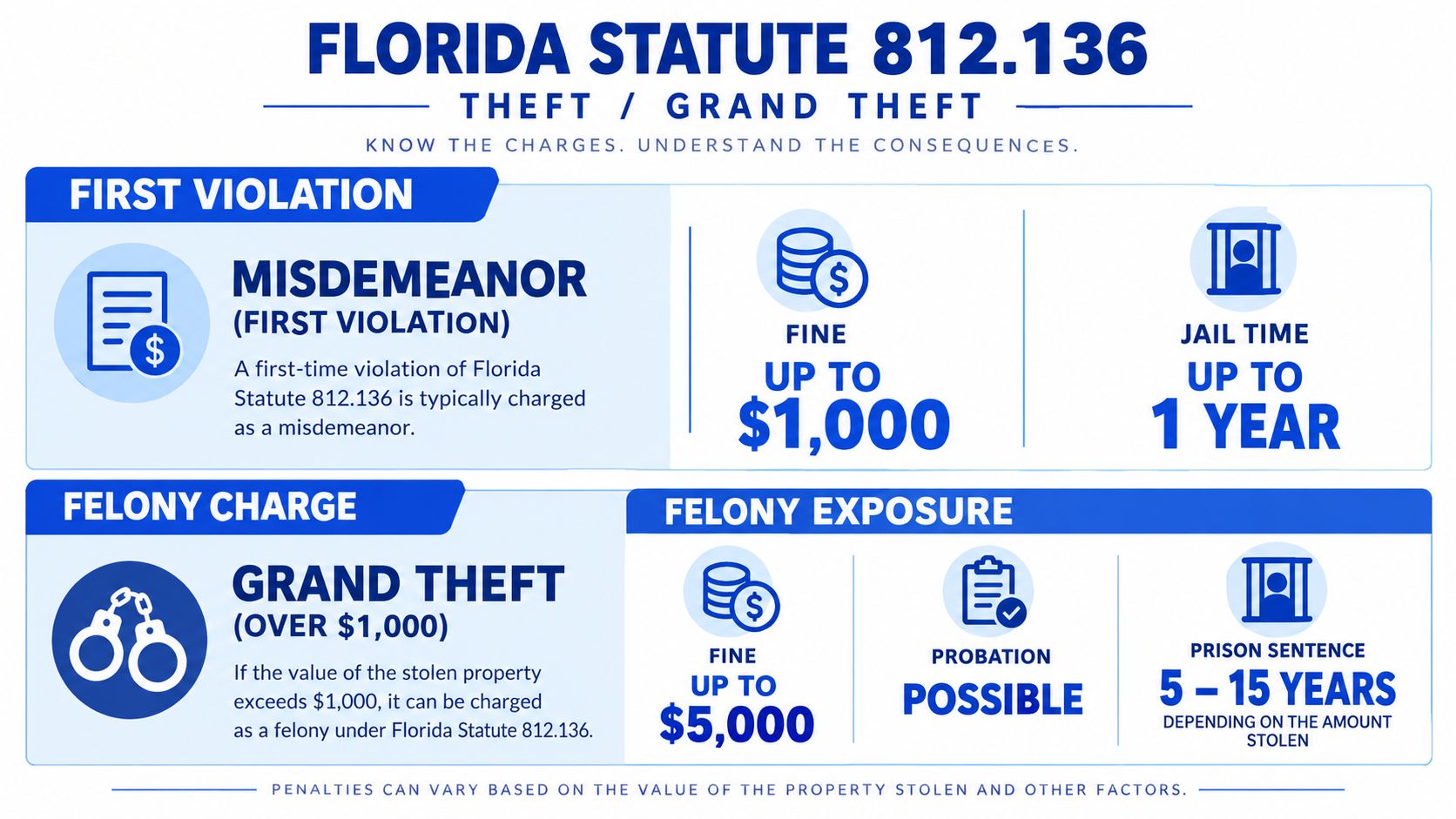
Florida has its own mail-theft statute, section 812.136, and it's narrower in one sense and sharper in another. The law defines mail broadly to include a letter, postal card, parcel, envelope, package, bag, or other sealed article addressed to another person, along with its contents. It covers knowingly removing mail from a depository or carrier, getting mail by fraud or deception, and selling, receiving, possessing, transferring, buying, or concealing mail when the person knows or should know it was illegally obtained. Florida Statute 812.136
First violation and repeat exposure
A first violation under 812.136 is generally a first-degree misdemeanor. That means the case stays in misdemeanor territory unless the facts or criminal history push it upward. The second or subsequent violation is the key pressure point, because the statute upgrades it to a third-degree felony.
The escalation matters in Florida because prosecutors and judges treat repeat conduct very differently from a one-off allegation. A repeat case can affect plea negotiating power, bail arguments, and sentencing exposure. The defense also has to examine whether the prior actually qualifies, whether it's being counted correctly, and whether the state is using an out-of-state prior to justify the felony bump.
Why the classification changes the case
A misdemeanor case usually focuses on county court consequences, local resolution, and whether the facts support diversion, dismissal, or a negotiated outcome. A felony case changes everything. It adds the risk of prison, a permanent felony record, and the downstream problems that come with a conviction in housing, work, and background screening.
Practical rule: The label on the charging document isn't just paperwork. It changes how the case is negotiated, defended, and resolved.
Florida theft cases can also bring restitution claims, especially when the mail contained checks, financial records, or items with replacement costs. In some theft-related felony cases, collateral consequences can reach beyond the courtroom, including license issues and immigration problems depending on the charge and the person's status.
A local case can also get bundled with other allegations when the facts escalate. If the state believes the mail theft was part of a broader fraud, identity theft, or burglary pattern, the filing strategy usually reflects that bigger picture rather than the mail allegation standing alone.
Florida theft statute overview
How Federal and State Charges Overlap in South Florida
South Florida mail theft cases often sit in a zone where both systems have a legitimate interest. The postal service gives the federal government a direct path, while Florida can prosecute the same conduct when it spills into local fraud, identity theft, or property crime. That overlap is why two people with similar facts can end up in very different courtrooms.
Choosing the forum
Federal authorities tend to focus on cases that involve repeated conduct, broader schemes, or stronger proof of intentional interference with the mail stream. State prosecutors often handle cases that are more local in scope, especially when the evidence centers on a residence, apartment building, or neighborhood delivery pattern.
That doesn't mean one system cancels out the other. The same act can trigger separate proceedings if each sovereign chooses to act. In practice, one case may be resolved in state court while federal investigators continue gathering evidence, or federal authorities may take over once the conduct looks more organized.
What changes the charging decision
The case often turns on the quality of the evidence, the scale of the alleged conduct, and whether the item was used for fraud afterward. A single opened envelope can remain a lower-level state matter. Repeated theft, concealed possession, or use of the mail for account access or identity misuse pushes the matter toward federal interest or more serious state treatment.
The defense has to understand the forum early, because motion practice, discovery, and plea negotiations look different in each court. A resolution that works in county court can be unavailable in federal court, and a federal investigation can outpace the local timeline if the Postal Inspection Service is already involved. Dealing in stolen property in Florida
Factor | Federal (18 U.S.C. § 1708) | Florida (Fla. Stat. § 812.136) |
|---|---|---|
Primary focus | Protection of the mail stream | Theft of addressed mail and related conduct |
Typical venue | Federal court | State court |
Repeat conduct | Can increase exposure through broader federal charging | Second or subsequent violation can become a felony |
Practical effect | Faster federal investigative build and indictment risk | Local resolution may be possible in lower-level cases |
Common Defenses to Mail Theft Allegations
The strongest defense usually starts with intent. Both federal and state mail-theft laws depend on knowing conduct, not a harmless mistake. If the item was not recognized as mail, or if the person lacked intent to steal, conceal, or use it, the state's case can weaken fast.
Intent and knowledge
A common defense issue is whether the person knew the item was mail and knew it belonged to someone else. That matters in apartment buildings, shared mail areas, and situations where family members, roommates, or coworkers handle deliveries. A defense lawyer looks for the context, not just the accusation.
Practical insight: A mail theft case often turns on ordinary details, like who had access, who opened the item first, and whether the item was immediately returned or kept.
Evidence problems and search issues
Surveillance footage is often incomplete. A grainy camera angle, a partial plate, or a vague identification can be enough to start an investigation, but not always enough to prove guilt beyond a reasonable doubt. If the state or federal government relies on circumstantial linking instead of direct proof, that gap becomes a defense issue.
Search and seizure problems also matter. Postal inspectors and local officers still have to respect constitutional limits, and an unlawful search, defective warrant, or overbroad seizure can create suppression issues. Once evidence gets excluded, the case may narrow dramatically.
Lack of knowledge: The person didn't know the item was mail or didn't know it belonged to someone else.
No criminal intent: The item was handled, moved, or opened by mistake rather than taken for personal use.
Insufficient proof: The government can't connect the accused to the item with reliable evidence.
Search challenges: The evidence came from a search that overstepped constitutional limits.
Early intervention: A defense lawyer can raise weaknesses before charges harden into an indictment or formal filing.
A defense lawyer usually starts looking at these issues before the prosecutor makes a final charging decision. That early stage can matter more than people expect, because once the case is filed, some options are already gone and the government has had time to lock in its theory. Types of criminal defenses
Plea Options, Diversion, and Realistic Outcomes
Mail theft cases don't all end the same way. The outcome depends on the facts, the person's record, the value or use of the mail, and whether the case is moving through state or federal court. The best negotiations usually happen when the defense addresses the evidence early and puts the prosecutor in a position to see the weaknesses before deadlines harden.
What can happen in state court
In Florida, first-offender cases may be candidates for diversion or deferred prosecution when the facts are favorable and the allegation isn't tied to a larger pattern. A court can also withhold adjudication in the right case, which can matter because it may avoid a formal conviction even though the person still has to comply with probation terms or other conditions.
Restitution is often part of the discussion if the mail involved checks, financial documents, or other recoverable loss. Cooperation, prompt explanation, and proof of innocent access can all affect whether the prosecutor is willing to reduce the charge or resolve the case short of a conviction.
Federal negotiations are different
Federal plea discussions tend to focus on the guidelines, the strength of the postal investigation, and whether the case can be pared down before indictment or after discovery. The process can still leave room for negotiation, but the government usually starts from a more structured posture than a local misdemeanor case.
Practical rule: The earlier a defense lawyer identifies the weakness, the more room there usually is to argue for a reduction instead of a conviction.
Ticket Shield, PLLC handles Florida theft matters, including misdemeanor and felony theft cases, and the firm communicates by phone, text, or email so clients can respond quickly when investigators start asking questions. That kind of early contact matters in mail-theft cases because timing often shapes whether the case stays manageable or becomes harder to unwind. Pretrial diversion program in Florida
Practical Steps If You Are Accused or Under Investigation
If postal inspectors or local police want to talk, don't try to explain your way out of the problem on the spot. A careful statement can help, but an unprepared one can also give the government exactly what it needs. The safest move is to get counsel involved before any interview, proffer, or request for a polygraph.
What to preserve right away
Keep every text message, email, receipt, delivery notice, and photo that might show lawful access to the mail or explain why the item was in your possession. If you have surveillance footage, save it immediately and don't overwrite the original copy. Write down a timeline while the details are fresh, because small facts are often the ones that matter most later.
Retain a defense attorney: Get counsel before speaking to investigators.
Stop the conversation: Don't answer questions from postal inspectors or police without representation.
Preserve messages: Save texts, emails, and call logs that explain what happened.
Secure records: Keep receipts, delivery notices, and other proof of lawful possession.
Collect witnesses: Identify household members, coworkers, or anyone else who can confirm access or timing.
Why early action matters
Early intervention can change what happens next. Counsel may be able to present mitigating facts before indictment, correct a misunderstanding about possession, or narrow the issue before prosecutors lock in the charge. That's especially important when the same facts could be viewed as a mistake in one courtroom and a felony theory in another.
Do not delete anything, even if it looks unhelpful. Deleting records after an investigation starts can create a separate problem and make the original matter harder to defend. Keep the originals, keep your timeline, and let counsel decide what matters.
If you're being questioned about mail theft in Broward, Miami-Dade, Palm Beach, or anywhere else in South Florida, Ticket Shield, PLLC can review the facts, explain your options, and step in before a statement makes the case harder to defend. Visit Ticket Shield, PLLC to discuss the situation with a Florida criminal defense team that handles theft cases with direct, practical guidance.