
Cargos por drogas en Florida: Posesión con la intención de distribuir
Jason Goldsmith, Abogado
Una detenciu00f3n de tru00e1fico en el sur de la Florida puede escalar ru00e1pidamente. El oficial afirma que usted conducu00eda a exceso de velocidad, luego le pregunta por quu00e9 parece nervioso y despuu00e9s solicita registrar el vehu00edculo. Minutos mu00e1s tarde, una bolsa, una bu00e1scula, dinero en efectivo o mensajes en su telu00e9fono se convierten en el fundamento de una acusaciu00f3n por un delito grave. Para cuando lo liberan, usted no estu00e1 pensando en teoru00eda legal. Estu00e1 pensando en la cu00e1rcel, su empleo, su familia y en si una mala noche acaba de cambiarlo todo por completo.
Si enfrenta cargos de posesiu00f3n con intenciu00f3n de distribuir en Fort Lauderdale, el condado de Broward, Miami-Dade, Palm Beach o en cualquier lugar del sur de la Florida, el temor es real. Tambiu00e9n lo es la confusiu00f3n. Muchas personas acusadas de un delito de drogas en Florida no tenu00edan idea de que el Estado trataru00eda el caso como distribuciu00f3n en lugar de consumo personal.
Esa escalada procesal ocurre constantemente. Mu00e1s del 85% de los 1.16 millones de arrestos anuales por drogas en los Estados Unidos son por posesiu00f3n simple; sin embargo, los fiscales au00fan utilizan las leyes de posesiu00f3n con intenciu00f3n de distribuir para convertir hechos circunstanciales como la cantidad o el empaque en una exposiciu00f3n a delitos graves mucho mu00e1s severos, segu00fan las estadu00edsticas de arrestos por drogas resumidas a partir de datos del FBI. Si estu00e1 intentando comprender la situaciu00f3n de su caso, comience con una perspectiva mu00e1s amplia sobre las opciones de defensa para delitos de drogas en Florida.
Un arresto no equivale a una condena. En muchos casos, la defensa mu00e1s su00f3lida comienza por desacelerar el proceso del caso, identificar las suposiciones de la policu00eda y obligar al Estado a probar cada elemento de la imputaciu00f3n.
u00cdndice de Contenido
El momento en que su vida cambiu00f3: Una guu00eda sobre cargos por drogas en Florida
Definiciu00f3n de la posesiu00f3n con intenciu00f3n bajo la ley de Florida
Posesiu00f3n simple frente a intenciu00f3n de distribuir: La diferencia cru00edtica
Cu00f3mo construyen los fiscales un caso de intenciu00f3n de distribuir
Cu00f3mo una defensa estratu00e9gica puede proteger su futuro
Medidas inmediatas a tomar tras un arresto por drogas en el sur de la Florida
El momento en que su vida cambiu00f3: Una guu00eda sobre cargos por drogas en Florida
Un momento usted estu00e1 conduciendo a casa por la I-95, Federal Highway, o una calle residencial en el condado de Broward. Al siguiente, se encuentra parado a un costado de la vu00eda mientras los oficiales registran su auto, abren compartimentos y le formulan preguntas diseu00f1adas para acorralarlo en una versiu00f3n de los hechos. Para cuando mencionan la "intenciu00f3n de distribuir", a menudo se asume que el caso debe involucrar una operaciu00f3n a gran escala. No es asu00ed.
En la realidad, estos cargos suelen comenzar con hechos ordinarios que la policu00eda interpreta de manera agresiva. Un pequeu00f1o fajo de bolsitas. Dinero en efectivo de un sueldo o de un trabajo secundario. Mu00e1s de un telu00e9fono. Un vehu00edculo de uso compartido. Una mochila que no es claramente de su propiedad. En los tribunales de Florida, esos detalles pueden elevar un caso de drogas mucho mu00e1s allu00e1 de la posesiu00f3n simple.
Lo que importa en este momento es lo siguiente: la calificaciu00f3n en la documentaciu00f3n del arresto es nicamente la acusaciu00f3n del Estado. Los fiscales todavu00eda tienen que demostrar conocimiento, posesiu00f3n e intenciu00f3n. Si uno de esos elementos se debilita, el caso cambia por completo.
Regla pru00e1ctica: La primera versiu00f3n del informe policial no constituye la verdad definitiva del caso. Es la postura inicial del Estado.
Las personas que buscan un abogado especializado en delitos de drogas en el condado de Broward o un abogado de defensa penal en Fort Lauderdale de manera urgente necesitan dos cosas inmediatamente: respuestas claras y un plan juru00eddico. El plan adecuado no surge del pu00e1nico. Comienza por salvaguardar sus derechos constitucionales, revisar la legalidad de la detenciu00f3n, examinar el registro fu00edsico y someter a escrutinio cada suposiciu00f3n presentada por el Estado.
Definiciu00f3n de la posesiu00f3n con intenciu00f3n bajo la ley de Florida
Los fiscales de Florida no ganan estos casos demostrando simplemente que se encontraron drogas cerca de usted. Deben probar una teoru00eda legal especu00edfica. En tu00e9rminos juru00eddicos, la posesiu00f3n con intenciu00f3n de distribuir significa que el Estado alega que usted poseu00eda a sabiendas una sustancia ilu00edcita y tenu00eda el propu00f3sito de venderla, suministrarla o transferirla a otra persona.

Lo que el Estado debe probar
Tres elementos juru00eddicos suelen definir esta disputa:
Conocimiento: El fiscal debe demostrar que usted sabu00eda de la presencia de la sustancia y de su naturaleza ilu00edcita. Si el objeto estaba oculto en un automu00f3vil prestado, un apartamento compartido o la bolsa de otra persona, este elemento se convierte ru00e1pidamente en objeto de impugnaciu00f3n.
Posesiu00f3n: Esta puede ser posesiu00f3n fu00edsica (real) o posesiu00f3n implu00edcita (constructiva). La posesiu00f3n real significa que la sustancia estaba sobre usted o en su mano. La posesiu00f3n implu00edcita significa que el Estado sostiene que usted tenu00eda el control de la sustancia, incluso si no se encontraba fu00edsicamente en su persona.
Intenciu00f3n de distribuir: Este es el elemento adicional que convierte un caso de posesiu00f3n en un cargo por delito grave mucho mu00e1s severo. El Estado intenta deducir la intenciu00f3n a partir de las circunstancias, en lugar de presentar pruebas directas.
Muchas personas se confunden con el tu00e9rmino "posesiu00f3n". Asumen que si habu00eda sustancias ilu00edcitas cerca, el caso estu00e1 perdido. No es asu00ed.
La posesiu00f3n implu00edcita, el fundamento donde se ganan o pierden muchos casos
La posesiu00f3n implu00edcita (constructiva) es uno de los aspectos mu00e1s litigados en los casos de drogas en Florida. Si la policu00eda encuentra narcu00f3ticos en la consola central, debajo del asiento del pasajero, dentro de una habitaciu00f3n compartida o en una cocina utilizada por varias personas, el Estado au00fan tiene la obligaciu00f3n legal de vincular esa propiedad con usted.
Ese vu00ednculo probatorio suele ser du00e9bil.
Un vehu00edculo de uso compartido es el ejemplo clu00e1sico. Si mu00faltiples personas tenu00edan acceso a u00e9l, el fiscal debe hacer mu00e1s que seu00f1alar la proximidad fu00edsica. Necesita evidencia contundente de que usted sabu00eda que las drogas estaban allu00ed y tenu00eda la capacidad de ejercer control sobre ellas. Un ex-fiscal comprende con precisiu00f3n cu00f3mo el Estado intenta sobredimensionar esos hechos y, de igual importancia, los puntos exactos donde dicha argumentaciu00f3n carece de sustento.
El Estado no tiene derecho a omitir exigencias procesales por el hecho de que la acusaciu00f3n resulte grave. Los cargos severos au00fan requieren prueba mu00e1s allu00e1 de toda duda razonable.
La intenciu00f3n tambiu00e9n es juru00eddicamente independiente de la posesiu00f3n. Una persona puede admitir la propiedad de la sustancia y, aun asu00ed, combatir la acusaciu00f3n de que estaba destinada a la venta o suministro. Esta distinciu00f3n es fundamental en la defensa penal de delitos de drogas en Florida, ya que puede incidir directamente en la formulaciu00f3n de cargos, el poder de negociaciu00f3n, los acuerdos de declaraciu00f3n de culpabilidad y la estrategia de juicio.
Posesiu00f3n simple frente a intenciu00f3n de distribuir: La diferencia cru00edtica
La diferencia mu00e1s significativa no siempre radica en la sustancia en su00ed. Consiste en la forma en que los oficiales describen las circunstancias del hallazgo. Lo que para usted puede interpretarse como consumo personal, para un fiscal puede perfilarse como un caso de distribuciu00f3n si el informe de arresto hace menciu00f3n de la cantidad, empaque, dinero en efectivo, bu00e1sculas o comunicaciones.
Para comprender la naturaleza del cargo, resulta de utilidad comparar ambos supuestos de manera directa.
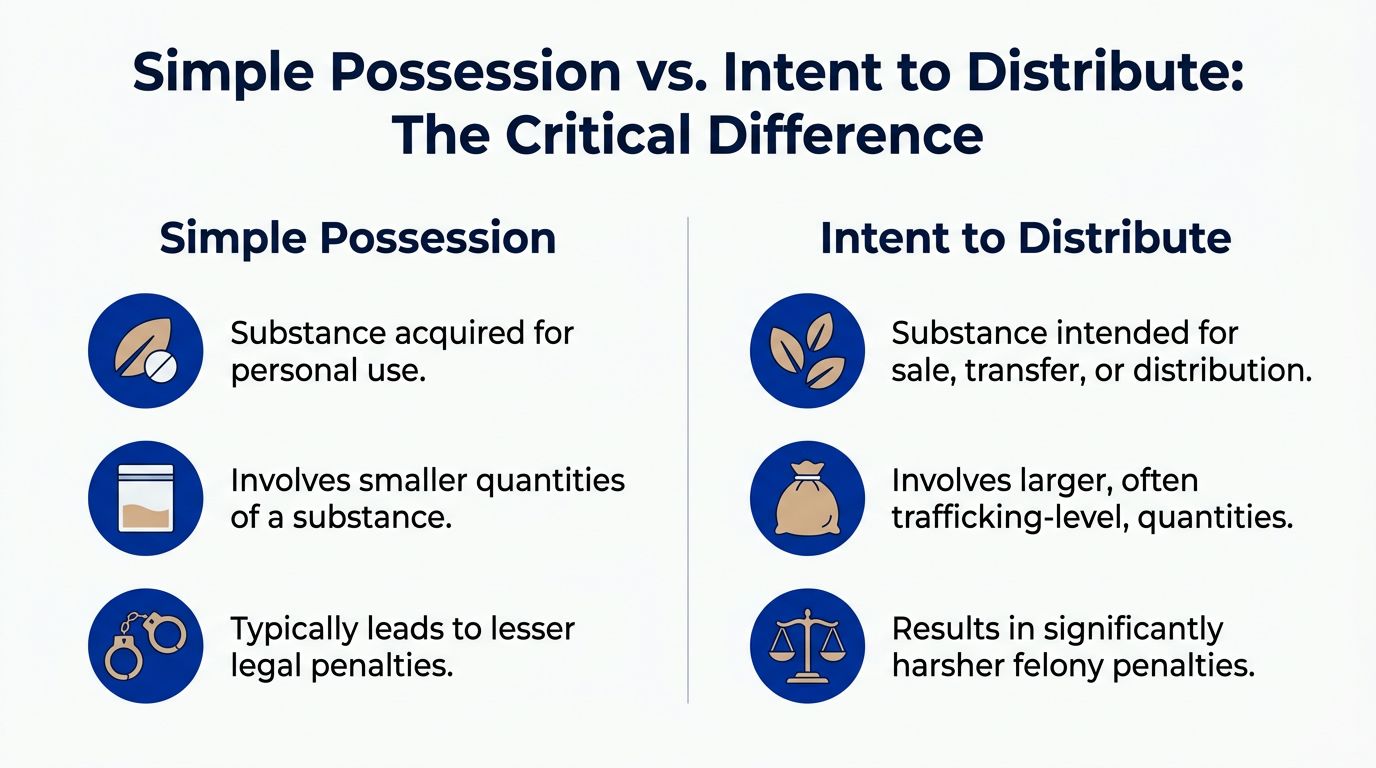
Por quu00e9 las mismas drogas pueden derivar en cargos muy diferentes
Aspecto legal | Posesiu00f3n simple | Posesiu00f3n con intenciu00f3n de distribuir |
|---|---|---|
Teoru00eda del caso | Uso o consumo personal | Venta, suministro o transferencia |
Prueba clave | Presencia de la sustancia | Sustancia mu00e1s indicios circunstanciales |
Descripciu00f3n policial | Conducta propia de un consumidor | Conducta propia de un distribuidor |
Situaciu00f3n procesal | Disputa fu00e1ctica generalmente mu00e1s delimitada | Disputa amplia sobre interpretaciu00f3n e inferencias |
La diferencia pru00e1ctica en tu00e9rminos de exposiciu00f3n penal es inmensa. Un caso de posesiu00f3n simple suele centrarse en determinar si las drogas le pertenecu00edan y si el registro cumpliu00f3 con los paru00e1metros constitucionales. Un caso de posesiu00f3n con intenciu00f3n de distribuir incluye esas cuestiones, pero au00f1ade una batalla procesal secundaria sobre el significado atribuido al material incriminatorio circunstancial.
Si requiere una explicaciu00f3n sobre el delito base, consulte cu00f3mo procesa Florida los cargos por posesiu00f3n de sustancias controladas.
Cu00f3mo formulan los fiscales la intenciu00f3n
Los tribunales de Florida facultan a los fiscales para argumentar que la sola cantidad de sustancia puede sustentar una inferencia de intenciu00f3n en determinados casos. Montos que excedan lo considerado regular para el consumo personal, tales como mu00e1s de una libra de marihuana o mu00e1s de 5 a 10 gramos de cocau00edna, se utilizan comu00fanmente como evidencia circunstancial de distribuciu00f3n aun en ausencia de prueba de una transacciu00f3n de venta consumada, segu00fan se detalla en este anu00e1lisis de intenciu00f3n de distribuir versus posesiu00f3n simple.
Esto no significa que la cantidad determine irrefutablemente el resultado del proceso. Significa que la cantidad dota al Estado de un argumento juru00eddico inicial.
Asu00ed se desarrolla habitualmente este escenario en el tribunal:
Cantidad menor, sin aditamentos adicionales: El Estado encuentra mayor dificultad en argumentar actividad de venta.
Cantidad moderada acompau00f1ada de empaques o bu00e1scula: Los fiscales configuran los hechos presentu00e1ndolos como preparaciu00f3n para la distribuciu00f3n.
Espacio compartido con evidencia diversa: Tanto la posesiu00f3n implu00edcita como la intenciu00f3n pasan a ser u00e1reas vulnerables susceptibles de ser atacadas por la defensa.
Una breve guu00eda sobre el tema puede ilustrar la forma en que evolucionan las decisiones en la imputaciu00f3n de cargos en estos casos espinosos.
Suponer que el Estado requiere sorprenderle cometiendo una transacciu00f3n de venta directa constituye un error cru00edtico. En muchas fiscalu00edas del condado de Broward y Miami-Dade, no lo intentan. En su lugar, estructuran un caso basado en la inferencia legal.
Cu00f3mo construyen los fiscales un caso de intenciu00f3n de distribuir
Cuando examino estos expedientes bajo la perspectiva de la fiscalu00eda, el patru00f3n es recurrente. El Estado raras veces dispone de un elemento de prueba u00fanico y contundente. Mu00e1s bien, acumula detalles cotidianos hasta lograr hilar un argumento de distribuciu00f3n ante un juez o jurado.
Dicha narrativa de cargo suele basarse en lo que en el u00e1mbito de la defensa penal denominamos la tru00edada forense.
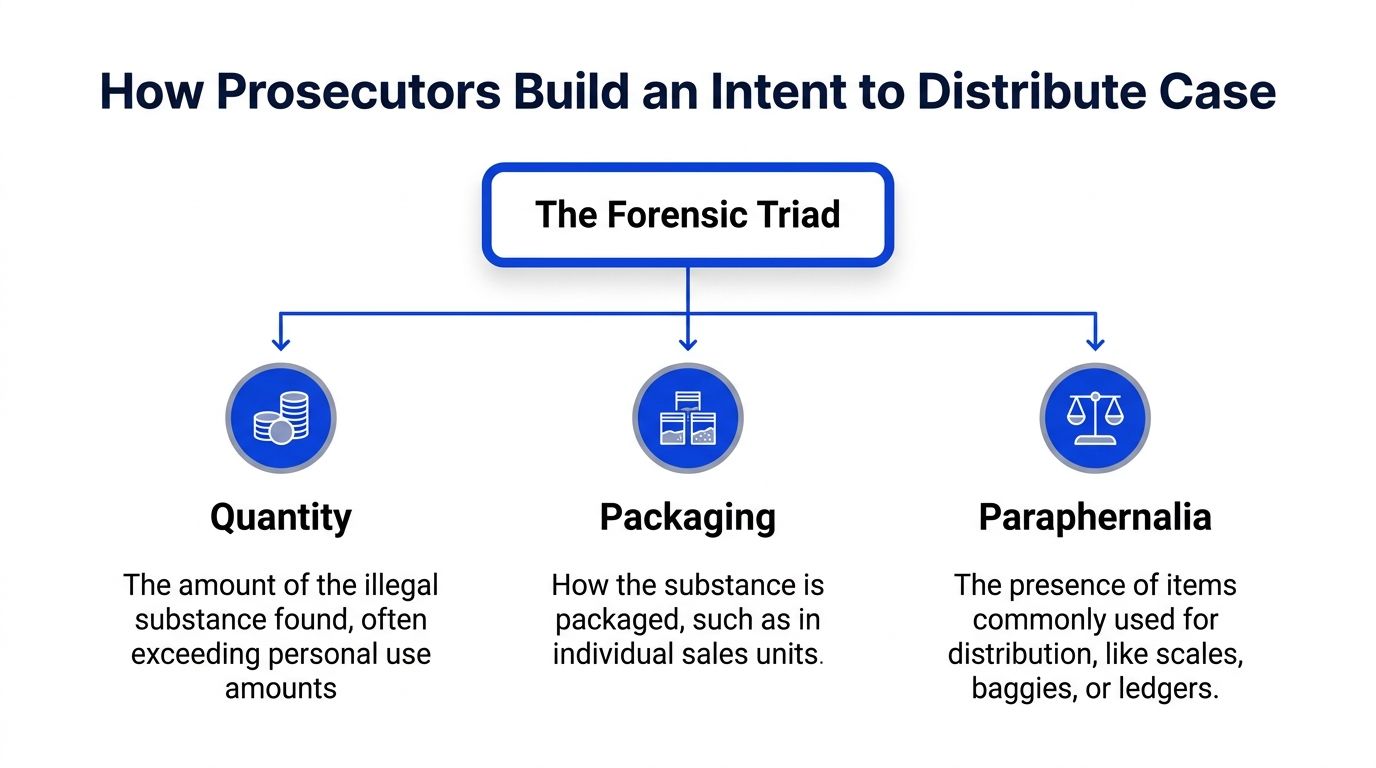
La tru00edada forense en la que confu00edan los fiscales
Las agencias del orden pu00fablico construyen gran parte de los casos de posesiu00f3n con intenciu00f3n de distribuir en torno a la cantidad, el empaque y la evidencia financiera, donde objetos como bu00e1sculas digitales, pequeu00f1as bolsas de plu00e1stico y mu00faltiples telu00e9fonos son catalogados como distintivos de tru00e1fico ilu00edcito para elevar la probabilidad de un cargo agravado, segu00fan esta exposiciu00f3n sobre cu00f3mo se formulan los cargos de PWID.
Esa estructura se plasma sistemu00e1ticamente en los informes de arresto, las declaraciones juradas de causa probable y las negociaciones de cargos. Entre los ejemplos comunes destacan:
Evidencia de cantidad: Un volumen superior al que los agentes alegan como coherente con el consumo individual.
Evidencia de empaque: Dosificaciu00f3n en bolsas individuales, envoltorios sellados al vacu00edo o sustancias fraccionadas en unidades mu00ednimas.
Evidencia financiera: Posesiu00f3n de dinero en efectivo en denominaciones pequeu00f1as, registros de transacciones o anotaciones que la policu00eda califica como contabilidad informal.
El hallazgo de parafernalia puede hacer que los hechos descritos en el informe policial parezcan considerablemente mu00e1s graves de lo que en realidad son. Por ello, una acusaciu00f3n colateral referida a parafernalia de drogas en Florida ostenta mayor relevancia penal de la que la mayoru00eda de los acusados cree.
La evidencia digital es ahora parte de la estrategia acusatoria
Los dispositivos de telefonu00eda mu00f3vil han redefinido esta lu00ednea de confrontaciu00f3n juru00eddica. Las conversaciones de texto, chats de redes sociales, transacciones en aplicaciones como Cash App, registros de llamadas, listas de contactos y el historial de geolocalizaciu00f3n son utilizados habitualmente para estructurar la acusaciu00f3n. La policu00eda no necesita que sus mensajes empleen de forma explu00edcita las palabras "venta de drogas". Se apoyan e interpretan de manera interesada el argot, abreviaturas, horas de envu00edo y presunciones.
Muchas de las guu00edas de informaciu00f3n pu00fablica omiten un peligro sustancial: explican el impacto de las bu00e1sculas y bolsas, pero eluden el riesgo derivado de expresiones coloquiales por vu00eda digital.
Un mensaje que indique "estoy afuera", "trae dos" o "lo mismo de la vez pasada" puede ser calificado como jerga de venta de substancias si la policu00eda previamente ha calificado el caso como uno de comercializaciu00f3n. Llamadas repetidas de corta duraciu00f3n suelen tildarse de clientela frecuente. Las ubicaciones geogru00e1ficas compartidas se conceptualizan como puntos de entrega. Nada de lo anterior representa una prueba incontrovertible.
La estrategia del fiscal consiste en dotar de conexiu00f3n lu00f3gica a hechos que se encuentran aislados. El deber de un abogado defensor penal consiste en desarticular cada uno de esos vu00ednculos.
La lu00ednea de defensa mu00e1s eficaz no radica en manifestaciones de indignaciu00f3n general, sino en la precisiu00f3n procesal. u00bfA quiu00e9n pertenecu00eda legalmente el dispositivo? u00bfQuiu00e9n redactu00f3 efectivamente el mensaje? u00bfCumpliu00f3 el proceso de extracciu00f3n con las garantu00edas constitucionales? u00bfResulta cientu00edficamente confiable la interpretaciu00f3n de jerga dada por la policu00eda? u00bfSe descontextualizu00f3 la comunicaciu00f3n? u00bfLa policu00eda aseguru00f3 el dispositivo y realizu00f3 la descarga de datos segu00fan los protocolos de cadena de custodia?
El contrainterrogatorio mu00e1s fuerte en estas causas tu00edpicamente confronta las premisas de los agentes de la ley y del orden, no solo sus deducciones finales. Si el "perfil de distribuidor" propuesto por el Estado se ampara puramente en artu00edculos comunes y mensajes fu00e1cilmente malinterpretables, dicho perfil puede ser invalidado pieza por pieza.
Las severas penas por una condena de PWID en Florida
Un cargo de posesiu00f3n con intenciu00f3n de distribuir no es asimilable a una contravenciu00f3n de posesiu00f3n simple. En Florida, se persigue penalmente como un delito grave (felony), y la magnitud de la penalidad puede agravarse de acuerdo con el tipo de sustancia, el peso aducido, la ubicaciu00f3n de la detenciu00f3n y si el Estado promueve agravantes por tru00e1fico ilu00edcito.
Por quu00e9 la exposiciu00f3n a un delito grave lo cambia todo
El perjuicio inminente no reside exclusivamente en la privaciu00f3n de la libertad. Un procesamiento por delito grave reconfigura los debates sobre la fianza, las opciones de resoluciu00f3n por vu00eda de fu00f3rmulas alternas, la estrategia de investigaciu00f3n previa al juicio y la estimaciu00f3n de dau00f1os por parte de los fiscales. En tu00e9rminos pru00e1cticos, la acusaciu00f3n tiende a tornarse ru00edgida desde las etapas tempranas, especialmente si en el informe judicial consta la presencia de efectivo, enseres de empaque o informaciu00f3n telefu00f3nica.
En la jurisdicciu00f3n federal, las consecuencias punitivas revisten una severidad au00fan mayor. Los procesos federales por posesiu00f3n con intenciu00f3n y tru00e1fico se ventilan al amparo del tu00edtulo 21 del Cu00f3digo de los EE. UU. (21 U.S.C. u00a7 841(a)), y la Comisiu00f3n de Sentencias de los Estados Unidos seu00f1ala que en 2023 mu00e1s de 18,000 personas recibieron sentencia en tribunales federales por ilu00edcitos relacionados con el tru00e1fico de estupefacientes, en su manual de 2025 sobre delitos federales de drogas. El citado informe detalla que una cantidad igual o superior a 5 kilogramos de cocau00edna, u ostentar 280 gramos o mu00e1s de cocau00edna en base (crack), puede activar una pena de prisiu00f3n federal mu00ednima obligatoria de 5 au00f1os, exponiendo a los procesados a rangos de sentencia superiores si los volu00famenes resultan mayores.
Aun cuando la jurisdicciu00f3n del caso permanezca en los tribunales del estado de Florida, la pauta es exactamente la misma. En el momento en que las autoridades catalogan un expediente bajo el rubro de distribuciu00f3n, asimilan la condiciu00f3n del indiciado a la de un proveedor y no a la de un enfermo por adicciu00f3n.
Dau00f1os colaterales mu00e1s allu00e1 de la sala del tribunal
La sentencia de prisiu00f3n no constituye el castigo u00fanico. Los antecedentes por delitos de drogas de naturaleza grave (felony) pueden mermar:
La situaciu00f3n laboral: Las verificaciones de antecedentes penales por parte de empleadores truncan contrataciones o promociones corporativas.
La bu00fasqueda de vivienda: Los arrendadores suelen denegar el alquiler a solicitantes que ostenten condenas por delitos de esta gravedad.
Habilitaciones profesionales: Profesionales de la salud, docentes, contratistas y demu00e1s oficios regulados se exponen a procesos de cancelaciu00f3n de licencias.
El derecho a portar armas de fuego: Una condena por delito grave restringe permanentemente la posesiu00f3n legal de armas.
Su reputaciu00f3n: El entorno familiar, los compau00f1eros de trabajo y el cu00edrculo acadu00e9mico emiten juicios mucho antes de que el proceso sea dirimido formalmente.
Para la generalidad de las personas bajo investigaciu00f3n en Fort Lauderdale y el sur de la Florida, estas consecuencias paralelas revisten igual gravedad que la sanciu00f3n penal en su00ed. Por ello, un objetivo juru00eddico acertado no se reduce a "concluir el juicio"; debe enfocarse en blindar su historial delictivo, sus prerrogativas legales y sus opciones futuras.
Cu00f3mo una defensa estratu00e9gica puede proteger su futuro
La lu00ednea de defensa mu00e1s su00f3lida no recurre a justificaciones endebles. Se ampara en someter a rigurosa verificaciu00f3n la carga probatoria estatal. En un caso de drogas en Florida, esto implica impugnar el actuar policial en la obtenciu00f3n de la evidencia, verificar si es posible vincularla con usted de forma inequu00edvoca, y desacreditar la teoru00eda de intenciu00f3n de distribuciu00f3n frente al autoconsumo.

Impugnar la detenciu00f3n, el registro y Incautaciu00f3n
La viabilidad juru00eddica de la defensa penal suele determinarse en hechos previos al hallazgo de las sustancias. u00bfFue constitucionalmente legu00edtima la detenciu00f3n vehicular? u00bfMantuvieron los oficiales la restricciu00f3n de movimiento de forma indebida y sin justificaciu00f3n suficiente? u00bfHubo un consentimiento expreso y libre para inspeccionar la propiedad, o la policu00eda manipulu00f3 las circunstancias para simularlo? u00bfPesaba una orden judicial vu00e1lida que facultara la extracciu00f3n mu00f3vil?
Si la actuaciu00f3n policial vulneru00f3 sus derechos constitucionales contra registros e incautaciones arbitrarias, el recurso legal idu00f3neo es la exclusiu00f3n judicial del material incriminatorio. Este procedimiento suele definir la suerte de casos de gran envergadura penal, por lo que resulta imperativo comprender cu00f3mo funciona una mociu00f3n para suprimir evidencia.
El peso de la informaciu00f3n digital requiere una atenciu00f3n defensiva meticulosa. Los textos SMS, posteos en portales digitales y registros de posicionamiento geogru00e1fico se emplean persistentemente para deducir intencionalidad, y las cortes de Florida analizan los derechos a la privacidad frente al acopio y confiabilidad tu00e9cnica de esos materiales, como se advierte en estos recursos de referencia sobre pru00e1ctica procesal y objeciones de prueba. Dichos elementos probatorios son susceptibles de ser atacados por vu00eda de legalidad, autenticidad y resguardo tu00e9cnico de la informaciu00f3n.
Cuestionar la posesiu00f3n y desmantelar la intenciu00f3n
El siguiente frente es de naturaleza fu00e1ctica. Si la localizaciu00f3n de la sustancia se dio en un habitu00e1culo, vehu00edculo o pertenencia con acceso polivalente, el argumento de posesiu00f3n implu00edcita puede resultar endeble. Las representaciones del Estado tienden a sobredimensionar la nociu00f3n de "dominio y control" en contextos de accesibilidad mu00faltiple.
Un litigio defensivo exhaustivo obliga a plantear interrogantes incu00f3modas a la contraparte:
u00bfQuu00e9 otras personas tenu00edan acceso al lugar fu00edsico? El rol de coarrendatarios, acompau00f1antes de viaje, integrantes del nu00facleo familiar, compau00f1eros de labor o visitas eventuales resulta de vital trascendencia.
u00bfEn quu00e9 punto especu00edfico se localizu00f3 la sustancia? La visibilidad del artu00edculo, la proximidad fu00edsica del implicado, la titularidad juru00eddica del receptu00e1culo y las condiciones del entorno son cruciales.
u00bfQuu00e9 justificaciu00f3n legu00edtima puede explicar los indicios? Las sumas de dinero en efectivo pueden corresponder a ingresos ordinarios. El uso de diversos mu00f3viles puede obedecer a la delimitaciu00f3n de asuntos privados y laborales. La existencia de envoltorios plu00e1sticos puede guardar finalidades asu00e9pticas y lu00edcitas.
u00bfFueron evaluados los mensajes en su correcto contexto conversacional? Las bromas, expresiones coloquiales, uso del mu00f3vil por terceras personas, diu00e1logos recortados y la ausencia de metadatos de confirmaciu00f3n pueden alterar su sentido.
No tome la construcciu00f3n del Estado como la versiu00f3n conclusiva. En la mayor parte de las ocasiones, representa el relato corporativo mu00e1s lesivo para usted.
La experiencia previa en el rol de fiscal aporta una ventaja sustantiva, pues clarifica los flancos du00e9biles en las teoru00edas acusatorias habituales. Aquello que sobre el papel se vislumbra como una imputaciu00f3n su00f3lida suele resultar endeble en la dinu00e1mica de la sala de audiencias. El relato del oficial de policu00eda puede sonar pulcro por escrito, pero en el momento en que se le cuestiona especu00edficamente sobre la secuencia de tiempo, la voluntariedad de los registros, el acceso fu00edsico al u00e1rea, la pertenencia de los enseres y el actuar pericial sobre los aparatos electru00f3nicos, el caso comienza a fracturarse du00eda a du00eda.
Permanecer pasivo a la espera de que el propio Estado reconozca que ha sobredimensionado los cargos del caso es una estrategia condenada al fracaso. Los fiscales raramente ceden de manera espontu00e1nea prebendas procesales. El defensor penal tiene que exigir y arrancar los resultados mediante mociones fundadas, indagaciu00f3n profunda y un cuestionamiento implacable de la prueba de cargo.
Medidas inmediatas a tomar tras un arresto por drogas en el sur de la Florida
Las primeras horas que siguen a una detenciu00f3n policial resultan determinantes. Sus manifestaciones de palabra, los datos que decida conservar y los consentimientos de inspecciu00f3n que otorgue incidiru00e1n en la viabilidad futura de toda la defensa penal.
Quu00e9 hacer ahora mismo
Ejercite su derecho constitucional a guardar silencio: Aporte los datos requeridos para su identificaciu00f3n civil, pero evite dar explicaciones, justificaciones o conjeturas fu00e1cticas.
Solicite asistencia letrada de forma clara e inequu00edvoca: Al manifestar su peticiu00f3n de asistencia de un profesional del derecho, las autoridades deben detener de inmediato todo interrogatorio fu00e1ctico.
Documente pormenorizadamente los acontecimientos: Ponga por escrito cuanto antes todos los detalles que recuerde sobre la detenciu00f3n, la posterior requisa, declaraciones expresadas, personas presentes y los tiempos de ejecuciu00f3n.
Proteja y preserve toda su informaciu00f3n digital: Evite purgar chats, historiales telefu00f3nicos, datos de aplicaciones o registros de geoposiciu00f3n. La remociu00f3n de informaciu00f3n puede configurar nuevas conductas punibles.
Cumpla estrictamente con las condiciones de la fianza impuestas: La incomparencia a citaciones judiciales o el incumplimiento de mandatos empeoran la situaciu00f3n en cualquier proceso penal.
Lo que habitualmente agrava el caso
Diversas fallas de conducta se repiten recurrentemente en el u00e1mbito de la defensa juru00eddica penal en Florida:
Sostener contactos con investigadores tras ser puesto en libertad: Los agentes suelen telefonear una vez que el procesado se siente fuera de peligro, induciu00e9ndole a aportar declaraciones perjudiciales de forma voluntaria.
Consentir la inspecciu00f3n de dispositivos mu00f3viles: Su telu00e9fono puede transformarse en la prueba de cargo medular de la fiscalu00eda.
Contactar a testigos de la causa para acordar versiones: Estas acciones son fu00e1cilmente catalogadas por la fiscalu00eda como delito de obstrucciu00f3n a la justicia.
Realizar publicaciones en portales de internet: Las redes sociales son utilizadas constantemente por los investigadores como fuente de elementos incriminatorios.
Suponer que el cargo penal se solucionaru00e1 espontu00e1neamente mu00e1s adelante: La intervenciu00f3n legal oportuna provee de un margen de actuaciu00f3n considerablemente mu00e1s favorable para salvaguardar sus intereses.
Si usted o un ser querido ha sido objeto de arresto en el condado de Broward, Fort Lauderdale, Miami-Dade, Palm Beach o demarcaciones colindantes del sur del estado de Florida, consulte de inmediato con profesionales del derecho penal. Entre mu00e1s pronto disponga un abogado especialista de los informes de arresto, las grabbing de las cu00e1maras corporales policiales, el examen de legalidad de los registros de bienes y la evidencia electru00f3nica recabada, mejores seru00e1n las proyecciones juru00eddicas para mitigar el perjuicio juru00eddico y blindar su libertad.
Si enfrenta una acusaciu00f3n de posesiu00f3n con intenciu00f3n de distribuir o cualquier otra imputaciu00f3n penal en el sur de la Florida, comunu00edquese con Ticket Shield, PLLC a fin de concertar una evaluaciu00f3n confidencial de su caso. La oficina representa a ciudadanos en el condado de Broward, Fort Lauderdale, Miami-Dade, Palm Beach y el resto de los tribunales de la Florida. El abogado Jason S. Goldsmith incorpora su experiencia previa de fiscal para refutar inspecciones deficientes, atacar presunciones du00e9biles de intenciu00f3n de distribuciu00f3n y estructurar una estrategia firme adaptada a las particularidades de su situaciu00f3n juru00eddica. En momentos donde se encuentran en juego su libertad fu00edsica, su historial y su futuro familiar, la intervenciu00f3n juru00eddica oportuna es lo que define su caso.
La intención de distribución convierte un caso de posesión en un delito grave mayor. Conozca cómo los fiscales de Florida demuestran dicha intención y cómo ejercer su defensa legal.