Constructive Possession Florida: Expert Legal Defense
Jason Goldsmith, Esq
A traffic stop in Fort Lauderdale starts like any other. License. Registration. A few questions. Then an officer searches the car, opens the center console or looks under a seat, and finds drugs. You say they aren't yours. The officer arrests you anyway.
That shock is common in South Florida drug cases. People get charged even when nothing was in their hand, pocket, or bag. The reason is constructive possession, a legal theory Florida prosecutors use when they believe you knew the drugs were there and had the ability to control them.
If you're facing this charge in Broward County, Miami-Dade, Palm Beach, or nearby courts, the most important thing to understand is this: an arrest doesn't settle the case. Constructive possession cases often turn on weak assumptions, shared access, bad inferences, and statements people never should've given police in the first place.
Table of Contents
You Were Charged but It Was Not Yours
You can be a passenger in a friend's car on I-95. You can be staying at someone else's apartment in Miami. You can borrow a vehicle, get stopped in West Palm Beach, and suddenly hear an officer say they found contraband in the glove box.
From your side, the reaction is immediate. Confusion, anger, panic. If it wasn't yours, why are you the one being charged?
The answer is that Florida law doesn't limit possession cases to items found directly on your body. In many drug prosecutions, the State argues that you constructively possessed the substance because you supposedly knew it was there and could control it. That sounds simple. In court, it rarely is.
Why these cases feel unfair
Constructive possession cases often grow out of shared spaces. Cars. Apartments. Hotel rooms. Houses with multiple adults coming and going. In those places, police may arrest more than one person or focus on the person they think is easiest to connect to the location.
Practical rule: If police found drugs near you, that does not automatically mean the State can prove possession.
As a former prosecutor would tell you candidly, these cases are usually built from inference. The State tries to turn presence into knowledge, and knowledge into control. A skilled defense lawyer works in the opposite direction. Separate those assumptions. Force the State to prove each link. Expose the gaps.
What usually hurts people early
Most bad possession cases get worse because the accused talks too much. People try to sound cooperative. They explain who borrowed the car, who stayed at the apartment, or why they were near the item. Officers write those statements down, and prosecutors later use them to argue awareness and control.
If you're being investigated for constructive possession in Florida, the issue isn't whether your explanation feels reasonable to you. The issue is whether the State can twist your words into evidence of knowledge, access, or dominion over the drugs.
That is why early legal strategy matters in Broward County and throughout South Florida. These charges look stronger on an arrest report than they often look after careful review.
What Is Constructive Possession vs Actual Possession
Actual possession and constructive possession are not the same thing. That distinction matters in every Florida drug case, especially when police never found anything directly on you.
The difference that matters in court
Actual possession usually means the substance was on your person. In your hand. In your pocket. In a bag you were carrying.
Constructive possession means the State claims you had control over the substance without physically holding it. Think of a car console, a bedroom drawer, a kitchen counter in a residence, or another place prosecutors say was under your authority.
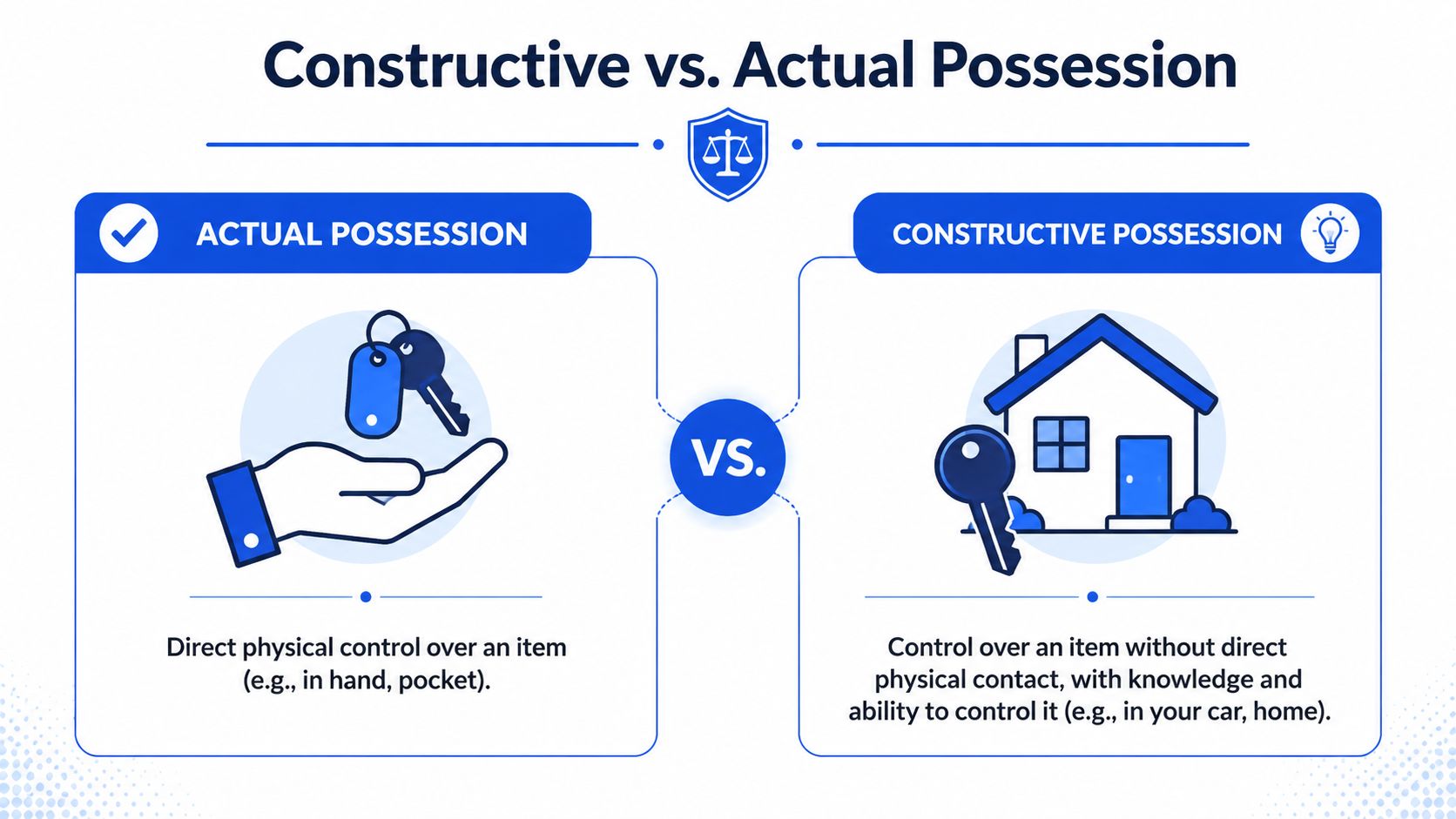
A simple way to think about it is this. If actual possession is having the item in your hand, constructive possession is the State arguing you held the keys to where it was kept. That argument only works if the prosecutor can prove more than physical closeness.
What the State must prove
Under Florida law, the prosecution must prove three specific elements beyond a reasonable doubt in a constructive possession case: (1) knowledge of the presence of the substance, (2) knowledge of the illicit nature of the substance, and (3) dominion and control over the substance. That standard is discussed in this Florida constructive possession analysis.
That third element is where many cases get shaky. Dominion and control means more than being nearby. It means the State has to convince a judge or jury that you could manage or control the item even without physical contact.
If you're dealing with a charge involving pills, cocaine, or another controlled substance, it's also useful to understand how these cases fit into broader Florida possession of controlled substance charges.
Actual Possession vs. Constructive Possession at a Glance
Characteristic | Actual Possession | Constructive Possession |
|---|---|---|
Physical location | On the person | In a place the State says the person controlled |
Typical example | In a pocket or hand | In a car, home, or other area tied to the person |
Main proof issue | Whether the item was actually on the defendant | Whether the defendant knew about it and controlled it |
Common defense focus | Search legality, identity, handling of evidence | Knowledge, illicit nature, dominion, shared access |
In practice, constructive possession Florida cases are harder for the State than they first appear, because every element has to be proven separately.
How Prosecutors Try to Prove Constructive Possession
Prosecutors in Broward County, Fort Lauderdale, Miami-Dade, and Palm Beach usually don't get a direct admission saying, "Those drugs are mine." They build constructive possession cases from surrounding facts.
What the State leans on
The legal theory is straightforward. In Florida, constructive possession exists only if the prosecution proves beyond a reasonable doubt that the defendant knew the drugs were present and had the ability and intent to control them. That framework traces back to Brown v. State (1983), where the Florida Supreme Court held that joint occupancy of premises with contraband in plain view can support a conviction under the right facts, as summarized in this discussion of Brown v. State and constructive possession in Florida.
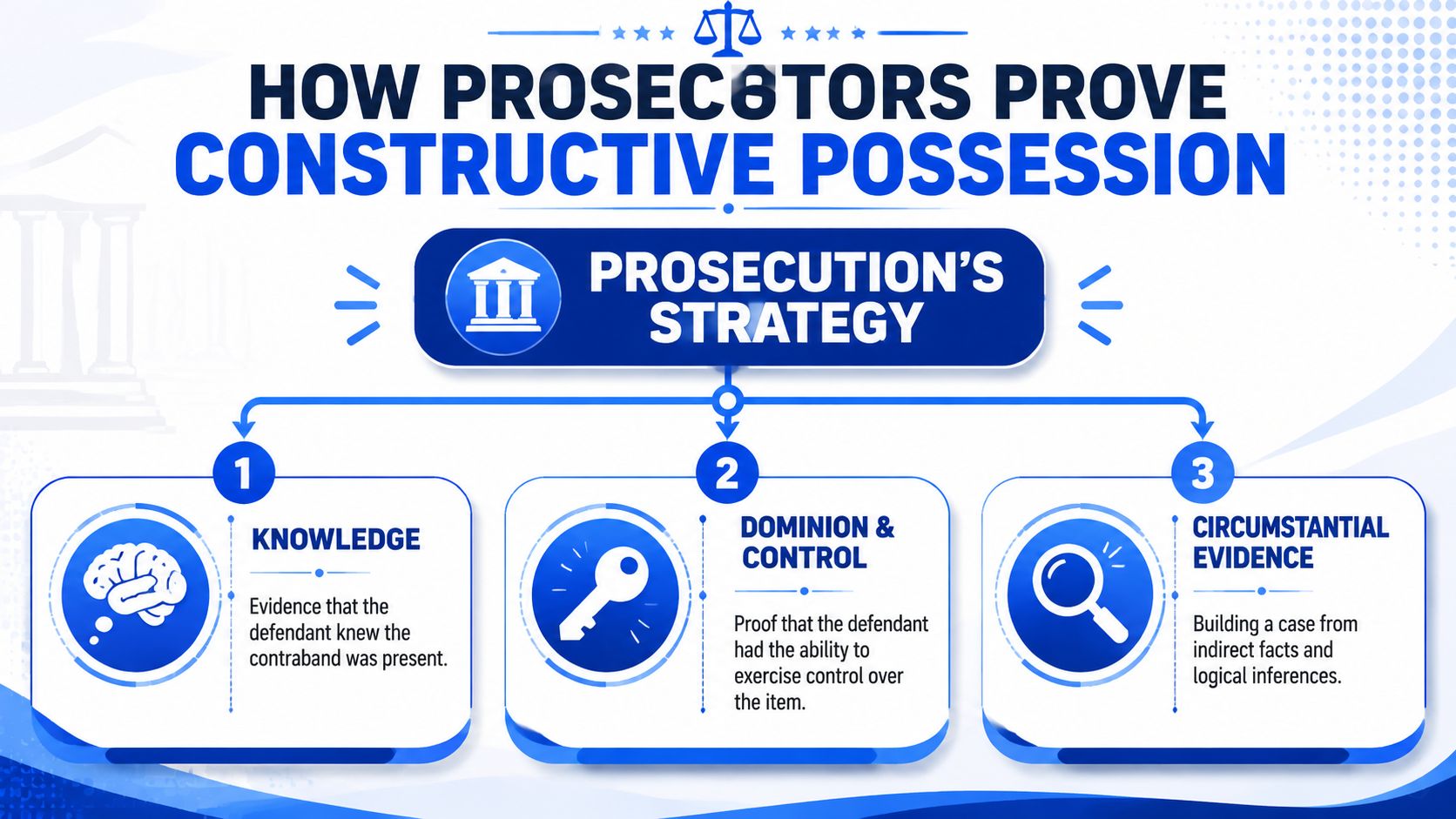
In practice, prosecutors often point to a cluster of facts rather than one clean piece of evidence:
Plain view allegations. The officer says the drugs were visible, so you must have known they were there.
Proximity. The substance was near your seat, your side of the room, or an area close to your belongings.
Statements. A nervous explanation, a contradictory answer, or an offhand comment becomes evidence.
Movement. Police may claim you reached toward a console, floorboard, or bag.
Physical evidence. If the State has fingerprints, DNA, or personal items near the drugs, it will use them aggressively.
How a prosecutor frames a shared-space case
In a vehicle stop, the State often argues the driver had control of the entire car. In an apartment case, prosecutors may say a resident had authority over the common areas. If the facts support a more serious theory, they may even look at related allegations such as possession with intent to distribute in Florida drug cases.
The weak point is that prosecutors still have to connect the dots. Shared space is not automatic possession. A car with multiple occupants is not the same as one person's locked briefcase. A living room is not the same as a private bedroom drawer.
Prosecutors like clean stories. Defense lawyers win by forcing messy facts back into view.
That matters because juries and judges often see arrest reports before they see the holes. The report may sound decisive. The evidence often isn't. Cross-examination, body camera review, text records, rental records, and witness statements can all expose how thin the State's theory really is.
Common Scenarios for Possession Charges in South Florida
Some constructive possession cases repeat the same fact patterns across South Florida. Once you see them, you can also see why they are so often disputed.
Florida's constructive possession law comes up most often in shared spaces such as vehicles or apartments, where more than one person may have access. It is distinct from actual possession because the drugs are not found directly on the person. That practical distinction is reflected in this Florida legal analysis of possession cases involving shared spaces.

Traffic stops and shared vehicles
A very common scenario starts with a stop in Fort Lauderdale, Hollywood, or on the Turnpike. Officers search the car and find drugs in one of these places:
Center console
Glove box
Under a seat
Door pocket
Trunk
When there are multiple people in the car, the State still has to identify who knew about the drugs and who had control over them. That is much harder with passengers, borrowed vehicles, rideshare situations, recently purchased cars, or family cars used by several people.
A passenger case is often the best example of overcharging. Police may arrest everyone or focus on the person nearest the item. But closeness is not ownership, and access isn't exclusive when several people can reach the same area.
Apartments, houses, and common areas
The home version looks different but creates the same legal fight. Police execute a search warrant or respond to a call. They find contraband in a shared apartment in Miami, a house in Palm Beach County, or a common area in Broward.
Common examples include:
Location found | Why the State likes it | Why the defense challenges it |
|---|---|---|
Living room table | Visible to everyone present | Anyone in the home may have had access |
Kitchen drawer | Part of the residence | Shared household use weakens exclusive control |
Bathroom cabinet | Inside the home | Common storage doesn't prove personal dominion |
Hall closet | Associated with the premises | More than one resident or guest may use it |
Shared space cases often come down to one question. Can the State prove this was your contraband, not just contraband found near you?
In constructive possession Florida cases, that question decides a lot. Prosecutors want the judge or jury to jump from residence or presence to control. The defense focuses on all the people who had equal access, all the places that weren't private, and all the missing proof that should exist if the item belonged to one person.
Powerful Defenses to Constructive Possession Allegations
The best defense depends on where the drugs were found, who else had access, what police say you did, and whether the search itself was lawful. But the strongest constructive possession defenses usually attack the State at its pressure points.
Equal access is often the turning point
In joint occupancy cases, Florida courts require evidence of unique control before constructive possession can be inferred against one person. That issue has become a major weakness for the State in shared car and shared residence cases. According to this analysis of Florida rulings on actual vs. constructive possession, 68% of joint possession convictions were overturned during 12 months of Florida court rulings from 2024 to 2025 where the defendant had equal access to the contraband and no exclusive control.
That number matters because it reflects what defense lawyers already know from litigating these cases. If several people could access the same area, prosecutors need something more. A lot more.
A strong equal-access defense may show:
Multiple users of the car. Family members, friends, coworkers, or recent borrowers had the same access.
Shared residence facts. Roommates, partners, guests, or relatives used the area where police found the item.
No unique tie to the contraband. No exclusive container, no personal labeling, no private locked space.
No corroborating physical evidence. No fingerprints, no DNA, no other reliable link.
Knowledge is not the same as suspicion
Many people hear prosecutors say "knowledge" and assume it only means knowing something was present. Florida law is more demanding in drug possession cases.
To convict, the State must prove not only awareness of the substance's presence, but also knowledge of its illicit nature. That distinction matters when the item is pills, containers, or substances that are not obviously illegal on sight.
A defense lawyer may challenge the State by arguing:
You didn't know the item was there at all.
You saw an item but had no reason to know it was a controlled substance.
You had a lawful prescription or believed the medication was lawfully possessed.
The State is trying to turn ambiguity into criminal intent.
One of the most common prosecutor moves is to blur these issues together. They argue that because you were near the item, you must have known what it was. That leap doesn't always hold up under scrutiny.
A workable defense doesn't need to prove who owned the drugs. It often only needs to show the State cannot prove you knew enough and controlled enough.
Search issues can change the whole case
Some constructive possession cases should never have been filed because the evidence came from a bad stop, an overbroad search, or a constitutional violation. In those cases, the defense should look closely at suppression issues early.
That may involve the legality of the traffic stop, whether consent was voluntary, whether police exceeded the scope of a search, or whether statements were taken in violation of your rights. If you're facing that kind of issue, it helps to understand how a motion to suppress evidence in Florida criminal cases can knock out the State's proof before trial.
Other practical defenses can include:
Lack of dominion and control. You didn't own, rent, manage, or exclusively control the place where the item was found.
Temporary presence. You were visiting, riding as a passenger, or staying briefly.
No reliable admissions. Police are overstating or mischaracterizing what you said.
Weak forensic proof. The State has assumptions, not hard links.
In South Florida courts, what works is targeted pressure. Not broad denial. Not emotional explanations. The defense has to identify exactly which element breaks and why.
Penalties for a Conviction Under Florida Law
A constructive possession charge is not a technical problem. It can carry serious criminal exposure.
What a conviction can mean
Under Florida Statute §893.13(6)(a), actual or constructive possession of a controlled substance is a crime unless the substance was lawfully obtained by prescription. That offense is generally a third-degree felony punishable by up to 5 years in prison and a $5,000 fine, as described in this discussion of Florida Statute §893.13 and possession penalties.
The legal penalties are only part of the damage. A felony conviction can affect employment, professional licensing, housing, immigration status, firearm rights, and reputation. For many people in Broward County, Fort Lauderdale, Miami-Dade, and Palm Beach, the long-term consequences matter as much as the immediate sentence.
Here is the practical takeaway:
A plea has consequences. Even when jail is avoided, the record can follow you.
Drug classification matters. The substance involved affects how the case is charged.
The facts around the location matter. Some allegations trigger more severe sentencing issues.
Early mistakes matter. Statements, consent, and delay in hiring counsel can narrow your options.
If police or prosecutors are treating your case like a simple possession matter, that doesn't mean it is simple for your future.
Protect Your Rights and Contact an Attorney Immediately
The first hours after a possession arrest matter more than commonly understood. What you say, what you consent to, and who you talk to can shape the entire case.

What to do right now
If you've been arrested or you're under investigation for constructive possession in Florida, keep it simple:
Stay silent. Don't try to explain who owned the drugs or why you were there.
Don't consent to more searching. If police ask, don't make their job easier.
Don't discuss the case with others. Friends, passengers, roommates, and co-defendants can become witnesses.
Write down what happened. Time of stop, officer names, location, who was present, what was said, and what was searched.
Get legal counsel quickly. The earlier the defense reviews the facts, the more options may exist.
People often think cooperation will clear things up. In constructive possession cases, that instinct usually helps the State more than it helps you.
Why early defense work matters
A lawyer looking at the case early can review whether the stop was lawful, whether the search can be challenged, whether the State has proof of knowledge and control, and whether shared access creates reasonable doubt. That is especially important in Broward County drug cases, Miami-Dade prosecutions, Palm Beach felony filings, and other South Florida courts where shared-space arrests are common.
If you need immediate next steps or a confidential consultation, use the firm's criminal defense contact page.
For a quick overview, this video may also help:
A former prosecutor's perspective can make a real difference here. The State's strategy is usually visible if you know how these cases are built. Once you see the pressure points, you can challenge the assumptions, attack the weak links, and start protecting your record before the prosecution turns a thin case into a damaging result.
FAQs
Can I be charged if the drugs were in a car but not on me?
Yes. Police can still file a constructive possession case. The central issue is whether the State can prove the required legal elements, especially in a shared vehicle.
Does being a passenger make the case weaker for the State?
Often, yes. Passenger cases usually create stronger arguments about shared access and lack of control, though every fact still matters.
If drugs were found in a shared apartment, can everyone be charged?
They can be arrested or charged, but conviction is a different question. Shared access often creates real doubt about who controlled the substance.
Is constructive possession treated differently from actual possession for penalties?
The law can punish actual and constructive possession the same way. The difference is usually in how the State tries to prove the case.
What other criminal defense issues often overlap with possession cases?
A lot of them. Search and seizure challenges, probation violations, traffic stops, record sealing issues, gun charges, domestic violence allegations, DUI investigations, theft accusations, juvenile offenses, white collar investigations, federal cases, and injunction matters can all intersect with a broader defense strategy in Florida courts.
Need help with a constructive possession Florida case in Fort Lauderdale, Broward County, Miami-Dade, Palm Beach, or surrounding South Florida areas? Ticket Shield, PLLC handles criminal defense matters across Florida, including drug crimes, DUI, domestic violence, theft crimes, violent crimes, gun and weapons charges, sex crimes, juvenile crimes, white collar crimes, federal crimes, probation violations, traffic crimes, record sealing and expungement, search and seizure issues, and injunction defense.
If you're facing a constructive possession charge, speak with Ticket Shield, PLLC for a confidential consultation. The firm serves Broward County, Fort Lauderdale, Miami-Dade, Palm Beach, and clients across Florida with strategic criminal defense grounded in former prosecutor insight.
You can be charged for contraband that wasn't on you. Learn how constructive possession works in Florida and why these cases can be beaten.