Qué constituye el robo en segundo grado en Florida
Jason Goldsmith, Abg.
In Florida, second-degree theft generally means grand theft in the second degree, a second-degree felony involving property valued at $20,000 or more but less than $100,000. Certain property types and theft patterns can trigger the same felony level even when the dollar amount is lower.
You may be searching “what is 2nd degree theft” after a detective called, an employer accused you of taking money, or an arrest report used a serious legal phrase you didn't expect. The wording matters, but the label alone doesn't prove that the State can establish the required value, intent, ownership, or circumstances.
Florida law uses more than one route to classify theft as second-degree grand theft. The prosecution may rely on the property's value, a specially protected category of property, or alleged thefts involving more than 20 dwellings. This article explains what the statute means, what penalties are legally available, how realistic fact patterns are analyzed, and which defense issues usually require immediate attention.
Table of Contents
Penalties, Long-Term Consequences, and What Really Happens After a Conviction
Defense Strategies That Experienced Florida Counsel Evaluate First
When the Phone Rings and the Charge Is 2nd Degree Theft
A South Florida resident receives a call from a detective after a workplace accusation. The detective says the conversation is informal and asks the person to explain missing equipment or disputed payments. The person feels innocent, wants to cooperate, and starts answering questions before realizing that the investigation may already be focused on them.
Another person learns about the accusation at booking. A former roommate says tools and electronics were taken. The accused believed there was permission to use them, but the arrest paperwork describes the incident as theft. In both situations, the first problem is often confusion. People assume the accusation itself establishes the facts, or that returning property automatically ends the case.
It doesn't. An arrest, an investigation, a filed charge, and a conviction are different events. The State still must prove the legal elements beyond a reasonable doubt, and a defense attorney needs to examine the evidence rather than accept the description in a police report.
Practical rule: Don't give a detective a detailed statement before speaking with a criminal defense lawyer. You can identify yourself when required and clearly say that you want counsel present.
What to do immediately
The first decisions can affect the evidence available later. Don't delete messages, alter records, contact witnesses to coordinate stories, or confront the person who made the accusation. Preserve contracts, receipts, invoices, account records, photographs, access logs, delivery records, and texts that show ownership, permission, repayment, or a dispute over performance.
If law enforcement contacts you, politely decline an interview until you've received legal advice. If you've already been arrested or received a court date, gather the paperwork and write down what happened while your memory is fresh. You can submit your case details securely for an initial review.
This charge is frightening because the difference between a misdemeanor and a felony affects liberty, finances, employment, housing, and future legal rights. The general felony sentencing statute allows a second-degree felony sentence of up to 15 years in prison, and Florida's general fine statute allows a fine of up to $10,000, unless another law provides otherwise. Those are maximum statutory penalties, not automatic sentences, but they explain why the accusation deserves prompt attention.
The questions are practical. What exactly does Florida's theft statute require? Which facts make the charge a second-degree felony? How does the State calculate value? What happens after a conviction? And what defenses can challenge the prosecution's theory before a person gives up important rights?
How Florida Law Defines Theft and Its Building Blocks
Florida Statutes §812.014 defines theft through conduct and intent. In plain English, the State generally must prove that a person knowingly obtained, used, or attempted to obtain or use another person's property, while intending either to deprive the owner of the property or its benefits, or to appropriate the property for the accused or someone not authorized to use it. The Florida statute governing theft provides the controlling language.
Possession alone isn't theft. A person may lawfully possess property because the owner lent it to them, gave permission, hired them to handle it, or placed it in their care. The legal issue is whether the person knowingly exercised control in a way that fits the statute and had the required intent.
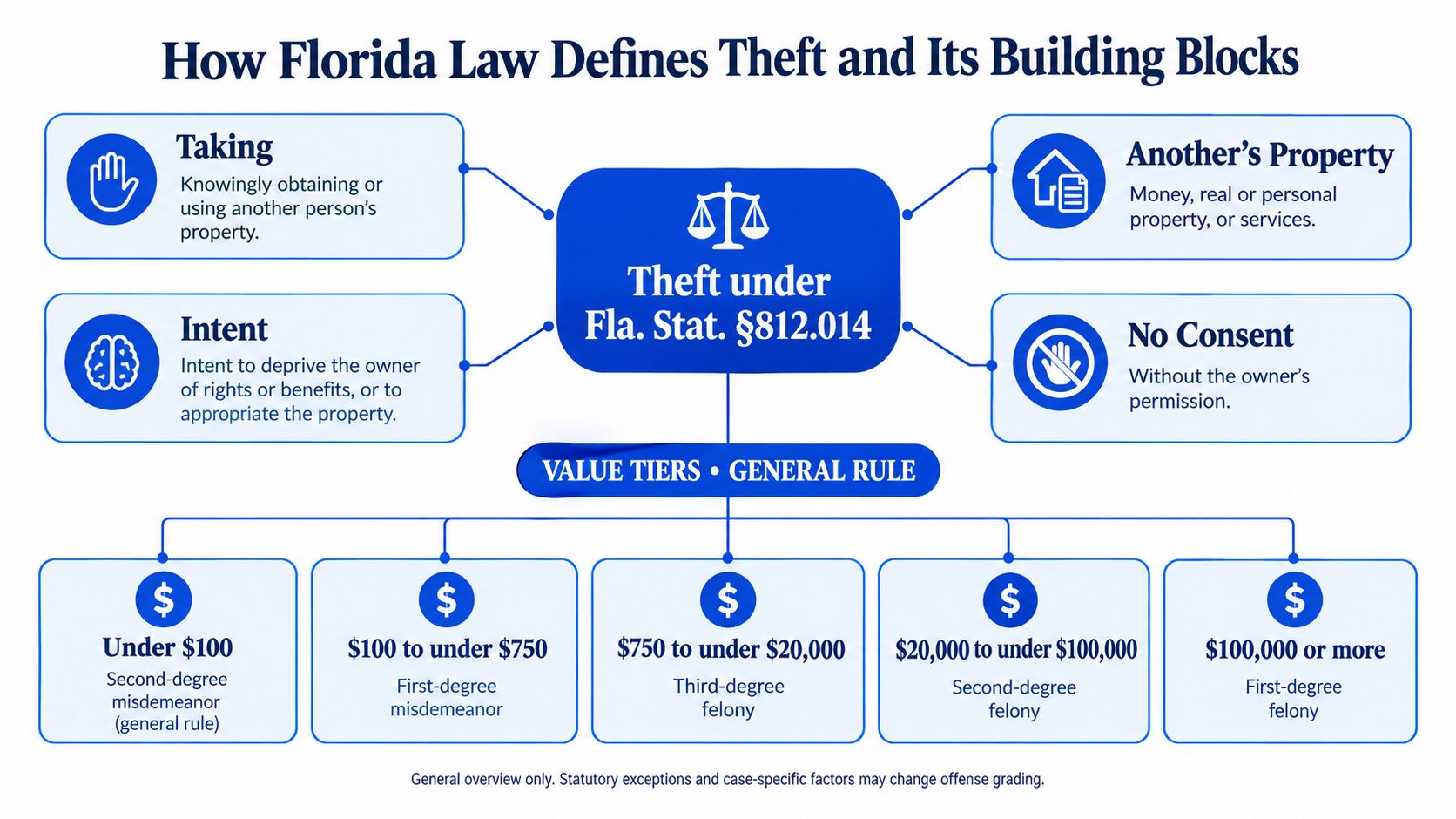
The two questions a prosecutor must answer
Think of the case as two connected inquiries:
Was there a knowing taking or unauthorized use? The State may rely on surveillance, access records, possession of property, financial records, witness testimony, or statements attributed to the accused.
What was the intent? Prosecutors may point to concealment, a sale or pawn transaction, altered records, failure to return property, messages, or conduct they interpret as showing an intent to deprive or appropriate.
The evidence may look persuasive at first and still fail to establish every element. A former employee may have had authorized access. A contractor may have received money under a contract but failed to complete work. A roommate may have believed shared use was permitted. Those facts don't automatically defeat a charge, but they can create serious disputes about knowledge, authorization, ownership, and intent.
The phrase “another person's property” also matters. The State must connect the property to an owner or person with a legally recognized interest. Ownership records, purchase documents, business accounts, serial numbers, and testimony may become important. A police report's description isn't a substitute for proof in court.
For a detailed explanation of the statutory framework, review this guide to Florida Statute 812.014 and theft classifications. The central point is simple: the prosecution must prove more than possession of valuable property. It must prove the required act and mental state.
The Statutory Pathways to a Second-Degree Felony
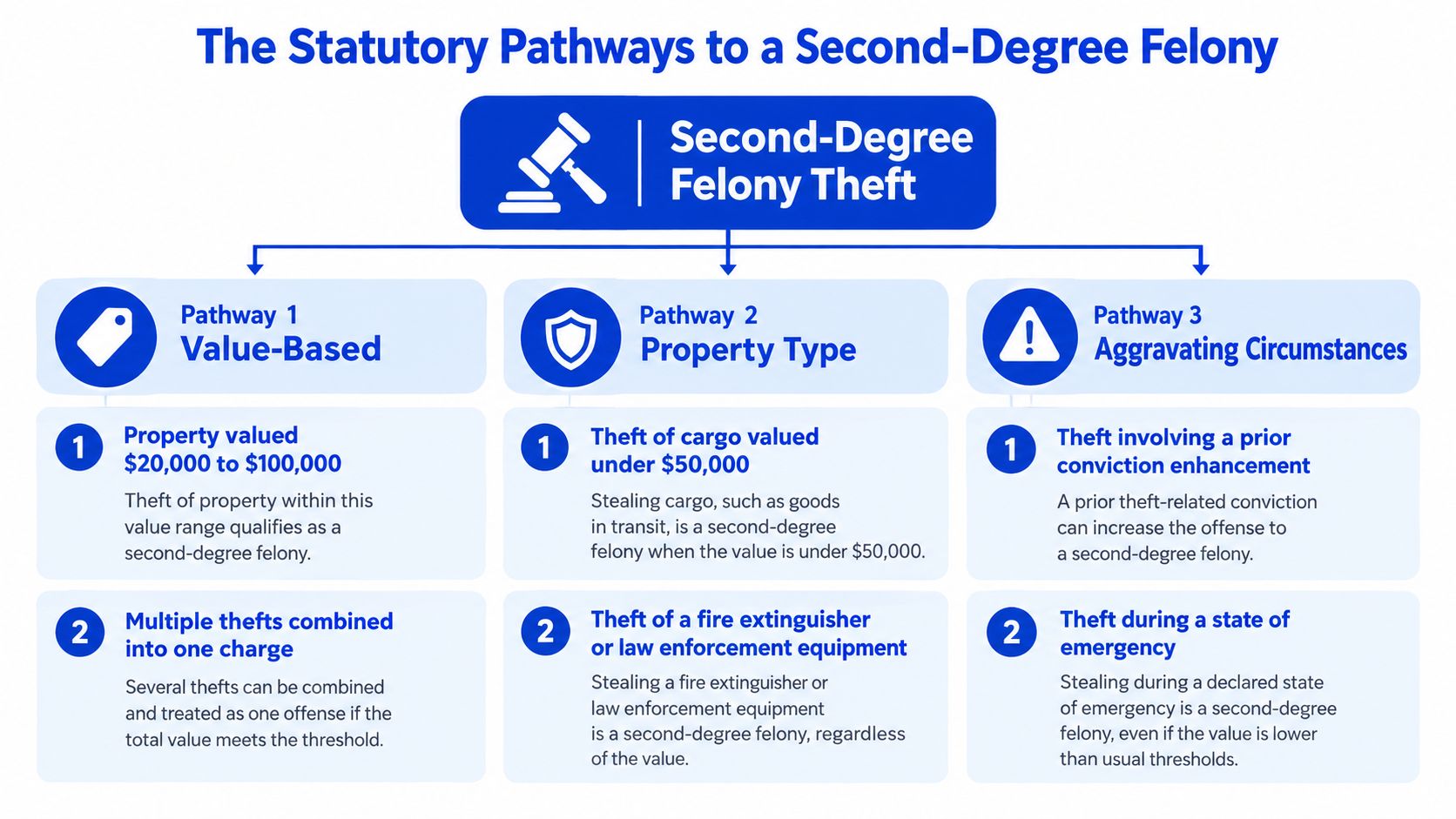
The most common pathway involves value. Florida generally classifies grand theft in the second degree when property is worth $20,000 or more but less than $100,000. The relevant question isn't automatically what the owner paid. Florida defines value by the property's market value at the time and place of the offense, or, when market value can't be satisfactorily established, its reasonable replacement cost. The current statutory language is available in Florida's theft statute.
That creates a factual issue, not merely a math exercise. Comparable sales, depreciation, invoices, ownership records, expert testimony, and replacement estimates may produce different conclusions. If the State's valuation crosses the felony threshold only because it uses an inflated replacement figure or ignores depreciation, counsel should test that calculation.
Value is only one route
Florida's statute also identifies specially protected property and circumstances. Certain cargo, emergency medical equipment, and law-enforcement equipment can support second-degree grand theft under statutory rules that don't depend solely on ordinary market value. That means the answer to “Can I face second-degree grand theft if the property was worth less than $20,000?” can be yes, depending on the property and the facts alleged.
A separate pathway concerns residences. Theft from more than 20 dwellings, theft from the unenclosed curtilage of more than 20 dwellings, or a combination of those locations can qualify as grand theft in the second degree. The prosecution's theory may therefore focus on a series of incidents rather than the value of one item.
Prosecution theory | Question the defense should examine |
|---|---|
Value-based | What was the market value at the time and place of the alleged offense, and is the evidence reliable? |
Property-based | Does the item actually fit the specially defined statutory category? |
Residence-pattern based | Can the State prove the required number and identity of residences or curtilage locations? |
This is why a dollar-value chart can mislead. The charging subsection, property type, location, alleged aggregation, ownership, and evidence of intent all matter. The statute has also retained the $20,000-to-under-$100,000 range since at least the 2000 version of §812.014, which shows that the value structure isn't a newly created label.
Don't confuse two different “second-degree” offenses
Florida also recognizes petit theft in the second degree, ordinarily a second-degree misdemeanor when the property doesn't fall into a grand-theft category. That phrase sounds similar to second-degree grand theft, but the consequences and legal classification are materially different. Prior theft convictions can also change the treatment of petit theft, making the date and disposition of earlier cases important.
The distinction is explained further in this discussion of grand theft versus petit theft in Florida. A lawyer should verify the exact charging subsection, the legally provable value, any protected-property allegation, the residence theory, and the defendant's record before evaluating exposure.
Penalties, Long-Term Consequences, and What Really Happens After a Conviction
A second-degree grand theft conviction can affect far more than the day of sentencing. Under Florida's general felony sentencing rules, the statutory maximum is 15 years in prison and a fine of up to $10,000, unless another law provides otherwise. The governing figures appear in Florida's general felony sentencing and fine provisions. For a plain-English overview of how the classification works, see this guide to second-degree felony penalties in Florida.
That maximum is a ceiling, not a prediction. The actual sentence can turn on the Criminal Punishment Code, the scoresheet, criminal history, admissible evidence, restitution, plea negotiations, and whether the State proves every required element. A first-time defendant facing uncertain property valuation may present a very different sentencing picture from someone with a substantial record and strong evidence against them.
Consequences beyond incarceration
A felony conviction can affect employment, housing, professional licensing, and credentialing. Organizations may view a theft conviction as relevant to honesty or trustworthiness. Noncitizens can face serious immigration consequences, and felony convictions may affect firearm rights. The outcome depends on the precise conviction and the person's circumstances, so qualified counsel should review those issues individually.
Restitution may become part of a plea resolution or sentence. The claimed amount should connect to documented loss. Defense counsel may challenge speculation, property not tied to the allegation, or figures inconsistent with the available evidence. Returning property or paying money may support negotiations in some cases, but it does not automatically erase the alleged offense or require a dismissal.
The record itself can create lasting practical problems. A background check may affect a job or housing application even after court supervision ends. The difference between a dismissal, a withhold of adjudication where legally available, and an adjudication of guilt can therefore matter greatly. Statutory restrictions, the facts, criminal history, the prosecutor, and the court all shape the available resolutions.
The charge level and the person's record must be evaluated together:
Counsel should calculate the scoresheet and investigate the evidence before discussing likely outcomes. No responsible attorney can promise probation, dismissal, a reduced charge, or freedom from prison. A careful defense can identify unsupported allegations, address provable facts, and determine which resolution options deserve serious discussion.
Real-World Examples of 2nd Degree Theft in South Florida
Consider a contractor accused of receiving $45,000 in client payments for work that was never completed. That amount falls within the ordinary value range for second-degree grand theft, but the number alone doesn't resolve the case. The State would still need to prove the payments were obtained or used with the required intent. The defense might examine the contract, change orders, permits, material purchases, communications, delays, partial performance, and whether the disagreement is purely civil rather than criminal.
Now consider a warehouse employee accused of removing repeated shipments of electronics. The prosecution may rely on inventory records, camera footage, access logs, shipping data, and statements from coworkers. If the State alleges that the shipments qualify as protected cargo or uses their combined value, counsel should test both the statutory category and the method of connecting each shipment to the accused.
A different case involves packages taken from porches across one neighborhood. Each package might have modest value, but the residence-based pathway can become significant if the State alleges theft from more than 20 dwellings or their unenclosed curtilage. The defense must examine whether the locations are actually separate qualifying residences, whether the accused is correctly identified in each incident, and whether the evidence supports a common pattern rather than speculation.
Finally, imagine a roommate accused of pawning tools and electronics. The roommate may say the property was shared, permission existed, or the items were taken temporarily with an intent to return them. The pawn ticket may establish a transaction, but it doesn't by itself prove the mental state required for theft. Messages, household arrangements, ownership records, and the parties' prior conduct may become central.
These examples show why the arrest label is only a starting point. The same statute can apply to a business dispute, an alleged employee theft, repeated residential incidents, or a domestic disagreement. The legal analysis turns on proof, not merely on the accusation's emotional force.
Defense Strategies That Experienced Florida Counsel Evaluate First
A defense lawyer usually starts by separating the State's assumptions from admissible proof. The first priority may be valuation. A property owner may use an original invoice even though the statute focuses on market value at the time and place of the alleged offense. Counsel can examine comparable sales, depreciation, replacement-cost evidence, expert opinions, invoices, and ownership records.
Intent comes next. A contract dispute, shared-use arrangement, alleged loan, family disagreement, or misunderstanding about authority may undermine the claim that the accused knowingly intended to deprive or appropriate property. The question isn't whether the conduct looks suspicious in hindsight. It's whether the State can prove the required mental state beyond a reasonable doubt.
Evidence and procedure matter
Searches, seizures, interviews, employer investigations, traffic stops, and pawnshop evidence all deserve scrutiny. A lawyer may examine whether officers had lawful grounds, whether consent was voluntary and informed, whether a statement was obtained properly, and whether the State can establish a reliable chain of custody.
Witness evidence also needs testing. Identification may be affected by lighting, distance, stress, prior relationships, or inconsistent descriptions. A cooperating witness may have a personal motive, a benefit to gain, or a version that changed over time. Those issues can affect both negotiations and trial strategy.
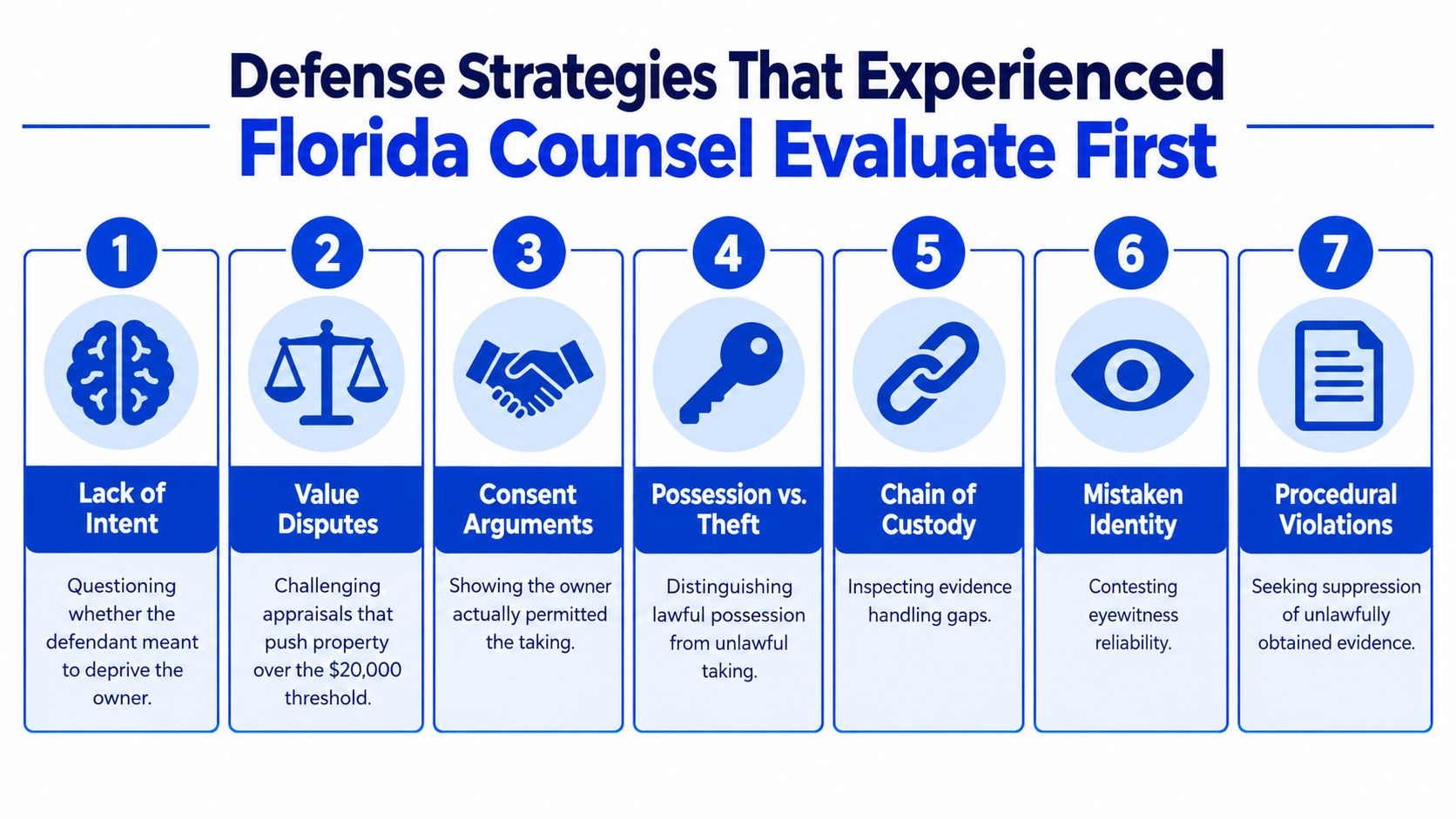
A case may also call for an early resolution rather than trial, but that decision should follow investigation. Depending on eligibility and the facts, counsel may explore diversion, deferred prosecution, a withhold of adjudication, restitution-based negotiations, or reduction to a lesser theft offense. These options aren't automatic, and some may be unavailable because of the charge, record, victim's loss, or statutory restrictions.
The practical defense questions often include:
Value: Can the State prove the threshold through reliable evidence?
Intent: Does the evidence show an intent to deprive or appropriate, or does it show a dispute about permission, ownership, or performance?
Authorization: Did the owner permit access, use, transfer, or possession?
Identity: Can the State reliably connect the accused to the taking?
Procedure: Did officers or investigators obtain evidence lawfully?
Resolution: Is there a lawful way to avoid a conviction or reduce the charge?
For additional information about defense representation in these cases, see this resource on a criminal defense attorney for theft charges. The right strategy depends on the actual evidence, not a standard checklist applied without investigation.
Your Next Steps and Answers to Common Questions
If you've learned about an investigation or charge, don't speak with law enforcement without counsel. Preserve texts, contracts, receipts, photos, recordings, and records, and identify witnesses before memories fade. An arrest isn't a conviction, and the State must prove every element beyond a reasonable doubt.
Can second-degree grand theft be reduced to a misdemeanor? It can be possible in some cases, but it depends on proof, valuation, statutory limits, criminal history, and negotiations. Can a first offender avoid a felony record? Sometimes, depending on eligibility and the resolution offered. Bail and pretrial release depend on the court and case facts, while the time needed to resolve a case varies with discovery, motions, negotiations, and trial preparation. You have the right to remain silent and to challenge unlawful searches.
Ticket Shield, PLLC handles Florida theft and other criminal defense matters for clients in Broward County, Fort Lauderdale, Miami-Dade, Palm Beach, and surrounding South Florida communities. Contact the firm promptly for a confidential consultation so an attorney can review the charging theory, valuation evidence, intent issues, and immediate steps to protect your rights.