Qué es la agresión por delito grave según la ley de Florida explicado
Jason Goldsmith, Abg.
In Florida, felony battery under section 784.041 means intentionally touching or striking someone against that person's will and causing great bodily harm, permanent disability, or permanent disfigurement. It's a third-degree felony punishable by up to 5 years in prison and a fine of up to $5,000.
If you're reading this after a fight in Fort Lauderdale, Broward County, Miami-Dade, Palm Beach, or another South Florida community, you may be trying to understand how a shove, punch, or struggle became a felony investigation. The police report may use words such as “battery,” “injury,” or “felony,” while family members are left wondering what happens next.
The answer depends on more than whether someone was touched. Florida law looks at how the contact occurred, what injury resulted, whether the contact was intentional, and whether the accused has a qualifying prior conviction. A case involving serious injury can follow one path to felony charges. A later battery involving a person with a qualifying record can follow another path, even when the new injury appears less severe.
The distinction matters immediately. A felony charge can affect bond, court restrictions, plea negotiations, employment, housing, immigration concerns, and the accused person's long-term record. The State still must prove every required element, and an arrest or accusation isn't a conviction. Understanding the charge is the first step toward protecting constitutional rights and evaluating whether the evidence supports the allegation.
Table of Contents
How Felony Battery Differs From Simple and Aggravated Battery
Penalties Court Process and Long Term Consequences in Florida
Introduction to Felony Battery Charges in Florida
A late-night argument outside a restaurant in Broward County can change quickly. One person steps forward, another person pushes back, someone falls, and paramedics later document an injury. By the time an officer arrives, witnesses may remember the confrontation differently, surveillance video may show only part of it, and the injured person's medical condition may influence the charge.
That uncertainty is common in battery cases. People often assume that a punch automatically equals felony battery, or that a minor push can never become a felony. Neither assumption is safe under Florida law. The legal classification depends on the statutory elements and the available proof.
Florida's felony battery law, section 784.041, focuses on intentional, nonconsensual touching or striking plus a specified level of harm. The statute describes “great bodily harm, permanent disability, or permanent disfigurement” and classifies the offense as a third-degree felony. Florida's sentencing framework allows a third-degree felony to carry up to 5 years in prison and a fine of up to $5,000. The Florida felony battery statute provides the governing language.
Practical rule: The label on an arrest report isn't the final answer. The State must connect the evidence to every element of the charged offense.
A second route involves criminal history. Florida can reclassify a new battery as a felony when the accused has a qualifying prior conviction. That means two cases involving similar physical contact can receive different treatment because the defendants' records differ.
This guide addresses the questions families usually ask first: what Florida must prove, how felony battery differs from simple and aggravated battery, why medical evidence and prior records matter, what the court process may look like, and which defense issues deserve immediate investigation. For broader information about allegations involving physical harm, review these Florida violent crime defense resources, but remember that every case turns on its own facts.
What Felony Battery Means Under Florida Law
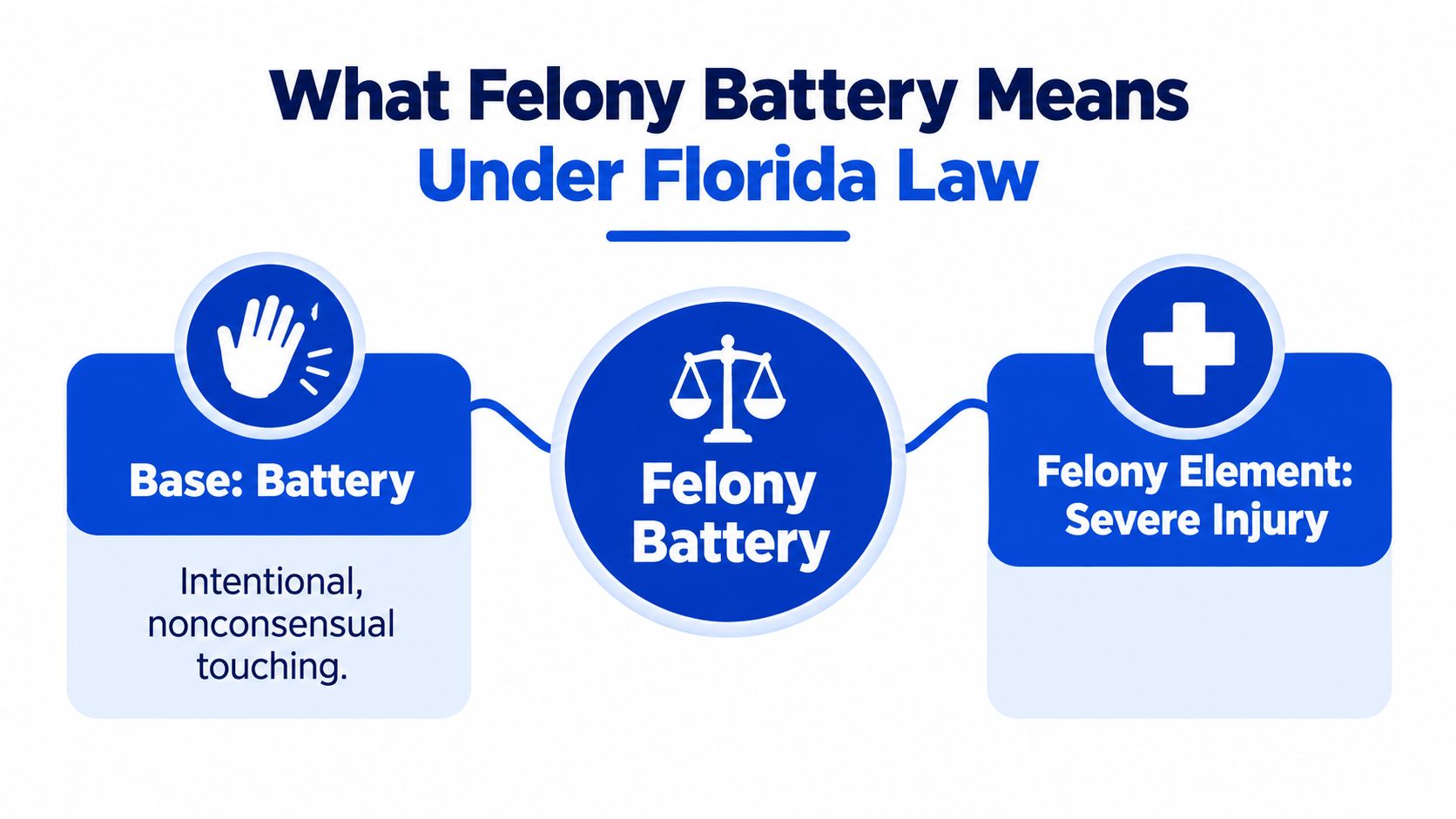
The easiest way to understand felony battery is to build the charge in parts. Florida starts with the concept of battery, which generally involves intentional, nonconsensual touching or striking. Section 784.041 adds a serious injury requirement for the injury-based form of felony battery.
The statute states:
“Actually and intentionally touches or strikes another person against the will of the other” and causes “great bodily harm, permanent disability, or permanent disfigurement.”
Each phrase carries weight.
The contact must be intentional
“Willfully and intentionally” means the allegation concerns a physical act, not merely an angry statement or accidental proximity. The State generally focuses on whether the accused deliberately touched or struck the other person. It doesn't have to prove that the accused intended the precise medical result required for felony battery. The alleged intentional contact and the resulting harm are separate parts of the analysis.
“Against the will” means the touching wasn't consented to. A consensual sport, mutual contact during an agreed activity, or an accidental collision raises different questions from an unwanted strike during an argument. Context matters, including what happened immediately before the contact and whether either person was defending against an attack.
The injury must reach the statutory level
Ordinary pain, redness, or a temporary mark may support an allegation of battery, but felony battery requires more under the injury-based statute. Great bodily harm refers to a level of injury substantially more serious than ordinary battery harm. Permanent disability concerns lasting impairment of a bodily function or ability. Permanent disfigurement concerns lasting alteration of appearance.
A simple analogy helps. A deliberate push that causes no serious injury may remain at the battery level. The same type of intentional contact, if it causes a lasting impairment or qualifies as great bodily harm, can create felony exposure. The contact may look similar in a video, but the medical outcome can change the legal classification.
Medical records, diagnostic images, treatment notes, photographs, testimony, and evidence about recovery can therefore become central. A defense lawyer must examine not just whether an injury exists, but whether the evidence proves the specific statutory threshold and connects that harm to the charged contact.
How Felony Battery Differs From Simple and Aggravated Battery
Florida's battery offenses share a foundation, but they aren't interchangeable. Simple battery generally concerns intentional touching or striking against another person's will. It can remain a misdemeanor when the facts don't establish a qualifying felony pathway.
Felony battery under section 784.041 adds a serious injury result to the intentional, nonconsensual contact. Florida also has a repeat-offender reclassification statute, discussed below, that can make a new battery a third-degree felony based on a qualifying prior conviction.
Aggravated battery is a different and more serious offense. Under section 784.045, it involves intentionally or knowingly causing great bodily harm, permanent disability, or permanent disfigurement, or using a deadly weapon. Aggravated battery is a second-degree felony, which carries greater exposure than felony battery under section 784.041. The Florida aggravated battery statute sets out those distinguishing requirements.
Florida Battery Offenses Compared
Offense | Required Elements | Felony Degree | Maximum Exposure |
|---|---|---|---|
Simple battery | Intentional touching or striking against the person's will | Usually misdemeanor treatment when no felony reclassification applies | Depends on the applicable misdemeanor statute |
Felony battery | Intentional touching or striking against the person's will, plus great bodily harm, permanent disability, or permanent disfigurement | Third-degree felony | Up to 5 years in prison and up to $5,000 fine, under Florida's sentencing framework |
Aggravated battery | Intentionally or knowingly causing great bodily harm, permanent disability, or permanent disfigurement, or using a deadly weapon | Second-degree felony | Greater exposure than a third-degree felony |
The most important difference isn't just the word "aggravated." Felony battery under the injury-based statute focuses on the result of intentional contact. Aggravated battery adds a different mental-state requirement for the serious harm alternative, or it focuses on the use of a deadly weapon.
A weapon allegation can therefore move a case away from ordinary felony battery analysis and toward aggravated battery. A serious injury can also support different charging theories depending on what the State can prove about intent, knowledge, causation, and the circumstances of the contact.
For a closer look at the more serious charge, review this guide to aggravated battery in Florida. The correct classification affects discovery, bond conditions, negotiations, trial preparation, and the consequences of any conviction.
Two Paths to a Felony Battery Charge in Florida
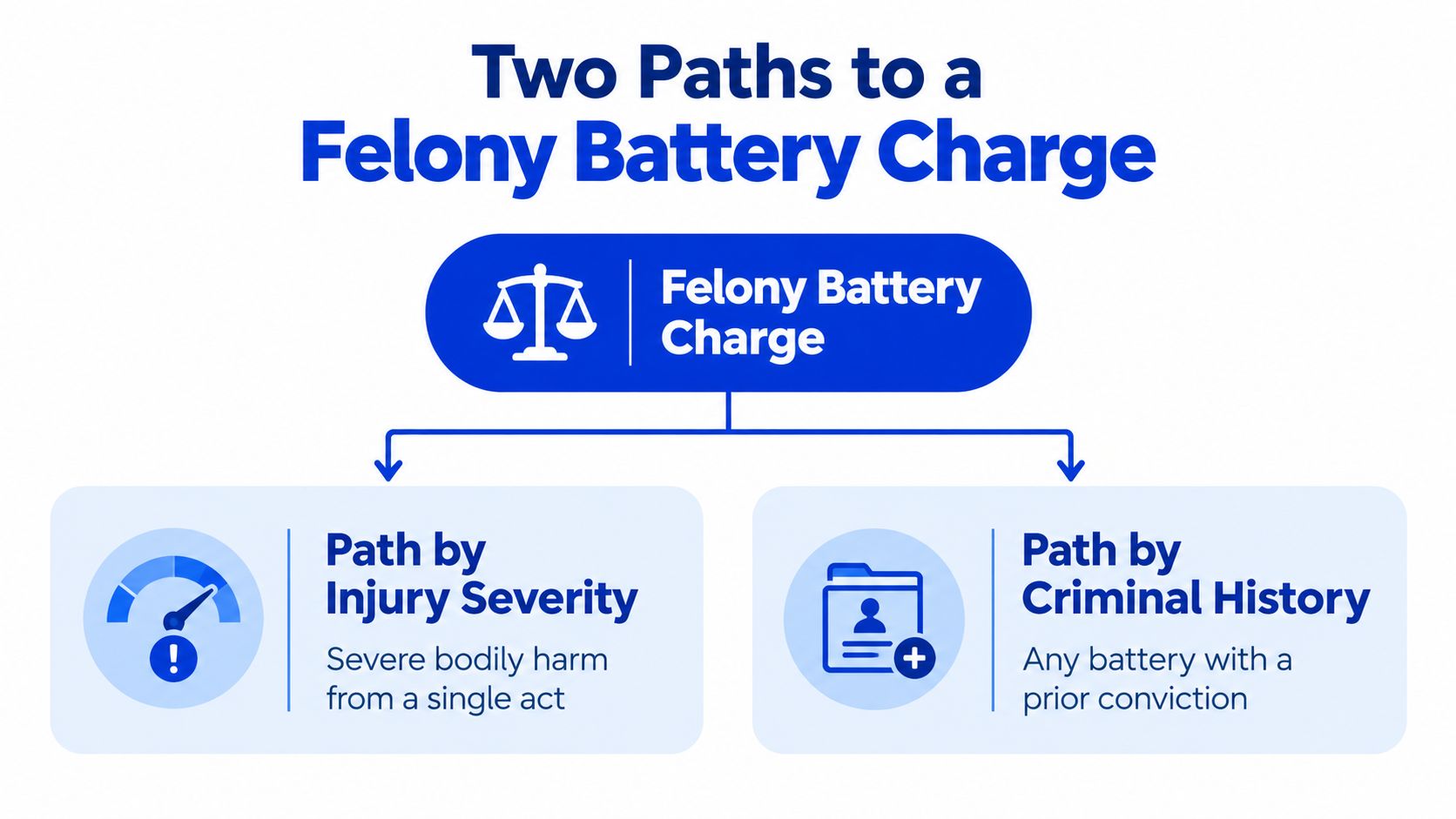
Florida felony battery cases can develop through two distinct escalation paths. The first is injury-based. The second is history-based. These paths may involve the same alleged touching, but they require different proof.
Path one involves injury severity
Under section 784.041, the State must connect intentional, nonconsensual touching or striking to great bodily harm, permanent disability, or permanent disfigurement. The central dispute may involve the medical evidence. A defense lawyer may examine whether the injury was temporary, whether the claimed condition existed before the incident, whether another event caused the harm, and whether the medical records support the statutory threshold.
Causation matters. Even if the alleged contact occurred, the State must establish that the contact caused the qualifying injury. Witness accounts, video, photographs, emergency records, specialist opinions, and the timing of symptoms can all affect that question.
Path two involves criminal history
Florida also allows a new battery to be reclassified as a third-degree felony when the accused has one prior conviction for battery, aggravated battery, or felony battery. Florida's definition of conviction is broad. It can include guilt after a plea or trial even when adjudication was withheld or a nolo contendere plea was entered. The Florida repeat-battery statute contains this reclassification framework.
That rule changes the central defense question. The current injury may not need to meet the injury-based threshold if the State pursues felony treatment through the prior-conviction pathway. Counsel must scrutinize certified records, plea documents, disposition language, identity, and whether the earlier case qualifies under the statute.
A separate rule applies when a battery occurs in furtherance of a riot or aggravated riot. That circumstance can also make the offense a third-degree felony. Because the escalation paths differ, a lawyer shouldn't evaluate only the police narrative. The investigation should identify which theory the State is using and whether the evidence supports it.
For a broader explanation of how Florida handles battery allegations, see this discussion of battery charges in Florida.
Real World Examples of Felony Battery and Related Charges
Consider a confrontation outside a bar in Fort Lauderdale. One person throws a punch, the other falls, and medical professionals later document a serious orbital injury with lasting vision problems. The State may investigate injury-based felony battery because the alleged intentional strike is paired with evidence that could support permanent impairment. The defense would still examine video, witness credibility, the sequence of events, causation, and whether the medical evidence meets the statutory standard.
Now consider a domestic dispute involving a person with a qualifying prior battery conviction. The new allegation involves a push, and the injured person reports soreness but no lasting impairment. The injury-based felony theory may be weak, but the repeat-offender pathway can create third-degree felony exposure if the prior record qualifies and the State proves the new battery. Florida law treats a battery committed in furtherance of a riot or aggravated riot as another route to third-degree felony treatment under the applicable statute. The Florida Senate statutory text describes those repeat-battery and riot-related provisions.

A third scenario involves an alleged strike with a knife, firearm, or another item the State claims was a deadly weapon. Even if the victim's injury isn't permanent, the weapon allegation can point toward aggravated battery rather than felony battery. That charge has a different structure and greater exposure.
These examples aren't predictions. They show why small factual details matter. The same word, “battery,” can describe a misdemeanor allegation, an injury-based third-degree felony, a repeat-offender felony, or a second-degree aggravated battery case. A careful review must identify the charging theory rather than relying on the label alone.
Penalties Court Process and Long Term Consequences in Florida
A third-degree felony in Florida carries potential exposure of up to 5 years in prison and a fine of up to $5,000 under the State's sentencing framework, as reflected in the felony battery statute. The sentence in an individual case depends on the charge, criminal history, evidence, negotiations, sentencing rules, and the judge's decision. Other consequences can include probation, court-ordered restrictions, restitution, and no-contact conditions.
What happens after an arrest
In Broward, Fort Lauderdale, Miami-Dade, Palm Beach, and nearby courts, a case commonly develops through several stages:
First appearance and release conditions: The court addresses custody, bond, and restrictions. A no-contact order can affect housing, family communication, and employment.
Formal charging: The prosecutor evaluates reports, witness statements, medical evidence, prior records, and any available video before proceeding.
Discovery and investigation: Defense counsel reviews the evidence, interviews witnesses, preserves footage, obtains records, and identifies constitutional issues.
Resolution or trial: The parties may negotiate a reduction or other resolution, or the defense may challenge the State's proof before a judge or jury.
The Florida arrest process guide explains why early decisions can affect the direction of a criminal case.
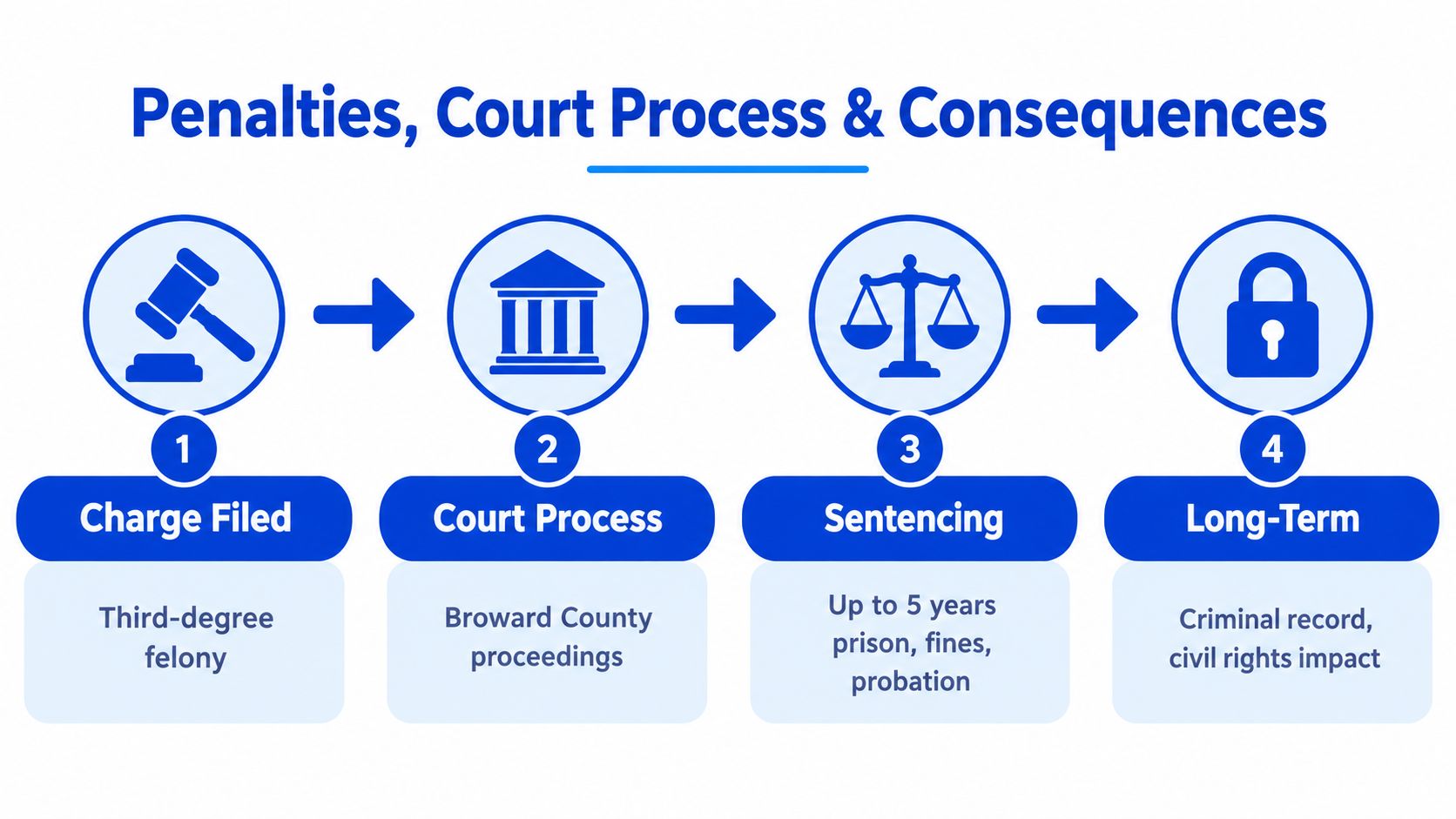
A conviction can create problems beyond incarceration or fines. Employers, landlords, licensing bodies, and immigration authorities may treat a felony record seriously. Firearm rights and other civil rights may also be affected. These consequences make charge reduction, dismissal, acquittal, and careful sentencing advocacy important goals, though no lawyer can guarantee a particular outcome.
Common Defense Angles for Felony Battery Cases
A defense begins with the elements, not the emotion surrounding the accusation. The State must prove the required contact, lack of consent, causation, injury level, and, when applicable, the qualifying prior conviction.
Several issues can matter:
Injury threshold: Medical records may show an injury without proving great bodily harm, permanent disability, or permanent disfigurement.
Intent and consent: The evidence may not establish that the touching was intentional or against the other person's will.
Self-defense or defense of others: Witnesses, video, injuries on both sides, and the timing of force may support a lawful defensive response.
Causation: Another event, preexisting condition, or later incident may explain the claimed harm.
Prior-record proof: The State must establish that the earlier disposition qualifies and belongs to the accused. Florida's broad definition can include withheld adjudication or a nolo contendere plea, so counsel must review the actual court documents rather than rely on a background summary.
Identification and reliability: Lighting, distance, intoxication, inconsistent statements, missing video, and witness relationships can affect identification and credibility.
A former-prosecutor perspective can help identify weaknesses in how the State assembled its case, including gaps in medical proof, unreliable statements, incomplete video, or unlawful searches and seizures. The defense may also examine whether police obtained statements in violation of constitutional protections.
For related issues involving physical-contact allegations, review this assault and battery defense resource. If you or a family member is facing a felony battery investigation or charge, preserve messages, photographs, medical records, and video, avoid discussing the facts publicly, and request legal guidance before answering substantive questions.
Ticket Shield, PLLC helps people facing Florida felony battery allegations evaluate injury evidence, prior-conviction issues, self-defense claims, and constitutional challenges through a confidential consultation. Visit Ticket Shield, PLLC to discuss the situation with a Florida criminal defense team and identify practical next steps before the case moves further.