
Nudilleras de metal con diamantes: riesgos legales en Florida
Abogado Jason Goldsmith
Table of Contents
When a Pretty Object Becomes a Criminal Case in Florida
A shiny object in your pocket can turn into a criminal case fast in Florida. If it fits the definition of metallic knuckles, the diamonds, stones, polish, or luxury marketing do nothing to change the charge. Under Florida Statutes section 790.09, owning, selling, exposing for sale, or carrying metallic knuckles is a second-degree misdemeanor.
That is the trap with brass knuckles with diamonds. The item may look like jewelry, a collectible, or a novelty gift, but prosecutors do not care about the sparkle. They care about whether the object is metallic knuckles under the statute, and they will charge it that way if the shape, hardness, and design fit.
A driver gets stopped on I-95 for a tag-light problem. The officer spots something shiny in the cupholder, reaches in, and finds a diamond-studded knuckle piece that was bought as a pendant or a novelty item. By the time the stop ends, the item is photographed, bagged, and treated as evidence. If you want a plain-English outline of the process after an arrest, start with what comes next after a Florida arrest.
The point is simple. A decorative object becomes a criminal case the moment law enforcement decides it fits the statutory definition of metallic knuckles.
Practical rule: if the item fits over the knuckles and hardens a punch, expect it to be treated as a weapon first and a fashion piece second.
That is why people get caught off guard. They are not thinking about the statute when they buy something flashy. They are thinking about appearance, a gift, or a collectible. Florida law does not share that view.
How Florida Law Defines Metallic Knuckles
Florida Statutes section 790.09 is written broadly. It reaches an instrument made of metal or another hard substance, designed to be worn over the fingers, and used or intended to be used as a striking weapon. The decoration on the outside does not change the legal analysis.
Brass, steel, titanium, sterling, or any other hard material can qualify if the object still fits over the fingers and is built to increase the force of a punch. A seller can call it an accessory, a luxury item, or a collectible. The statute still asks what the object is, not what the listing said.
Florida charging decisions focus on function over form. Officers and prosecutors look at shape, grip, hardness, and how the item would be used. They do not get distracted by a seller's branding. A “diamond edition” label usually means nothing once the case reaches the prosecutor.
For a plain-English look at weapon categories and why appearance does not control, read the discussion of weapons crimes in Florida.
The legal question is whether it still works like knuckles.
That matters because people often assume jewelry framing changes the charge. It does not. A hard object that fits over the knuckles stays in the statutory lane even if stones cover it.
The Statute Looks at the Object, Not the Packaging
A box, pouch, or online description will not save the item if its shape and use still match metallic knuckles. If the object is meant to be worn on the hand and used as a striking instrument, prosecutors can charge it even if the seller wrapped it in luxury language.
Acts the Statute Actually Prohibits
Florida does more than punish one narrow act here. The statute reaches manufacture, sale, exposure for sale, and possession of metallic knuckles. Each theory shows up differently in real life, and each one can support a charge.
A vendor posting diamond-studded pieces on Instagram can trigger the sale theory even if the item never leaves the mailer. A pawn shop displaying the item in a glass case can create exposure-for-sale problems. A floorboard discovery during a traffic stop can become a possession case even if nobody saw the item used.
That last point trips people up. The State does not need proof that someone swung the knuckles at another person. Possession can be enough if the prosecutor can prove the object was on the defendant and that the item really was metallic knuckles.
For the defense, the fight usually starts with who possessed it and what the officer found. Was the item in a shared car? Was it in a purse, backpack, or center console with several people present? Did the officer photograph it where it was found, or did the chain of custody get sloppy after the stop? Those details matter because the State still has to connect the object to the accused.
Defense takeaway: if the State cannot prove possession or knowledge cleanly, the charge gets weaker fast.
What Prosecutors Have to Prove
The prosecutor needs more than suspicion. They need evidence that the item falls within the statute and that the defendant committed the prohibited act. If the item is a novelty piece, a belt buckle, or something that only resembles knuckles from a distance, identification becomes the battleground.
The best defense work starts early, before the case hardens into a quick plea deal. Once a prosecutor has a clean photograph, a property receipt, and a solid stop report, the State feels stronger. Break one of those links, and the case starts looking different.
Penalties for a Metallic Knuckles Conviction
Under Florida Statutes section 790.09, metallic knuckles possession is a second-degree misdemeanor. The statutory ceiling is up to 60 days in county jail and a $500 fine. Many cases end with less than the maximum, but a conviction still creates a criminal record.
A light sentence is not the same thing as no record. A withhold of adjudication, probation, or a county jail alternative may reduce immediate pain, but the case still exists and can matter later with employers, licensing boards, and background checks.
Scenario | Charge Level | Max Jail | Max Fine | Collateral Impact |
|---|---|---|---|---|
First offense, no aggravating facts | Second-degree misdemeanor | 60 days | $500 | Criminal record risk, employment screening, future licensing issues |
First offense with messy stop facts | Second-degree misdemeanor | 60 days | $500 | Search challenge, stronger plea leverage if evidence is weak |
Prior misdemeanor record | Second-degree misdemeanor | 60 days | $500 | Less room for leniency, more concern from the court |
Accompanying weapons or resistance charges | Mixed case, depending on count | Depends on added charge | Depends on added charge | Broader exposure, more leverage for the State |
Alleged use during another offense | Metallic knuckles plus related charge | Depends on related charge | Depends on related charge | Higher sentencing range through the companion case |
Most first-time offenders without aggravating facts are not looking at a dramatic jail sentence. They are looking at a case that can still leave a mark if it is handled casually. The defense goal is to reduce the charge, protect the record, and keep a bad stop from becoming a lasting problem.
Prior misdemeanors, companion charges like carrying a concealed weapon or resisting without violence, and any claim that the item was brandished during another event make the case harder. If the knuckles get folded into a related felony, such as aggravated assault, the sentencing picture changes even though the metallic knuckles count itself remains a misdemeanor.
If you want a deeper look at how weapons counts can affect the larger case, read the discussion of a felony weapons charge.
Why Decorative and Jewelry Arguments Usually Fail
The jewelry argument sounds intuitive. If the item has stones, a polished finish, or a marketing label that says “accessory,” it must be jewelry. Florida law does not work that way.
Section 790.09 focuses on the object's identity as metallic knuckles, not its packaging or shine. An item that fits over the fingers and has a hard striking surface still falls in the danger zone even if it is sold as a collectible, a gift, or an art piece. The statute does not carve out a broad exemption for heirlooms, theatrical props, or fashion items.
Why Marketing Copy Can Hurt, Not Help
Online seller language can backfire. Terms like “self-defense pendant,” “hand accessory,” or “art piece” usually do not change charging decisions. In some cases, they can help show that the item was being presented as a weapon in disguise, which gives the State more room to argue intent.
That is the part defendants should not ignore. If the object looks like jewelry but still functions like knuckles, the gap between appearance and use becomes the problem. Prosecutors know that trick, and they use it.
Defense Strategies a Lawyer May Pursue
A defense starts with the stop itself. If the officer had no legal reason to search the car, the item may never make it into evidence, which is why a Fourth Amendment challenge is often the first move. If the search was illegal, the case can weaken or fall apart before trial.
For a practical explanation of suppression practice, see what a motion to suppress evidence does.
A lawyer also looks closely at identification. Was it really metallic knuckles, or was it a belt buckle, keychain, or novelty piece that only looked similar? That issue matters because the State has to prove the item fits the statute, not just that it looked suspicious on a dashboard.
If the object does not legally qualify as metallic knuckles, the whole case can change shape.
Intent and context matter too. An inherited item, a lawful collectible, or something bought before a statutory change can support a defense narrative, even if it does not erase the charge by itself. A defense lawyer will also push pretrial motions, negotiate for diversion when eligible, and work toward a withhold of adjudication or a dismissal if the facts support it.
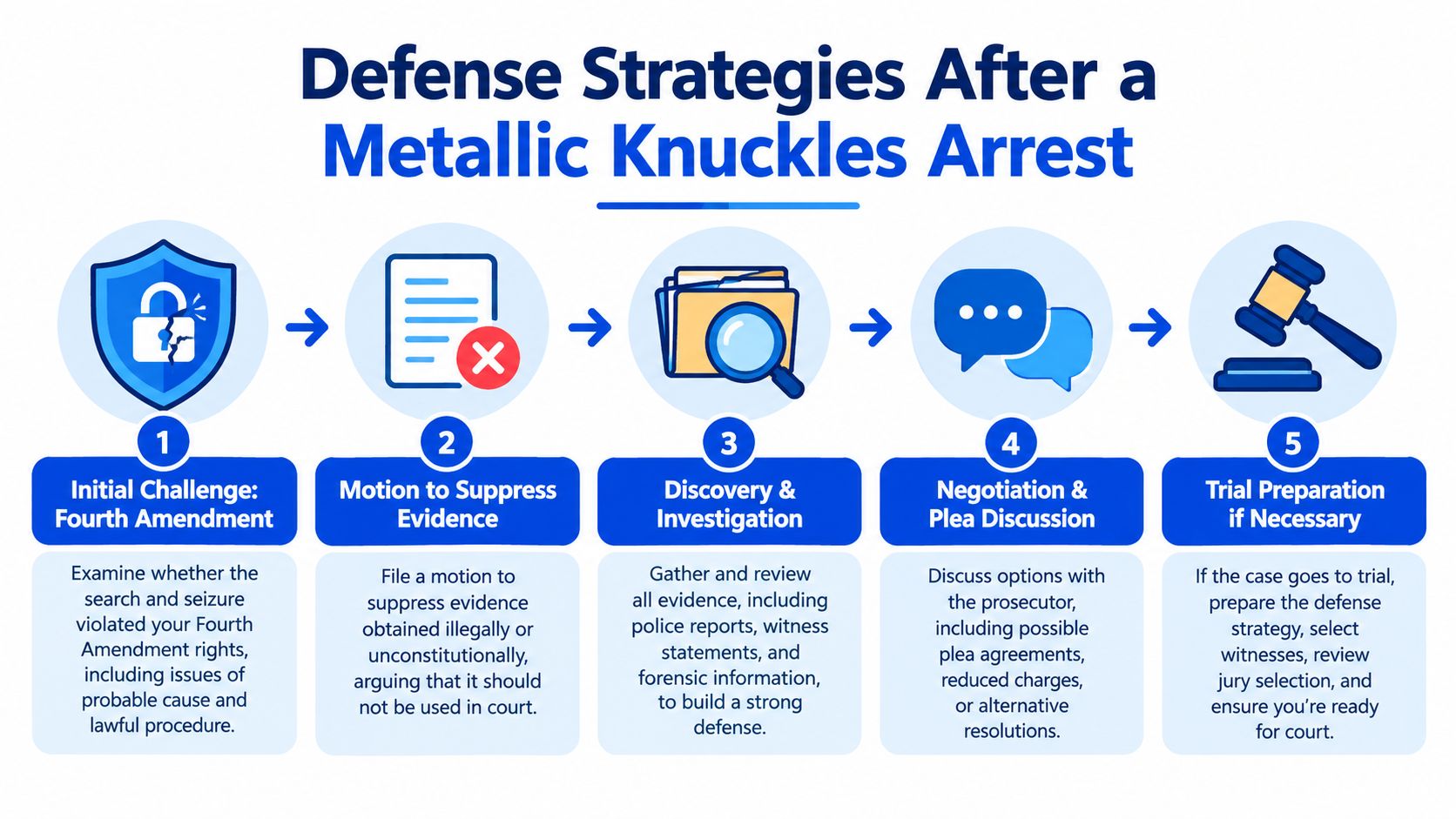
Preservation matters. Photograph the object from multiple angles, keep purchase records, and do not let anyone toss the item before your lawyer has seen it. The physical evidence can help prove what it is, and sometimes what it is not.
The Five Moves That Usually Matter Most
Initial Challenge: attack the legality of the stop or search first, because evidence from an unlawful search is often the weakest part of the State's file.
Motion to Suppress: force the court to decide whether the item should be excluded before the case goes any farther.
Discovery and Investigation: demand photos, reports, body-cam footage, and property records, then compare them for gaps.
Negotiation and Plea Discussion: use weak identification, shaky possession proof, or clean background facts to push for better outcomes.
Trial Preparation: if the State will not back down, build the case to contest possession, definition, or admissibility at trial.
Deciding Whether to Call a Florida Defense Attorney
If the stop involved a search, call a lawyer. If the item was purchased in Florida, call a lawyer. If you have prior arrests or a professional license, call a lawyer. Those facts can affect what happens long after the arrest report is filed.
The issue is not just the court date ahead. It is the record behind it. A Florida criminal record can follow you with employers, and some weapons-related cases can complicate future license applications or other background review. Non-citizens need to treat any weapons conviction with even more care because the immigration consequences can be serious.
If you are weighing whether to handle this alone, read the questions to ask a lawyer first at criminal defense consultation questions.
Why Going Alone Costs More Than You Think
A defendant acting alone gives up negotiating power. That includes the chance to seek diversion under section 921.0006, to ask for a withhold of adjudication, or to pursue early sealing under section 943.0585 when the case qualifies. Even when the immediate penalty looks small, the long tail of the case can be expensive.
Frequently Asked Questions From Florida Defendants
What happens at arraignment?
At the county courthouse, the court tells you the charge and asks for a plea. A not-guilty plea usually preserves your defenses and gives counsel time to review the stop, the item, and the State's proof.
How long does a metallic knuckles case take?
A negotiated case often moves in about two to four months. If the case is set for trial, it can take longer depending on discovery, motion practice, and the court's calendar.
Does a withhold of adjudication erase everything?
No. It can help with public-facing consequences, but the arrest still exists in state records, and background systems can still reflect that the case happened.
Can the case be sealed or expunged?
Sometimes, but only if the facts and disposition qualify under Florida law. You cannot assume that outcome just because the charge is a misdemeanor.
Do you have to give up the item?
Usually, yes, if it is seized as evidence. Do not argue about destruction at the roadside. Let your lawyer deal with the property issue through the court file.
What if I was visiting from another county?
The case is still prosecuted where the arrest happened. A tourist or snowbird does not get a pass just because the home address is elsewhere.
The statutes discussed here reflect the law as of this article date, and the facts of your stop can change the analysis fast. A case that looks simple on paper can turn on one photo, one search issue, or one statement you made at the scene.